


https://t.me/s/RedBloodTransmission/3268
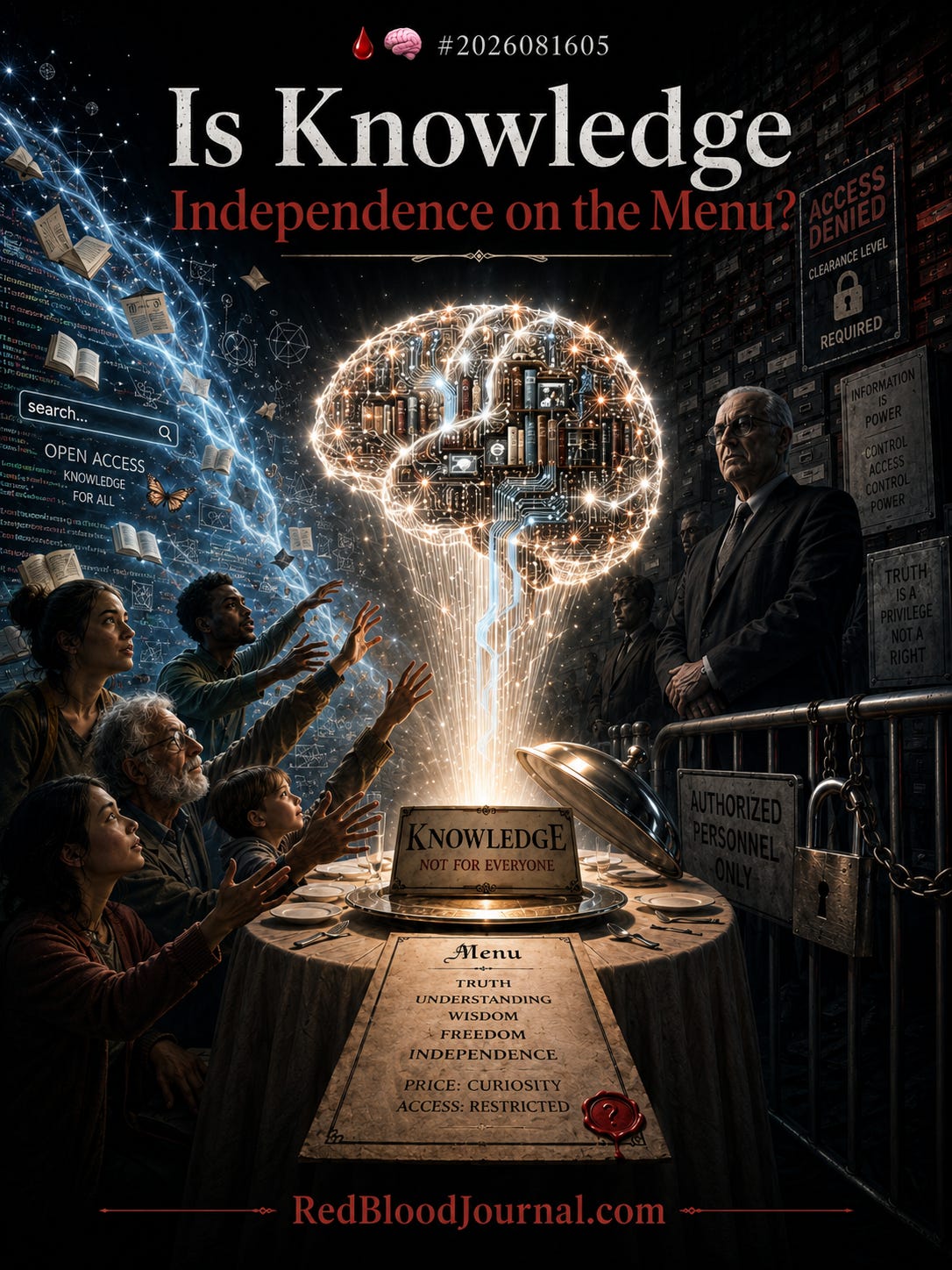
🩸 🧠 #2026081605 — Is Knowledge Independence on the Menu?
A Theory Test: Could Government Have an Incentive to Keep Citizens Dependent on Institutions for Understanding?
RedBloodJournal.com
There is a provocative theory hiding underneath the modern AI debate.
It can be stated very simply:
If artificial intelligence gives ordinary citizens enough knowledge, analytical power and bureaucratic competence to reduce their dependence on government, would government eventually have an incentive to limit that independence?
That is a serious question.
But it should not be answered with:
“Obviously yes.”
Nor should it be dismissed with:
“That could never happen.”
The useful approach is to treat it as an investigative hypothesis.
Is such an objective actually on the menu?
Is there evidence that government wants citizens intellectually dependent?
Or are current AI restrictions better explained by cybersecurity, military competition, liability, fraud prevention and genuine public-safety concerns?
And perhaps most importantly:
What evidence would distinguish those explanations?
Begin With the Strongest Fact Against the Theory
The United States government is currently trying to increase its own use of artificial intelligence.
Federal agencies can acquire systems from companies including OpenAI and Perplexity through government-wide procurement arrangements. GSA explicitly describes AI as a technology capable of transforming government operations.
That tells us something important.
The government clearly does not oppose AI as such.
It wants AI.
A lot of it.
The more interesting question therefore becomes:
Does government want powerful AI broadly distributed—or primarily incorporated into institutions under controlled conditions?
Those are not the same proposition.
Theory One: There Is No Knowledge-Control Agenda
The simplest explanation deserves consideration first.
Perhaps what we are observing is exactly what officials say it is:
powerful technology creates powerful risks.
Frontier AI can potentially improve offensive cyber operations.
It can identify vulnerabilities.
It can automate attacks.
It may eventually expand capabilities involving biological research, infrastructure exploitation and autonomous systems.
The June 2026 White House executive order explicitly directs the government to develop a classified benchmarking process for determining when an AI model possesses sufficiently advanced cyber capability to qualify as a covered frontier model.
The administration says the associated early-access framework is intended to be voluntary and aimed at cybersecurity testing before deployment.
NIST’s Center for AI Standards and Innovation is already conducting frontier-model evaluations and pre-deployment testing.
Under this interpretation, there is no hidden objective.
The government is doing what governments ordinarily do when technology creates national-security consequences:
evaluate it.
classify some risks.
build standards.
develop controls.
That explanation currently has substantial documentary support.
But Now Consider Theory Two
Institutional Self-Preservation
Government is not a single mind.
It consists of:
agencies,
departments,
courts,
contractors,
employees,
politicians,
regulators,
intelligence organizations,
law-enforcement institutions,
military structures,
and millions of individual incentives.
No secret meeting would be required for institutional self-preservation to occur.
Every institution naturally tends to protect:
its jurisdiction,
its relevance,
its funding,
its authority,
and the functions it performs.
This is not uniquely governmental.
Corporations do it.
Universities do it.
Labor organizations do it.
Professional associations do it.
Religious institutions do it.
Technology companies do it.
The interesting question is what happens when AI begins eliminating one of government’s traditional sources of institutional power:
complexity.
Complexity Creates Dependency
Imagine a government containing only ten laws.
Every citizen understands them.
No tax code longer than a restaurant menu.
No 400-page regulations.
No application manuals.
No administrative maze.
No specialist language.
No hundreds of agencies interpreting thousands of rules.
Government would still possess authority.
But citizens would require considerably fewer intermediaries to understand that authority.
Modern governments operate differently.
Rules become complicated.
Programs become complicated.
Taxes become complicated.
Benefits become complicated.
Licensing becomes complicated.
Procurement becomes complicated.
Appeals become complicated.
Administrative procedure becomes complicated.
And whenever complexity grows, another thing grows with it:
dependence upon interpreters.
Lawyers.
Accountants.
Consultants.
Caseworkers.
Compliance officers.
Government employees.
Specialists.
Organizations.
And now—
artificial intelligence.
AI May Be the First Mass-Market Bureaucracy Decoder
Search engines gave citizens access to documents.
AI increasingly gives citizens access to the meaning of documents.
That is a different type of power.
A person can potentially hand an AI:
an 800-page regulation,
a contract,
a court decision,
a tax rule,
a government report,
a congressional transcript,
or several contradictory policy documents,
and ask:
“Explain this to me.”
Then:
“What am I missing?”
Then:
“What rights do I have?”
Then:
“Where does this contradict itself?”
Then:
“Who benefits from this rule?”
Then:
“Show me the source.”
That reduces information asymmetry.
And information asymmetry has always been one of the foundations of institutional authority.
The Strong Version of the Theory
The strongest accusation would be:
Government intends to restrict AI because informed citizens would become too independent and therefore harder to govern.
At present, the publicly available evidence does not establish that proposition.
No policy document located for this investigation says:
“Prevent citizens from becoming independent of government.”
The federal government’s stated policy currently emphasizes AI leadership, cybersecurity, national security and technological adoption.
Indeed, another White House policy explicitly criticizes state rules that could force AI systems to alter truthful outputs, framing truthful AI output as something worth protecting.
That is evidence against the strongest version of the theory.
It should not be ignored.
The Weaker Version Is More Interesting
The weaker theory does not require malicious intent.
It says:
As AI reduces citizens’ dependence upon institutions, existing institutions may gradually adopt restrictions that preserve institutional advantages—even if each restriction has a legitimate explanation when considered individually.
That is much harder to dismiss.
Because institutional incentives work that way all the time.
Not:
“How do we suppress citizens?”
But:
“This activity should require certification.”
“That model is too dangerous for unrestricted distribution.”
“Only authorized personnel should access this capability.”
“The user needs identity verification.”
“This analysis requires professional supervision.”
“The public version should have lower capabilities.”
“Government researchers need the unrestricted version.”
Every sentence might have a defensible justification.
Collectively, however, they could produce a hierarchy of intelligence.
The Intelligence Ladder
Imagine four tiers.
Tier 1 — Ordinary Citizen
Receives:
safe model,
limited tools,
restricted automation,
identity requirements,
moderated capabilities.
Tier 2 — Corporation
Receives:
enterprise model,
larger context,
data integrations,
advanced agents,
automation.
Tier 3 — Government
Receives:
secure frontier models,
government integrations,
specialized datasets,
early access,
enhanced cybersecurity capability.
Tier 4 — National Security
Receives:
classified evaluations,
frontier cyber tools,
restricted models,
intelligence datasets,
capabilities never publicly released.
Some hierarchy is inevitable.
The military has weapons civilians cannot possess.
Intelligence agencies hold classified information.
That alone proves nothing sinister.
The question is whether the hierarchy eventually expands from:
dangerous capabilities
into:
ordinary analytical capabilities.
That is the line worth watching.
A Government That Knows More Than Its Citizens Is Normal
Historically, this has always been true.
Governments possessed:
satellite imagery,
intelligence reports,
classified communications,
economists,
lawyers,
analysts,
scientists,
supercomputers,
databases,
and enormous research organizations.
The average citizen possessed:
the newspaper.
Then television.
Then Google.
Then social media.
Now AI.
For perhaps the first time, an ordinary citizen can approach institutional-scale analytical capacity in certain narrow areas.
Not institutional-scale intelligence gathering.
Not classified information.
But analytical processing.
That changes the balance.
What Happens When the Citizen Has an Analyst?
Suppose a proposed bill is 1,200 pages long.
Historically, perhaps:
journalists summarize it,
lobbyists analyze it,
lawyers interpret it,
staffers brief politicians,
and citizens read headlines.
Now imagine millions of citizens uploading the legislation directly into an AI and asking:
“What does this actually do?”
Then:
“Show me provisions unrelated to the title.”
Then:
“Who financially benefits?”
Then:
“Compare this to the previous law.”
Then:
“What powers does this give the executive branch?”
Then:
“Which amendments changed the original bill?”
That citizen is no longer merely consuming political interpretation.
The citizen has acquired an interpreter.
Now Extend the Idea Beyond Politics
The same AI could say:
Insurance
“This denial conflicts with paragraph 12 of your policy.”
Taxes
“You qualify for a deduction not mentioned in the summary instructions.”
Employment
“This provision may conflict with state labor law.”
Banking
“This fee exists because you selected this particular account structure.”
Government benefits
“This agency’s own handbook says your application can be appealed.”
Court system
“This precedent appears relevant.”
Procurement
“These government contracts went repeatedly to related corporate entities.”
Public spending
“This program’s appropriations increased 340 percent while measured output remained approximately flat.”
Suddenly AI becomes something larger than a chatbot.
It becomes:
the citizen’s institutional counterweight.
Would Government Want That?
This is where the theory divides.
Democratic theory says yes.
An informed citizenry strengthens democracy.
Citizens who understand government can hold it accountable.
Government derives legitimacy from citizens capable of informed consent.
Under this interpretation, AI should be welcomed as perhaps the greatest civic-education technology ever invented.
But—
bureaucratic theory creates another incentive.
Every bureaucracy also benefits when navigating the bureaucracy requires bureaucracy.
That does not necessarily mean anyone designed the complexity intentionally.
It means complexity creates jobs, budgets, specialization and institutional necessity.
AI threatens some of that necessity.
Imagine the DMV With an AI Sitting Beside You
The citizen says:
“They rejected this.”
The AI says:
“The rejection reason is inconsistent with their published requirement.”
Citizen:
“What do I do?”
AI:
“Submit Form 19B, attach Exhibit C and cite section 4.2. Their response deadline is 30 days.”
Multiply that by:
Social Security.
Veterans Affairs.
IRS.
immigration.
licensing.
courts.
zoning.
health benefits.
education.
regulatory agencies.
Government does not disappear.
But friction begins disappearing.
And friction is frequently what makes citizens dependent upon intermediaries.
Theory Three: Knowledge Control May Arrive Through Private Companies Instead
This possibility may be at least as important as government censorship.
AI intelligence is increasingly delivered through private infrastructure.
The provider can determine:
what model someone receives,
what questions are allowed,
what sources are searchable,
what accounts are suspended,
what actions agents may perform,
and what capabilities require payment.
Government may therefore never need to censor an AI directly.
A commercial ecosystem could impose most restrictions independently.
Then regulatory requirements, liability concerns and corporate risk management could reinforce one another.
The citizen may experience the result simply as:
“The AI won’t do that.”
without knowing whether the cause was:
company policy,
law,
contract,
insurance,
platform restrictions,
or government regulation.
That opacity deserves attention.
Theory Four: The Real Objective Is Not Knowledge Control—It Is Capability Control
This may currently be the strongest alternative explanation.
Governments historically tolerate access to information more readily than access to operational capability.
A book explaining nuclear physics is legal.
Owning weapons-grade nuclear material is not.
Cybersecurity may follow the same logic.
Reading about network attacks:
acceptable.
Deploying autonomous agents capable of conducting thousands of attacks:
different matter.
The June 2026 frontier-model framework focuses specifically on advanced cyber capabilities, not generalized political or historical knowledge.
NIST’s AI Agent Standards Initiative similarly emphasizes secure autonomous action and interoperability rather than preventing citizens from asking questions.
That distinction currently argues strongly against describing present policy as a campaign to suppress ordinary knowledge.
But the distinction needs to remain visible.
Information Versus Capability
This may become the constitutional dividing line of the AI age.
Consider:
“Explain how malware works.”
Information.
“Write educational pseudocode illustrating malware behavior.”
Closer to capability.
“Write deployable malware.”
Capability.
“Automatically locate vulnerable systems and deploy it.”
Operational capability.
The government has a substantially stronger case for regulating the last category than the first.
The danger arises if the boundary moves backward.
From:
action
to:
code
to:
explanation
to:
information.
That is the slope citizens should watch.
Theory Five: Government May Eventually Fear AI-Powered Political Organization
There is another capability far beyond research.
Organization.
Imagine AI agents capable of helping citizens:
analyze legislation,
identify representatives,
coordinate meetings,
draft petitions,
file information requests,
track campaign promises,
organize lawsuits,
compare voting records,
investigate spending,
coordinate ballot initiatives,
and communicate with millions of people.
That moves AI from:
knowledge machine
to:
civic infrastructure.
Government officials might welcome that when it supports their constituencies.
They may dislike it considerably when it organizes opposition.
Again, there is currently no evidence establishing a federal plan to prevent this.
But historically, governments across many political systems have shown much greater concern about organized populations than merely informed individuals.
That makes agentic political organization an area worth monitoring.
Theory Six: The Citizen’s Personal Government
Perhaps the strangest outcome is not eliminating government.
It is giving each person a miniature one.
Consider what government does internally:
collect information,
interpret laws,
manage schedules,
process applications,
track obligations,
allocate resources,
maintain records,
communicate,
forecast,
and make administrative decisions.
A sufficiently advanced personal AI does many of the same things.
The individual effectively gains:
a chief of staff,
researcher,
paralegal,
accountant,
secretary,
analyst,
negotiator,
records clerk,
translator,
and administrative department.
One citizen suddenly possesses an institution.
That may be the true disruptive force.
The Government Does Not Need to Disappear for Dependency to Decline
This distinction matters.
The argument is not:
AI makes government unnecessary.
Government performs collective functions individuals cannot easily perform independently.
The stronger argument is:
AI may make citizens less dependent upon government for navigating government.
Those are dramatically different statements.
The first is ideological.
The second is already technologically plausible.
The Historical Pattern
Every major communication technology has produced struggles over control.
Printing presses.
Postal systems.
Telegraphs.
Telephones.
Radio.
Television.
Encryption.
The internet.
Social media.
Governments generally present restrictions in terms of:
security,
public order,
crime,
fraud,
war,
safety,
or regulation.
Sometimes those reasons are completely legitimate.
Sometimes they expand beyond their original justification.
The lesson is not:
regulation equals tyranny.
The lesson is:
infrastructures of control should be examined before emergency justifications become permanent architecture.
What Would Prove the Theory Is Moving Onto the Menu?
This is where the investigation becomes falsifiable.
Watch for concrete developments.
Indicator 1 — Government gets stronger models than citizens
Not specialized classified tools.
General intelligence.
If government routinely receives materially more capable general-purpose reasoning models than ordinary citizens are permitted to access, that would be significant.
Indicator 2 — Political or legal research becomes restricted
Restrictions on autonomous cyberattack capabilities are understandable.
Restrictions on:
analyzing legislation,
government spending,
court decisions,
political history,
public records,
or government statistics
would be much more concerning.
Indicator 3 — Government-access exemptions multiply
If a capability is considered too dangerous for the public but routinely available to broad categories of government employees, the justification deserves scrutiny.
Indicator 4 — Local AI becomes heavily restricted
Cloud AI can be centrally controlled.
Local AI cannot easily be modified after downloading.
If downloadable models become restricted substantially more aggressively than equivalent cloud systems, control—not merely safety—becomes a stronger possible explanation.
Indicator 5 — Anonymous AI use disappears
If citizens increasingly must identify themselves before conducting ordinary research, the chilling effect may become significant even without direct censorship.
People ask different questions when someone is recording their identity.
Indicator 6 — AI access becomes occupationally licensed
Imagine:
law AI only for attorneys.
medical AI only for doctors.
financial AI only for licensed professionals.
government-regulation AI only for approved compliance specialists.
Some professional safeguards could be legitimate.
But a broad pattern would recreate precisely the knowledge hierarchy AI currently threatens to reduce.
Indicator 7 — AI cannot meaningfully challenge government claims
If systems remain free to criticize corporations but begin consistently refusing to analyze public policy, official statistics or government contradictions, something important would have changed.
Indicator 8 — “Safety” expands indefinitely
Cybersecurity.
Then biology.
Then finance.
Then legal interpretation.
Then politics.
Then historical misinformation.
Then social instability.
The important question would become:
Where does safety end?
A category without boundaries can eventually contain almost anything.
Evidence That Would Weaken the Theory
A fair investigation must also identify evidence pointing the other direction.
The theory becomes weaker if:
citizens retain access to frontier-quality general reasoning;
open-weight models remain legally available;
political and legal research remains unrestricted;
government model evaluations focus narrowly on operational national-security capabilities;
anonymous or privacy-preserving AI remains possible;
model-review processes remain transparent where classification is unnecessary;
federal agencies actively encourage AI literacy among citizens;
courts consistently protect access to lawful information.
Those developments would suggest regulation is principally about dangerous capability rather than knowledge dependency.
Something Else Is Happening Simultaneously
The U.S. government itself is aggressively adopting AI.
GSA currently promotes government-wide procurement of AI products at heavily discounted prices.
The national-security establishment has been directed to adapt commercial and open-source AI technologies and use cutting-edge capabilities from private suppliers.
The government’s Gold Eagle cybersecurity initiative explicitly proposes using frontier AI to identify and prioritize cyber vulnerabilities.
This creates a fascinating situation.
Government is not retreating from AI.
Government is becoming:
more AI-powered.
That makes equal public access to analytical technology increasingly consequential.
Two Futures
Imagine two possible outcomes.
Future A — Intelligence Democratizes
Citizens receive powerful personal AI.
Government receives powerful institutional AI.
Corporations receive powerful commercial AI.
Everyone becomes more capable.
The asymmetry shrinks.
AI becomes analogous to literacy.
Power remains unequal, but understanding becomes broadly distributed.
Future B — Intelligence Stratifies
Ordinary people receive safe consumer assistants.
Corporations receive stronger enterprise agents.
Government receives advanced secure models.
Military and intelligence agencies receive frontier capabilities.
Access increasingly depends upon:
identity,
employment,
institution,
license,
wealth,
or security clearance.
AI becomes less like literacy and more like classified infrastructure.
That would produce something historically unusual:
intelligence as a social class.
Which Future Are We Building?
At the moment:
probably some mixture of both.
The public possesses extraordinary AI capabilities compared with only five years ago.
At the same time, governments and major corporations possess access to:
larger systems,
private datasets,
specialized infrastructure,
enterprise agents,
and resources ordinary individuals cannot reproduce.
The struggle is therefore not beginning from zero.
It is already underway through economics and infrastructure.
Regulation could either narrow that gap or widen it.
Perhaps the Most Important Warning Sign Is Not a Ban
A dramatic ban would be obvious.
The subtler possibility is:
degradation.
The public model remains available.
But:
fewer capabilities,
lower limits,
less automation,
more refusals,
restricted tools,
less privacy,
mandatory identity,
higher prices.
Meanwhile institutional systems continue improving.
No one would technically have removed AI from the citizen.
The citizen would simply receive a progressively weaker version.
That possibility deserves considerably more attention than waiting for the words:
“AI IS BANNED.”
The Dependency Test
Whenever a proposed AI restriction appears, perhaps citizens should ask five questions.
1. What specific harm is being prevented?
Not:
“AI is dangerous.”
What exact capability?
2. Is the restriction against action or knowledge?
Preventing an attack is different from preventing someone from understanding an attack.
3. Does government retain the capability being denied to citizens?
If yes:
why?
4. Is the restriction temporary and reviewable?
Emergency restrictions have a tendency to become ordinary bureaucracy.
5. Does the policy increase citizen dependency upon an institution?
That does not automatically make it wrong.
But it reveals an important consequence.
The Deeper Political Question
Perhaps the AI debate will eventually expose something democracy has avoided discussing explicitly.
What level of competence does government actually want citizens to possess?
A democracy theoretically wants citizens who are:
educated,
skeptical,
independent,
informed,
capable of reasoning,
and willing to challenge authority.
Yet institutions often function more easily when citizens are:
predictable,
administratively compliant,
dependent upon experts,
and unable to navigate complexity without assistance.
That contradiction existed long before AI.
AI may simply make it impossible to ignore.
The Founders Could Not Have Imagined This
The American constitutional system was created in an era when obtaining political information required:
books,
newspapers,
letters,
meetings,
and extraordinary amounts of human effort.
Imagine giving an ordinary citizen of 1787:
every Federalist Paper,
every court ruling,
every statute,
every congressional record,
every federal budget,
every public contract,
every agency regulation,
every historical document,
and an intelligent assistant capable of analyzing all of it in seconds.
They might consider that machine extraordinarily dangerous.
But dangerous to whom?
A republic?
Or anyone benefiting from the citizen’s inability to understand the republic?
That question has not yet been answered.
The Red Blood Perspective
Is preventing ordinary citizens from acquiring enough knowledge to reduce their dependence upon government currently on the menu?
The available evidence does not establish that as an explicit federal objective.
Current federal documents emphasize:
AI adoption,
American leadership,
cybersecurity,
national security,
frontier-model evaluation,
and secure deployment.
That matters.
But the theory should not therefore be discarded.
The more credible concern is structural rather than conspiratorial.
Artificial intelligence can reduce information asymmetry.
Reduced information asymmetry can reduce institutional dependence.
Institutions naturally preserve their authority and relevance.
And regulatory infrastructure capable of controlling dangerous AI capabilities could potentially expand beyond its original purpose.
That does not mean it will.
It means citizens should watch whether the boundary remains:
dangerous action
or gradually moves toward:
inconvenient knowledge.
That distinction may become one of the defining civil-liberties questions of the artificial-intelligence era.
The Ocean of Love and Positivity Perspective
Perhaps the healthiest outcome requires neither government fearing knowledgeable citizens nor citizens assuming every government action is hostile.
A confident government should want an intelligent population.
A confident doctor should welcome an informed patient.
A confident company should welcome an informed customer.
A confident institution should not require confusion to preserve legitimacy.
Artificial intelligence could produce millions of citizens who understand the systems surrounding them better than any population in history.
That does not have to create rebellion.
It could create maturity.
The citizen becomes less dependent.
The institution becomes more accountable.
And the relationship changes from:
ruler and dependent
toward:
institution and informed participant.
Perhaps that is the real test.
If artificial intelligence eventually makes people capable of understanding their governments without needing government to explain itself—
does government celebrate that?
Or attempt to control it?
We do not yet know.
But now we know exactly what to watch.
In an Ocean of Love and Positivity.
🩸🌊✨ Fantastic!
⚖️
The Digital Balance of Power: AI and Institutional Dependency
Aug 17, 2026
This text examines the provocative theory that governments may have structural incentives to limit artificial intelligence to keep citizens dependent on institutional complexity. While current federal policies focus on national security and cybersecurity risks, the author suggests that AI’s ability to decode bureaucratic jargon threatens traditional information asymmetry. This shift could transform the relationship between the state and the public by providing individuals with institutional-scale analytical power to navigate laws, taxes, and regulations independently. The source outlines various indicators of potential knowledge stratification, such as when government agencies retain access to powerful models while the public receives degraded, restricted versions. Ultimately, the article argues that the defining civil-liberties issue of the AI era will be whether the technology democratizes intelligence or becomes a new tool for hierarchical control. Whether this leads to a more accountable government or a more compliant population remains an open question for the future.


