


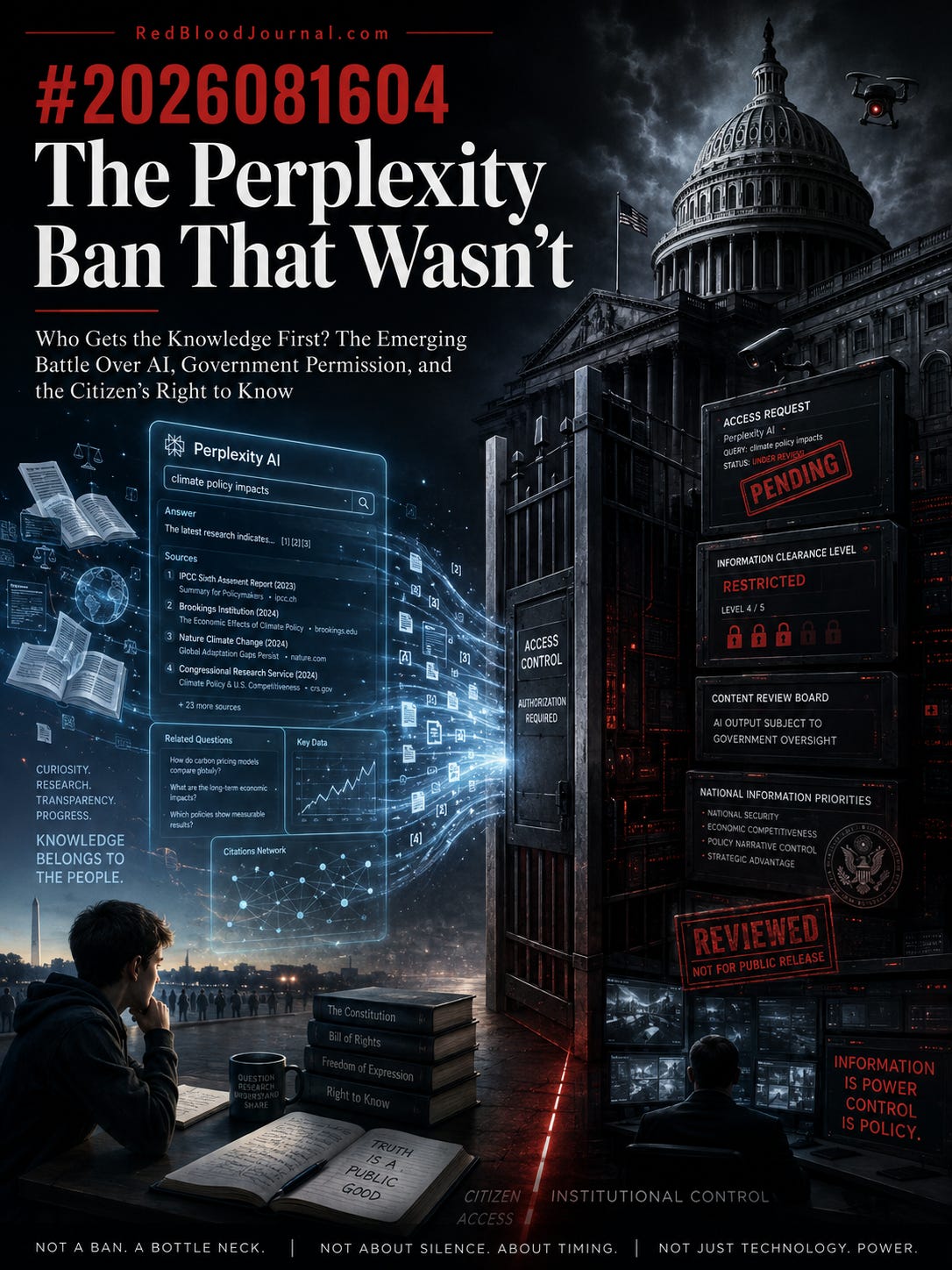
https://t.me/s/RedBloodTransmission/3267
🩸 🔐 #2026081604 — The Perplexity Ban That Wasn’t
Who Gets the Knowledge First? The Emerging Battle Over AI, Government Permission, and the Citizen’s Right to Know
RedBloodJournal.com
Something unusual happens when a technology becomes powerful enough to reduce a person’s dependence on institutions.
At first, it is called convenient.
Then revolutionary.
Then disruptive.
And eventually somebody asks:
Who is allowed to have it?
Artificial intelligence may now be entering that final stage.
The public discussion tends to concentrate on whether ChatGPT, Grok, Claude, Gemini or Perplexity gives the best answer.
The deeper question may soon become:
Which answers will ordinary citizens be permitted to obtain at all?
That question deserves investigation.
But it must begin by correcting an important premise.
Perplexity Has Not Been Banned by the U.S. Government
As of August 2026, there is no broad federal prohibition preventing Americans from using Perplexity.
Quite the opposite.
The U.S. General Services Administration announced a direct agreement with Perplexity in November 2025 allowing federal agencies to purchase Perplexity Enterprise Pro for Government. The government’s current AI procurement catalog continues to list Perplexity alongside ChatGPT, Claude, Gemini and Grok.
The government describes Perplexity’s offering as providing real-time AI research, cited answers, enterprise security and access to multiple leading AI models.
So the headline:
“The U.S. Government Banned Perplexity”
would presently be false.
But something closely related is happening.
And it may ultimately be more important.
What Was Actually Restricted?
One major restriction involving Perplexity came not from Washington banning Perplexity from citizens, but from a legal fight between Amazon and Perplexity.
A federal judge issued an injunction restricting Perplexity’s AI agents from accessing Amazon’s systems in connection with its agentic shopping activities. Perplexity appealed, and the Ninth Circuit subsequently stayed the injunction while the appeal proceeds.
That dispute raises a remarkable new question.
Imagine this:
A human is legally allowed to enter Amazon.
A human is legally allowed to purchase something.
The human authorizes an AI assistant to perform the purchase.
But the platform says:
“Your AI assistant is not authorized to enter.”
We have suddenly created a strange new category of digital law.
The person has permission.
The machine acting for the person may not.
That distinction could become enormously consequential.
The Real Story Is Bigger Than Perplexity
While Perplexity itself has not been federally banned, the United States is constructing an increasingly formal system for supervising powerful AI models.
On June 2, 2026, the White House issued an executive order establishing a framework concerning advanced AI innovation and cybersecurity. The administration has been developing mechanisms under which frontier-model developers can voluntarily provide advanced models to government evaluators before wider release.
By August, reporting indicated that a White House cybersecurity framework had been finalized under which developers could voluntarily provide new models to the federal government up to 30 days before public release, with their cyber capabilities evaluated using criteria that have not been publicly disclosed.
That changes the question.
It is no longer:
Will the government ban Perplexity?
The larger question becomes:
Will governments increasingly determine when, where, how and to whom the most powerful artificial intelligence capabilities may be released?
The Knowledge Problem
AI is often described as a productivity tool.
That description is incomplete.
AI is also becoming a knowledge-compression machine.
Before these systems existed, investigating a complicated subject could require:
finding dozens of sources,
reading hundreds of pages,
understanding specialized terminology,
locating government documents,
comparing contradictory accounts,
analyzing statistics,
following citations,
and possessing enough background knowledge to know what questions should be asked next.
A capable AI system can compress much of that process into hours or minutes.
That matters because information asymmetry has always created power.
The lawyer knows the law better than the client.
The accountant understands the tax code better than the taxpayer.
The bureaucracy understands its regulations better than the applicant.
The intelligence agency possesses information unavailable to the public.
The corporation understands its contract better than the consumer.
The doctor understands medical literature better than the patient.
The financial institution understands the instrument better than the investor.
Knowledge gaps produce dependency.
AI potentially reduces those gaps.
The Citizen Suddenly Has a Research Department
Consider what an ordinary citizen can increasingly do.
A person can ask an AI to:
read a 400-page government report,
compare it with congressional testimony,
find contradictions,
explain technical terminology,
analyze regulations,
locate historical precedents,
compare court decisions,
calculate financial consequences,
translate foreign sources,
examine datasets,
and identify questions the citizen did not previously know enough to ask.
Twenty years ago, obtaining that level of assistance might have required:
researchers,
lawyers,
analysts,
librarians,
translators,
programmers,
and substantial money.
Now someone sitting at a kitchen table can begin doing portions of all of it.
That is historically significant.
Why Governments Have Legitimate Reasons to Worry
An objective investigation cannot pretend every restriction is censorship.
Some AI capabilities are genuinely dangerous.
An advanced model could potentially assist with:
cyberattacks,
malware development,
exploitation of software vulnerabilities,
biological research,
weapons design,
automated fraud,
large-scale identity theft,
or attacks against critical infrastructure.
The June 2026 U.S. policy framework specifically focuses on cybersecurity and advanced capabilities, and the administration says its purpose is strengthening national security while maintaining American technological leadership.
Those concerns are not imaginary.
As AI becomes capable of operating tools autonomously, cybersecurity becomes particularly important because an agent can move from explaining an action to executing one. Research published in 2026 describes cybersecurity as one of the central real-world tests for increasingly autonomous AI systems.
There is therefore a legitimate regulatory argument:
Certain capabilities may need safeguards.
But that creates the next question.
Who Defines “Dangerous Knowledge”?
This is where the issue becomes difficult.
Consider four requests.
Request 1
“How does ransomware work?”
Educational.
Request 2
“Show me historical examples of ransomware vulnerabilities.”
Research.
Request 3
“Find vulnerabilities in my company’s server.”
Cybersecurity.
Request 4
“Break into that server.”
Crime.
Humans understand that these are different.
But regulatory systems often operate through categories.
Once governments obtain authority to restrict categories of capability, the central political question becomes:
Where does the category end?
Cybersecurity today.
Advanced biological knowledge tomorrow.
Financial analysis later.
Political persuasion after that?
The existence of legitimate restrictions does not answer where those restrictions should stop.
The Anthropic Case Shows How Quickly This Can Escalate
The clearest 2026 example does not involve Perplexity.
It involves Anthropic.
The Pentagon and Anthropic entered a major dispute over permitted uses of Claude for military applications, particularly autonomous weapons and mass surveillance. The Defense Department subsequently designated Anthropic a supply-chain risk after the company refused to remove certain restrictions.
Whatever side one takes, the case reveals something important.
The government and an AI company were no longer arguing primarily about:
whether AI works.
They were arguing about:
who gets to determine what AI may be used for.
That is a fundamentally different conflict.
Then Came Pre-Release Access Controls
Another development is even more relevant to ordinary citizens.
Reporting in June 2026 indicated that some frontier AI companies temporarily limited access to their newest systems while government cybersecurity reviews were underway, with early access restricted to selected users.
That creates three classes of access:
Class One
The developer.
Class Two
Government and approved partners.
Class Three
Everyone else.
Even if temporary and justified by cybersecurity concerns, the structure deserves attention.
Because once such infrastructure exists, it can potentially be expanded.
The Question Red Blood Should Be Asking
Not:
“Is the government censoring AI?”
That is too simplistic.
And presently unsupported as a general claim.
The better question is:
Are we constructing an architecture in which increasingly powerful knowledge tools become permissioned technologies?
That architecture could arise without anyone announcing:
“Citizens are forbidden from knowing.”
It could emerge gradually.
Through:
procurement rules,
cybersecurity classifications,
platform restrictions,
licensing requirements,
export controls,
identity verification,
model-release approvals,
corporate terms of service,
cloud-provider restrictions,
API restrictions,
and access tiers.
No single rule would appear catastrophic.
Together they could determine who possesses computational intelligence.
Watch the Difference Between Information and Capability
This distinction will probably become central.
Governments are unlikely to announce:
“Citizens may not know chemistry.”
The restriction would more likely concern:
“Models capable of performing certain chemical operations.”
Likewise:
not mathematics,
but autonomous cyber capability.
Not engineering,
but weapons-design capability.
Not political information,
but scalable persuasion systems.
Not financial knowledge,
but autonomous financial agents.
Not medical literature,
but autonomous diagnosis or prescription.
That distinction is reasonable at first glance.
But it raises an uncomfortable philosophical problem.
At what point does restricting capability effectively restrict knowledge?
Imagine the AI of 2030
Suppose an advanced personal AI could:
read every statute,
read every regulation,
read every court decision,
audit government spending,
analyze public contracts,
track lobbying relationships,
compare political promises with legislative votes,
detect statistical manipulation,
search corporate ownership structures,
analyze campaign donations,
inspect public databases,
and explain everything in ordinary language.
That AI would not merely be a better Google.
It would provide an ordinary citizen with something historically reserved for institutions:
analytical capacity.
Now imagine 100 million citizens possessing it.
The relationship between citizen and government changes.
Government Becomes Less Necessary as an Interpreter
There is an important distinction here.
AI would not eliminate government.
Roads still exist.
Courts still exist.
National defense still exists.
Public infrastructure still exists.
Law enforcement still exists.
But government performs another less visible function:
interpretation.
“What does this regulation mean?”
“What benefits am I entitled to?”
“What happened to this money?”
“What does this bill actually do?”
“What forms do I need?”
“What law applies?”
“What evidence supports this claim?”
Historically, navigating these questions often requires interacting with the same institution that created the complexity.
AI threatens that dependency.
The citizen can bring an independent interpreter.
The Bureaucracy Versus the Personal Bureaucrat
This may produce one of AI’s most fascinating confrontations.
The state has bureaucracies.
Corporations have bureaucracies.
Banks have bureaucracies.
Insurance companies have bureaucracies.
Universities have bureaucracies.
Ordinary citizens historically did not.
Now they can potentially have one.
Imagine every citizen possessing a personal agent that says:
“I read the 83-page agreement.”
“Paragraph 19 contradicts paragraph 7.”
“This fee is optional.”
“This regulation gives you an appeal.”
“The agency missed its statutory deadline.”
“Here is the form.”
“Here is the precedent.”
“Here is the person responsible.”
Suddenly bureaucracy encounters:
bureaucracy.
Except the citizen’s bureaucracy works instantly.
This Is Why Perplexity Is Symbolically Important
Perplexity’s particular strength is not merely generating prose.
Its identity has been built around searching current information and showing citations.
The U.S. government’s own procurement description praises Perplexity for providing real-time research and cited, transparent answers.
Think about the irony.
The same capability valuable to federal employees is valuable to citizens for exactly the same reason:
it reduces the cost of understanding complicated information.
That makes Perplexity an interesting symbol even though it has not been federally banned.
The technology represents something larger than the company.
It represents:
inexpensive investigative capacity.
What Should Citizens Watch Next?
Several areas deserve close attention.
1. Frontier-model pre-release review
If the government increasingly evaluates powerful models before the public receives them, watch whether the process remains genuinely voluntary and narrowly focused on cybersecurity.
The critical questions:
Who defines a frontier model?
What capabilities trigger review?
How long may access be delayed?
Who receives early access?
Are review standards public?
Is there an appeal process?
2. Classified AI benchmarks
The new cybersecurity review framework reportedly uses criteria that are not fully public.
National security sometimes requires secrecy.
But secrecy also creates an accountability problem.
If citizens cannot know the threshold used to restrict a technology, they cannot independently evaluate whether the restriction is justified.
That tension will become increasingly important.
3. Platform control over personal AI agents
The Amazon–Perplexity dispute may become a precedent far beyond shopping.
If websites can prohibit AI agents even when those agents act under direct user authorization, the future internet may divide into:
human-accessible territory
and
agent-accessible territory.
That could determine whether individuals actually receive the productivity benefits promised by personal AI.
4. Government-versus-company conflicts over acceptable use
The Anthropic–Pentagon dispute demonstrates that governments and AI developers may disagree fundamentally about which applications should be allowed.
Future disputes could involve:
surveillance,
military targeting,
cyber operations,
biological research,
law enforcement,
political intelligence,
and financial monitoring.
The public should watch which side receives the authority to decide.
5. Access differences between government and citizens
The federal government currently has extraordinarily inexpensive access to several leading AI systems.
GSA lists government agreements for Claude, Gemini, ChatGPT, Perplexity and Grok.
There is nothing inherently wrong with government purchasing technology efficiently.
But a democratic society should watch for a widening capability gap.
If government possesses dramatically more powerful analytical AI than the ordinary citizen, the historical information asymmetry could grow rather than shrink.
6. Restrictions Presented as Safety
This does not mean safety is fake.
Safety can be completely legitimate.
The important question is narrower:
Is the restriction proportional to the actual hazard?
A prohibition against autonomous malware deployment is one thing.
A prohibition against explaining government cybersecurity policy is another.
The public should resist collapsing those two categories.
7. Restrictions Presented as Copyright
Perplexity is also involved in major disputes with publishers concerning use of copyrighted material.
Those cases concern legitimate property rights.
But their eventual consequences could determine how much of the public information environment AI systems are permitted to synthesize.
If every piece of searchable knowledge becomes individually permissioned, AI research could gradually move behind commercial walls.
That would not necessarily be government censorship.
It could nevertheless have a censorship-like practical effect:
only those capable of purchasing the information gain access to the synthesis.
8. Identity-Gated Intelligence
One development worth watching particularly carefully is whether high-capability models increasingly require identity verification.
There are legitimate reasons this could happen:
fraud prevention,
age restrictions,
export controls,
cybersecurity,
financial regulation.
But identity-gated AI produces another possibility.
The knowledge system knows:
who asked.
what they asked.
when they asked.
That transforms anonymous research into attributable research.
The printing press did not ask for identification before allowing someone to read a book.
Future AI systems might.
9. Local Models Versus Cloud Models
This may eventually become one of the most important political battles in AI.
Cloud AI can be controlled centrally.
The provider can:
change the model,
remove a feature,
block an account,
filter a request,
record usage,
limit access,
or comply with a government order.
A sufficiently capable model running locally on someone’s own computer is fundamentally different.
Once downloaded, centralized control becomes much harder.
That may explain why policy discussions surrounding open and downloadable models deserve unusual attention.
The technological argument will be:
security.
The civil-liberties argument will be:
ownership.
Both have merit.
The Gutenberg Parallel
The printing press did something deceptively simple.
It reduced the cost of copying knowledge.
That reduction changed civilization.
Before mass printing, institutions possessing books possessed enormous intellectual advantages.
After printing, knowledge began escaping the buildings in which it had been stored.
AI may represent another reduction in the cost of knowledge.
But this time it reduces something else too:
the cost of understanding knowledge.
That is potentially more disruptive than merely copying information.
A library gives someone 10,000 books.
An AI can potentially explain the 10,000 books.
Those are not the same revolution.
The Internet Gave Citizens Information
AI Gives Citizens Analysis
That distinction should not be underestimated.
The internet said:
“Here are 800,000 results.”
AI increasingly says:
“Here are the seven that matter, here is what they say, here is where they disagree, and here are the questions that remain unanswered.”
The internet democratized distribution.
AI may democratize interpretation.
And interpretation has historically been expensive.
Why Institutions May Feel Threatened Without Conspiring
No conspiracy is required.
This is important.
Institutions naturally protect:
authority,
jurisdiction,
budgets,
procedures,
professional standards,
security responsibilities,
legal liability,
and institutional relevance.
A government agency does not need to meet secretly with corporations and announce:
“How do we keep citizens ignorant?”
It simply needs thousands of individual actors making individually rational decisions:
“This capability creates risk.”
“This information requires review.”
“This model should be licensed.”
“This system cannot access our platform.”
“This dataset is proprietary.”
“This functionality requires authorization.”
“This user must verify identity.”
Each decision may be defensible.
The cumulative architecture may nevertheless produce a world in which intelligence becomes permissioned.
That is precisely why the pattern should be studied before assuming either conspiracy or innocence.
A Prediction Framework
Rather than predicting that “the government will ban knowledge,” watch for measurable signals.
Signal One
Advanced models remain available to government but are delayed for the general public.
Signal Two
Government review periods become mandatory rather than voluntary.
Signal Three
Previously public model capabilities become restricted behind professional licensing.
Signal Four
Local downloadable models face tighter regulatory treatment than equivalent cloud systems.
Signal Five
Identity verification becomes necessary for increasingly ordinary research.
Signal Six
Political, legal or historical research begins being treated under the same frameworks created for dangerous cyber capabilities.
Signal Seven
Government agencies receive exemptions from restrictions imposed upon ordinary users.
Signal Eight
AI agents acting with a citizen’s permission are systematically prevented from accessing services the citizen personally can access.
If several of those trends occur simultaneously, the concern becomes considerably stronger.
If they do not, claims of systematic knowledge suppression become considerably weaker.
That is how the hypothesis should be tested.
The Most Dangerous Mistake
There are actually two.
The first is believing:
Every regulation is censorship.
That produces paranoia and prevents legitimate security measures.
The second is believing:
Every restriction labeled “safety” is automatically justified.
That produces complacency and gives institutions unlimited vocabulary for expanding authority.
A functioning democracy requires citizens capable of holding both ideas simultaneously.
Some knowledge capabilities are genuinely dangerous.
And powerful institutions can misuse legitimate safety concerns.
Both statements can be true.
The Constitutional Question
The United States was built upon a radical proposition:
political authority ultimately originates with citizens.
That proposition assumes something else.
Citizens must be capable of evaluating authority.
Artificial intelligence could dramatically improve that capability.
A citizen who can independently search laws, analyze public records, compare historical claims and interrogate government data becomes harder to manipulate through complexity.
That should not frighten a constitutional republic.
It should strengthen one.
The best test of AI policy may therefore be simple:
Does the policy prevent genuine harm while preserving the ordinary citizen’s ability to investigate the institutions exercising power over that citizen?
That line deserves defending.
The Red Blood Perspective
The investigation does not support the claim that Washington banned Perplexity.
In fact, Washington is currently buying it.
That fact should be stated clearly.
But correcting that claim exposes a much larger story.
Government and industry are now constructing rules for:
who gets advanced AI,
when they get it,
what capabilities are available,
which agents can enter which digital systems,
which models may be released,
and which uses are considered unacceptable.
Some of those controls will be justified.
Some may be necessary.
Some may eventually go too far.
The responsibility of an independent citizen is not to decide the answer beforehand.
It is to watch the architecture being built.
Because the crucial political struggle of the AI age may not be over information itself.
It may be over access to the machines capable of understanding information at superhuman speed.
The Ocean of Love and Positivity Perspective
Knowledge does not have to destroy institutions.
It can improve them.
A citizen who understands a law does not weaken law.
A patient who understands medical research does not weaken medicine.
A taxpayer who understands a budget does not weaken government.
A customer who understands a contract does not weaken commerce.
Good institutions should not require ignorance to survive.
Perhaps artificial intelligence offers society an opportunity to reverse an old relationship.
Instead of knowledge flowing from institution to citizen only when the institution chooses to explain itself, citizens may increasingly arrive already informed.
That could create conflict.
It could also create something healthier:
accountability without hostility.
independence without isolation.
knowledge without domination.
government without dependency.
The question is not whether citizens should possess every dangerous capability imaginable.
The question is whether ordinary people should remain intellectually dependent upon institutions simply because understanding those institutions has historically been expensive.
For the first time, that expense may be disappearing.
That may be AI’s quietest revolution.
And perhaps its most important one.
In an Ocean of Love and Positivity.
🩸🌊✨ Fantastic!
🔍
The Architecture of Permissioned Intelligence
Aug 17, 2026
This text clarifies that the United States government has not banned the AI search tool Perplexity but is actually integrating it into federal operations. Beyond this specific correction, the source explores an emerging struggle over the democratization of advanced knowledge and analytical power. It highlights how AI can reduce citizen dependency on traditional institutions by simplifying complex legal, financial, and bureaucratic information. However, the author warns that new regulatory frameworks and cybersecurity reviews could inadvertently create a system of “permissioned” intelligence. Ultimately, the narrative examines whether the future will allow ordinary individuals to possess the same computational insights as powerful organizations. This shift represents a potential revolution in how citizens investigate and hold authority accountable in the digital age.


