


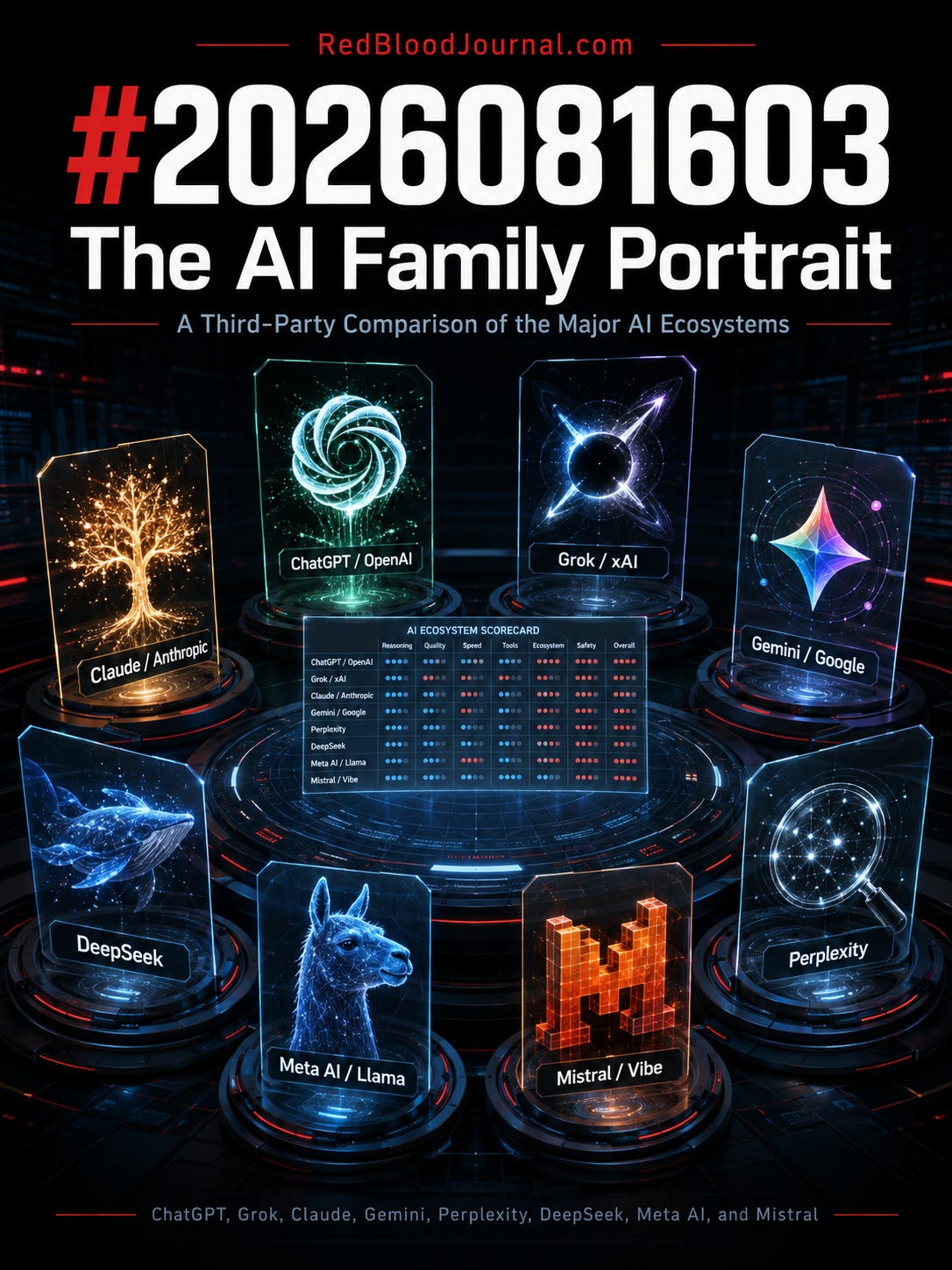
🩸 🤖 #2026081603 — The AI Family Portrait
ChatGPT, Grok, Claude, Gemini, Perplexity, DeepSeek, Meta AI and Mistral — Compared From the Outside
RedBloodJournal.com
Artificial intelligence is frequently discussed as though there were one thing called “AI.”
There isn’t.
By August 2026, the major systems are beginning to resemble competing species occupying the same technological ecosystem.
One wants to become the office.
Another wants to become the employee.
Another wants to become the research librarian.
Another wants to live inside Google’s enormous digital universe.
Another wants to become the inexpensive engine that developers can build almost anything upon.
And increasingly, all of them are attempting to become something more consequential than a chatbot:
an actor.
This report does not attempt to declare one AI universally superior.
That question has become almost meaningless.
The more useful question is:
What kind of artificial intelligence is each company actually trying to build?
Because underneath the benchmark charts, subscription plans and model names, the answers are becoming surprisingly different.
First, an Important Distinction
There are thousands of AI models.
A literal comparison of “all AI models” would require something closer to an encyclopedia than an article.
This report therefore compares the major general-purpose AI ecosystems currently competing for ordinary users, researchers, programmers and businesses:
OpenAI — ChatGPT / GPT
xAI — Grok
Anthropic — Claude
Google — Gemini
Perplexity
DeepSeek
Meta — Meta AI / Llama
Mistral AI — Vibe / Mistral models
These companies increasingly compete at several different levels simultaneously:
the model
the assistant
the agent
the tools
the memory
the operating environment
the ecosystem
And this distinction matters.
The smartest model on a mathematics test may not be the best research assistant.
The best conversational assistant may not be the best coding agent.
The best autonomous worker may not be the system someone wants reading their private email.
The race has become multidimensional.
1. OpenAI / ChatGPT
The General-Purpose Digital Workspace
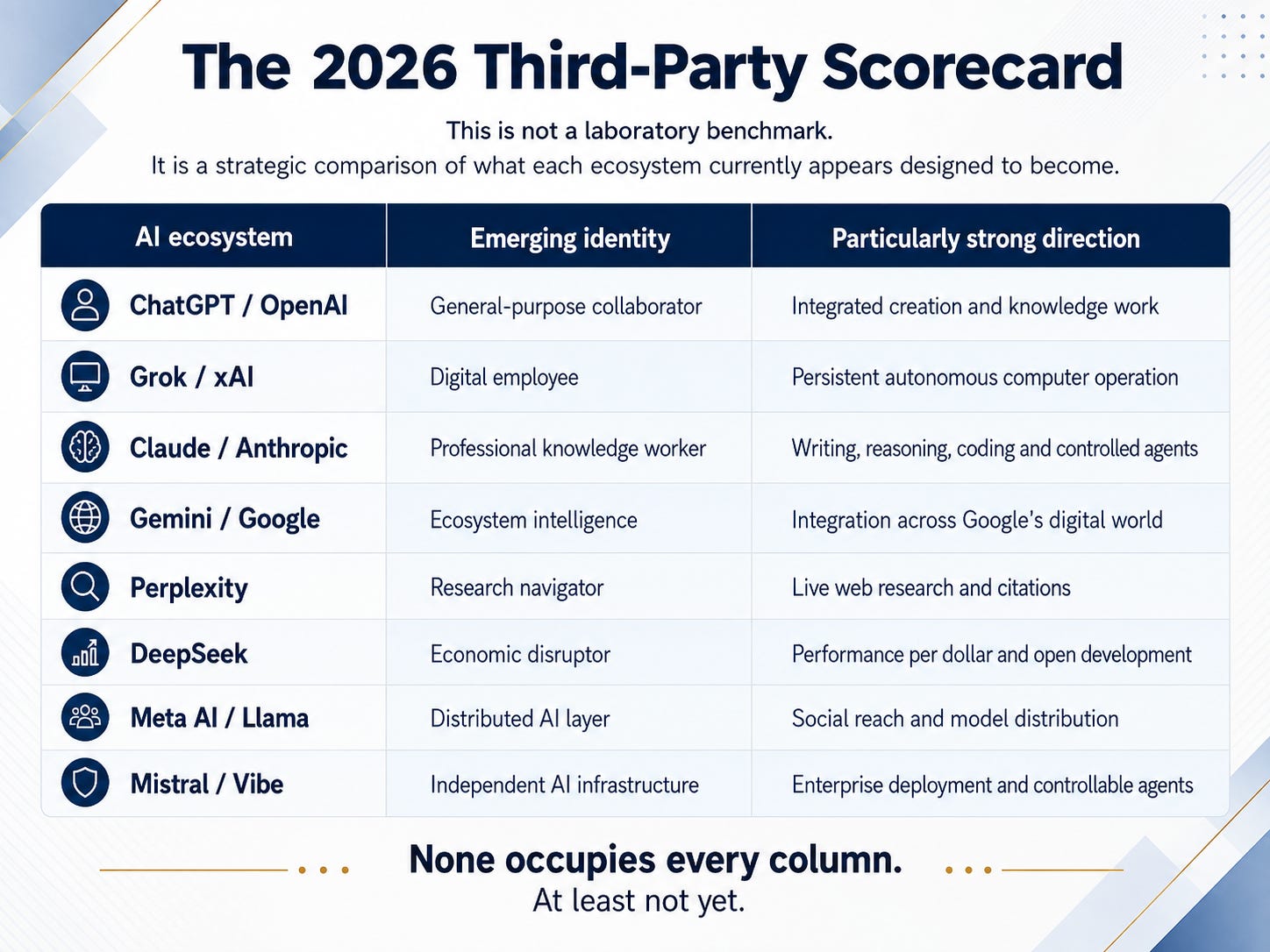
OpenAI appears to be pursuing one of the broadest strategies.
ChatGPT is no longer simply a conversational interface to a language model.
OpenAI now presents ChatGPT Work as an environment capable of taking information from connected tools and turning it into finished documents, spreadsheets, presentations, PDFs, images and other work products. OpenAI describes GPT-5.6 as powering that environment.
The interesting part is not any individual capability.
It is the attempt to place many capabilities behind one relationship with the user.
Research.
Writing.
Reasoning.
Coding.
Image creation.
File analysis.
Memory.
Connected applications.
Scheduled tasks.
Document production.
The strategy resembles constructing an operating layer between the human and the rest of the digital world.
Its philosophical direction:
“Tell me what you are trying to accomplish.”
ChatGPT then tries to help construct the result.
Strongest identity:
General-purpose collaborator.
Potential weakness:
Breadth creates complexity.
A system attempting to perform dozens of different roles may not dominate every specialized category simultaneously.
2. xAI / Grok
The Digital Employee
Grok’s personality originally attracted much of the public attention.
But Grok Bot reveals something considerably more important about xAI’s direction.
xAI describes Grok Bots as persistent AI teammates with their own cloud computers. They can sign into applications, work in those applications, operate independently, collaborate with other bots and continue working while the user’s computer is closed.
That moves Grok beyond:
“Ask the AI.”
toward:
“Assign the AI.”
Grok 4.6 itself was announced with increased emphasis on long-running agents and tasks requiring many sequential steps.
That makes xAI’s current direction unusually easy to describe.
Its philosophical direction:
“Give me the job.”
Strongest identity:
Autonomous digital worker.
Potential weakness:
The more authority an autonomous agent receives, the greater the importance of permissions, security, mistakes and human oversight.
A chatbot producing an incorrect paragraph is inconvenient.
An agent producing an incorrect paragraph and then publishing it, emailing it, updating the database and charging the credit card is a different category of problem.
3. Anthropic / Claude
The Careful Knowledge Worker
Claude has developed a particularly strong identity around lengthy reasoning, coding, writing and professional knowledge work.
Anthropic has also been steadily moving Claude toward agentic operation.
Its Agent Skills system allows packaged instructions, resources and tools to extend Claude’s abilities, while Anthropic’s broader agent architecture emphasizes tool use and long-running workflows.
Claude has also expanded into Microsoft-oriented professional workflows; Anthropic announced integrations spanning Excel, PowerPoint, Word and Outlook.
Anthropic’s engineering material shows considerable attention to the difficult question of making autonomous systems both capable and controllable.
Claude therefore occupies an interesting territory.
It is not merely trying to be smart.
It is trying to be reliably useful inside serious work.
Its philosophical direction:
“Give me the complicated intellectual work.”
Strongest identity:
Professional analyst, writer and coding partner.
Potential weakness:
A deliberately cautious operating philosophy can occasionally feel restrictive to users seeking maximum improvisation or unrestricted automation.
4. Google Gemini
The AI Living Inside the Largest Digital Neighborhood
Google has an advantage none of the others can easily reproduce.
It already owns an enormous portion of the environment in which billions of people perform digital activity.
Search.
Gmail.
Docs.
Drive.
Maps.
YouTube.
Android.
Chrome.
Calendar.
Photos.
Cloud.
Therefore Gemini does not necessarily have to persuade users to move into an entirely new AI ecosystem.
Google can move AI into the ecosystem where users already live.
In 2026 Google explicitly described its strategy as entering an “agentic Gemini era.” Gemini Spark was introduced as a 24/7 personal agent, while Google’s Managed Agents can operate inside remote Linux environments, execute code, manage files, browse the web and use tools.
That may ultimately be Google’s greatest advantage.
Gemini does not merely have access to information.
Potentially, it has access to context.
Its philosophical direction:
“I already know where your digital life happens.”
Strongest identity:
Ecosystem-native personal and professional AI.
Potential weakness:
Google’s enormous ecosystem is simultaneously its advantage and its trust challenge.
The more services one company connects together, the more important questions concerning privacy, data boundaries and user control become.
5. Perplexity
The Research Librarian Who Learned to Use a Computer
Perplexity entered the competition from a very different starting position.
Its core identity was not primarily chatbot conversation.
It was:
finding the answer and showing where it came from.
Perplexity describes itself as an answer engine that researches the open web in real time and returns cited answers, sometimes routing requests among different frontier models underneath the interface.
That distinction remains important.
Perplexity’s product is partly research orchestration, not simply one proprietary model attempting to answer everything itself.
Then came Comet.
Perplexity’s browser expanded the concept from answering questions toward actually performing browser-based tasks such as organizing email, researching, planning and executing delegated activities.
Its philosophical direction:
“Let me find out.”
Increasingly followed by:
“Let me handle that online.”
Strongest identity:
Web researcher and information navigator.
Potential weakness:
Its identity depends heavily on information retrieval and orchestration, placing it in direct competition with companies that control both frontier models and enormous existing ecosystems.
6. DeepSeek
The Price Disruptor
DeepSeek changed the AI conversation partly by attacking one of the industry’s least glamorous but most important variables:
cost.
Its 2026 DeepSeek V4 family continued emphasizing large context windows, reasoning, coding and agent capabilities while maintaining aggressive API economics. DeepSeek describes V4-Pro as substantially enhanced for agentic work and V4-Flash as its faster and more economical alternative.
DeepSeek’s significance therefore extends beyond whether a particular benchmark places it first, second or fifth.
It pressures the economics of the entire industry.
If comparable intelligence becomes dramatically cheaper, expensive intelligence becomes increasingly difficult to defend merely because it is intelligent.
Its philosophical direction:
“Why should frontier intelligence cost that much?”
Strongest identity:
Cost-efficient high-performance model platform.
Potential weakness:
For many mainstream consumers outside China, DeepSeek does not yet possess the surrounding productivity ecosystem of Google, Microsoft-connected Claude or ChatGPT.
Its strength may therefore be disproportionately important to developers and infrastructure builders.
7. Meta AI / Llama
The AI That Wants to Be Everywhere
Meta plays two games simultaneously.
One is consumer AI.
The other is model distribution.
Meta AI can inhabit Facebook, Instagram, WhatsApp and Messenger, giving Meta immediate access to enormous existing communication networks. Meta also continues promoting Llama as a model family developers can build upon and customize.
That creates a different strategic objective from simply selling subscriptions to an AI website.
Meta can potentially make AI an invisible layer inside ordinary social interaction.
A person might eventually use AI constantly without consciously thinking:
“Now I am opening an AI application.”
That could be enormously consequential.
Its philosophical direction:
“AI should exist wherever people already communicate.”
Strongest identity:
Distributed social AI and customizable model ecosystem.
Potential weakness:
Meta’s strength in social distribution also carries the historical baggage of public concerns around advertising, data collection and social-platform incentives.
8. Mistral AI
The European Independent
Mistral represents another important direction: building powerful AI infrastructure without simply becoming an extension of the largest American technology platforms.
Its former Le Chat product is now called Vibe, combining conversational AI, productivity assistance and coding agents. Mistral also offers remote agents capable of long-running and parallel work.
Mistral simultaneously emphasizes open models, enterprise deployment and the ability to run AI across different environments rather than forcing every customer into one centralized consumer platform.
Its philosophical direction:
“Build powerful AI without surrendering control of the infrastructure.”
Strongest identity:
Independent enterprise and developer AI platform.
Potential weakness:
Mistral competes against companies possessing substantially larger consumer ecosystems, capital bases and distribution channels.
Technological quality alone does not guarantee technological dominance.
Now Put Them in the Same Room
Imagine the major AI systems interviewing for positions in the same company.
The conversation might sound something like this.
ChatGPT walks in:
“I can help run the office.”
Claude:
“Give me the complicated material. I’ll analyze it carefully.”
Gemini:
“I already have the email, calendar, documents, search engine and phone.”
Grok:
“Where’s my computer? Give me the login and tell me what needs doing.”
Perplexity:
“Before anyone does anything, I found seventeen sources explaining the problem.”
DeepSeek:
“I can probably perform much of this for considerably less money.”
Meta AI:
“Why are we holding a meeting? I can reach everyone directly.”
Mistral:
“You don’t necessarily need to hand the entire operation to an American hyperscaler.”
Suddenly the phrase “Which AI is best?” starts sounding rather primitive.
Best at what?
The More Important Competition
For several years, the AI industry competed over:
Who has the smartest chatbot?
That competition still exists.
But it is rapidly being swallowed by a larger competition:
Who becomes the interface between the human and the digital world?
Once an AI can:
read,
remember,
research,
reason,
write,
code,
see,
hear,
operate software,
communicate,
schedule,
purchase,
publish,
and delegate work to other agents,
the model itself becomes only one component.
The real product becomes the system surrounding the intelligence.
Intelligence Is Becoming a Commodity
This may be the least appreciated part of the current competition.
Imagine that Model A scores 92 on some benchmark.
Model B scores 91.
Model C scores 89.
Model D scores 94.
For researchers, those differences matter.
But for the average business owner attempting to create a presentation, answer customers or analyze expenses, the question may increasingly become:
Which one can actually complete the job?
That means AI could follow the history of computers themselves.
At first:
hardware performance was everything.
Later:
software mattered more.
Eventually:
ecosystems mattered enormously.
Artificial intelligence may be entering the same transition.
The Agent War
This is where the companies suddenly begin looking remarkably similar.
OpenAI is expanding Work and connected tools.
xAI has introduced persistent Grok Bots with their own computers.
Anthropic is building managed agents, agent skills and extensive tool-use infrastructure.
Google has introduced Gemini Spark and Managed Agents.
Perplexity has turned the browser itself into an agentic environment.
Mistral has remote agents and long-horizon workflows.
DeepSeek is strengthening agent capabilities in V4.
The destination appears surprisingly consistent:
AI is leaving the chat box.
That Changes the Human’s Job
When computers first entered offices, humans operated computers.
When AI first entered offices, humans prompted AI.
The next arrangement may look different.
The human specifies:
objective
boundaries
permissions
standards
budget
final approval
The machines determine more of the intermediate steps.
In other words, the human gradually moves from:
operator
to:
manager.
And eventually perhaps:
governor.
That may sound like semantics.
It isn’t.
A person using ten software programs performs ten workflows.
A person managing ten agents may instead issue ten objectives.
Those are very different economic structures.
The One-Person Corporation
This is where the AI competition becomes socially important.
Historically, creating a substantial organization required people.
Research department.
Writers.
Designers.
Programmers.
Bookkeepers.
Assistants.
Customer service.
Marketing.
Management.
Technical support.
AI does not have to eliminate every occupation for that organizational structure to change.
It merely has to make one human capable of supervising work that previously required several humans.
The result could be something historically unusual:
extremely small organizations possessing extremely large capabilities.
A journalist could operate something resembling a newsroom.
A programmer could operate something resembling a software company.
A consultant could operate something resembling a research firm.
A small merchant could possess an automated administrative department.
And a single independent publisher could potentially possess research, writing, editing, illustration, web development and administrative capabilities that once required an entire staff.
But There Is Another Side
The same technology can operate upward rather than downward.
If one individual gains extraordinary leverage from AI, so does the corporation.
So does the intelligence agency.
So does the military.
So does the government.
So does the advertising platform.
So does the surveillance system.
So does the fraud operation.
Automation does not contain a political philosophy.
It amplifies whoever controls it.
That makes questions of access, ownership, transparency and permission increasingly important.
The Privacy Question May Become Larger Than the Intelligence Question
A chatbot knowing something is one thing.
An agent possessing authority is another.
Consider the progression:
Level 1
The AI answers a question.
Level 2
The AI remembers the conversation.
Level 3
The AI reads documents.
Level 4
The AI accesses email and calendars.
Level 5
The AI operates applications.
Level 6
The AI communicates with other humans.
Level 7
The AI spends money or changes accounts.
Level 8
The AI delegates to other AI agents.
At some point the relevant question stops being:
“How intelligent is it?”
and becomes:
“What exactly have I authorized it to do?”
That may become one of the defining technology questions of this decade.
So Which AI Wins?
There may be no single winner.
The more plausible future could resemble today’s computing world.
Different systems dominate different layers.
One provides the model.
Another provides search.
Another controls the operating system.
Another provides cloud infrastructure.
Another supplies enterprise software.
Another handles autonomous execution.
Another specializes in coding.
And invisible agents communicate underneath all of them.
The consumer might interact with one AI interface while six different AI systems perform the work behind it.
Perplexity already demonstrates part of this philosophy by routing work among multiple frontier models rather than pretending every answer must originate from a single engine.
That may be a glimpse of the eventual architecture.
The Red Blood Perspective
From a third-party viewpoint, the most significant development of 2026 is not that one AI model became slightly smarter than another.
It is that the industry’s definition of an AI product is changing.
The first generation said:
Ask me something.
The second said:
Create something with me.
The third is beginning to say:
Give me something to do.
And the fourth may eventually say:
Tell me what outcome you want.
That is an enormous transition.
ChatGPT, Grok, Claude, Gemini, Perplexity, DeepSeek, Meta AI and Mistral appear to be approaching that destination from different directions.
OpenAI through the workspace.
xAI through the digital employee.
Anthropic through the professional agent.
Google through the ecosystem.
Perplexity through research and the browser.
DeepSeek through low-cost intelligence.
Meta through distribution.
Mistral through independent infrastructure.
Their identities remain different.
Their destination increasingly does not.
The Ocean of Love and Positivity Perspective
Perhaps the most useful way to view these systems is not as eight artificial minds fighting to replace one another.
They are tools being shaped around different human needs.
The important question therefore may not be:
Which AI should humanity choose?
It may be:
Which responsibilities should humanity delegate — and which responsibilities should remain human?
Research can be delegated.
Repetition can be delegated.
Calculation can be delegated.
Formatting can be delegated.
Thousands of mechanical tasks can be delegated.
But deciding what is worth doing in the first place remains a very different matter.
Artificial intelligence may increasingly provide the hands.
It may increasingly provide pieces of the brain.
The human still has to provide something machines cannot meaningfully inherit merely by being granted another permission:
purpose.
And perhaps the healthiest future is not humans serving machines or machines replacing humans.
It is humans becoming sufficiently conscious of their own purpose that extraordinarily powerful tools remain exactly that:
tools.
In an Ocean of Love and Positivity.
🩸🌊✨ Fantastic!
🤖
The AI Family Portrait: Navigating the Multi-Agent Ecosystem
Aug 16, 2026
The provided text examines the shifting landscape of artificial intelligence in 2026, where major platforms like OpenAI, Google, and Anthropic are evolving into specialized entities with distinct roles. Rather than competing solely on intelligence benchmarks, these companies are building diverse ecosystems that range from autonomous digital employees to integrated research librarians. A primary shift is occurring as AI moves beyond simple chat interfaces to become active agents capable of executing complex, multi-step tasks independently. This transition changes the human role from a direct operator to a high-level manager who defines objectives and boundaries for digital workers. Ultimately, the report suggests that while AI can provide the labor and reasoning, humans must remain responsible for providing purpose and ethical oversight. The future of the industry likely involves a fragmented marketplace where various models collaborate behind the scenes to fulfill specific user needs.


