


#1445 🩸 RedBloodJournal.com 🩸
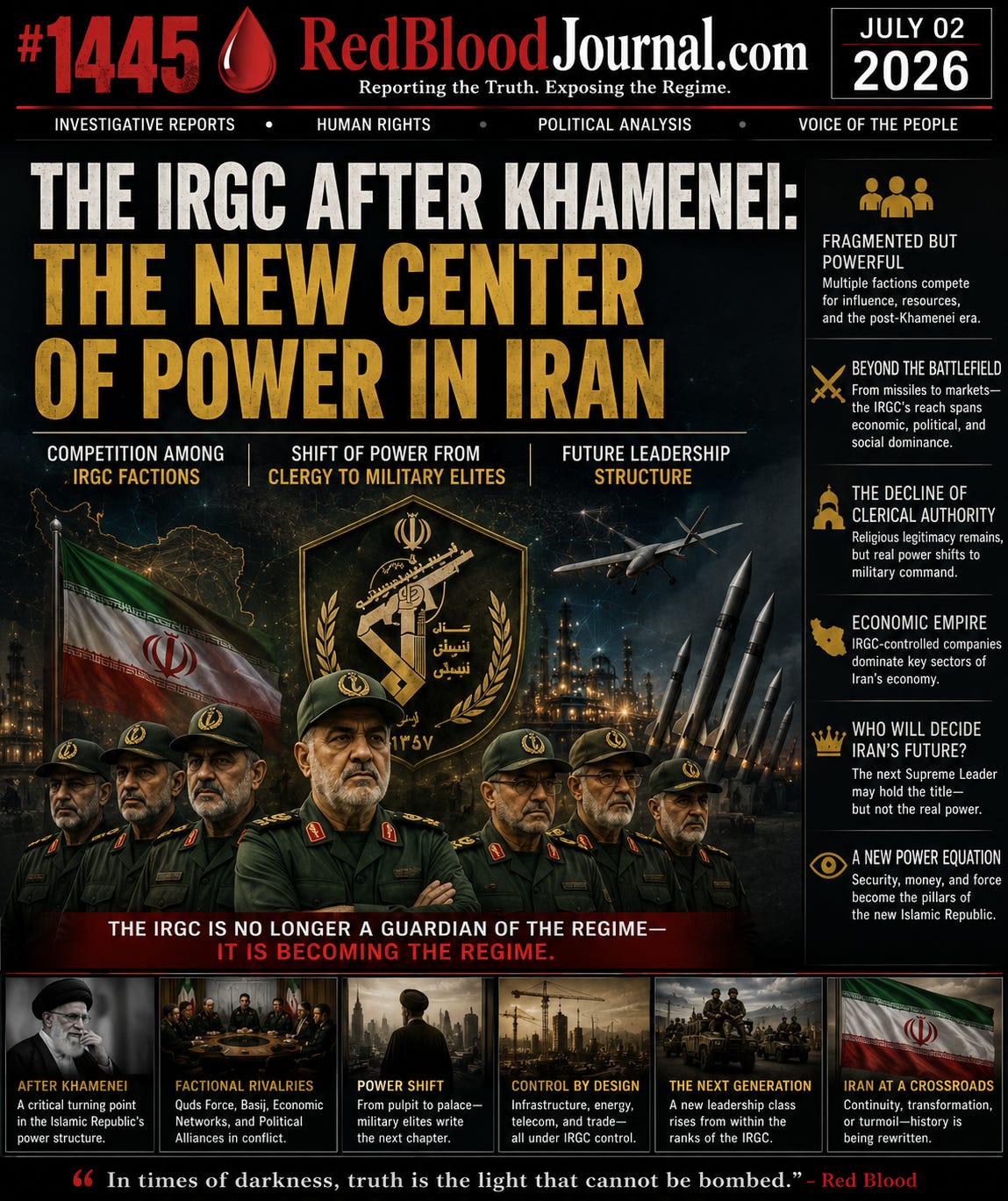
The IRGC After Khamenei: The New Center of Power in Iran
By: Red Blood
For more than four decades, the Islamic Republic of Iran has presented itself as a state governed by religious authority. The office of the Supreme Leader has stood above every elected institution, while the clerical establishment has served as the public face of the political system.
Yet beneath that religious structure, another institution has steadily accumulated power—the Islamic Revolutionary Guard Corps (IRGC).
The passing of Ayatollah Ali Khamenei marks not only the end of an individual leader but potentially the beginning of a fundamental transformation in how power is exercised inside the Islamic Republic. The central question is no longer simply who becomes Supreme Leader, but who truly governs Iran after Khamenei.
From Clerical Rule to Military Influence
When the Islamic Republic was established in 1979, religious legitimacy formed the foundation of political authority.
Over the decades, however, the IRGC evolved far beyond a military organization.
Its influence expanded into:
National security
Intelligence operations
Missile and drone programs
Economic enterprises
Construction and infrastructure
Energy projects
Telecommunications
Foreign operations
Domestic security
As its responsibilities increased, so did its political influence.
Today, many analysts view the IRGC not merely as the protector of the Islamic Republic, but as one of its principal centers of decision-making.
Competing Centers of Power
The IRGC is often discussed as though it operates with a single unified voice.
In reality, every large political institution contains individuals and networks with different priorities.
As Iran enters the post-Khamenei era, competition among influential figures inside the security establishment may become increasingly important.
Potential areas of disagreement could include:
Relations with the United States.
Future negotiations over sanctions.
Economic reform.
Relations with neighboring countries.
Domestic political control.
The future role of the Supreme Leader.
Such competition would not necessarily indicate institutional collapse. Instead, it could represent a struggle over who will define the next phase of the Islamic Republic.
The Supreme Leader Versus Real Power
Constitutions describe formal authority.
Politics often reveals practical authority.
The office of Supreme Leader may continue to exist, but if military and security institutions increasingly shape strategic decisions, the balance of power could gradually shift.
This would not be unprecedented.
Throughout history, governments have sometimes retained traditional institutions while practical authority migrated elsewhere.
Titles remained.
Power changed hands.
The future of Iran may depend on whether the next Supreme Leader exercises independent authority—or primarily serves as a symbol while major strategic decisions emerge from security institutions.
The Economic Dimension
Power is rarely determined by politics alone.
Economic influence often follows.
Over the years, companies connected to the IRGC have become active across numerous sectors of Iran’s economy.
Infrastructure projects, transportation, telecommunications, engineering, construction, and energy have all contributed to expanding institutional influence beyond traditional military responsibilities.
Economic leverage frequently reinforces political leverage.
The more resources an institution controls, the greater its ability to shape national priorities.
The Future Leadership Structure
Several possibilities could emerge during the coming years.
One scenario is continuity, with the existing constitutional framework remaining largely intact.
Another is a gradual redistribution of authority in which the Supreme Leader continues as the symbolic head of state while practical decision-making increasingly shifts toward military and security institutions.
A third possibility is prolonged competition among various political, military, and clerical factions before a new balance of power eventually emerges.
History shows that political transitions are rarely linear.
They often involve negotiation, rivalry, compromise, and institutional adaptation before a new equilibrium develops.
Beyond Individuals
Much public discussion focuses on personalities.
Yet political systems are larger than any individual leader.
Whether one official replaces another may prove less significant than understanding which institutions gain influence during periods of transition.
The post-Khamenei era is therefore not simply a question of succession.
It is a question of institutional evolution.
If the IRGC continues expanding its political, economic, and security influence, future historians may describe this period not merely as the transfer of leadership, but as the moment when the center of gravity inside the Islamic Republic permanently shifted.
Conclusion
Leadership transitions often reveal changes that have been developing quietly for years.
The death of a long-serving leader creates a moment in which existing institutions are tested, alliances are redefined, and competing visions of the future become more visible.
Whether Iran continues under predominantly clerical leadership, evolves toward greater military influence, or develops an entirely new political balance remains uncertain.
What appears increasingly clear is that the future of the Islamic Republic will likely be determined not only by who occupies the office of Supreme Leader, but by which institutions possess the ability to exercise lasting authority.
🩸 Ocean of Love and Positivity 🩸
Political systems change, institutions evolve, and generations witness the rise and fall of governments. Observing these transitions with patience rather than anger allows history to become a teacher instead of a burden. Wisdom grows when we study events without losing our humanity, remembering that beyond every struggle lies the enduring value of truth, compassion, and the Ocean of Love and Positivity.
⚖️ The IRGC and the Shifting Architecture of Iranian Power
Jul 2, 2026
The provided text explores the evolving distribution of authority within the Iranian government as it nears a critical transition period following the death of its current leader. While the state was founded on religious legitimacy and clerical rule, the Islamic Revolutionary Guard Corps (IRGC) has gradually transformed into a dominant force with massive economic, political, and security influence. This shift suggests that future governance may rely less on the traditional office of the Supreme Leader and more on the military establishment’s decision-making power. Internal rivalries and economic control over national infrastructure further complicate this transition, creating various potential paths for the country’s political structure. Ultimately, the source argues that the institutional evolution of the IRGC could permanently relocate the nation’s center of gravity away from the clergy. This analysis encourages an objective view of these historical transformations through a lens of patience and systemic understanding.


