


#1444 🩸 RedBloodJournal.com 🩸
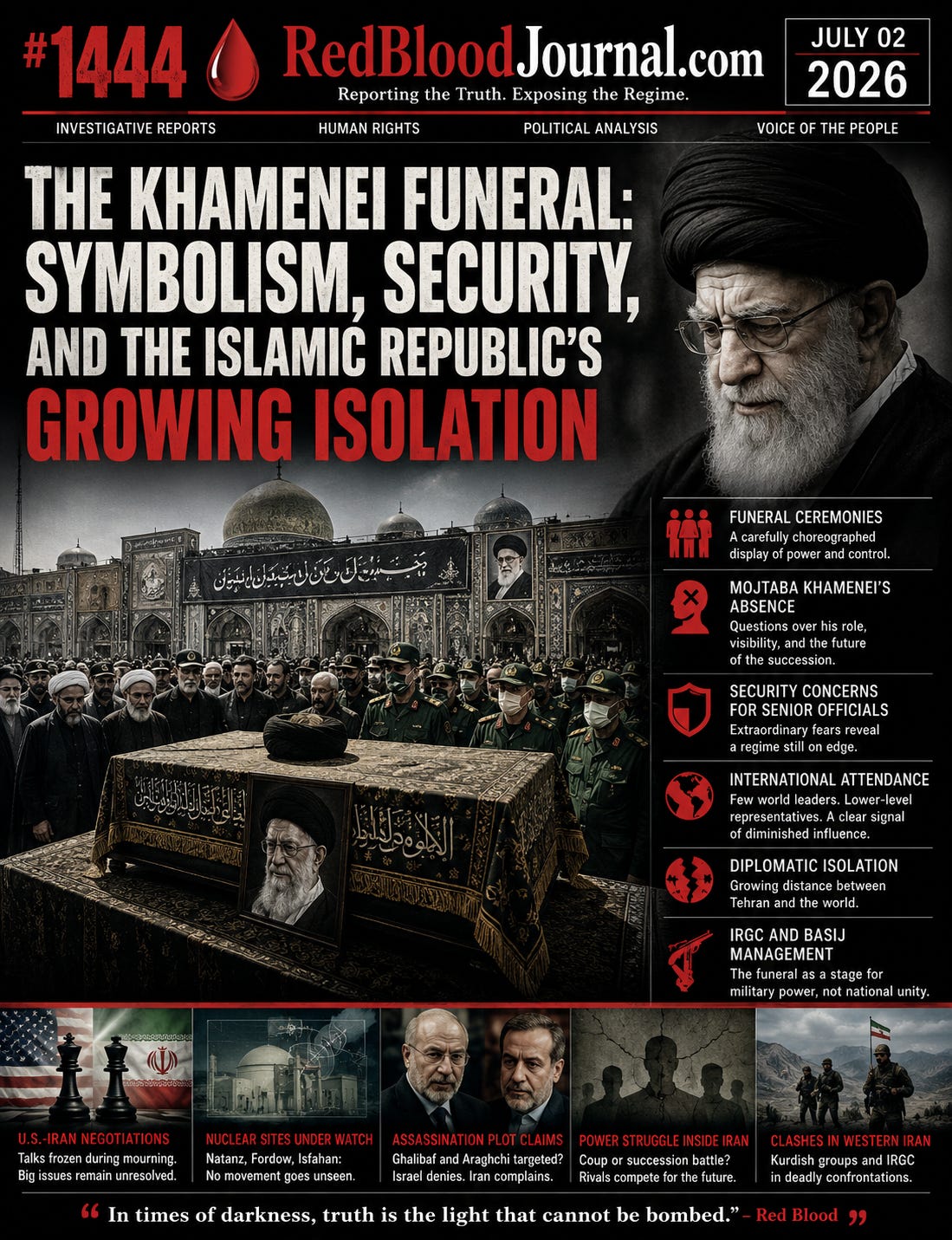
The Khamenei Funeral: Symbolism, Security, and the Islamic Republic’s Growing Isolation
By: Red Blood
The death of a country’s supreme leader is traditionally designed to project continuity, confidence, and stability. State funerals are carefully orchestrated political events meant to reassure allies, intimidate adversaries, and convince the public that power remains firmly under control.
The funeral ceremonies following the death of Iran’s Supreme Leader, however, appeared to communicate a different message. Beyond the official speeches, carefully selected camera angles, and state-organized crowds, the event revealed several signs that many political observers interpreted as evidence of a government still struggling with internal insecurity after months of military confrontation and political uncertainty.
Whether these observations ultimately prove significant will be judged by history, but several aspects of the ceremonies deserve close examination.
A Funeral Under Extraordinary Security
One of the most striking characteristics of the ceremonies was the extraordinary level of security surrounding senior officials.
Unlike many state funerals throughout modern history, where leaders openly appear beside one another to project confidence, Iranian officials reportedly maintained unusually cautious movements throughout the ceremonies.
The concern appeared to extend beyond ordinary security precautions. Following months of reports of targeted strikes against senior military and political figures, the leadership seemed determined to minimize any opportunity for additional attacks.
For critics, this suggested that the government’s own security institutions still lacked complete confidence in their ability to protect the country’s highest-ranking officials.
A government that feels secure generally behaves differently from one that continues operating as though the battlefield has merely paused.
The Absence of Mojtaba Khamenei
Among the most discussed aspects of the ceremonies was the reported limited public presence—or absence during key moments—of Mojtaba Khamenei, long viewed by many analysts as one of the most influential figures surrounding the office of the Supreme Leader.
Whether his limited visibility reflected personal security concerns, deliberate political strategy, or routine logistical decisions remains uncertain.
Nevertheless, in politics, symbolism often matters as much as official explanations.
When a figure widely believed to play a major role in the future of the leadership is largely absent during one of the most significant state events in decades, observers naturally begin asking questions.
Sometimes what is missing receives as much attention as what is visible.
A Funeral Without the World’s Leaders
State funerals often become demonstrations of international influence.
Presidents, monarchs, prime ministers, and senior diplomats attend not only to honor the deceased but also to signal diplomatic relationships and geopolitical priorities.
The attendance at this funeral appeared considerably more limited than many previous state funerals involving major world leaders.
Several countries sent lower-ranking representatives rather than heads of state.
Many Western governments were absent altogether.
Even several countries generally viewed as maintaining cooperative relations with Tehran reportedly sent officials below their highest leadership levels.
Diplomatic attendance alone cannot fully measure a nation’s international standing.
However, diplomatic symbolism matters.
The absence of numerous prominent leaders inevitably contributed to the perception that the Islamic Republic faces increasing political isolation on the world stage.
The Role of the IRGC and Basij
Another notable feature of the ceremonies was the central organizational role reportedly played by the Islamic Revolutionary Guard Corps (IRGC) and the Basij.
Rather than presenting the funeral primarily as a national event uniting all sectors of society, the organizational emphasis appeared heavily centered on the state’s military and security institutions.
Supporters view these organizations as protectors of the Islamic Republic.
Critics argue that their prominent role reinforces the perception that the government increasingly relies on its security apparatus as the principal foundation of political authority.
Regardless of perspective, the images projected during the ceremonies emphasized institutional strength more than national reconciliation.
Optics Versus Reality
Political ceremonies are carefully designed performances.
Every camera angle, every guest list, every speech, and every public appearance sends intended messages.
Yet observers often analyze not only the official narrative but also the unintended signals.
Questions surrounding security.
Questions surrounding succession.
Questions surrounding diplomatic participation.
Questions surrounding internal confidence.
None of these individually determine the future of the Islamic Republic.
Together, however, they create an image of a political system navigating one of the most uncertain transitions in its modern history.
Looking Beyond the Ceremony
History frequently remembers state funerals not simply as memorial services but as turning points.
The death of a long-serving leader often exposes underlying tensions that were previously hidden beneath centralized authority.
Whether Iran experiences continuity, gradual reform, intensified internal competition, or deeper instability remains impossible to predict with certainty.
What can be observed is that the funeral became more than a farewell.
It became a reflection of the questions now surrounding the future of the Islamic Republic itself.
As always, separating verified facts from political interpretation remains essential. Public ceremonies reveal much—but rarely everything.
🩸 Ocean of Love and Positivity 🩸
Every political system eventually faces moments of transition. Governments rise, governments fall, and leaders come and go. The greatest constant is not political power, but the human capacity to remain thoughtful, compassionate, and committed to truth. By observing history with calm minds instead of emotional reactions, we become better students of life itself. Whatever changes tomorrow may bring, let them strengthen our commitment to wisdom, understanding, and the Ocean of Love and Positivity.
⚰️ The Funeral of Khamenei:
A Republic in Transition
Jul 2, 2026
The provided text analyzes the Supreme Leader’s funeral in Iran, interpreting the event as a signal of a government in transition rather than a display of absolute stability. The author highlights extraordinary security measures and the conspicuous absence of world leaders as evidence of the regime’s internal anxiety and deepening international isolation. Furthermore, the article notes the limited visibility of Mojtaba Khamenei, which fuels uncertainty regarding political succession and future leadership. The Islamic Revolutionary Guard Corps played a dominant organizational role, suggesting that the state now relies heavily on its military apparatus to maintain authority. Ultimately, the source suggests that these unintended symbolic signals reveal a political system facing profound uncertainty and institutional tension. These observations collectively portray a nation at a critical and potentially volatile historical turning point.


