


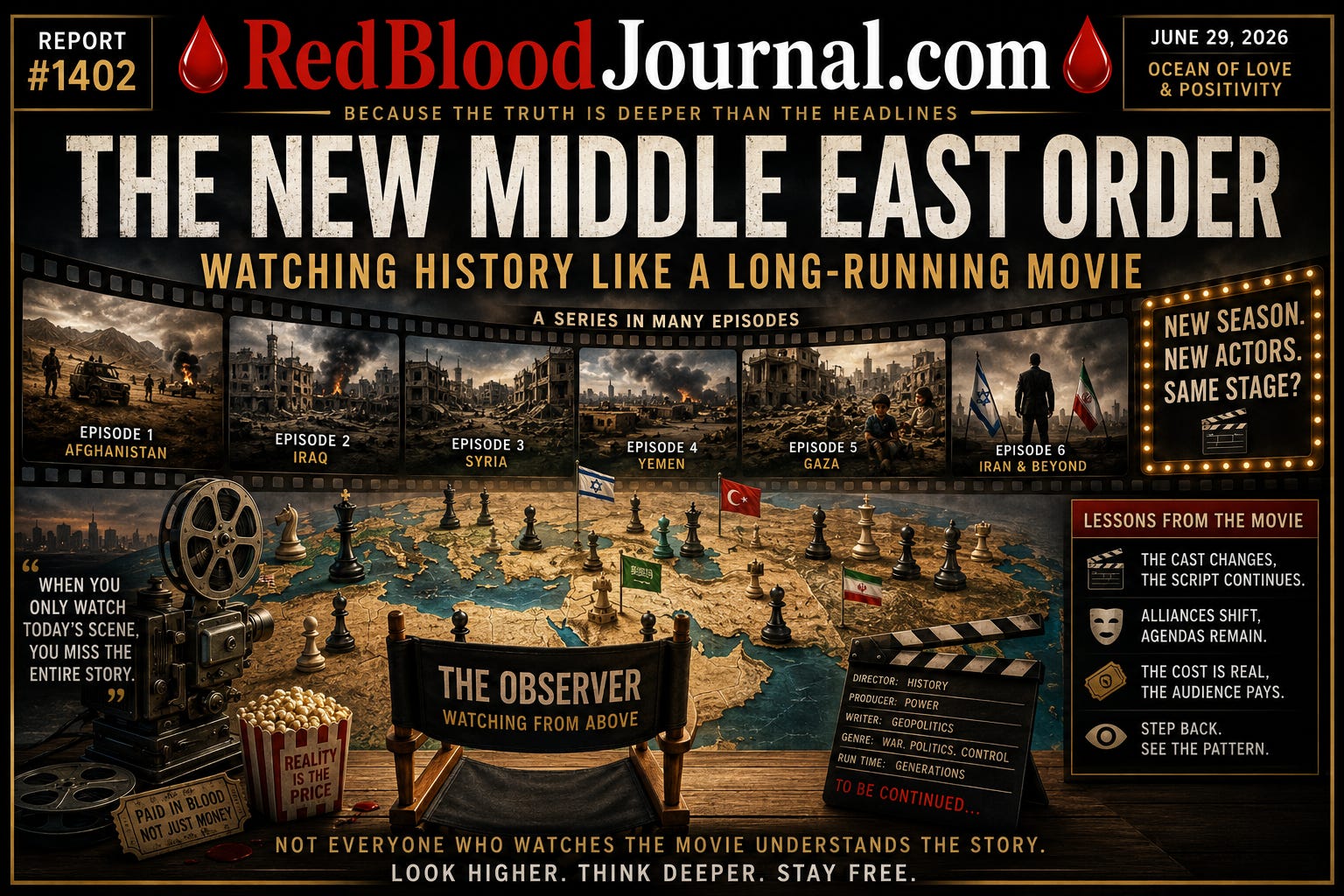
🩸 RedBloodJournal.com 🩸
Report #1402
The New Middle East Order
Watching History Like a Long-Running Movie
Date: June 29, 2026
Introduction
Imagine arriving at a movie theater halfway through a three-hour film.
The lights are already dim.
The battle has already begun.
One side is firing.
The other side is retreating.
The audience immediately begins choosing heroes and villains.
Few stop to ask:
“What happened in the first hour?”
Now imagine that instead of one movie, it is a television series that has been running for generations.
Every season has different actors.
Different locations.
Different costumes.
Different alliances.
Yet somehow, every season seems connected to the one before it.
This report invites the reader to examine current events through that cinematic analogy.
Episode One Never Ends
Most people remember wars as isolated events.
Afghanistan.
Iraq.
Libya.
Syria.
Ukraine.
Gaza.
Lebanon.
Iran.
Each appears to begin and end independently.
But viewed as a movie series, another possibility emerges.
Perhaps these are not separate stories.
Perhaps they are chapters within a much longer narrative.
The ending of one episode becomes the opening scene of the next.
Changing the Cast
Every successful television series eventually changes its cast.
Popular characters disappear.
Unknown characters suddenly become central.
Former enemies become allies.
Former allies become enemies.
Governments change.
Coalitions change.
Public opinion changes.
Yet the series continues.
The audience often believes they are watching a completely new story, while the underlying structure feels familiar.
Why Every Season Feels Different
A director understands that repetition becomes boring.
To keep viewers emotionally invested, every season needs new scenery.
A different country.
A different slogan.
A different conflict.
A different justification.
The audience feels they are witnessing something entirely new.
Yet when multiple seasons are viewed together, recurring themes often become easier to notice.
Whether those similarities reflect genuine recurring historical patterns or coincidence is open to interpretation.
The Camera Position Matters
The biggest difference between viewers is not intelligence.
It is camera angle.
The ground-level camera captures today’s events.
Today’s bombing.
Today’s negotiations.
Today’s speeches.
Today’s outrage.
It produces vivid detail.
But it cannot show the entire landscape.
Now imagine a second camera.
It slowly rises above the battlefield.
Higher.
Higher still.
Eventually, individual explosions become almost invisible.
Instead, movement becomes visible.
Entire regions can be observed.
Political shifts become easier to compare across years.
The viewer is no longer watching only today’s scene.
They are watching the direction of the story itself.
The Audience Often Forgets Earlier Seasons
One challenge with long-running series is memory.
After enough seasons, many viewers forget how earlier chapters ended.
A government once presented as an enemy later becomes a negotiating partner.
Former allies become rivals.
Groups once described one way may later be described differently as circumstances change.
History contains many examples of shifting alliances and changing political relationships.
Remembering earlier chapters can provide useful context for understanding later ones.
The Cost of Every Episode
Unlike cinema, history has no special effects.
Every explosion represents real lives.
Every battlefield contains real families.
Every refugee is real.
Every soldier is someone’s child.
Every civilian carries memories long after the cameras leave.
The audience may eventually move to the next episode.
The people living inside the story cannot.
Who Watches the Audience?
Perhaps the most interesting part of every movie is not the actors.
It is the audience.
People laugh together.
Cry together.
Cheer together.
Become angry together.
The emotional experience becomes part of the entertainment.
History sometimes produces similar emotional reactions.
Daily headlines naturally encourage strong feelings.
Stepping back to observe long-term patterns does not eliminate emotion, but it can provide additional perspective.
The New Middle East Order
Many analysts today describe the Middle East as entering another period of political transformation.
Governments negotiate.
Influence shifts.
New agreements emerge.
Old assumptions are challenged.
Whether these developments represent a lasting reordering of the region or another stage in an ongoing historical cycle remains uncertain.
Only time will answer that question.
Final Scene
Imagine reaching the final episode of a long series.
Instead of asking,
“Who won today’s battle?”
you begin asking,
“What has this entire story been teaching us?”
That single change in perspective transforms the viewing experience.
One begins paying less attention to individual scenes...
...and more attention to recurring patterns.
The goal is not to stop watching history.
The goal is to watch it with a wider lens.
Because those who only watch today’s scene often react emotionally.
Those who remember previous seasons begin recognizing patterns.
And those who continually step back become less captivated by each new episode and more interested in understanding the story as a whole.
🩸 RedBloodJournal.com 🩸
“History may be one long story told through many seasons. Wisdom begins when we occasionally stop watching from the front row and look at the entire stage.”
🌊 Ocean of Love and Positivity 🌊
🎬 The Cinematic Framework of Middle Eastern History
Jun 28, 2026
This text uses a cinematic metaphor to analyze the evolving political landscape of the Middle East and global conflict.
It suggests that modern history functions like a long-running television series where individual wars are merely connected chapters rather than isolated events.
By viewing geopolitical shifts through a wider lens, the author argues that observers can identify recurring patterns and changing alliances that are often missed during daily news cycles.
The framework emphasizes that while actors and settings change, the underlying narrative structure of power remains familiar across generations.
Ultimately, the source encourages a detached perspective to better understand the long-term trajectory of history rather than reacting emotionally to every new development.
This approach highlights the human cost of these events, reminding the audience that real lives exist behind the dramatic headlines.


