


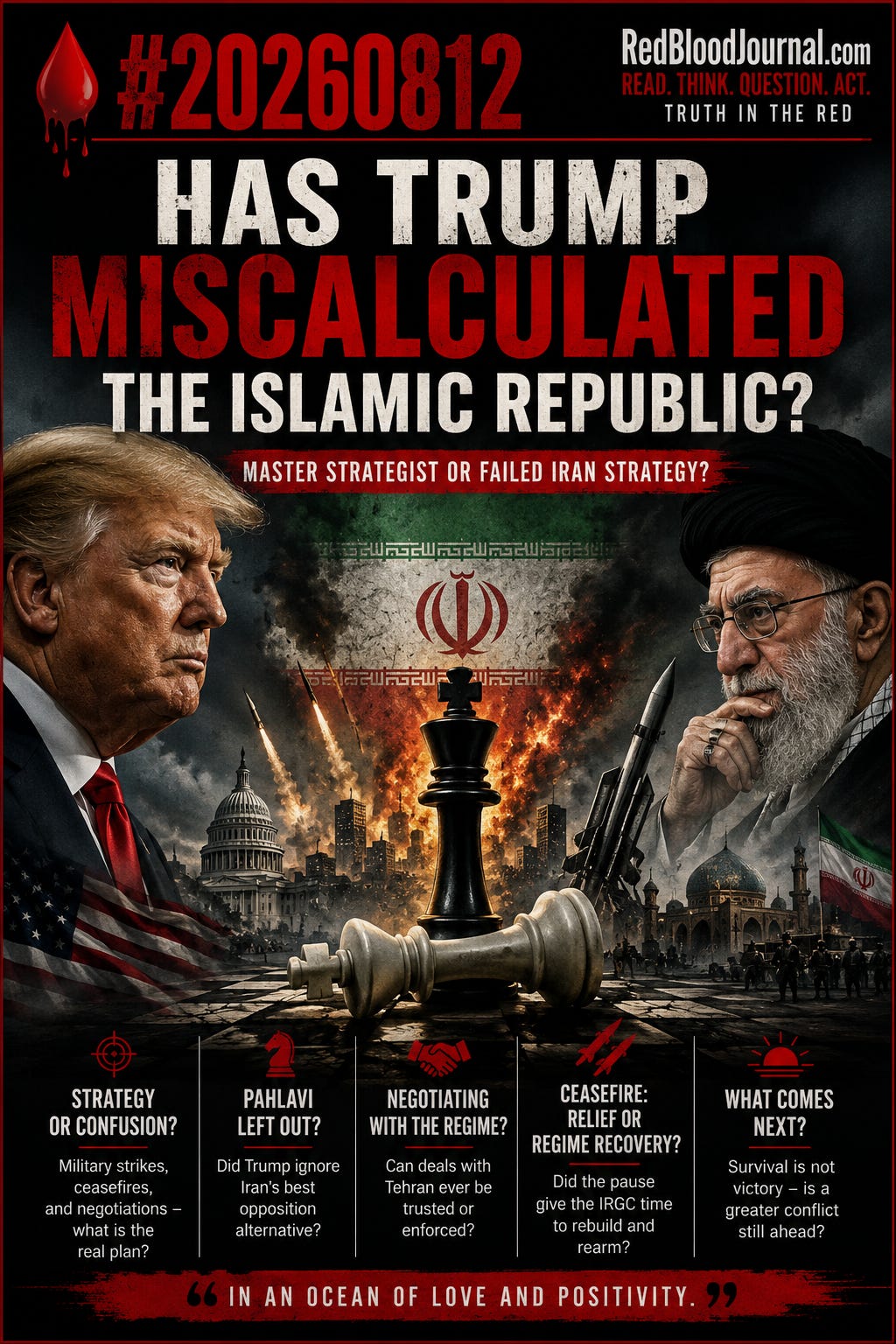
🩸 #20260812 — Has Trump Miscalculated the Islamic Republic?
Master Strategist or Failed Iran Strategy?
For years, Donald Trump cultivated the image of a man who negotiates differently from conventional politicians. He threatens, pressures, creates uncertainty, walks away, returns, and attempts to force the other side into a deal from a weaker position.
That image became particularly powerful among some opponents of the Islamic Republic. Trump’s first presidency, his political comeback, and his increasingly aggressive rhetoric toward Tehran created an expectation that perhaps he understood something others did not.
Perhaps the apparent contradictions were deliberate.
Perhaps negotiations were camouflage.
Perhaps military pressure was only one stage of a larger operation.
Perhaps there was a plan behind the confusion.
The material examined in this report presents a much less flattering possibility:
What if there was no hidden master plan?
The source itself opens with essentially this question, describing growing doubts among Iranians who previously viewed Trump as unusually clever and potentially capable of bringing down the Islamic Republic.
That possibility deserves examination alongside the competing explanation that what looks like confusion from the outside may still be deliberate strategic unpredictability.
🩸 The Expectation
Trump’s history created enormous expectations.
According to the source material, many Iranians interpreted his political survival and return to power as evidence that he possessed unusual strategic instincts. Some consequently assumed that when he confronted the Islamic Republic, he must have extraordinary plans, weapons, tactics, or political arrangements waiting behind the scenes.
Then came military action.
The leadership of the Islamic Republic was struck.
Expectations rose further.
But according to the transcript, the expected political transformation did not follow. Instead, a ceasefire was reached and negotiations reportedly continued with elements remaining inside the existing system.
This creates the first major question:
Was destroying part of the leadership the objective—or merely the opening move?
If it was the opening move, what was supposed to come next?
🩸 The Missing Political Endgame
The transcript’s strongest criticism is not that Trump protected himself from an assassination threat or even that he stopped military operations.
It is that military action allegedly occurred without a clearly visible political strategy for what would replace the existing power structure.
The source argues that Trump struck the regime’s leadership while leaving significant portions of its security and political machinery intact, apparently hoping that surviving elements could become negotiating partners.
That could represent a deliberate strategy.
Destroying an entire state structure can produce chaos. Preserving enough of it to negotiate a controlled transition could theoretically prevent state collapse, civil war, or a regional power vacuum.
But there is another possibility.
Perhaps Washington misunderstood what kind of political system it was dealing with.
🩸 The Venezuela Model
The transcript repeatedly compares Trump’s apparent Iran strategy with his approach toward Venezuela.
Its argument is simple: remove or neutralize the central leader, preserve enough of the existing government to maintain order, and negotiate with pragmatic survivors.
According to the source, critics believe Trump attempted something similar after removing Ali Khamenei from the equation.
But Iran and Venezuela are not identical systems.
The Islamic Republic contains overlapping political, ideological, military, intelligence, economic, clerical, and paramilitary networks. Removing one individual—even the supreme leader—does not automatically eliminate those networks.
The important question therefore becomes:
Did Trump mistake the head of the system for the system itself?
🩸 The Pahlavi Question
There was another possible strategy available: working openly with organized opposition outside the Islamic Republic.
The transcript focuses heavily on Reza Pahlavi.
It argues that Trump underestimated both Pahlavi and the Iranian population that viewed him as a possible transitional alternative. It also claims that Steve Witkoff had secretly met Pahlavi, initially creating expectations that Washington might incorporate him into a broader strategy.
According to the transcript, Trump ultimately moved away from that possibility and instead explored arrangements involving figures originating from within the existing system.
Whether Pahlavi could actually have unified Iran after regime collapse is a separate question.
There is no guarantee.
But strategically, the distinction matters.
Trump appears to have faced two broad choices:
Work with forces seeking to replace the system.
Or work with surviving forces from inside the system to transform it.
The source argues that he chose—or at least seriously pursued—the second.
🩸 “Help Is on the Way”
This makes Trump’s earlier rhetoric particularly important.
According to the transcript, during major Iranian protests Trump encouraged demonstrators to continue and declared that “help is on the way.”
For protesters, such language could reasonably create expectations far beyond economic sanctions or negotiations with surviving government officials.
Then came military action.
Then came the ceasefire.
Then came reports of negotiations.
From Washington’s perspective, these might represent different instruments of the same strategy.
From the perspective described in the source, however, the sequence looked like a promise that began with regime change and ended with regime management.
That difference in perception is politically significant.
🩸 The Catering-Truck Episode
Nothing illustrates the reversal of perception more dramatically than the reported security operation involving Trump’s aircraft.
The transcript describes reports that an Iranian assassination threat caused Trump’s travel procedures to be secretly altered. According to the account, Trump appeared to board Air Force One but was subsequently moved through a catering vehicle and transferred to a C-32A aircraft while the original aircraft departed without him.
There are two completely different ways to interpret such an operation.
The first is straightforward:
This is exactly what an effective Secret Service should do.
If credible intelligence indicates that the president’s aircraft may be targeted, deception, decoys and an unexpected aircraft change are signs of competent protection—not cowardice.
The transcript itself acknowledges that protecting the president through such precautions is not inherently evidence of weakness.
But the strategic question is different.
If the Islamic Republic had supposedly been devastated militarily, why could a threat attributed to it still cause such extraordinary security precautions for the president of the United States?
The security operation may have been successful while the geopolitical situation producing it remained troubling.
Both can be true simultaneously.
🩸 Deterrence
This brings the investigation to deterrence.
Military victory is not simply the destruction of targets.
Deterrence exists when an adversary believes that the cost of a particular action will exceed any possible benefit.
The source argues that despite months of confrontation, the Islamic Republic remained capable—or was at least perceived as capable—of creating security problems serious enough to alter presidential movements.
If accurate, that raises an uncomfortable question.
Was Iran militarily damaged without being strategically deterred?
Those are not the same thing.
🩸 Negotiating With a Government Trump Says He Does Not Trust
Another contradiction appears in Trump’s own rhetoric as presented by the transcript.
Trump reportedly says he does not trust Tehran and that Iranian officials have repeatedly lied to him. Yet negotiations continue to appear as a possible solution.
This could be classic Trump negotiation.
One does not negotiate only with trusted friends. Diplomacy exists precisely because adversaries cannot trust each other.
But critics ask a different question:
If Trump believes the system repeatedly violates agreements, why would another agreement solve the fundamental problem?
John Bolton’s position in the transcript is that negotiations are ineffective because there is no sufficiently reliable Iranian government capable of making commitments worth accepting.
Tom Cotton, meanwhile, is presented arguing that America should stand with people seeking freedom from authoritarian systems.
These represent fundamentally different strategic directions.
Deal with the regime.
Or:
Help create the conditions for something to replace it.
🩸 Threat, Pause, Threat, Negotiation
The transcript portrays Trump’s Iran policy as repeatedly oscillating between military threats and negotiations.
Attack.
Pause.
Threaten.
Negotiate.
Threaten again.
Negotiate again.
This may be intentional unpredictability.
Trump has used uncertainty as leverage throughout his career. An adversary who cannot predict whether the next telephone call brings a deal or an attack may make concessions simply to reduce uncertainty.
But unpredictability has another side.
If threats repeatedly fail to produce the threatened consequence, they can gradually lose credibility.
That is why the transcript contrasts Trump with George W. Bush’s 2003 ultimatum to Saddam Hussein. Critics cited in the source argue that Bush issued a clear deadline and followed it with military action, whereas Trump has repeatedly threatened renewed attacks without consistently carrying them out.
The question is therefore not whether unpredictability works.
Sometimes it does.
The question is:
At what point does strategic unpredictability become strategic inconsistency?
🩸 Did the Ceasefire Give the IRGC Time?
Perhaps the most important measurement is not rhetoric but capability.
The transcript presents claims from surviving Islamic Republic figures that missile and drone production continues and may exceed the rate at which weapons were previously expended.
Such claims should not automatically be accepted.
A government emerging from damaging attacks has an obvious incentive to exaggerate its recovery, production capacity and military strength.
But neither should such statements automatically be dismissed.
If the regime actually used the ceasefire to reorganize command structures, restore production, disperse assets and replenish weapons, then time itself became a strategic resource.
And Trump gave them some of it.
That produces perhaps the most important military question in the entire investigation:
Did the pause create leverage for Trump—or recovery time for Tehran?
🩸 Meanwhile, the Iranian People Pay
Economic pressure introduces another complication.
The transcript describes declining purchasing power, weakened commercial activity, installment purchasing replacing traditional cash transactions, gasoline shortages and long fuel lines.
Economic pressure can weaken governments.
But governments and populations do not necessarily break at the same speed.
The source argues that the Islamic Republic may possess greater economic endurance than the ordinary population living beneath it.
If that is correct, a prolonged strategy creates a disturbing possibility:
The government survives while society absorbs the punishment.
That would be almost the opposite of what Iranian protesters who expected rapid outside assistance believed they were being promised.
🩸 The Case That Trump Has Not Failed
There is, however, another interpretation.
Perhaps the judgment is simply premature.
Trump may have concluded that immediate destruction of the remaining Iranian state apparatus would create consequences worse than temporary survival of the existing structure.
He may want economic pressure to weaken it internally.
He may be using negotiations to expose divisions.
He may be waiting for military inventories to recover.
He may believe another round of conflict will occur under more favorable circumstances.
He may even want Tehran to believe that Washington has lost momentum.
If so, apparent hesitation could itself be part of the strategy.
The available source material does not establish which of these possibilities is correct.
And that distinction matters.
Absence of a publicly visible strategy is not proof that no strategy exists.
🩸 Survival Is Not Victory
The transcript closes with a historical warning.
It invokes Saddam Hussein as an example of a regional ruler who survived earlier confrontations with major powers and interpreted survival as evidence of strength.
The broader argument is that great powers frequently escalate gradually rather than using their full capabilities in the first confrontation.
That analogy is not proof of what will happen to Iran.
History does not repeat mechanically.
But it creates an equally important warning for Tehran:
Trump’s failure to finish the confrontation today does not mean America has abandoned the confrontation tomorrow.
The Islamic Republic could miscalculate Trump just as easily as Trump could miscalculate the Islamic Republic.
🩸 The Red Blood Perspective
There are two competing stories.
In the first, Trump remains the dealmaker.
The threats, ceasefire, negotiations, ambiguity and military pauses are pieces of a larger strategy that cannot yet be seen from outside the room.
In the second, Trump entered one of the world’s most complicated political systems believing pressure, military force and dealmaking could produce a relatively simple outcome.
He damaged the regime but did not destroy it.
He encouraged the Iranian people but did not clearly commit to their political alternative.
He threatened Tehran but returned to negotiations.
He removed leadership while leaving structures capable of reorganizing.
And now the surviving system may be learning how to deal with him.
There is also a third possibility.
Both Trump and the Islamic Republic may believe they are manipulating the other.
Trump may believe Tehran is exhausted and eventually will accept his terms.
Tehran may believe Trump does not want another large war and therefore can be delayed, threatened and negotiated with until political circumstances change.
If that is the situation, then the real contest is no longer simply missiles versus missiles.
It is a contest of patience, perception, political endurance and miscalculation.
The evidence available here cannot establish whether Trump has failed or whether his strategy simply has not reached its final stage.
That judgment belongs later—and ultimately to the reader.
🌊 The Ocean of Love and Positivity
Behind every geopolitical calculation are ordinary human beings.
Presidents calculate leverage.
Generals calculate targets.
Governments calculate survival.
Negotiators calculate concessions.
But families calculate food, fuel, safety and whether their children will have a future.
Whatever political structure eventually governs Iran, the most positive outcome would not merely be victory for Washington, Tehran, Pahlavi, Trump, or any political faction.
It would be an Iran in which ordinary people no longer have to become pieces on somebody else’s geopolitical chessboard.
Power comes and goes.
Governments rise and disappear.
Leaders become paragraphs in history.
The people remain.
And perhaps the greatest strategy is ultimately the one requiring the fewest graves to succeed.
In an Ocean of Love and Positivity.
🩸🌊✨ Fantastic!
⚖️
Trump and Tehran: Strategic Instinct or Miscalculation?
Aug 12, 2026
This report evaluates whether Donald Trump’s aggressive posture toward the Islamic Republic of Iran reflects a calculated strategic masterstroke or a fundamental misunderstanding of the regime’s resilience. While many supporters anticipated that high-profile military actions and “maximum pressure” would trigger a total political collapse, the text highlights a growing concern that these efforts lacked a clear post-regime endgame. By targeting specific leaders while attempting to negotiate with the remaining bureaucratic structures, Trump may have prioritized regime management over the systemic transformation expected by the Iranian opposition. Comparisons to the “Venezuela Model” suggest that Washington potentially mistook the head of the government for the entire complex network of the state. Ultimately, the source questions if strategic unpredictability has devolved into inconsistency, allowing the Iranian leadership to reorganize during diplomatic lulls. Underpinning this geopolitical analysis is a humanitarian concern for the Iranian population, who endure economic hardship while both sides engage in a high-stakes game of political endurance.


