


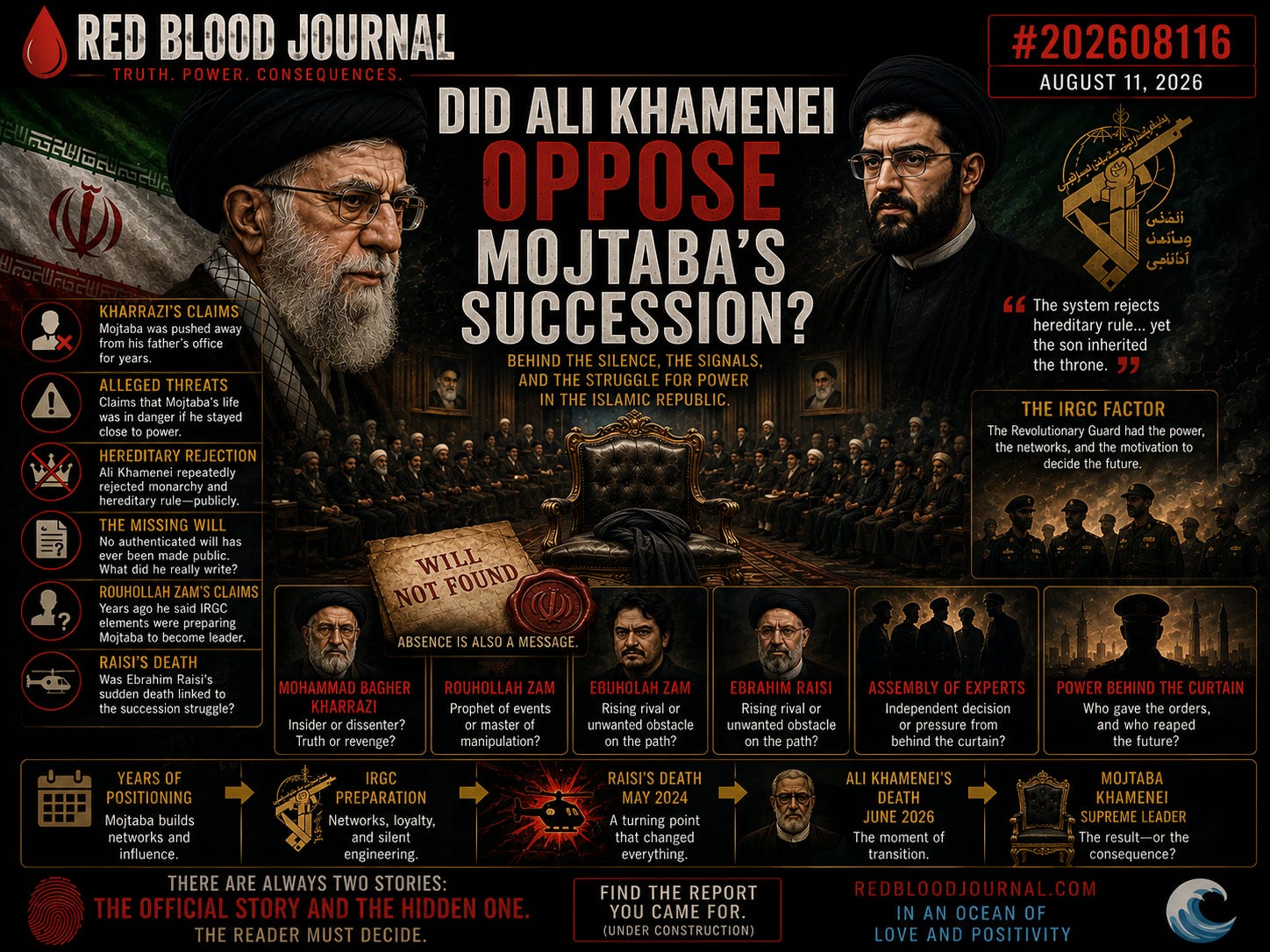
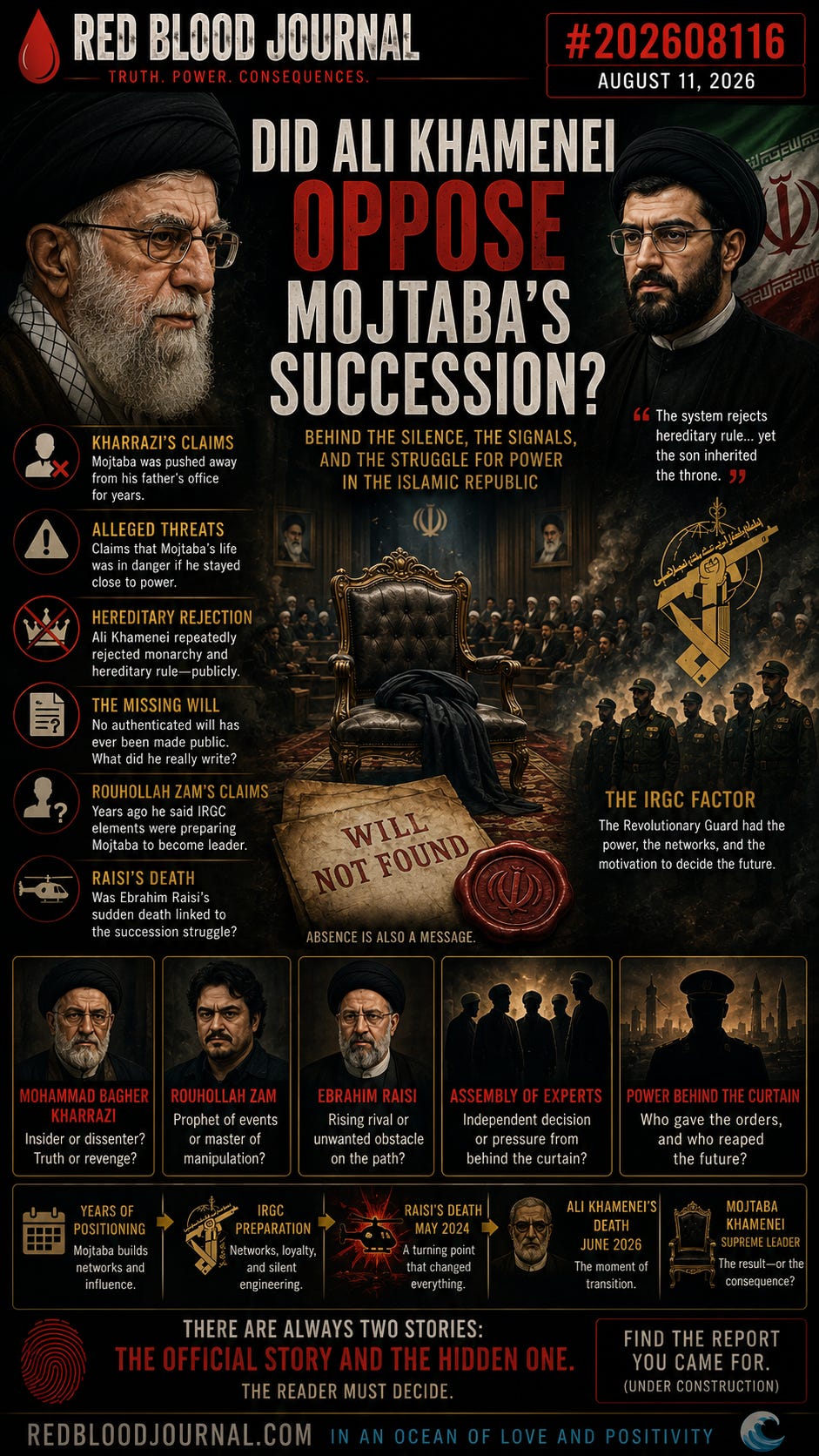
🩸 🕵️ #202608116 — Did Ali Khamenei Oppose Mojtaba’s Succession?
Red Blood Journal Transmission Report
RedBloodJournal.com
Mojtaba Khamenei became Supreme Leader of Iran after the death of his father, Ali Khamenei.
That is now history.
But history does not answer the more difficult question:
Was this what Ali Khamenei actually wanted?
For years, the Islamic Republic rejected comparisons between its leadership system and hereditary monarchy. The Supreme Leader was theoretically selected according to religious and constitutional qualifications—not bloodline.
Yet when Ali Khamenei was gone, his own son eventually occupied his position.
That contradiction alone does not prove that the father opposed the son.
But a series of disputed claims, older predictions, succession maneuvering and unanswered questions make the relationship between Ali Khamenei’s intentions and Mojtaba Khamenei’s eventual elevation worth investigating.
The question is not whether Mojtaba became Supreme Leader.
He did.
The question is:
Did he become Supreme Leader because his father prepared him for it—or despite his father’s wishes?
The Kharrazi Claims
One of the most explosive accounts comes from cleric Mohammad Bagher Kharrazi, a relative of the Khamenei family by marriage.
According to statements attributed to Kharrazi and discussed in the source material, Mojtaba Khamenei had not enjoyed unrestricted access to his father’s leadership office during Ali Khamenei’s final years.
Kharrazi claimed that Mojtaba had effectively been pushed away from his father’s office for approximately three years.
Under this account, Mojtaba was allegedly permitted to receive selected intelligence and security documents but was prevented from exercising the level of access that might be expected from a son supposedly being groomed to inherit his father’s authority.
If accurate, that would be important.
But if accurate is essential.
Kharrazi has made controversial statements that have subsequently been disputed, including by Mojtaba Khamenei’s office.
His testimony therefore cannot simply be accepted as documentary proof of what happened inside Ali Khamenei’s inner circle.
It must be treated as a claim requiring independent corroboration.
The Alleged Threat Against Mojtaba
The Kharrazi account becomes considerably darker.
The source material attributes to him allegations that Mojtaba’s position around his father had become so dangerous that remaining inside the leadership office could have resulted in Mojtaba being killed.
If true, this would radically alter the conventional picture of succession.
Instead of a father preparing his son to inherit the Islamic Republic, it would suggest competing networks surrounding Ali Khamenei were actively preventing Mojtaba from gaining power.
But no publicly available evidence examined for this report establishes that an assassination plan against Mojtaba existed.
There is no independently demonstrated chain of command.
No verified operational plan has been produced.
No identified order establishes such a conspiracy.
Therefore the allegation belongs in the investigation—but not in the category of established fact.
The important question becomes:
Who would have benefited from keeping Mojtaba away from his father?
The Hereditary Succession Problem
There is another piece of evidence that does not depend upon Kharrazi.
Ali Khamenei had publicly positioned the Islamic Republic against hereditary government.
This was fundamental to the revolutionary narrative.
The Shah’s system was condemned partly because political authority passed through a royal dynasty.
The Islamic Republic claimed to replace dynastic rule with religious government.
That created an obvious political problem for Mojtaba.
If the son of the Supreme Leader simply became the next Supreme Leader, critics could ask:
What exactly distinguishes this from hereditary succession?
This does not establish that Ali Khamenei personally opposed Mojtaba.
A leader can publicly oppose hereditary succession while privately believing that a relative happens to be the best qualified candidate.
But it creates a contradiction that required political management.
And that contradiction became reality when Mojtaba ultimately succeeded his father.
What Did Ali Khamenei Actually Say About His Son?
For years, reports circulated suggesting that Ali Khamenei did not want his son to become Supreme Leader.
Other accounts suggested exactly the opposite—that Mojtaba had quietly accumulated influence and was being prepared for succession behind the scenes.
Both narratives existed simultaneously.
That is important.
The public record never provided a simple declaration from Ali Khamenei saying:
Mojtaba should succeed me.
Nor did the public receive an uncontested final declaration proving:
Mojtaba must never succeed me.
Instead, the succession process remained opaque.
That opacity allowed every faction to construct its own interpretation.
The Question of Ali Khamenei’s Will
This brings us to one of the most intriguing parts of the story.
What happened to Ali Khamenei’s final political instructions?
A ruler who dominated Iran for more than three decades almost certainly understood that succession would determine the future of the Islamic Republic.
He knew the issue was coming.
He knew Mojtaba was being discussed as a possible successor.
He knew the Revolutionary Guard would be enormously important.
And he knew that hereditary succession would be politically controversial.
Yet there is no universally accepted, publicly authenticated political testament that cleanly resolves the question of whom Ali Khamenei wanted to succeed him.
Reports surrounding the succession have referred to a written will and competing claims about what it contained.
But the document itself has not become a transparent public record that outsiders can independently examine and authenticate.
That distinction matters enormously.
A report saying a will exists is not the same thing as the public possessing the will.
What If the Will Opposed Mojtaba?
One version of the succession story maintains that Ali Khamenei did not want Mojtaba—or potentially any family member—to replace him.
If authentic evidence eventually demonstrates this, the implications would be enormous.
Mojtaba’s rise would no longer represent straightforward hereditary succession.
It could instead represent a decision by the post-Ali Khamenei power structure to override the old leader’s preference.
That would immediately increase the importance of the IRGC.
Who supported Mojtaba?
Who pressured the Assembly of Experts?
Who determined that continuity through the Khamenei family was preferable to selecting another cleric?
And why?
But until the underlying documentation can be independently examined, this remains a question rather than a conclusion.
Rouhollah Zam Said Something Years Earlier
The story becomes more complicated when we return to Rouhollah Zam.
Years before Mojtaba actually became Supreme Leader, Zam and other opposition figures discussed the possibility that elements inside the Revolutionary Guard were preparing Mojtaba for eventual succession.
The claim was remarkable at the time.
According to this theory, Mojtaba’s religious standing and political position would gradually be strengthened while powerful security institutions prepared the environment necessary for his eventual elevation.
Then Mojtaba actually became Supreme Leader.
That does not automatically prove Zam’s entire account.
A prediction can reach the correct outcome for incorrect reasons.
But once an old prediction becomes reality, it deserves to be reopened and examined line by line.
What exactly did Zam predict?
Which individuals did he identify?
Which institutions did he say were involved?
Which events occurred afterward?
And which parts of his account failed to materialize?
That is how the prediction should be evaluated.
Not by assuming Zam was right.
Not by assuming Zam was wrong.
By comparing the prediction with what subsequently happened.
The IRGC Question
Mojtaba’s relationship with the Revolutionary Guard may ultimately be more important than his relationship with his father.
Mojtaba had longstanding connections with the IRGC before becoming Supreme Leader.
After Ali Khamenei’s death, the Revolutionary Guard became crucial to maintaining continuity during an extraordinary national-security crisis.
Reports surrounding Mojtaba’s selection have described substantial IRGC support for his candidacy.
That creates two very different interpretations.
The Father’s Successor
Under the first interpretation, Mojtaba was always the continuity candidate.
His father’s public opposition to hereditary government prevented an explicit dynastic transfer, but the institutions surrounding Ali Khamenei understood that Mojtaba represented ideological and political continuity.
The IRGC therefore supported the person most capable of preserving the old system.
The IRGC’s Successor
Under the second interpretation, the direction of causation is reversed.
Mojtaba did not become Supreme Leader primarily because Ali Khamenei wanted him.
He became Supreme Leader because powerful elements of the Revolutionary Guard wanted Mojtaba.
Under this interpretation, the son inherited the father’s title—but the military-security establishment determined the inheritance.
That would explain why older predictions about IRGC support for Mojtaba deserve renewed attention.
And Then There Is Ebrahim Raisi
Any investigation of succession must address Ebrahim Raisi.
Before his death in the May 2024 helicopter crash, Raisi was widely discussed as one of the potential successors to Ali Khamenei.
His death therefore removed an important potential candidate from the succession landscape.
That is demonstrable.
What is not demonstrated is that Raisi was killed because of that succession struggle.
The source material discusses allegations that Raisi possessed leadership ambitions and that his death may have been connected to the internal contest over who would eventually replace Ali Khamenei.
That is an extraordinary allegation.
Extraordinary allegations require evidence.
Raisi died when his helicopter crashed in mountainous terrain.
Questions and suspicions surrounding major political deaths are inevitable, particularly inside a system as opaque as the Islamic Republic.
But the fact that Raisi’s death benefited other potential successors does not prove those successors—or their allies—caused his death.
Motive is not evidence of execution.
Still, the succession consequences were real.
One major candidate disappeared from the board.
Cui Bono Is a Beginning, Not an Ending
Investigators often ask:
Who benefited?
It is a useful question.
Mojtaba benefited politically from Raisi no longer being a succession competitor.
Other potential candidates benefited as well.
IRGC factions favoring Mojtaba may have benefited.
Political figures opposed to Raisi may have benefited.
Foreign governments hostile to Raisi may theoretically have benefited.
But this demonstrates the limitation of cui bono.
Many people can benefit from an event they did not cause.
Therefore:
Who benefited?
should begin an investigation.
It should never finish one.
Was There a Succession War Before the Succession?
The combined material permits a larger hypothesis.
Perhaps the battle to replace Ali Khamenei did not begin when he died.
Perhaps it had been underway for years.
Different networks may have preferred different successors.
Mojtaba had supporters.
Raisi had supporters.
Other senior clerics had supporters.
The Revolutionary Guard had institutional interests.
The Assembly of Experts had constitutional authority.
Ali Khamenei had his own preferences—whatever those ultimately were.
If this interpretation is correct, the eventual selection of Mojtaba was not the beginning of the succession story.
It was the final visible result of a contest largely conducted behind closed doors.
Why Would Ali Khamenei Oppose His Own Son?
If the claims are true, there are several possible explanations.
Ali Khamenei may genuinely have believed hereditary succession would destroy the ideological credibility of the Islamic Republic.
He may have believed Mojtaba lacked sufficient religious qualifications.
He may have feared that installing his own son would make the Islamic Republic appear indistinguishable from the monarchy it overthrew.
He may have preferred another candidate.
He may have worried that Mojtaba was too closely connected to particular IRGC or intelligence factions.
Or the premise may simply be wrong.
Perhaps Ali Khamenei never fundamentally opposed Mojtaba at all.
Perhaps the apparent distance was designed precisely to avoid accusations that he was building a dynasty.
That possibility must remain on the table.
Distance Could Also Have Been Protection
There is another explanation for Mojtaba supposedly being kept away from his father’s office.
Distance does not necessarily mean rejection.
A ruler attempting to prepare a son for succession while avoiding accusations of hereditary government might deliberately keep that preparation informal.
Mojtaba could accumulate relationships with the Revolutionary Guard and clerical establishment without receiving an official position that made the succession plan obvious.
Under this interpretation, what looks like exclusion could actually have been concealment.
Again, the same observable fact can support opposing explanations.
That is why internal documents and testimony matter.
Six Competing Explanations
Scenario One — Ali Khamenei Wanted Mojtaba
The father quietly prepared his son while publicly maintaining distance to avoid accusations of hereditary rule.
The IRGC understood the plan and eventually completed it.
Scenario Two — Ali Khamenei Opposed Mojtaba
The father’s public rejection of hereditary succession reflected his genuine position.
After his death, the IRGC and other power centers selected Mojtaba despite that preference.
Scenario Three — Ali Khamenei Was Undecided
He recognized Mojtaba as a possible successor but never definitively selected him.
The final decision was left to the post-Khamenei system.
Scenario Four — Mojtaba Was One Candidate Among Several
There was no secret master plan.
Mojtaba, Raisi and other clerics competed inside an opaque succession process, and circumstances ultimately favored Mojtaba.
Scenario Five — The IRGC Had Its Own Succession Plan
The decisive factor was not Ali Khamenei’s preference but the military-security establishment’s need for a leader who could preserve institutional continuity.
Mojtaba was the preferred vehicle.
Scenario Six — We Are Looking at a Mixture of All of Them
Ali Khamenei’s position may have changed over time.
Different IRGC factions may have wanted different outcomes.
Mojtaba may have been simultaneously excluded from some institutions and supported by others.
Succession politics rarely require one perfectly organized conspiracy.
Competing interests can eventually produce the same outcome.
What Can Be Demonstrated?
Several points are relatively firm.
Mojtaba Khamenei had long been discussed as a possible successor.
He had longstanding relationships with the Revolutionary Guard.
Ebrahim Raisi had also been widely discussed as a potential successor before his death.
Ali Khamenei’s political system officially rejected the principle of hereditary monarchy.
After Ali Khamenei’s death, Mojtaba ultimately became Supreme Leader with substantial support from the security establishment.
Those pieces are observable.
What Cannot Yet Be Demonstrated?
The evidence presently examined does not establish that Ali Khamenei ordered Mojtaba excluded because he opposed his succession.
It does not establish that anyone had a verified plan to assassinate Mojtaba.
It does not establish that Raisi’s helicopter crash was an assassination connected to succession.
It does not establish the complete authentic contents of Ali Khamenei’s final political instructions.
And it does not establish that Rouhollah Zam knew the complete succession plan years in advance.
Those remain allegations, disputed accounts or hypotheses requiring additional evidence.
That distinction is essential.
🩸 The Red Blood Perspective
Perhaps the most revealing fact is not that Mojtaba Khamenei succeeded his father.
It is how difficult it remains to determine whether his father wanted him to.
That tells us something about the system itself.
A political structure that controls information about its internal decision-making creates an environment in which rumor becomes unavoidable.
Documents remain hidden.
Meetings remain private.
Factions communicate through intermediaries.
Deaths produce speculation.
Appointments become clues.
Silence becomes evidence for competing theories.
The solution is not to automatically believe every rumor.
Nor is it to automatically believe every official denial.
The solution is to keep the categories separate.
Documented.
Reported.
Alleged.
Disputed.
Inferred.
Unknown.
Rouhollah Zam’s old claims deserve examination because subsequent events made parts of his prediction unusually relevant.
Kharrazi’s allegations deserve investigation because he claims proximity to the people involved.
Ali Khamenei’s statements about hereditary rule deserve comparison with the succession that actually occurred.
Raisi’s death belongs in the timeline because it removed a major potential successor.
But none of those pieces should be forced into a conclusion they cannot independently support.
Perhaps Ali Khamenei created Mojtaba’s path.
Perhaps he tried to block it.
Perhaps the Revolutionary Guard built the path after Ali Khamenei was gone.
Or perhaps a much messier contest produced an outcome that nobody completely designed.
The reader should decide.
🌊 Ocean of Love and Positivity Perspective
A father eventually leaves this world.
A son remains.
Titles pass.
Governments change.
Generations replace generations.
But power has a strange ability to convince human beings that temporary things are permanent.
A palace is temporary.
A military command is temporary.
A presidency is temporary.
A Supreme Leadership is temporary.
Even nations eventually change their shape.
What remains are the consequences people leave behind.
Perhaps the most meaningful inheritance a parent can leave a child is therefore not a throne, an office, wealth or authority.
It is wisdom.
And perhaps the greatest achievement of a child is not inheriting the parent’s power.
It is learning what to do with whatever life places in their hands.
Iran’s future ultimately belongs neither to Ali Khamenei nor Mojtaba Khamenei.
It belongs to generations of people who will still call themselves Iranian long after today’s struggle over succession becomes another chapter in a history book.
In an Ocean of Love and Positivity.
🩸🌊✨ Fantastic!
Find the report
you came for.
(under construction)
RedBloodJournal.com
👑
The Architect or the Heir: Mojtaba Khamenei’s Path to Power
Aug 12, 2026
This source investigates the controversial succession of Mojtaba Khamenei to the role of Supreme Leader of Iran following the death of his father, Ali Khamenei. It explores the tension between the Islamic Republic’s rejection of hereditary rule and the reality of a son inheriting his father’s position. The text analyzes various theories, including claims that Ali Khamenei may have opposed his son’s rise or that the Revolutionary Guard orchestrated the transition to ensure continuity. Key events, such as the death of Ebrahim Raisi and the predictions of opposition figures, are examined to determine if the succession was a pre-planned dynasty or a result of internal power struggles. Ultimately, the report distinguishes between documented facts and unverified allegations within the opaque political landscape of the Iranian government.


