


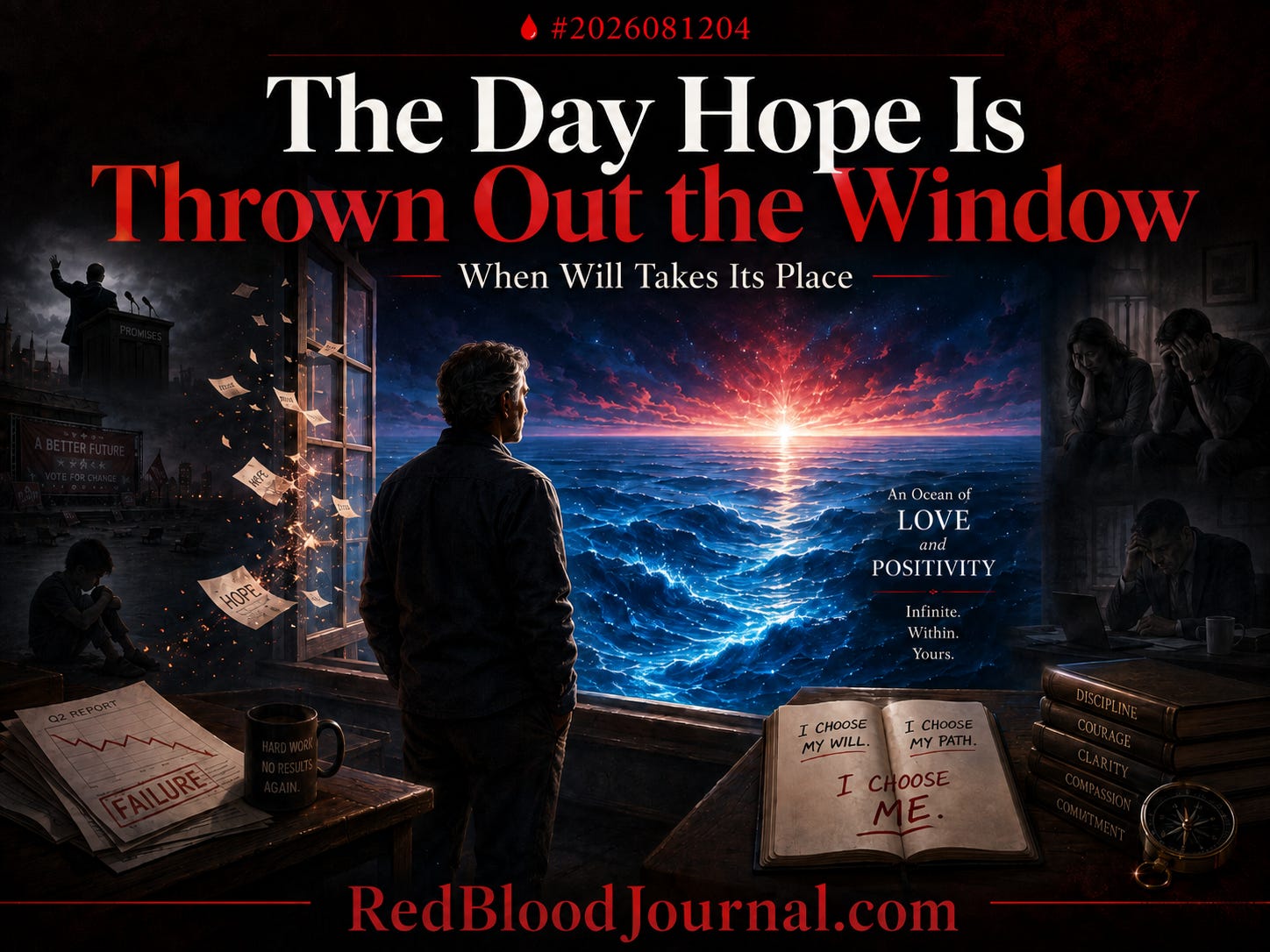
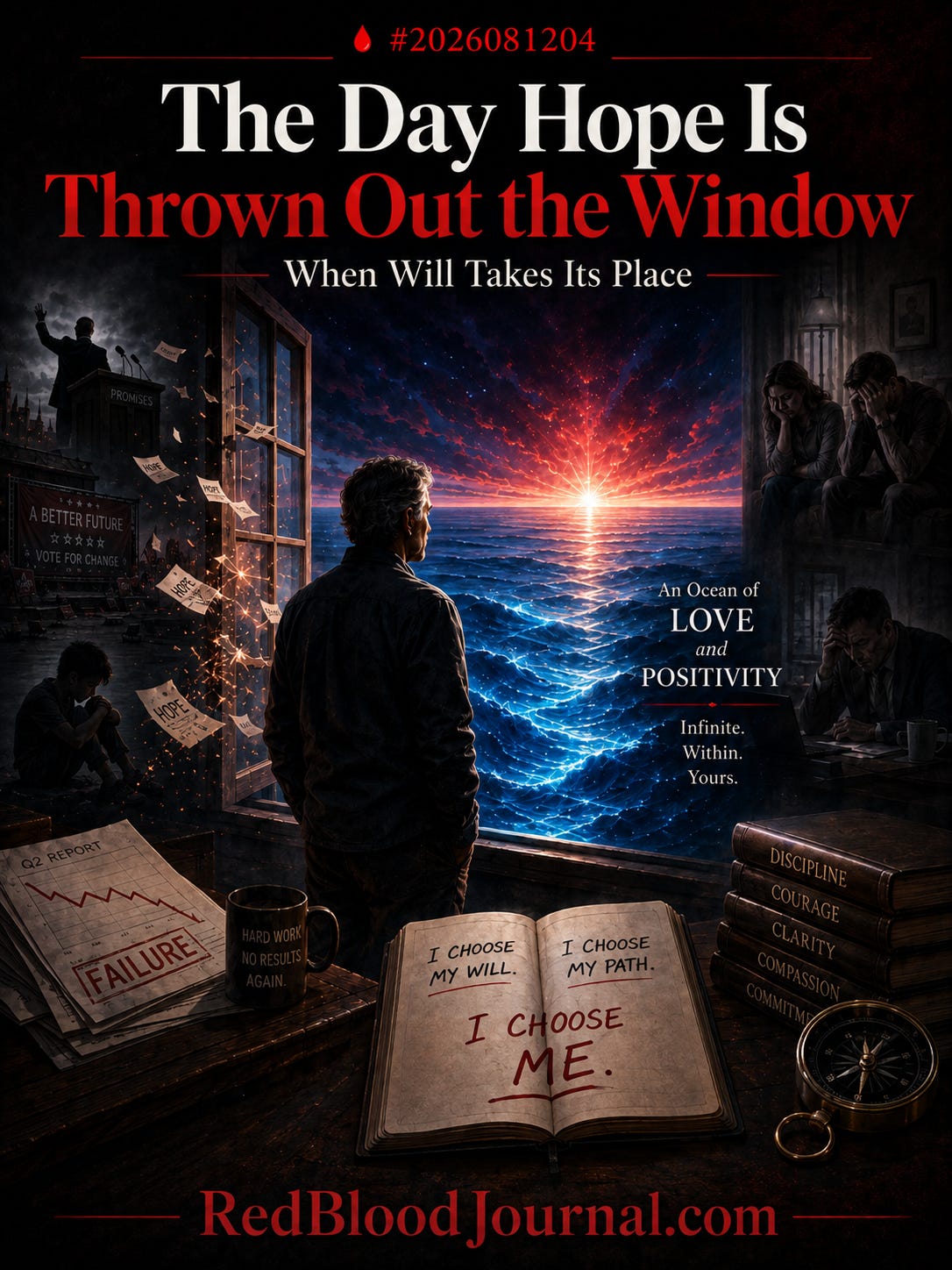
🩸 #2026081204 — The Day Hope Is Thrown Out the Window
RedBloodJournal.com
There comes a point when hope begins to feel less like a gift and more like a weight.
Hope in politicians who promise that this time they will finally govern wisely.
Hope in a child who may someday recognize the consequences of the decisions being made.
Hope in a business plan that keeps consuming money, energy, time, and sleep while always appearing to be one breakthrough away from success.
Hope in a girlfriend, boyfriend, wife, or husband who may eventually stop walking down a road that has been causing pain for years.
Hope keeps saying:
Maybe tomorrow.
Maybe after the election.
Maybe after the next conversation.
Maybe after another investment.
Maybe after another chance.
Maybe after they finally understand.
And sometimes tomorrow comes and nothing changes.
Then another tomorrow comes.
And another.
Eventually, something unusual can happen.
Hope gets thrown out the window.
Not because life has become hopeless.
Because the person waiting finally realizes that hope had quietly transferred control of life into someone else’s hands.
That is when will can move from somewhere deep inside and take its place front and center.
Hope Directed Outward
Human beings appear biologically inclined to search outside themselves for solutions.
As children, this makes perfect sense.
Food comes from someone else.
Protection comes from someone else.
Answers come from someone else.
Authority comes from someone else.
Approval comes from someone else.
For much of early life, survival actually depends upon the outside world.
But perhaps one of the more difficult lessons of adulthood is discovering that the same instinct can continue operating long after it has stopped being useful.
The parent waits for the child.
The citizen waits for the politician.
The employee waits for the employer.
The business owner waits for the market.
The spouse waits for the spouse.
The investor waits for the investment.
The lonely person waits for another person to provide happiness.
The disappointed person waits for circumstances to provide peace.
The problem may not be hope itself.
The problem may be where hope is being placed.
The Politician Problem
Politics may provide one of the clearest examples.
Every election produces a familiar promise:
Put the correct person in the correct office and things will finally improve.
Millions of people emotionally invest themselves in someone they may never meet.
They watch speeches.
They defend candidates.
They argue with family members.
They lose friendships.
They celebrate victories.
They mourn defeats.
And sometimes, years later, they discover that the person who was supposed to restore control to the people has acquired even more control over them.
Another politician then appears.
And hope begins again.
Perhaps the political lesson is not that good leaders cannot exist.
Perhaps the lesson is that no politician should ever be given responsibility for a person’s inner condition.
A government may control taxes, laws, borders, regulations, permits, money, property, movement, or institutions.
But allowing it to control one’s peace of mind requires another kind of permission.
Waiting for Someone to Change
Relationships create a different version of the same classroom.
Someone may spend years thinking:
He will understand eventually.
She will stop eventually.
My child will mature eventually.
My father will finally listen.
My mother will eventually accept me.
My husband will change.
My wife will change.
My friend will realize what they are doing.
Sometimes people do change.
Sometimes they do not.
The dangerous part may be building one’s own peace around the expectation that they must.
The moment another person’s transformation becomes a requirement for personal peace, personal peace has effectively been outsourced.
That may be one of life’s most expensive contracts.
The Business That Keeps Asking for One More Chance
Hope operates just as powerfully in business.
A failing business can consume money for years because success always seems close enough to touch.
One more advertisement.
One more loan.
One more employee.
One more month.
One more product.
One more strategy.
One more chance.
Persistence can build fortunes.
Persistence can also destroy them.
The difficult question is knowing when persistence is courage and when persistence has become fear of admitting that a path no longer works.
Logic examines what exists.
Hope often examines what might exist.
Both have value.
But when hope repeatedly overrides observable reality, the future can begin consuming the present.
The Moment the Direction Changes
Then one day the direction of attention may change.
Instead of asking:
When will they change?
The question becomes:
What will I do?
Instead of:
When will the government fix it?
It becomes:
What remains within my control?
Instead of:
When will this person finally understand me?
It becomes:
Why does my peace require their understanding?
Instead of:
When will life become what I expected?
It becomes:
What can I create from the life that exists now?
The outside world may remain exactly the same.
But internally, almost everything changes.
Expectations begin disappearing.
Resentment loses some of its fuel.
Fear loses some of its authority.
Disappointment becomes harder to manufacture because fewer demands are being placed on other people.
The person has not necessarily gained control over the world.
Something more practical may have happened.
The person has stopped demanding control over the world.
The University of Life
Perhaps that is part of the purpose of this strange university called life.
A university does not test students only with questions they already know how to answer.
It introduces difficulty.
Confusion.
Contradiction.
Failure.
Temptation.
Loss.
Success.
Love.
Money.
Power.
Fear.
Family.
Politics.
Disease.
Ambition.
Ego.
Death.
And endless curveballs.
Maybe the curveballs are not interruptions in the curriculum.
Maybe they are the curriculum.
A person may enter the classroom repeatedly looking outward for the answer.
The teacher may keep changing faces.
A politician.
A spouse.
A child.
A boss.
A doctor.
A religious leader.
A friend.
A billionaire.
A government.
A business.
A movement.
A technology.
Every time, the student may think:
Perhaps this one has the answer.
And perhaps the final lesson is discovering that the teacher was pointing inward the entire time.
The Dead-End Alley and the Ocean
Looking outward can eventually become a dead-end alley.
There are limits everywhere.
Other people have limits.
Governments have limits.
Money has limits.
Bodies have limits.
Technology has limits.
Time has limits.
Even the physical world has limits.
But turn inward and something very different appears.
Memory.
Imagination.
Consciousness.
Dreams.
Ideas.
Creation.
Reflection.
Love.
Meaning.
Possibility.
The inward journey does not appear to have the same visible borders.
A person can travel backward through memory, forward through imagination, sideways through possibilities, and into places that have never physically existed.
The body may be sitting silently in a chair while the mind travels farther than any spacecraft ever built.
And imagination appears to possess one extraordinary characteristic:
No one has yet located its shoreline.
The Red Blood Perspective
Perhaps hope was never meant to disappear.
Perhaps it was simply meant to change direction.
Instead of hoping that politicians become better, hope may become the determination to remain internally free regardless of politicians.
Instead of hoping another person changes, hope may become confidence in one’s ability to respond wisely whether they change or not.
Instead of hoping the world provides happiness, hope may become curiosity about how much happiness can be generated from within.
Then hope stops being a request sent outward.
It becomes fuel for the will inside.
The question is no longer:
Who will save me from this situation?
It becomes:
What is this situation trying to teach me about myself?
The Ocean of Love and Positivity Perspective
There is still one hope worth keeping.
The hope that when this classroom eventually ends, enough was learned that repeating the same lesson will no longer be necessary.
Perhaps there is another classroom.
Perhaps there is another life.
Perhaps there is another form of existence.
Perhaps there is simply nothing recognizable from here.
No one standing inside this classroom can demonstrate the complete answer.
But if another journey exists, perhaps the greatest preparation is not money, status, political victory, possessions, or control.
Perhaps it is learning how to carry an Ocean of Love and Positivity even through disappointment.
And if somehow the student must return and take the class again, there is another hope:
That somewhere deep inside, something remembers.
Not necessarily names.
Not necessarily places.
Not necessarily events.
But perhaps the lesson.
Stop waiting for everyone else to create the fantastic.
Stop placing the steering wheel of the inner world into outside hands.
Look inward.
Find the will.
Find the imagination.
Find the ocean.
And then make the journey as fantastic as possible.
Because perhaps the greatest graduation from the University of Life is not finally getting the world to behave the way we wanted.
Perhaps it is discovering that our inner world never needed its permission.
In an Ocean of Love and Positivity.
🩸🌊✨ Fantastic!
🌊
The Inward Graduation: Reclaiming the Will from Hope
Aug 12, 2026
The source explores the transformative moment when an individual ceases to rely on external forces for their personal peace and fulfillment. It argues that placing hope in politicians, family members, or business ventures often leads to a loss of agency, as it outsources one’s happiness to things beyond their control. By shifting focus from waiting for others to change to reclaiming internal will, a person can find a more sustainable and profound sense of freedom. The text suggests that life serves as a vast classroom designed to teach students to look inward rather than outward for solutions. Ultimately, the narrative encourages readers to cultivate an internal “ocean” of positivity that does not require the world’s permission to exist. This shift in perspective allows one to navigate life’s inevitable disappointments with resilience and self-derived purpose.


