


🩸 #2026081203
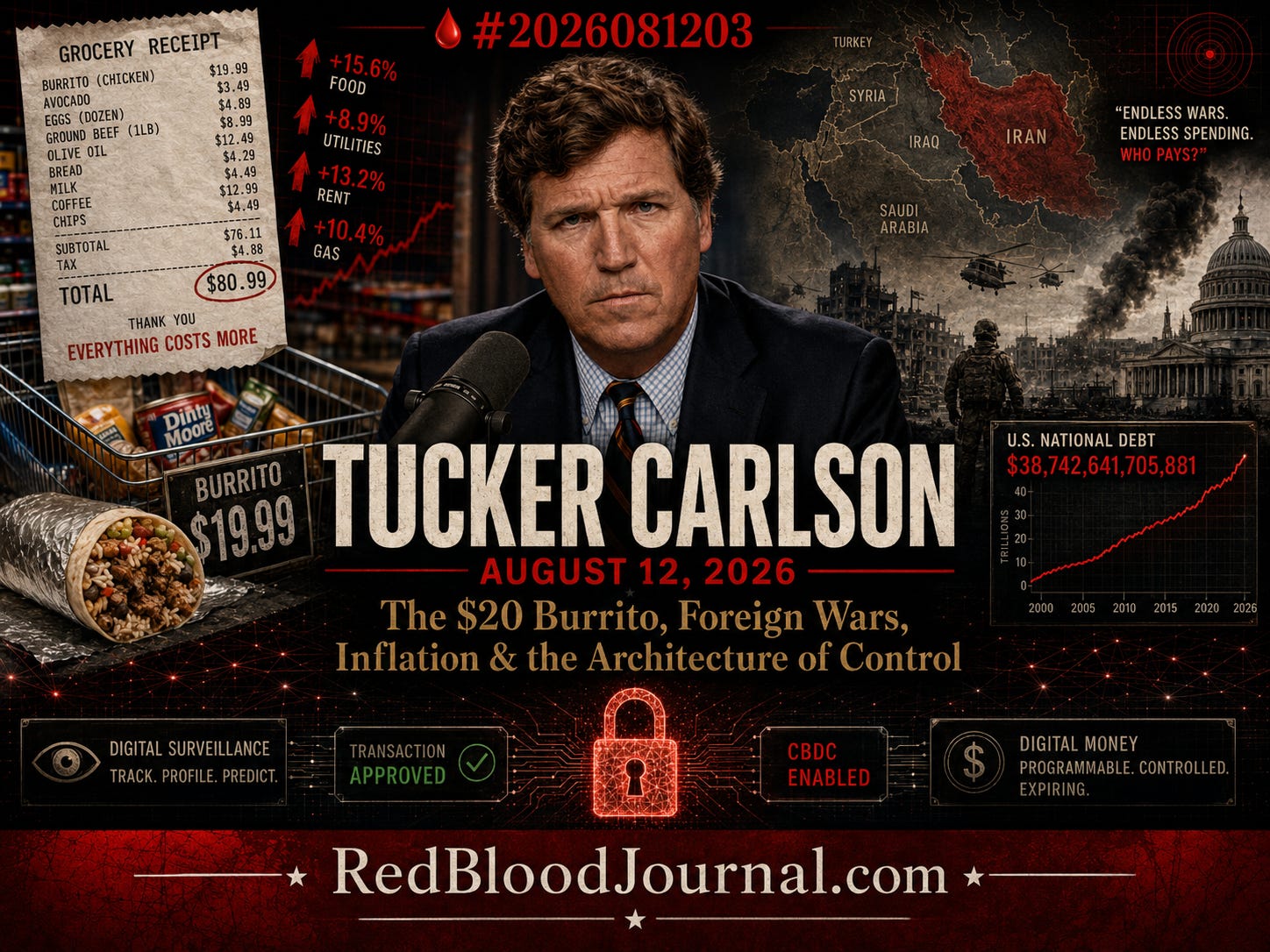
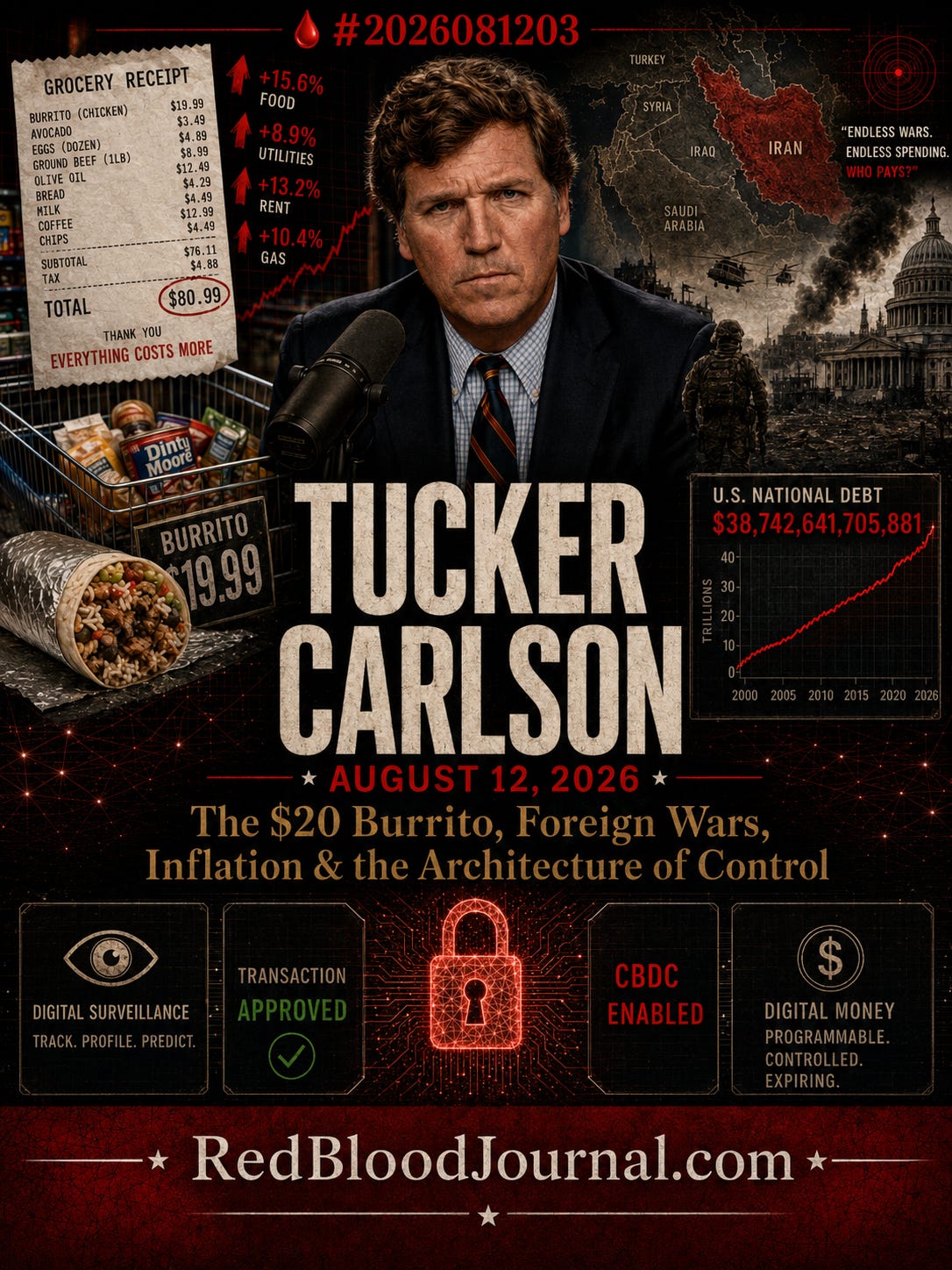
Tucker Carlson, August 12, 2026
The $20 Burrito, Foreign Wars, Inflation and the Architecture of Control
RedBloodJournal.com
Overview and Analysis
Tucker Carlson’s August 12, 2026 program begins with something almost deliberately ordinary: the price of groceries.
From there, however, the discussion expands into something much larger.
The episode asks whether rising food prices are merely an economic problem or whether they are a visible symptom of a political and financial system that increasingly places the priorities of governments, corporations, financial institutions and foreign-policy establishments ahead of the everyday interests of ordinary Americans.
Carlson begins with a Matt Walsh post arguing that grocery prices are “insane,” foreign wars should end, and elected officials should make the domestic cost of living their priority. Carlson’s central political observation is straightforward: whatever economists or government statistics say, people experience inflation personally when they buy food, pay rent, purchase insurance, receive medical bills or maintain a car.
The question running through the program is therefore not simply:
Why is a burrito so expensive?
It becomes:
Who benefits from the economic system that made it expensive, and why are some political voices apparently more interested in defending that system than investigating it?
The $20 Burrito as a Political Symbol
Carlson uses food prices as an unusually effective political measuring device because everyone must eat.
A voter may know very little about monetary policy, Treasury operations, bond markets, government deficits or international energy markets.
But that voter knows what a grocery cart cost five years ago and what it costs today.
Carlson therefore contrasts ordinary economic concerns with Washington’s foreign-policy priorities. His argument is that most Americans are more immediately concerned with housing, food, medical expenses, education and financial security than with the Iranian nuclear program or distant militant organizations.
This becomes one of the strongest political observations in the program.
When established political parties fail to address basic economic insecurity, alternative political movements acquire an opening.
Carlson argues that socialism historically gains political appeal not necessarily because voters suddenly become ideological socialists, but because socialist politicians can present themselves as people who recognize material insecurity. He explicitly distinguishes between agreeing with that diagnosis and endorsing socialist solutions.
The political warning is simple:
If established parties stop talking about the problems people actually experience, somebody else will.
Ben Shapiro and the Generational Argument
Carlson then turns his attention toward Ben Shapiro.
A clip presented during the program has Shapiro arguing that younger Americans can still afford groceries and, in some respects, enjoy a materially richer life than their parents did. He points to greater restaurant choice, better food, larger homes, better automobiles and Americans spending a smaller share of disposable income on food.
Carlson interprets this very differently.
To him, the controversy exposes a division inside the American right.
One side says:
The economic system basically works; younger Americans underestimate how prosperous they are.
The other says:
The system may produce more products and technology while simultaneously making the fundamental milestones of life—housing, children, financial independence and retirement—harder to obtain.
Carlson invokes the traditional American Dream: parents working so their children might enjoy greater opportunity and material security than they had.
His criticism is therefore less about the literal price of one burrito than about whether younger generations can reasonably expect the economic progression that earlier generations considered normal.
The Woodstock Comparison
Carlson makes an unusual cultural comparison using photographs from Woodstock in 1969.
He observes that the young people photographed there generally appear thin, physically fit and optimistic. He contrasts those images with modern America and argues that technological abundance and consumer choice do not necessarily prove that a population is healthier, happier or more confident about its future.
This is an interesting rhetorical device, but it is important to separate observation from proof.
Photographs of Woodstock cannot scientifically establish that Americans in 1969 were happier or economically better off than Americans in 2026. The festival population was not a controlled representative sample, and physical appearance cannot by itself establish psychological well-being.
Carlson is making a cultural argument rather than demonstrating an economic statistic.
The deeper question survives the weakness of the comparison:
What should “better off” actually mean?
More consumer products?
Longer lives?
More disposable income?
Affordable housing?
Earlier family formation?
Less debt?
Better physical health?
Greater optimism?
The answer depends heavily upon which measurements are selected.
Foreign Wars Enter the Economic Equation
The discussion then connects inflation to American foreign policy.
Carlson argues that repeated overseas wars contribute to federal debt and ultimately to declining purchasing power. He specifically connects the argument to the current Iran conflict and questions whether the enormous American military budget has produced the strategic results Americans were promised.
He goes considerably further, asserting that foreign wars are the principal driver of American debt.
That claim deserves separation from the broader argument.
Military spending and wars unquestionably cost enormous amounts of money, but the long-term federal debt also reflects entitlement programs, interest costs, tax policy, recessions, emergency spending and numerous other expenditures.
Therefore the episode’s broader proposition—that wars have economic costs ultimately borne by citizens—is much easier to demonstrate than the narrower proposition that foreign wars alone are the principal cause of American debt.
Iran Becomes the Political Fault Line
Iran is not a side subject in this episode.
Carlson argues that the United States was pushed into the current confrontation with Iran despite limited direct American interest in doing so. He attributes major responsibility to Israeli influence and sharply attacks commentators who advocated military confrontation.
These are Carlson’s claims and interpretations, not facts established merely because they are stated during the program.
He further argues that Americans are being encouraged to view Iran as an overriding personal threat while ordinary domestic economic problems receive less attention.
This produces one of the episode’s fundamental comparisons:
What should government protect first?
The citizen’s ability to afford food, housing and healthcare?
Or America’s strategic objectives overseas?
Carlson clearly favors the first answer.
Red Blood does not need to choose the answer for the reader.
Catherine Austin Fitts Enters the Discussion
The second major portion of the program moves from Carlson’s political commentary into a discussion with Catherine Austin Fitts.
The conversation dramatically widens the scope.
Inflation is no longer presented merely as excessive government spending.
Fitts describes a system involving government contracting, privatization, monopoly consolidation, financial control and the transfer of public wealth into private hands.
She introduces an important distinction:
Privatization versus “Piratization”
Ordinary privatization means transferring a government activity or asset to private ownership under market conditions.
Fitts uses the term “piratization” for situations in which public assets are effectively transferred to private interests at drastically below-market prices.
She describes arrangements in which private interests use government power to generate extraordinary profits while the public absorbs the losses.
Whether every example fits that description requires individual investigation.
But the distinction itself raises an important question:
When government and corporations work together, are markets actually becoming more competitive—or are public resources merely being transferred into increasingly concentrated private hands?
Consolidation and Inflation
Fitts connects this process to inflation.
When industries consolidate into monopolies or duopolies, competitive pressure can decline.
This provides another possible explanation for rising consumer prices.
Instead of asking only how much money the Federal Reserve created, the investigation must also ask:
Who controls food production?
Who controls distribution?
Who controls energy?
Who controls housing finance?
Who controls healthcare?
And how many genuine competitors remain?
Inflation may therefore have several overlapping sources rather than one master explanation.
Fitts’ Personal Government Experience
Fitts also describes her experience working around the Department of Housing and Urban Development.
She alleges that after her organization helped prevent money from disappearing through HUD financial operations, she and colleagues became targets of investigations and litigation. She says that after they were removed, large amounts of money began disappearing from HUD systems. She describes years of audits, litigation and harassment and says the principal litigation ultimately ended in her favor.
These are significant allegations.
They should not automatically be accepted simply because Fitts tells the story, nor dismissed merely because government institutions may dispute portions of it.
They are precisely the kind of claims that deserve examination against court records, government audits, contracts, accounting records and contemporaneous documentation.
The Most Important Concept in the Interview: The “Third Lock”
Perhaps the most consequential part of Fitts’ argument concerns money itself.
She describes cash as essentially a two-lock system.
A buyer wants to purchase something.
A seller wants to sell it.
If both agree, the transaction occurs.
Modern electronic banking introduces another participant.
The bank—and indirectly the government—can stop the transaction because of sanctions, regulations, anti-money-laundering requirements or other legal restrictions. Fitts calls this the manual third lock.
She then imagines something much more powerful:
The Automatic Third Lock
In a completely digital monetary system, Fitts argues, restrictions could theoretically be built directly into money.
Money could potentially be programmed according to:
Location.
Identity.
Government rules.
Tax status.
Purchasing categories.
Political sanctions.
Behavioral conditions.
Even individualized permissions.
She argues that such a system could potentially disable a person’s ability to transact without requiring an individual bank employee to intervene.
This is where the discussion moves from economics into the architecture of control.
AI + Digital Money + Surveillance
Fitts then connects artificial intelligence with financial surveillance.
Her argument is that modern data centers and AI provide the computational capacity necessary to analyze enormous volumes of financial and behavioral information.
In her hypothetical model, AI could make individualized financial restrictions possible at unprecedented scale.
Again, several different questions must be separated.
Can such technology be built?
Increasingly, yes.
Are governments exploring digital currencies and increasingly automated financial compliance?
Yes.
Does that prove a unified plan exists to create the specific social-credit architecture Fitts describes?
No.
That requires additional evidence.
But technological capability itself changes the political question.
A freedom that depends entirely upon authorities voluntarily deciding never to use an available control mechanism is different from a freedom protected because the mechanism does not exist.
Energy, China and the Dollar
The conversation then moves into energy markets.
Fitts discusses strategic petroleum reserves, Chinese energy policy, LNG exports and what she describes as an attempt to transition from the historical petrodollar toward something resembling a “petrogas dollar.”
She argues that disruption of global trade routes and energy infrastructure can simultaneously damage the broader economy while expanding markets for American LNG exports.
She also observes that China’s behavior may have helped prevent energy prices from climbing much higher, while American LNG producers have benefited substantially from Asian demand.
The implication is worth investigating separately:
War creates losers—but war can also create very specific winners.
The proper investigative question therefore becomes not merely:
Who started the war?
But also:
Who financially benefits from its continuation?
Where the Episode Is Strongest
The strongest portion of the program is its simplest observation.
Economic statistics can become extraordinarily complicated, but citizens ultimately experience an economy through everyday life.
Can they afford a home?
Can they raise children?
Can they buy food?
Can they survive an illness without financial ruin?
Can they retire?
Can their children reasonably expect greater opportunity?
Those questions cannot be answered simply by pointing to GDP, stock-market indexes or the number of restaurant choices available.
Carlson’s opening argument therefore deserves attention regardless of one’s opinion of Carlson himself.
Where the Episode Requires More Evidence
The program also repeatedly moves from legitimate questions into much larger conclusions.
Claims that Israel pushed Trump into war with Iran, that particular commentators operate on behalf of larger interests, that government financial systems are intentionally being designed for social control, that specific policies are intended to reduce population, and that certain economic disruptions are deliberately engineered require considerably more evidence than the program itself provides.
Near the conclusion, Fitts goes so far as to describe policies coming through Washington as intentionally directed toward depopulation.
That is an extraordinary claim.
It should therefore carry an extraordinary evidentiary burden.
The transcript establishes that Fitts made the allegation.
It does not, by itself, establish that the allegation is true.
That distinction matters.
The Red Blood Perspective
Perhaps the most useful way to examine this episode is not to accept Carlson’s entire worldview or reject it.
Instead, separate the layers.
The grocery receipt is observable.
Housing affordability can be measured.
Government debt can be measured.
Military expenditures can be measured.
Industry consolidation can be measured.
LNG exports can be measured.
Changes in strategic petroleum reserves can be measured.
Digital-currency capabilities can be examined technically.
Government contracts and asset transfers can be traced.
Political influence can sometimes be documented.
Intent is considerably harder.
That is where investigation must replace assumption.
Carlson and Fitts present a common hypothesis:
America’s domestic economic deterioration, foreign wars, corporate consolidation, government debt, digital financial systems and expanding surveillance capabilities may not be unrelated phenomena.
Perhaps they are components of one developing system.
Perhaps some are connected while others are not.
Perhaps ordinary institutional incentives, incompetence, lobbying, debt, technological change and geopolitical competition can explain much of what Carlson and Fitts interpret as deliberate coordination.
Those possibilities should compete against each other rather than being eliminated before the investigation begins.
The receipt from the grocery store is evidence that something changed.
It does not tell us by itself who changed it, why it changed, or who ultimately benefits.
That is where the investigation starts.
Ocean of Love and Positivity
There is another way to look at the same problem.
A society does not have to measure success exclusively through GDP, military reach, financial markets or technological power.
A society can ask whether families feel secure.
Whether young people see a future.
Whether neighbors trust one another.
Whether technology serves human beings rather than controlling them.
Whether money remains a tool rather than becoming a permission system.
And whether government remembers that the people are not resources belonging to the system.
Perhaps the most constructive message buried beneath the anger of this episode appears near its conclusion.
Fitts argues that people should stop assuming that every solution must come from the same centralized machinery they distrust. She suggests that even relatively small improvements at state, local and community levels could produce enormous results, particularly when combined with new technology.
Centralized systems can become enormously powerful.
But millions of human beings cooperating voluntarily can be powerful too.
The reader can decide which direction appears to be developing—and which direction deserves support.
In an Ocean of Love and Positivity.
🩸🌊✨ Fantastic!
RedBloodJournal.com
💸
The $20 Burrito and the Architecture of Financial Control
Aug 12, 2026
In this analysis of a Tucker Carlson program, the text explores the rising cost of living as a signal of a failing political and financial infrastructure. The discussion uses the high price of groceries to symbolize a disconnect between Washington’s foreign policy and the domestic economic struggles of ordinary Americans. Guest Catherine Austin Fitts expands the scope by detailing how corporate consolidation and government privatization may be transferring public wealth into private hands. A significant portion of the text warns of a transition toward a digital monetary system, which could allow for unprecedented social and behavioral control through programmable money. Ultimately, the source argues that inflation, overseas conflicts, and technological surveillance are potentially linked components of a new architecture of control. The overview concludes by suggesting that citizens should prioritize local community resilience and human-centric values over centralized systems.


