


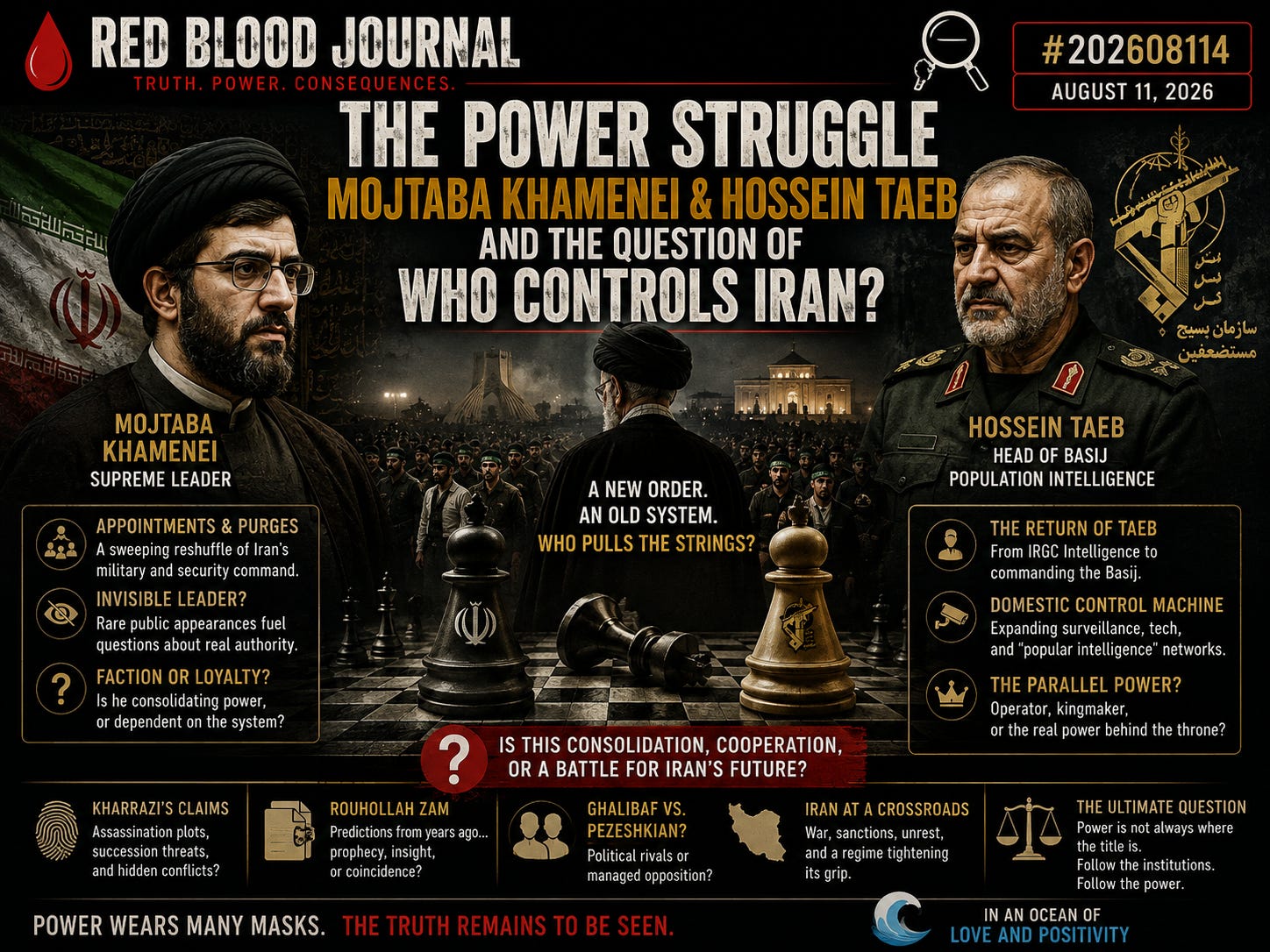
🩸 #202608114 — The Mojtaba Khamenei–Hossein Taeb Power Struggle and the Question of Who Controls Iran
Red Blood Journal Transmission Report
RedBloodJournal.com
There is a difference between holding the highest office in a political system and actually controlling the machinery underneath it.
That distinction may now be one of the most important questions surrounding the Islamic Republic of Iran.
Mojtaba Khamenei officially occupies the position once held by his father. But the events surrounding his rise, his continued absence from normal public view, the reappearance of veteran security operator Hossein Taeb, and a sweeping restructuring of Iran’s military command raise a larger question:
Who actually controls Iran?
Is Mojtaba Khamenei consolidating power?
Is Hossein Taeb helping him build a new security state?
Does the Islamic Revolutionary Guard Corps stand behind Mojtaba—or does Mojtaba stand behind the Revolutionary Guard?
Or are outsiders trying to identify a single ruler inside a system increasingly governed by competing networks of military, intelligence, clerical and political power?
The available evidence does not settle those questions.
But it makes them worth asking.
The Event That Changed the Picture
In August 2026, Mojtaba Khamenei issued a series of appointments across the highest levels of Iran’s military and security establishment.
Among the most consequential was the return of Hossein Taeb to a major operational position.
Taeb, the former head of the IRGC Intelligence Organization, was appointed to lead the Basij.
That is not an insignificant position.
The Basij is not simply another branch of Iran’s military establishment. Its enormous domestic network gives it a role in ideological mobilization, internal security, intelligence gathering and suppression of unrest.
The instructions accompanying Taeb’s appointment reportedly included strengthening what was described as the “popular intelligence network” and increasing the use of technology.
This makes Taeb’s return especially important.
A man associated for years with Iran’s internal security machinery has not merely returned to government.
He has returned to an organization capable of reaching deeply into Iranian society.
The Six Appointments
The broader reshuffling included senior positions across Iran’s armed forces and security establishment.
The names included figures such as:
Ahmad Vahidi
Ali Abdollahi
Kioumars Heydari
Mohsen Rezaei
Mostafa Izadi
and Hossein Taeb.
Taken individually, each appointment can be explained as filling command vacancies and rebuilding a wartime command structure.
Taken together, however, they also reveal something more fundamental:
Mojtaba Khamenei is putting names on the institutions that possess guns, intelligence networks and coercive power.
Whether those people are his men—or whether he depends upon them—is another question entirely.
The Return of Hossein Taeb
Taeb is particularly interesting because his relationship with the Khamenei power structure predates Mojtaba’s leadership.
He headed IRGC intelligence from 2009 until his removal in 2022.
His departure produced considerable speculation at the time. Analysts connected it to intelligence failures involving Israel, while other accounts described internal political struggles surrounding his removal.
Now he is back.
That creates two very different interpretations.
Interpretation One: Mojtaba Is Taking Control
Under this explanation, Mojtaba is rebuilding the leadership around people he trusts.
Taeb is useful precisely because of his experience in intelligence, internal security and the networks surrounding the Khamenei establishment.
His return therefore represents Mojtaba moving from ceremonial leadership toward operational control.
Interpretation Two: The Security Network Is Taking Control
Reverse the picture.
Perhaps Mojtaba’s power depends on precisely the people supposedly serving him.
A leader who remains physically hidden, relies heavily on the Revolutionary Guard and surrounds himself with veteran security officials could theoretically become the political face of a security establishment whose institutional power exceeds his own.
Under that interpretation, asking whether Taeb works for Mojtaba may be asking the question backward.
Perhaps the more interesting question is:
How dependent is Mojtaba on Taeb and the security network around him?
The Invisible Leader
Another extraordinary feature of Mojtaba Khamenei’s leadership has been his lack of conventional public visibility.
That has generated rumors concerning his health, physical condition and even whether some decisions attributed to him were actually being made by others.
Then President Masoud Pezeshkian supplied an important piece of information.
Pezeshkian said he recently spent approximately seven hours meeting with Mojtaba Khamenei and described him as being in completely good health.
According to Pezeshkian, they discussed economic problems, livelihoods, employment, housing and other national issues.
That testimony weighs against claims that Mojtaba is incapacitated or completely absent from decision-making.
But it does not answer every question.
A functioning leader can still depend heavily on the people controlling intelligence, military communications, access, information and security.
The question is therefore larger than:
Is Mojtaba alive and functioning?
It is:
How much independent power does he exercise?
The Kharrazi Claims
The transcript examined for this report introduces another layer through controversial statements attributed to cleric Mohammad Bagher Kharrazi.
Kharrazi reportedly made extraordinary claims about tensions surrounding Mojtaba during Ali Khamenei’s lifetime.
Among the allegations presented in the transcript are claims that Mojtaba had been pushed away from his father’s inner circle and that remaining too close to the center of power could have placed him in physical danger.
The transcript goes considerably further, connecting these alleged struggles with succession politics and even raising allegations concerning the death of Ebrahim Raisi.
These claims should not be treated as established facts.
They are extremely serious allegations.
The office of the Supreme Leader has disputed statements attributed to Kharrazi, and reports surrounding his comments have themselves become part of the information battle.
That dispute is important.
It means Kharrazi’s statements cannot simply be used as proof that an internal assassination struggle existed.
But neither should controversial testimony automatically disappear from an investigation merely because the institution accused by it denies it.
The appropriate question is:
What independent evidence supports or contradicts each claim?
Until that evidence appears, the claims remain claims.
Was Ali Khamenei Against Mojtaba?
This is one of the most intriguing questions raised by the source material.
Ali Khamenei publicly criticized the concept of hereditary Islamic government.
In other words, an Islamic Republic was not supposed to operate like a monarchy in which the ruler dies and his son inherits the throne.
Yet his own son eventually succeeded him.
That does not by itself prove that Ali Khamenei opposed Mojtaba’s succession.
But it creates a historical contradiction worth examining.
If Ali Khamenei genuinely wanted his son to succeed him, where is the evidence?
If he genuinely opposed it, where is that evidence?
And if different factions around the aging leader wanted different successors, then the eventual selection of Mojtaba may reveal more about the balance of power after Ali Khamenei’s death than about Ali Khamenei’s wishes before it.
The Missing Piece: Ali Khamenei’s Final Instructions
The transcript raises another interesting question:
Where are Ali Khamenei’s final political instructions?
A man who dominated the Islamic Republic for decades would reasonably be expected to have thought extensively about succession and the future of the system.
Yet the absence—or at least public absence—of a definitive document settling those questions creates fertile ground for competing theories.
Perhaps such instructions exist but remain private.
Perhaps they contain nothing politically important.
Perhaps they support Mojtaba.
Perhaps they oppose him.
Perhaps there is no meaningful document at all.
The absence of publicly available evidence cannot prove any of those possibilities.
But it leaves a vacuum.
And political vacuums are quickly filled with narratives.
The Rouhollah Zam Question
The transcript also reaches backward to statements attributed to the late dissident journalist Rouhollah Zam.
Zam had claimed years earlier that elements inside the Revolutionary Guard were working toward installing Mojtaba Khamenei as his father’s eventual successor.
At the time, such predictions could easily be dismissed as opposition speculation.
After Mojtaba actually became Supreme Leader, they inevitably appear more interesting.
But hindsight creates its own trap.
A prediction becoming true does not automatically prove every detail of the theory that produced the prediction.
The useful investigative question is narrower:
Which specific claims made years earlier can now be matched against documented events?
That is where prediction becomes potentially valuable evidence rather than retrospective mythology.
What About Ghalibaf and Pezeshkian?
The transcript presents another possible fault line involving Parliament Speaker Mohammad Bagher Ghalibaf and President Masoud Pezeshkian.
One interpretation sees political and military factions struggling against the emerging Mojtaba-Taeb structure.
Another possibility is less dramatic.
What appears externally as factional conflict may simply represent ordinary competition inside an authoritarian system where different institutions fight over influence while ultimately remaining committed to preserving the same state.
And there is a third possibility raised in the transcript:
Some of the apparent conflict could itself be political theater.
If foreign governments believe Tehran is divided between moderates and hardliners, negotiations can be structured around strengthening one faction against another.
If the supposed factions ultimately coordinate behind closed doors, the appearance of division becomes strategically useful.
There is presently insufficient evidence to establish that explanation.
But it belongs among the competing hypotheses.
Mohsen Rezaei and the Direction of the New Government
The appointment of Mohsen Rezaei is another piece of the puzzle.
Some observers can interpret his elevation as a signal of institutional experience and continuity.
Others see the reshuffle as evidence of a harder security posture.
Those interpretations are not necessarily mutually exclusive.
An establishment expecting prolonged confrontation might deliberately choose experienced figures precisely because it wants stability inside while maintaining pressure outside.
That produces an important distinction:
Personnel continuity does not necessarily mean policy moderation.
A regime preparing for a difficult period may prefer familiar operators rather than revolutionary newcomers.
A Coup Without Tanks?
The word coup appears repeatedly in the source material.
But it requires care.
A traditional coup is visible.
Soldiers occupy government buildings.
Political leaders are arrested.
Broadcasting stations are seized.
A new government announces itself.
Iran’s internal politics may operate differently.
If a security network gradually determines:
who reaches the leader,
what intelligence reaches the leader,
who commands military organizations,
who controls domestic intelligence,
who controls the Basij,
and which political figures remain influential,
then enormous transfers of power could occur without tanks surrounding a presidential palace.
That would not automatically constitute a coup in the conventional sense.
It might instead be called institutional capture, security consolidation, or elite restructuring.
The terminology matters less than the underlying question:
Where has effective decision-making power moved?
Follow the Institutions, Not Just the Titles
The easiest mistake would be to assume that the person with the largest title possesses the greatest power.
Instead, follow the institutions.
Who controls intelligence?
Who controls the Revolutionary Guard?
Who controls the Basij?
Who controls military appointments?
Who controls access to Mojtaba?
Who controls communications when he remains out of public view?
Who can suppress demonstrations?
Who can remove rivals?
Who communicates with foreign governments?
And who can say no to the Supreme Leader and survive?
Those answers would tell considerably more about who controls Iran than any official organizational chart.
Four Competing Explanations
At this stage, at least four explanations deserve to remain on the table.
Scenario One — Mojtaba Has Consolidated Power
The appointments are exactly what they appear to be.
Mojtaba survived the chaotic succession period and is now selecting trusted military and security officials to construct his own government.
Under this scenario, Taeb is powerful because Mojtaba has empowered him.
Scenario Two — Mojtaba and Taeb Are Partners
Neither man completely dominates the other.
Mojtaba provides religious and constitutional authority.
Taeb and allied security figures provide intelligence networks, institutional experience and coercive power.
Their interests currently overlap.
This could be a partnership rather than a hierarchy.
Scenario Three — The IRGC/Security Establishment Is the Real Power
Mojtaba possesses the title while the military-security establishment possesses the machinery.
The Supreme Leader provides legitimacy to decisions generated collectively—or selectively—inside the security apparatus.
Under this interpretation, Mojtaba may rule, but only within boundaries established by the institutions that secured the system.
Scenario Four — Iran Remains a Competitive Power Network
There may be no single hidden controller.
Mojtaba, Taeb, the IRGC command, Pezeshkian, Ghalibaf, clerical institutions and other security figures may continuously negotiate, compete and cooperate.
Power shifts according to the issue.
In that case, the search for one secret ruler would itself produce the wrong answer.
What We Know
Some things are considerably firmer than others.
Mojtaba Khamenei is exercising the formal authority of Supreme Leader.
Major military appointments have been issued under his authority.
Hossein Taeb has returned to a significant position commanding the Basij.
Pezeshkian says he held an approximately seven-hour meeting with Mojtaba and described him as healthy.
Iran’s military-security structure is being rebuilt and consolidated following extraordinary wartime disruption.
Those are observable pieces of the puzzle.
What We Do Not Know
We do not independently know the private relationship between Mojtaba and Taeb.
We do not know whether Taeb’s return represents personal loyalty, institutional necessity, factional victory or some combination.
We do not have sufficient evidence to establish the transcript’s allegations concerning assassination plots and internal killings.
We do not know exactly what Ali Khamenei privately intended for succession.
And we cannot presently demonstrate that apparent disagreements among Iranian factions are genuine conflicts, coordinated theater, or something between the two.
Those distinctions matter.
Otherwise investigation becomes storytelling.
🩸 The Red Blood Perspective
The most important question may not be whether Mojtaba Khamenei is Iran’s Supreme Leader.
Formally, that question has already been answered.
The deeper question is what the title Supreme Leader means inside the Iran that emerged from war, succession and the reconstruction of its military-security hierarchy.
Hossein Taeb’s return deserves particular attention because intelligence networks possess a form of power different from constitutional office.
They know.
They watch.
They control access.
They identify threats.
They decide which information travels upward and which information never arrives.
That can make the person standing beside the throne nearly as important as the person sitting on it.
But that still does not prove Taeb controls Mojtaba.
Nor does Mojtaba signing appointments prove that Mojtaba independently controls Taeb.
The evidence presently permits several explanations.
The coming months may reveal which one survives contact with observable events.
Watch who gets promoted.
Watch who disappears.
Watch whose policies prevail after disagreements.
Watch which institutions receive expanded authority.
And above all, watch who is permitted to fail without being removed.
Power often reveals itself most clearly not through speeches—but through consequences.
The reader should decide.
🌊 Ocean of Love and Positivity Perspective
Behind every struggle for political power are millions of people who never asked to participate in it.
Governments fight over succession.
Security organizations fight over authority.
Politicians fight over offices.
Military commanders fight over strategy.
But ordinary people still wake in the morning wanting remarkably simple things:
food,
safety,
family,
work,
dignity,
and a future for their children.
No political faction owns Iran.
Iran existed before today’s leaders and will exist after them.
The same is true of every nation.
Perhaps the greatest form of leadership is therefore not successfully defeating every rival.
Perhaps it is reaching the point where power no longer requires fear to survive.
When that happens, the question “Who controls Iran?” becomes less important than another:
“Do the people of Iran control their own lives?”
That may ultimately be the question that matters most.
In an Ocean of Love and Positivity.
🩸🌊✨ Fantastic!
RedBloodJournal.com
Find the report
you came for.
(under construction)
RedBloodJournal.com
🕵️
The Architecture of Power in Mojtaba Khamenei’s Iran
Aug 11, 2026
This report examines the opaque power dynamics within Iran’s political and military leadership following the succession of Mojtaba Khamenei. It highlights a major restructuring of the nation’s security apparatus, specifically focusing on the influential return of intelligence veteran Hossein Taeb to lead the Basij. The text weighs whether these appointments signify the new leader’s consolidation of authority or his growing dependence on an entrenched security establishment. Furthermore, the source addresses the mystery surrounding the leader’s public absence and investigates allegations of internal friction among the ruling elite. Ultimately, it questions whether true governance resides with the official head of state or within a complex network of military and intelligence operators.


