


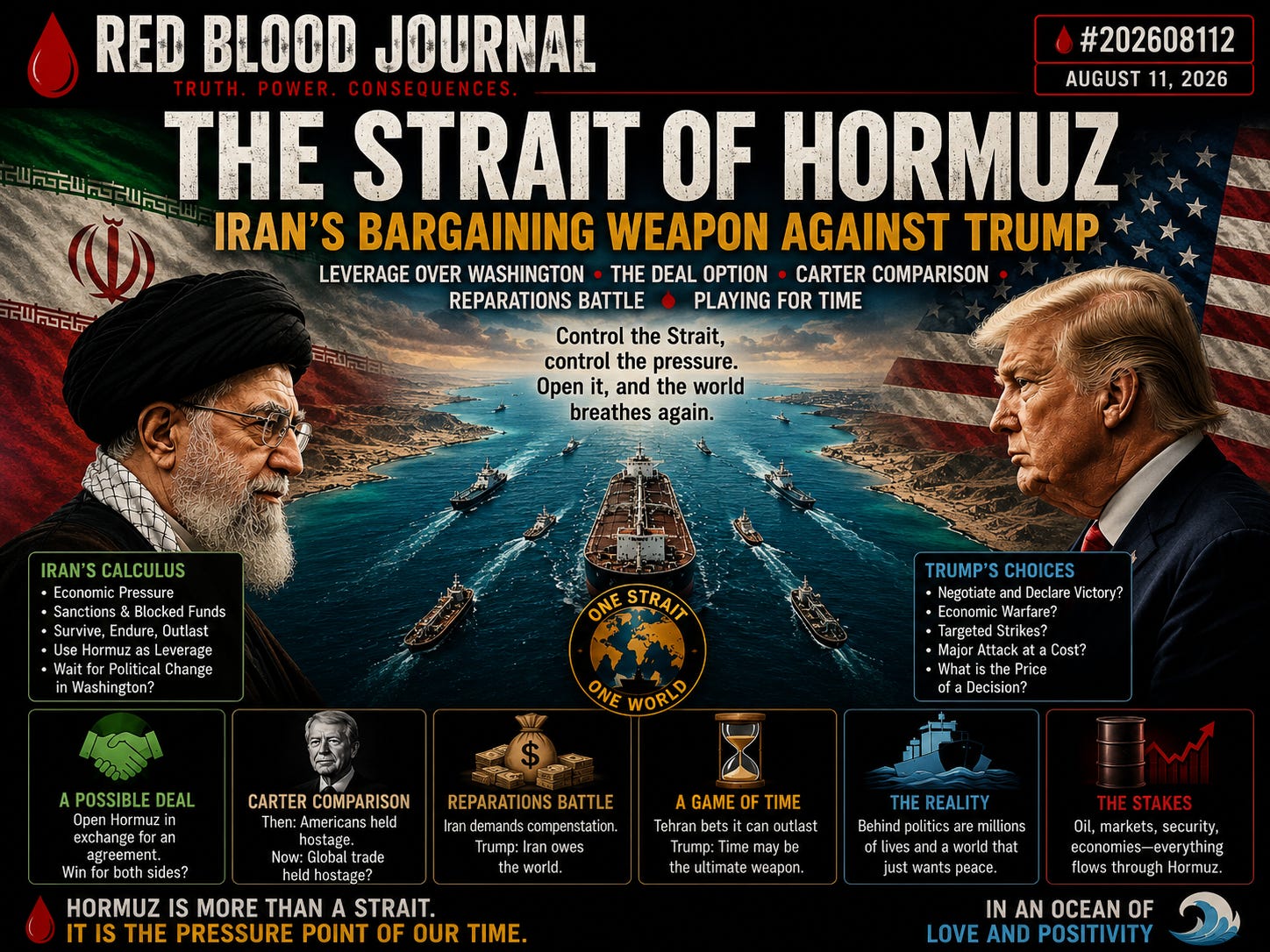
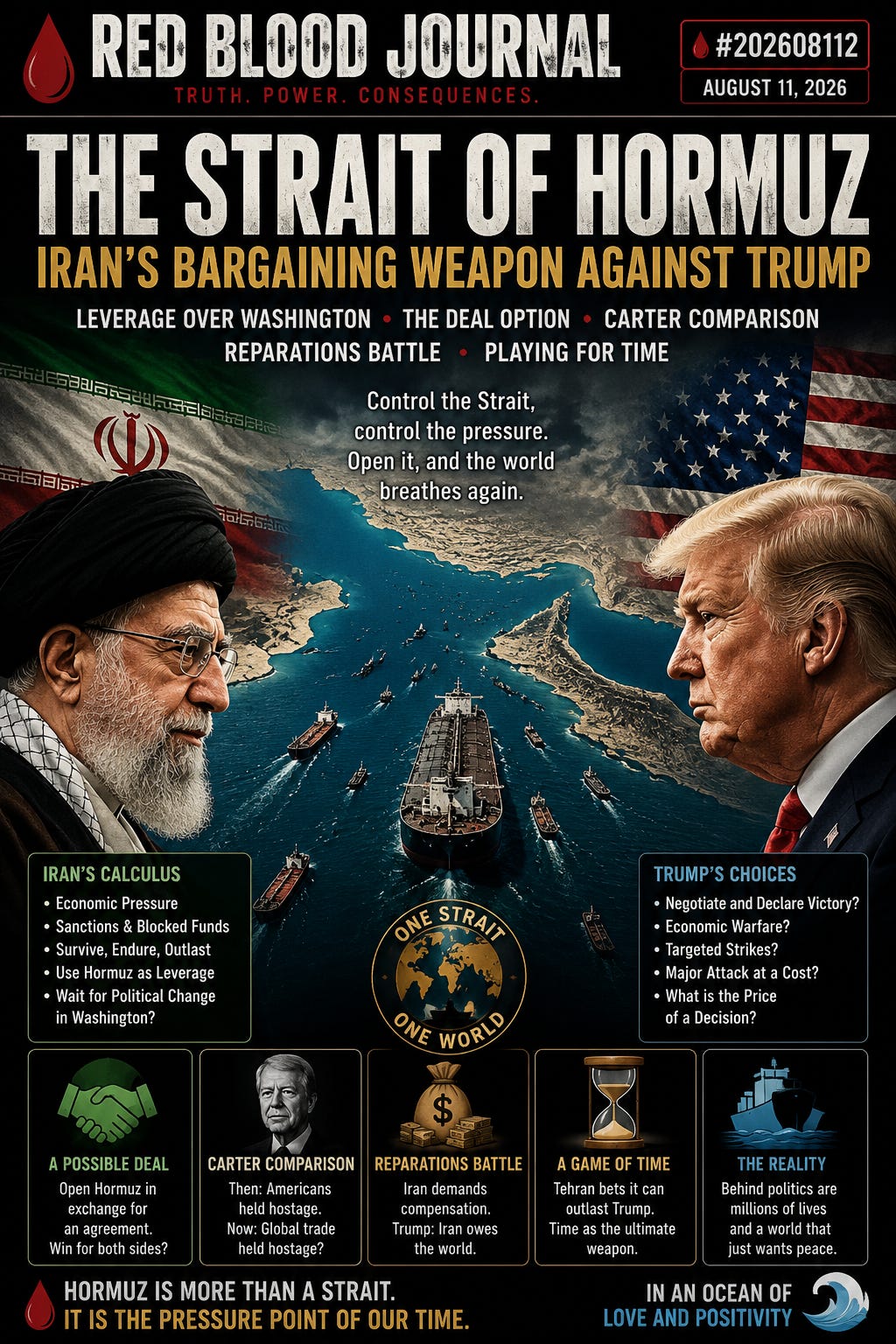
🩸 #202608112 — The Strait of Hormuz: Iran’s Bargaining Weapon Against Trump
RedBloodJournal.com
When a Waterway Becomes a Political Hostage
The Strait of Hormuz is more than a narrow passage between Iran and the Arabian Peninsula. It is one of the world’s strategic pressure points—a place where military power, energy markets, international trade, diplomacy, and domestic politics can collide.
The material examined for this report presents a provocative possibility:
What if Tehran does not need to defeat the United States militarily? What if it only needs to keep the Hormuz problem alive long enough to change the political calculation in Washington?
That possibility deserves examination without assuming it is either true or false.
The Hormuz Strategy
The central argument presented in the source material is that pressure surrounding the Strait of Hormuz may function as a bargaining instrument.
According to this interpretation, Tehran understands that Washington wants predictable shipping, stable energy markets, and an end to a crisis capable of spreading throughout the Persian Gulf.
The Islamic Republic therefore possesses something potentially valuable at the negotiating table:
the ability to create instability—and the ability to stop creating it.
The transcript suggests that the regime may be attempting to use disruption around Hormuz to force Washington toward an agreement, sanctions relief, access to blocked funds, or some other concession.
The question is whether this is desperation or leverage.
Perhaps it is both.
A Possible Deal: Open Hormuz and Declare Victory
One of the more interesting claims discussed in the source material is that Trump might ultimately be willing to accept the reopening or normalization of the Strait of Hormuz and present that outcome as an American victory.
Under such a scenario, Washington would not necessarily need to destroy the Islamic Republic.
Tehran would not necessarily need to defeat the United States.
Both governments could potentially step backward while telling their respective audiences that the other side had yielded.
For Trump, restored maritime traffic could be presented as proof that American pressure worked.
For Tehran, survival itself could be presented as victory.
That raises an important distinction:
Is the objective regime change—or changed behavior?
The answer determines almost everything that follows.
The Carter Comparison
The transcript introduces another provocative comparison: the Iran hostage crisis that damaged President Jimmy Carter politically.
After Iranian revolutionaries seized the U.S. Embassy in Tehran in 1979, American diplomats and citizens were held for 444 days. The crisis became inseparable from Carter’s presidency and his unsuccessful reelection campaign.
The comparison being made today is not that the events are identical.
They clearly are not.
The argument is instead about the political mechanism.
During the Carter crisis, people were the hostages.
In the present theory, international maritime passage becomes the hostage.
A prolonged Hormuz crisis could produce rising shipping costs, uncertainty in oil markets, pressure on American allies, economic anxiety and continuing questions about why Washington has not resolved the confrontation.
The transcript cites a social-media argument that Tehran could attempt to maintain this pressure long enough to damage Trump and the Republican Party politically.
That is an allegation and strategic interpretation—not demonstrated evidence of Tehran’s actual plan.
But it raises a legitimate investigative question:
Would the Islamic Republic benefit more from resolving the Hormuz crisis today, or from keeping it unresolved?
Tehran May Be Playing Against the American Calendar
The larger argument presented in the transcript goes beyond Hormuz.
It suggests that Iran’s leadership may believe it can simply survive Trump.
Under this theory, Tehran does not need economic prosperity.
It does not need normal international relations.
It does not even necessarily need popular approval.
It needs endurance.
The leadership absorbs sanctions.
The population absorbs economic hardship.
Domestic opposition is suppressed.
Regional pressure continues.
Hormuz remains available as leverage.
And the clock continues running.
The transcript explicitly presents the possibility that whoever is directing the current Iranian power structure intends to maintain the situation until Trump’s presidency ends.
That would turn time itself into a strategic weapon.
The Reparations Battle
Another unusual component of the confrontation is the question of compensation.
The Iranian side, according to material quoted in the transcript, argues that compensation should be paid for damage inflicted upon Iran.
The argument presented is that compensation is connected to responsibility for aggression rather than simply to which country wins or loses a conflict.
But Trump responded by reversing the argument.
If Iran wants compensation, he suggested, then the United States can also demand compensation for damage attributed to the Islamic Republic over decades.
The transcript references American military casualties, Iranian victims and damage associated with Iranian regional activities.
The result is a remarkable negotiating situation:
Both sides can claim to be the injured party.
Both can produce lists of deaths.
Both can produce destroyed property.
Both can construct historical timelines.
Both can demand payment.
And both can insist the other side started it.
This transforms reparations from a financial question into a battle over historical responsibility.
The Real Question Behind Reparations
The money may not even be the most important part.
A government paying reparations can implicitly acknowledge responsibility.
That makes the issue politically explosive.
Iran could describe American compensation as recognition that Washington committed aggression.
Washington could describe Iranian compensation as recognition of decades of responsibility for attacks, proxy warfare, terrorism, or American casualties.
Consequently, what appears to be an argument about money may actually be an argument about who gets to write the official history of the confrontation.
Why Doesn’t Trump Simply Attack?
The transcript presents another side of the calculation.
A large military operation designed to permanently secure the Hormuz region could produce serious consequences.
American military personnel could die.
Iranian civilians could die.
Bandar Abbas and surrounding infrastructure could suffer enormous destruction.
American forces could become responsible for territory rather than simply targets.
And a supposedly short operation could become something much larger.
The source therefore proposes that Trump’s hesitation may not necessarily indicate weakness or indecision.
It could reflect an unwillingness to accept the casualties associated with the military solution.
If so, Washington has alternatives:
economic pressure,
sanctions,
targeted operations,
pressure against regime leadership,
and continued negotiations.
The battlefield would then become financial and political as much as military.
Economic Warfare as the Alternative
The transcript repeatedly returns to Iran’s deteriorating economic circumstances.
Its argument is that sustained economic pressure could ultimately accomplish something that bombing might not:
weaken the political structure without destroying the country underneath it.
That theory has obvious uncertainties.
Economic pressure does not fall exclusively on governments.
Ordinary people often absorb enormous portions of the damage.
The transcript itself includes descriptions of Iranians working extraordinarily long hours while struggling simply to maintain ordinary lives.
Therefore another question emerges:
If economic warfare weakens the government by exhausting the population, who actually pays for the strategy while everyone waits for the government to break?
Two Clocks Are Running
The confrontation can therefore be viewed as a race between two clocks.
Tehran’s clock
Can the Islamic Republic survive sanctions, economic deterioration, internal opposition and external pressure until American politics changes?
Washington’s clock
Can American pressure force a major Iranian concession—or destabilize the regime—before political circumstances in the United States change?
Hormuz sits between those two clocks.
That may explain its extraordinary strategic value.
Iran does not have to match the United States aircraft for aircraft or dollar for dollar.
Geography provides leverage that conventional military and economic comparisons cannot fully measure.
Three Possible Explanations
The evidence presented in the source allows at least three competing interpretations.
Scenario One — Hormuz Is Negotiating Leverage
Tehran is deliberately applying controlled pressure to obtain concessions and intends eventually to trade normalization of the Strait for an acceptable agreement.
Scenario Two — Hormuz Is a Delay Strategy
The objective is not primarily obtaining a good agreement.
The objective is surviving.
Keeping the crisis alive imposes political and economic costs on Washington while Tehran waits for American political circumstances to change.
Scenario Three — The Crisis Is Moving Beyond Anyone’s Control
There may be no sophisticated master strategy.
Different Iranian factions, military commanders, American officials, Israeli leaders and regional governments may be pursuing separate objectives.
In that scenario, actions interpreted as carefully calculated bargaining could instead be the product of competing institutions improvising under pressure.
This may be the most dangerous possibility because neither side would completely control escalation.
Questions That Remain
Several questions therefore deserve continued investigation.
Is Tehran genuinely prepared to normalize passage through Hormuz in exchange for an agreement?
What exactly would Washington have to provide in return?
Would Trump accept a limited agreement and declare victory?
Are reparations genuine negotiating demands or opening positions designed to be traded away?
Is the Iranian leadership intentionally attempting to extend the confrontation into another American election cycle?
Would prolonged economic pressure weaken the regime faster than it weakens the Iranian population?
And perhaps most importantly:
Who benefits from time?
Because if Tehran believes time favors Tehran while Washington believes time favors Washington, neither side has a strong incentive to compromise today.
That is how temporary confrontations become prolonged ones.
🩸 The Red Blood Perspective
The Strait of Hormuz should not be viewed only as a shipping lane.
It can simultaneously be a military chokepoint, economic pressure valve, negotiating chip and political clock.
The most interesting possibility raised by the source is therefore not whether Iran can militarily defeat the United States.
That comparison may miss the strategy entirely.
The question is whether Tehran can make the cost of not reaching an agreement progressively uncomfortable enough that Washington eventually accepts a settlement.
But the opposite strategy may also be operating.
Washington may believe that economic pressure can make the cost of not reaching an agreement unbearable for Tehran first.
If so, both sides are attempting essentially the same maneuver:
Make the other side hurt longer than you can be hurt yourself.
Hormuz becomes the pressure point between them.
Whether this is sophisticated strategy, political theater, desperation, or a dangerous miscalculation remains unresolved.
The reader should decide.
🌊 Ocean of Love and Positivity Perspective
Behind discussions of oil, sanctions, warships, governments and elections are millions of ordinary human beings who did not design this confrontation.
An Iranian trying to support a family does not become more prosperous because Tehran gains negotiating leverage.
An American sailor does not become less human because governments disagree.
A merchant sailor passing through Hormuz is not a chess piece.
Neither are the people of the Persian Gulf.
Political systems measure victories in territory, agreements, influence and survival.
Human beings measure them differently.
A genuine victory would be a Strait of Hormuz through which ships pass without fear, Iranian families live without economic desperation, American families do not wait for casualty notifications, and governments discover that negotiations cost considerably less than funerals.
The ocean connecting these countries does not recognize Republican, Islamic Republic, American, Iranian, Sunni, Shia, Israeli or Arab.
It simply carries every ship placed upon it.
Perhaps there is something worth learning from that.
In an Ocean of Love and Positivity.
🩸🌊✨ Fantastic!
Find the report
you came for.
(under construction)
RedBloodJournal.com
⚖️
The Hormuz Bargain: Iran’s Strategic Clock Against Washington
Aug 11, 2026
The provided text explores the strategic utility of the Strait of Hormuz as a primary tool for Iranian leverage against the United States. Rather than seeking a direct military victory, Tehran may be using maritime disruption to force political concessions or to simply outlast the current American administration. The analysis compares this tactic to a geopolitical hostage situation, where international trade is held captive to influence Washington’s domestic stability and economic health. Both nations appear to be engaged in a war of attrition, utilizing economic sanctions and reparations demands to frame their respective historical narratives. Ultimately, the source suggests that the conflict is a race against time, where each government hopes the other will succumb to internal pressure first. This situation transforms a vital shipping lane into a multifaceted weapon involving diplomacy, global energy markets, and psychological warfare.


