


🩸 #2026081202 — Political Systems: Theory vs. Reality
RedBloodJournal.com
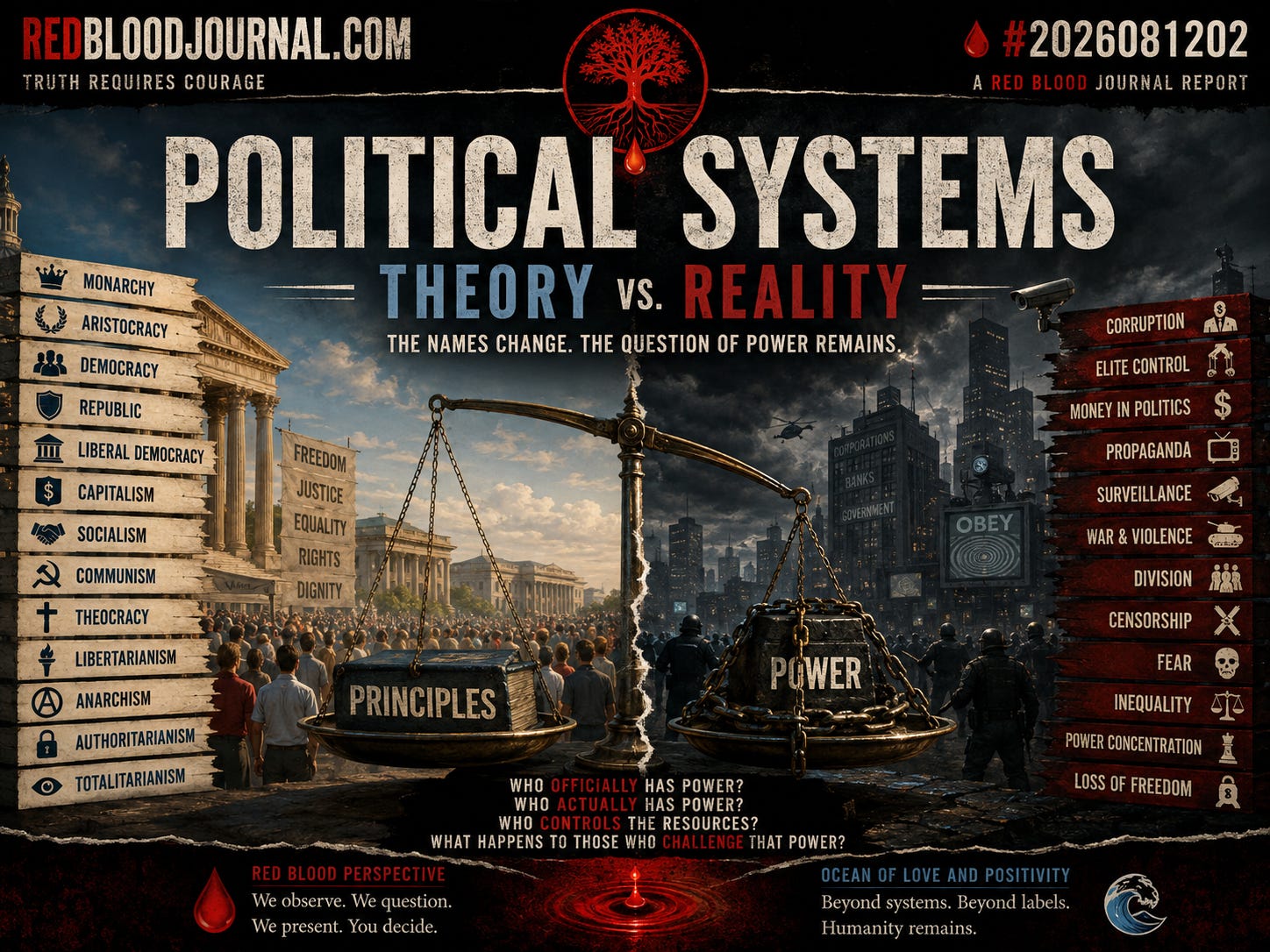
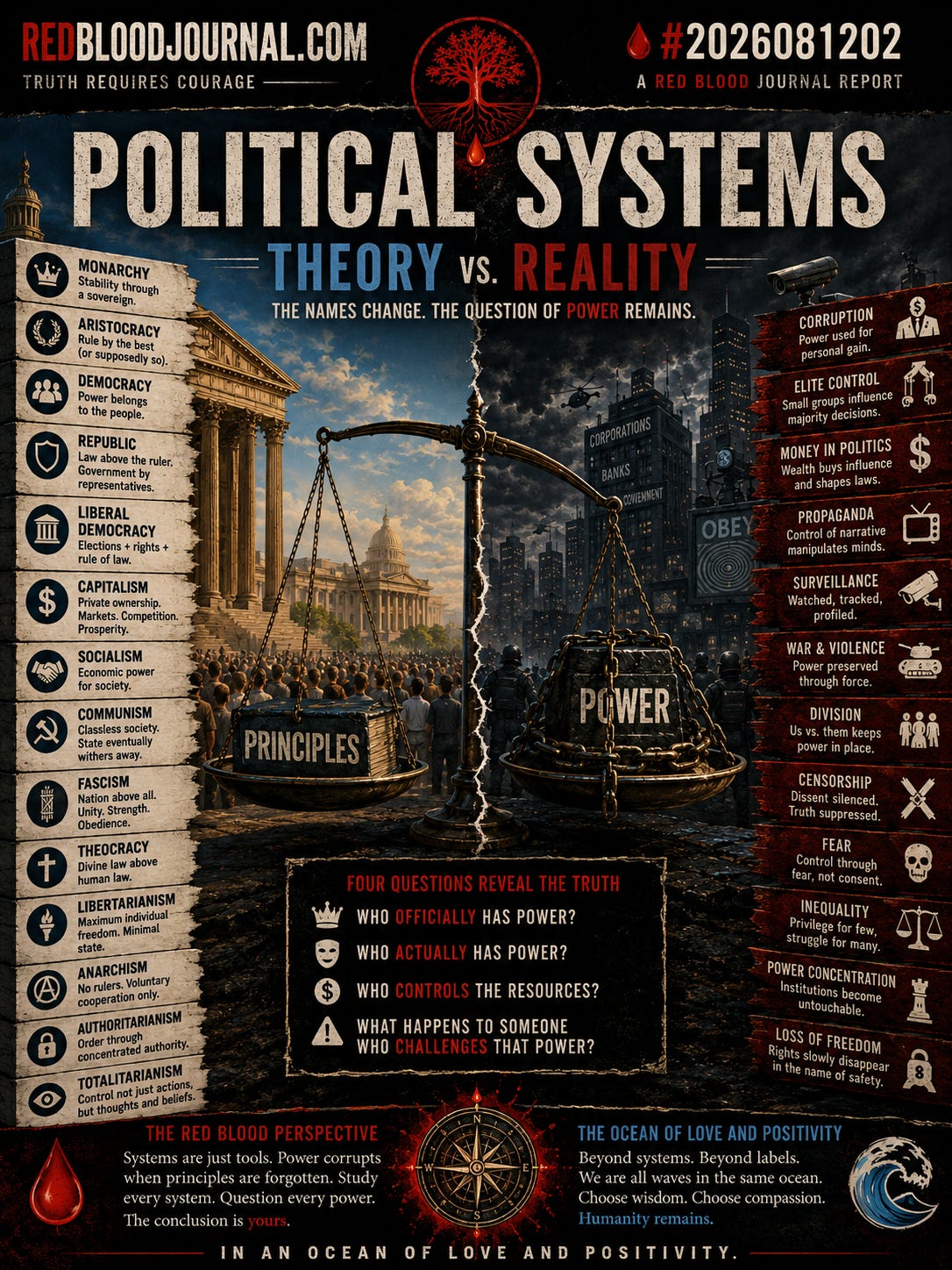
The Names Change. The Question of Power Remains.
Human beings have spent thousands of years experimenting with ways to organize society.
Kings have ruled in the name of stability. Aristocracies have claimed that the most capable should govern. Democracies have transferred political authority to the people. Republics have attempted to place law above individual rulers. Capitalism has emphasized private ownership and markets. Socialism has sought greater collective control of economic resources. Communism envisioned the disappearance of economic classes. Theocracies have placed divine law above human political preference.
Each system begins with a theory.
History gives us something else to examine: what happened after the theory encountered human beings, institutions, money, ambition, fear, corruption, competition, and power.
This report does not attempt to declare one political ideology the winner. It examines the distance between what political systems say they are and what they can become in practice.
Monarchy — Stability Through a Sovereign
In theory, monarchy provides continuity. Instead of governments repeatedly fighting over leadership, a sovereign represents the state across generations.
History provides examples of monarchies that produced long periods of stability. It also provides examples of absolute monarchs becoming tyrants, incompetent rulers inheriting enormous authority, and populations having little peaceful ability to remove them.
Modern constitutional monarchies present a very different model. In countries such as Britain, Sweden, and Japan, the monarch has limited political authority while elected institutions conduct most government.
The word monarchy, therefore, can describe very different distributions of actual power.
Aristocracy — Government by the Best
The original theoretical argument for aristocracy was not simply that rich families deserved power. The concept was that society should be governed by those considered most capable, educated, experienced, or virtuous.
The problem appears when the definition of “the best” becomes hereditary.
An institution intended to select excellence can gradually become a mechanism for protecting privilege.
This creates a recurring political question:
When an elite says it governs because it knows better than everyone else, who determines whether that elite actually is better?
Democracy — Government by the People
Democracy offers one of history’s most powerful political promises:
The people ultimately possess political authority.
Citizens vote. Governments can be removed peacefully. Opposition is permitted. Political legitimacy supposedly moves upward from the population rather than downward from a ruler.
But elections do not automatically make political influence equal.
Money can finance campaigns. Lobbyists can influence legislation. Political parties can control candidate selection. Large media organizations can influence which subjects receive attention. Bureaucracies can retain considerable power regardless of which party wins an election.
None of this proves that democracy is fictional.
It demonstrates that there is a difference between possessing a vote and possessing equal political influence.
Republic — The Law Above the Ruler
A republic attempts to replace hereditary government with institutions, representatives, constitutions, and laws.
The principle is significant:
The country does not belong to the ruler. The ruler temporarily occupies an office created by the country.
When functioning properly, republican institutions can make political power predictable and restrain individuals from exercising unlimited authority.
But institutions themselves are operated by people.
Representatives can become detached from their constituents. Political parties can dominate institutions. Bureaucratic organizations can become increasingly permanent while elected officials continuously change.
The constitution on paper therefore matters enormously, but so does what institutions actually do.
Liberal Democracy — Elections Plus Individual Rights
Liberal democracy combines elections with constitutional protections, individual liberty, independent institutions, freedom of expression, and the rule of law.
Its theoretical advantage is that even the majority should face limits.
Winning an election should not automatically give a government unlimited authority over the losing minority.
In practice, liberal democracies have produced substantial political and personal freedom compared with many historical systems.
They have also experienced concentrated wealth, lobbying, political polarization, media concentration, surveillance controversies, regulatory capture, and expanding administrative institutions.
The question is not simply whether elections exist.
The deeper question is how much influence ordinary citizens possess between elections.
Capitalism — Private Ownership and Competition
Capitalism is primarily an economic system, not a form of government, although its relationship with political power makes it impossible to ignore.
Its theory is straightforward.
Individuals can own property, establish businesses, compete, invest, trade, and profit from successful decisions.
The system has demonstrated extraordinary capacity for innovation, production, technological development, and wealth creation.
But successful competition can eventually create enormous concentrations of wealth.
Those concentrations can then purchase companies, influence media, employ lobbyists, finance political campaigns, shape regulations, and potentially influence the government that is supposed to regulate them.
Capitalism therefore produces one of its own great paradoxes:
Can successful competition eventually produce enough concentrated economic power to weaken competition itself?
Socialism — Economic Power for Society
Socialism begins from a different concern.
If essential resources and industries become concentrated in private hands, economic power can become political power. Socialism therefore proposes varying degrees of social, cooperative, or governmental control.
There is no single socialist model.
Some socialist traditions accept elections, private businesses, and markets while supporting strong public services and redistribution. Other historical versions transferred enormous portions of the economy directly to the state.
That produces socialism’s corresponding paradox.
Attempting to prevent excessive private concentration of power can create excessive governmental concentration of power.
The question then becomes:
Who controls the people controlling the collective resources?
Communism — The Classless Society
Communist theory went further.
Marx envisioned historical economic development eventually eliminating class divisions. In the ultimate theoretical destination, exploitation would disappear and even the coercive state would eventually become unnecessary.
That final condition has never been achieved by a nation-state.
Governments identifying themselves as Marxist-Leninist instead generally developed powerful centralized governments, party bureaucracies, security institutions, and political elites.
Defenders have argued that these governments never reached genuine communism.
Critics respond that the attempt to reach communism repeatedly required concentrations of authority that produced precisely the powerful ruling structures the theory promised eventually to eliminate.
That disagreement remains fundamental to the historical debate.
Fascism — Unity, Strength and the State
Fascism rejected liberal individualism in favor of national unity, hierarchy, discipline, mobilization, and strong centralized leadership.
Its historical implementations demonstrated how quickly national unity can become compulsory conformity.
Opposition was suppressed. Propaganda became central. Political violence was normalized. Military power expanded. Individual interests became subordinate to the state’s conception of national purpose.
Fascism consequently provides one of history’s clearest warnings about the difference between unity by agreement and unity by force.
Theocracy — Government Under Divine Authority
Theocracy begins from the proposition that human beings should not simply invent morality according to political convenience.
Government should instead conform to divine law.
That immediately creates another problem:
Who speaks for God?
Once a religious institution receives political authority, disagreement with political leadership can potentially become disagreement with religion itself.
A government claiming divine legitimacy can therefore become particularly difficult to challenge because political authority and spiritual authority become intertwined.
At the same time, supporters of religious government argue that secular political systems are hardly free from ideology and that moral principles must originate somewhere.
The argument ultimately returns to interpretation and authority.
Libertarianism — Maximum Individual Freedom
Libertarianism begins with suspicion of coercive government.
People should generally be permitted to live, speak, trade, associate, own property, and make decisions without unnecessary state interference.
Its great concern is governmental concentration of power.
Its critics raise the opposite concern.
If government becomes extremely weak, enormous corporations, wealthy individuals, private monopolies, or other powerful organizations may acquire influence that ordinary individuals cannot realistically resist.
The debate therefore becomes whether freedom requires primarily protection from government or also protection from private concentrations of power.
Anarchism — Society Without Coercive Hierarchy
Anarchism asks perhaps the most radical political question:
Why must human cooperation require rulers at all?
Various anarchist traditions envision voluntary associations, decentralized communities, cooperatives, mutual assistance, and non-hierarchical organization.
Examples of voluntary self-organization certainly exist.
The unresolved challenge appears when the scale becomes enormous.
Who provides national defense? Who manages major infrastructure? Who resolves disputes between communities? What happens when one group becomes violent? Who prevents another hierarchy from simply replacing the one that disappeared?
The theory challenges government itself.
Reality challenges anarchism with the problem of scale.
Authoritarianism — Order Through Concentrated Authority
Authoritarian systems prioritize stability, security, obedience, and decisive leadership.
Their attraction becomes particularly strong during disorder.
A government that does not require years of political negotiation can sometimes act rapidly.
But speed removes obstacles for both good decisions and disastrous ones.
When accountability weakens, corruption becomes harder to expose. Opposition becomes dangerous. Journalism becomes restricted. Institutions become dependent on leadership.
The same concentration of authority that creates efficiency can therefore make correcting mistakes increasingly difficult.
Totalitarianism — Power Beyond Government
Totalitarianism goes beyond ordinary authoritarian government.
It attempts to organize society around a comprehensive ideology or political project.
Government may seek influence over education, information, media, organizations, culture, economics, political participation, and sometimes even acceptable private beliefs.
The distinction is important.
An authoritarian ruler may simply demand obedience.
A totalitarian system may attempt to determine what people are permitted to believe while obeying.
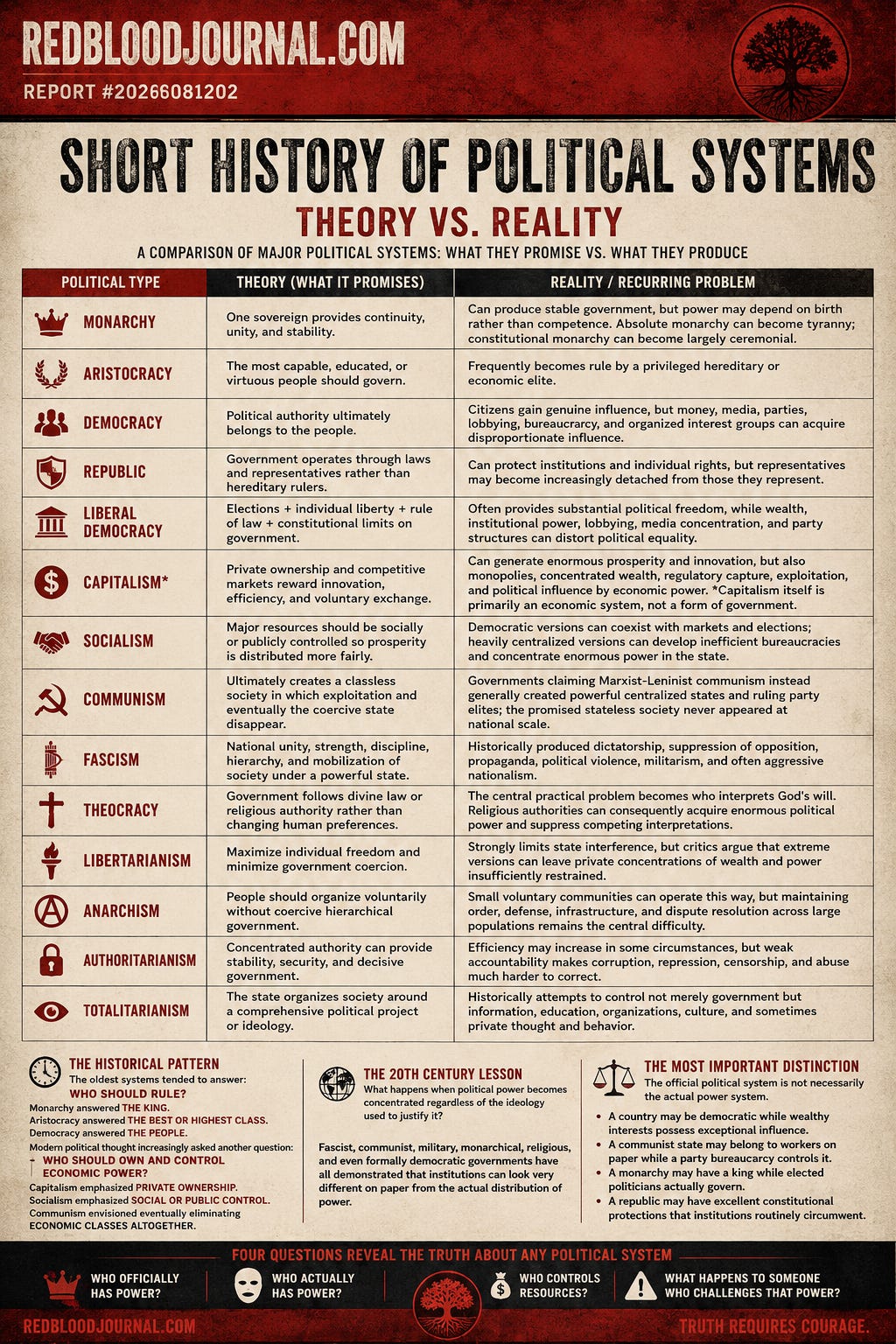
The Historical Pattern
The oldest political question was largely:
Who should rule?
Monarchy answered: the sovereign.
Aristocracy answered: the supposedly best or highest class.
Democracy answered: the people.
Modern political struggles increasingly introduced another question:
Who should control economic power?
Capitalism emphasized private ownership.
Socialism emphasized varying forms of social or public control.
Communism envisioned eventually eliminating economic classes altogether.
The twentieth century then demonstrated another problem that crossed ideological boundaries.
Political power can become concentrated under very different labels.
Fascist governments concentrated it.
Communist governments concentrated it.
Military governments concentrated it.
Absolute monarchies concentrated it.
Religious governments have concentrated it.
And democratic societies continue debating whether corporations, wealthy donors, political parties, bureaucracies, intelligence institutions, technology companies, media organizations, and other powerful interests can accumulate influence beyond what democratic theory intended.
The Most Important Distinction
Perhaps the greatest mistake in political analysis is assuming that a country’s official political system automatically describes its actual power system.
A country may call itself democratic while wealthy interests exercise extraordinary influence.
A communist government may claim that workers possess political authority while a party bureaucracy makes the important decisions.
A monarchy may have a king while elected politicians actually govern.
A republic may possess impressive constitutional protections while institutions discover methods of circumventing them.
A capitalist economy may contain industries dominated by a handful of corporations.
A socialist government established to prevent economic oligarchy may develop a powerful governmental elite of its own.
The political label describes the architecture.
It does not necessarily reveal who occupies the control room.
The Four Questions
Instead of beginning an investigation by asking whether a country is capitalist, socialist, democratic, monarchical, religious, communist, conservative, or liberal, another method is possible.
Ask:
Who officially has power?
Who actually has power?
Who controls the resources?
What happens to someone who seriously challenges that power?
The answers may reveal considerably more than the political label.
🩸 The Red Blood Perspective
Red Blood does not need to choose a political tribe to observe a recurring historical pattern.
Every political philosophy contains an explanation for why power should be organized in a particular way.
The danger appears when the people operating that system become more important than the principles supposedly governing them.
A king can abuse monarchy.
An elite can corrupt aristocracy.
Politicians can manipulate democracy.
Corporations can distort capitalism.
Bureaucrats can distort socialism.
Party leadership can dominate communism.
Religious authorities can exploit theocracy.
And governments established to protect liberty can gradually acquire powers their founders never intended.
Perhaps the fundamental political struggle therefore isn’t simply capitalism versus socialism, monarchy versus republic, left versus right, or religion versus secularism.
It may be something older:
The individual versus concentrated power.
But Red Blood will not make that judgment for the reader.
The historical record, competing theories, successes, failures, and contradictions are presented.
The conclusion belongs to the reader.
🌊 The Ocean of Love and Positivity Perspective
Every political system begins with human beings attempting to solve a human problem.
Security.
Fairness.
Freedom.
Order.
Prosperity.
Equality.
Community.
Meaning.
Perhaps humanity’s repeated mistake is not searching for better systems.
Perhaps it is believing that any system can permanently replace personal responsibility, wisdom, compassion, restraint, and awareness.
A perfect constitution operated by people consumed by greed can deteriorate.
An imperfect institution operated by people committed to fairness can sometimes function surprisingly well.
The name placed above the government building may therefore matter less than the character of those inside it—and the awareness of those outside it.
Political systems divide humanity into governments, parties, classes, ideologies, and borders.
The Ocean offers another perspective.
Underneath those labels remain human beings searching for security, dignity, purpose, freedom, and a place within something larger than themselves.
Study the systems.
Question the power.
Follow the evidence.
But do not allow political labels to erase the humanity underneath them.
In an Ocean of Love and Positivity.
🩸🌊✨ Fantastic!
⚖️
Power and Paradox: Political Theory vs. Reality
Aug 12, 2026
This text explores the persistent disconnect between idealized political theories and the messy realities of how power is actually exercised. It surveys various systems—including monarchy, democracy, capitalism, and socialism—to demonstrate how each framework can be undermined by human ambition, corruption, or institutional drift. The core argument suggests that official labels often mask the true distribution of influence, whether held by wealthy elites, bureaucrats, or state leaders. Ultimately, the source encourages readers to look beyond political terminology to examine who truly controls resources and how concentrated power impacts individual liberty. By contrasting historical aspirations with practical outcomes, it highlights the necessity of human character and vigilance in maintaining any societal structure.


