


🩸 🕵️ #202608115 — The New IRGC Command Structure: Purge, Coup, or Consolidation of Power?
Red Blood Journal Transmission Report
RedBloodJournal.com
A government does not need to announce a coup for the distribution of power inside it to change.
Sometimes the tanks never enter the capital.
Sometimes the television station is never seized.
Sometimes the constitution remains exactly where it was.
The names on the doors simply change.
That is why the latest restructuring of Iran’s military and security leadership deserves attention beyond the individual appointments themselves.
Supreme Leader Mojtaba Khamenei has installed a collection of experienced security and military figures across some of the Islamic Republic’s most powerful institutions.
Among the most important are Ahmad Vahidi, Mohsen Rezaei and Hossein Taeb.
On paper, this can be described simply as a military reshuffle.
But Iran is not operating under ordinary circumstances.
The country has emerged from war and leadership losses. Relations with the United States remain deeply confrontational. The Strait of Hormuz remains part of the larger strategic struggle. Economic pressure continues. And the new Supreme Leader is still establishing his own authority.
Under those circumstances, changing the people who control the guns, intelligence networks, internal-security forces and national-security machinery becomes considerably more important than an ordinary cabinet reshuffle.
The question is therefore not simply:
Who received which position?
The more important question is:
What kind of state is being constructed around Mojtaba Khamenei?
The New Command Structure
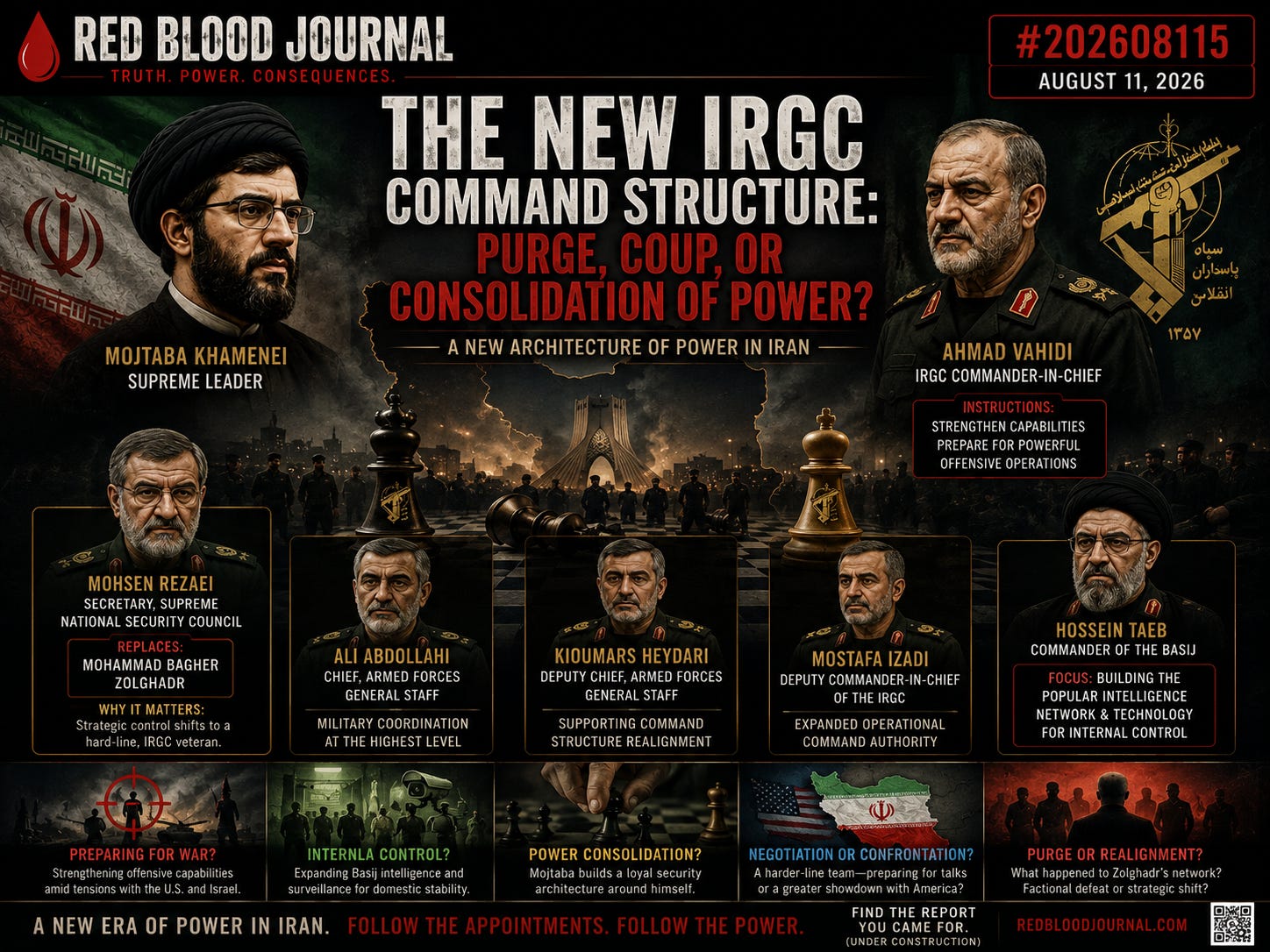
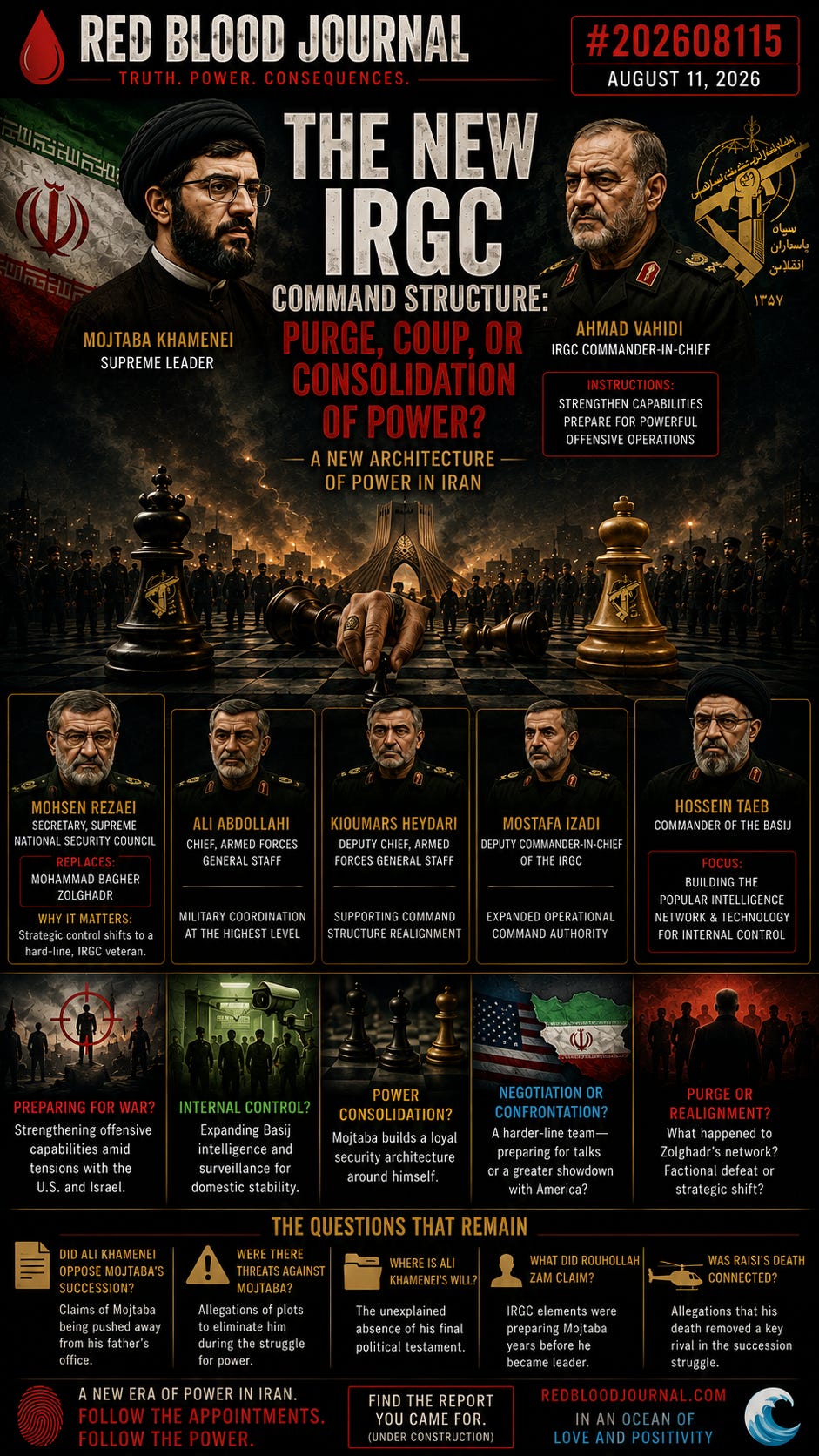
The latest appointments place veteran establishment figures across several centers of military and security power.
Among the appointments reported are:
Ahmad Vahidi — Commander-in-Chief of the Islamic Revolutionary Guard Corps
Ali Abdollahi — Chief of the Armed Forces General Staff
Kioumars Heydari — Deputy Chief of the Armed Forces General Staff
Mohsen Rezaei — Secretary of the Supreme National Security Council
Mostafa Izadi — Deputy Commander-in-Chief of the IRGC
Hossein Taeb — Commander of the Basij
These are not six disconnected personnel decisions.
Together they reach into military command, strategic planning, domestic security and national-security policymaking.
That makes the appointments worth examining as a structure rather than merely as a list.
Ahmad Vahidi — Preparing the IRGC for What?
One of the most important appointments is Ahmad Vahidi as commander-in-chief of the IRGC.
Mojtaba Khamenei’s instructions to Vahidi are particularly revealing.
He called for strengthening the Revolutionary Guard’s capabilities and preparing it for powerful offensive operations.
That language matters.
It does not prove that another war with the United States or Israel has already been decided.
Military organizations are expected to prepare for conflict.
But when such instructions arrive during an active geopolitical confrontation, they cannot be separated completely from their environment.
Vahidi therefore enters the position with two possible missions that may overlap.
The first is external:
prepare the Revolutionary Guard for another major confrontation.
The second is internal:
reconstruct and stabilize an organization whose command structure has suffered enormous wartime disruption.
Both may be occurring simultaneously.
Hossein Taeb — The Internal Side of the Reshuffle
If Vahidi represents the external military side of the restructuring, Hossein Taeb may represent its internal-security dimension.
Taeb previously headed the IRGC Intelligence Organization.
His return as commander of the Basij therefore deserves special attention.
The Basij reaches deep inside Iranian society.
Its functions extend beyond conventional military activity into ideological organization, domestic security and the state’s response to internal unrest.
The instructions associated with Taeb’s appointment reportedly emphasize strengthening the Basij’s intelligence network and expanding technological capabilities.
That creates a difficult question.
Why does a government preparing for external war simultaneously strengthen its internal intelligence and population-control infrastructure?
One answer is obvious.
Governments expecting foreign confrontation also fear domestic instability.
Economic deterioration, casualties, political uncertainty and military pressure can create unrest at home.
From that perspective, strengthening the Basij is simply part of wartime preparation.
But another interpretation is possible.
Perhaps internal instability is considered as dangerous to the regime as America or Israel.
If so, Taeb’s appointment tells us something important about what the leadership believes the battlefield actually is.
It may exist both outside and inside Iran.
The Mohsen Rezaei Appointment
The appointment that may require the closest examination is Mohsen Rezaei.
Rezaei is not a newcomer.
He commanded the Revolutionary Guard for approximately sixteen years and has remained inside the Islamic Republic’s political and strategic establishment for decades.
He has now been placed at the center of the Supreme National Security Council.
This matters because that institution sits at the intersection of military strategy, foreign policy and national security.
But the appointment becomes even more interesting because of the man Rezaei replaced:
Mohammad Bagher Zolghadr.
Why Remove Zolghadr?
This is where interpretations begin to diverge.
The transcript underlying this investigation presents Zolghadr as an important figure in the previous balance of power and raises the possibility that his removal represents a factional defeat.
Some interpretations suggest Zolghadr had become associated with approaches that differed from the emerging Mojtaba-centered security structure.
Under that reading, replacing him with Rezaei is not administrative housekeeping.
It is a political signal.
But another interpretation must also remain open.
Rezaei brings decades of military, political and strategic experience.
A government confronting war, sanctions, Hormuz, negotiations with Washington and internal economic instability may simply prefer an extremely experienced establishment figure at the center of national-security decision-making.
These explanations are not necessarily mutually exclusive.
Rezaei can simultaneously be an experienced appointment and the beneficiary of a factional shift.
Does Rezaei Mean Negotiation or Confrontation?
Here the interpretations become almost contradictory.
One school can look at Rezaei’s experience and see someone capable of managing a pragmatic national-security apparatus.
Another sees his Revolutionary Guard history and recent positions as evidence that the leadership is moving toward a harder posture against Washington.
This is precisely why individual biographies cannot settle the question.
The better evidence will be behavior.
Does the Supreme National Security Council become more willing to negotiate?
Does Iran alter its position on Hormuz?
Does it soften demands concerning sanctions?
Does military rhetoric decrease?
Or does the opposite happen?
If confrontation increases after the appointments, the harder-line interpretation gains strength.
If negotiations expand, the pragmatic interpretation gains strength.
Until then, the appointment itself permits both possibilities.
An Old Guard, Not a New Revolution
One detail stands out across the appointments.
These are largely experienced establishment figures.
That complicates the idea that Mojtaba is conducting a revolutionary purge.
A classic purge usually clears away an old elite and replaces it with a new generation personally loyal to the incoming ruler.
That is not obviously what has happened here.
Instead, Mojtaba appears to be reaching backward into the Islamic Republic’s experienced military-security establishment.
This may suggest that he does not want to reinvent the system.
He wants people who already know how it works.
That could indicate continuity.
It could indicate insecurity.
Or it could indicate that Mojtaba’s own political survival depends upon the security establishment that helped sustain the system through the succession crisis.
Purge?
There is evidence that some people and networks have lost influence.
Positions have changed hands.
Zolghadr’s replacement is particularly noteworthy.
Other figures associated with previous arrangements have been pushed toward the margins.
But calling the entire restructuring a purge would require evidence that officials are being systematically removed because of disloyalty or factional opposition.
The publicly observable appointments alone do not establish that.
A purge remains one possible interpretation.
It is not yet the only explanation.
Coup?
The word coup is even more complicated.
There has been no conventional military seizure of the Iranian government associated with these appointments.
Mojtaba Khamenei is issuing the appointments under the formal authority of the Supreme Leader.
From that perspective, the process is constitutional rather than revolutionary.
But formal legality does not answer the deeper question of where effective power resides.
If one military-security network controls access to the Supreme Leader, intelligence, military command, internal security and national-security decision-making, a substantial redistribution of power could occur without formally overthrowing anyone.
That would resemble institutional capture more than a traditional coup.
The distinction matters.
Consolidation?
Of the three possibilities, consolidation of power currently has the strongest directly observable evidence.
A relatively new Supreme Leader has placed experienced figures into crucial institutions.
The military command structure is being reorganized.
Responsibilities are being clarified.
Security institutions are being strengthened.
Longstanding figures connected to the Revolutionary Guard are being placed into positions capable of coordinating military and political strategy.
But even the word consolidation leaves another question unanswered:
Whose power is being consolidated?
Mojtaba Khamenei’s?
The IRGC’s?
The Mojtaba-Taeb network’s?
Or the Islamic Republic’s security establishment collectively?
Those are not necessarily the same thing.
A Harder-Line Faction?
Several of the appointments point toward people deeply rooted in the Revolutionary Guard and security establishment.
That makes predictions of immediate ideological moderation difficult to support.
There is little in the personnel choices themselves that suggests the Islamic Republic is transferring power toward civilian reformists.
The opposite appears more visible.
Military-security figures are being placed closer to the center.
But hard-line personnel do not automatically eliminate diplomacy.
Governments frequently negotiate through hardliners precisely because those figures possess the authority to make agreements that weaker political actors cannot enforce.
Iran could therefore strengthen its security establishment while simultaneously negotiating with Washington.
That would not necessarily be a contradiction.
It could be strategy.
Preparing for America?
Mojtaba’s instructions to strengthen offensive capabilities inevitably raise the question of another confrontation with the United States.
Iran has reasons to expect that possibility.
The military has suffered losses.
Command-and-control weaknesses have been exposed.
Israel has demonstrated intelligence penetration and targeting capabilities.
American military power remains positioned throughout the region.
Hormuz remains strategically explosive.
Under those circumstances, rebuilding the command structure would be rational even if Tehran desperately wanted to avoid another war.
Preparation does not prove intention.
A military can prepare for war precisely because its government wants deterrence strong enough to prevent one.
Preparing for Iran?
But Taeb’s return forces the investigation to look in the opposite direction.
The Basij is not principally needed to fight American aircraft.
It is extraordinarily useful for controlling Iranian streets.
If economic pressure becomes more severe, if sanctions continue, if another war produces shortages or casualties, or if political divisions widen, domestic unrest could become a major challenge.
The leadership therefore appears to be strengthening institutions capable of dealing with both external and internal threats.
That may be the most important pattern in the entire reshuffle.
Iran is not simply rebuilding an army.
It may be rebuilding a survival architecture.
The Wartime Explanation
There is also a less conspiratorial explanation that deserves equal consideration.
Iran has suffered extraordinary military disruption.
Senior commanders have been killed.
Command structures have been damaged.
Institutional weaknesses have been exposed.
A government emerging from those conditions would naturally reorganize its armed forces.
Reports also indicate broader efforts to streamline military coordination and reduce duplication between command structures.
Under this interpretation, the appointments are less mysterious.
They represent lessons learned from war.
Experienced commanders are being moved into positions where they can improve coordination, accelerate wartime decision-making and rebuild damaged institutions.
That explanation may account for much of what is happening.
But it still does not exclude political consolidation.
Military reform and political consolidation can occur at the same time.
Follow the Structure
Rather than deciding immediately whether this is a purge, coup or consolidation, several developments should be watched.
Who receives additional authority?
Who disappears from decision-making?
Does Rezaei change the direction of national-security policy?
Does Taeb’s Basij receive expanded surveillance or enforcement powers?
Does Vahidi receive greater independence from civilian institutions?
Does Pezeshkian’s government gain or lose influence over national security?
Do negotiations with Washington expand or collapse?
And when military and civilian leaders disagree:
Who wins?
That answer will reveal more than the appointments themselves.
Four Possible Explanations
Scenario One — Wartime Reconstruction
The appointments primarily repair military institutions damaged by war.
Experienced figures are being used because Iran expects further confrontation and cannot afford inexperienced leadership.
Scenario Two — Mojtaba Consolidates His Rule
The new Supreme Leader is constructing his own command structure and placing trusted figures in institutions necessary to protect his leadership.
Scenario Three — The IRGC Consolidates the State
The appointments demonstrate that Iran’s political system is becoming increasingly security-led, with Mojtaba providing supreme authority while the Revolutionary Guard provides the operational machinery.
Scenario Four — External War and Internal Control Are Being Prepared Together
Iran expects prolonged confrontation abroad and increasing instability at home.
Vahidi prepares the military.
Taeb strengthens domestic security.
Rezaei coordinates national strategy.
Under this scenario, the appointments are pieces of one larger survival plan.
🩸 The Red Blood Perspective
The temptation is to place a simple label on the reshuffle.
Purge.
Coup.
Hard-line takeover.
Preparation for war.
Any one of those could eventually prove partly correct.
But the appointments presently reveal something more fundamental.
The Islamic Republic is reorganizing around people who understand security, intelligence, military power and institutional survival.
That is observable.
What remains uncertain is the purpose.
Perhaps Mojtaba Khamenei is building his own government.
Perhaps the Revolutionary Guard is building Mojtaba’s government for him.
Perhaps both depend upon each other.
Perhaps the country is simply doing what governments do after suffering devastating military losses: placing experienced people where the system believes they are needed most.
The next actions will tell us more than the appointments.
Watch Rezaei.
Watch Taeb.
Watch Vahidi.
Watch what happens to Zolghadr’s former network.
Watch negotiations with Washington.
Watch Hormuz.
Watch the Iranian streets.
And most importantly, watch which institution gains authority whenever the next crisis arrives.
That is where the actual command structure will reveal itself.
The reader should decide.
🌊 Ocean of Love and Positivity Perspective
Military organizational charts show commanders, ranks and institutions.
They rarely show the people underneath them.
A decision made in Tehran can eventually reach a soldier standing at a missile battery.
A decision made in Washington can eventually reach a sailor aboard a ship.
A decision made inside an intelligence office can eventually reach an ordinary person walking through an Iranian street.
That is why power deserves examination.
Not because every powerful person is automatically evil.
Not because every military appointment hides a conspiracy.
But because decisions made by a very small number of people can determine whether millions experience peace, fear, prosperity, poverty, freedom or war.
Perhaps the strongest government is ultimately not the government with the largest security apparatus.
Perhaps it is the government secure enough that it no longer fears its own people or needs an enemy abroad to justify itself at home.
Until that day, follow the institutions.
Follow the power.
But never forget the people living beneath both.
In an Ocean of Love and Positivity.
🩸🌊✨ Fantastic!
Find the report
you came for.
(under construction)
RedBloodJournal.com


