


🩸 RedBloodJournal.com 🩸
Report #1401
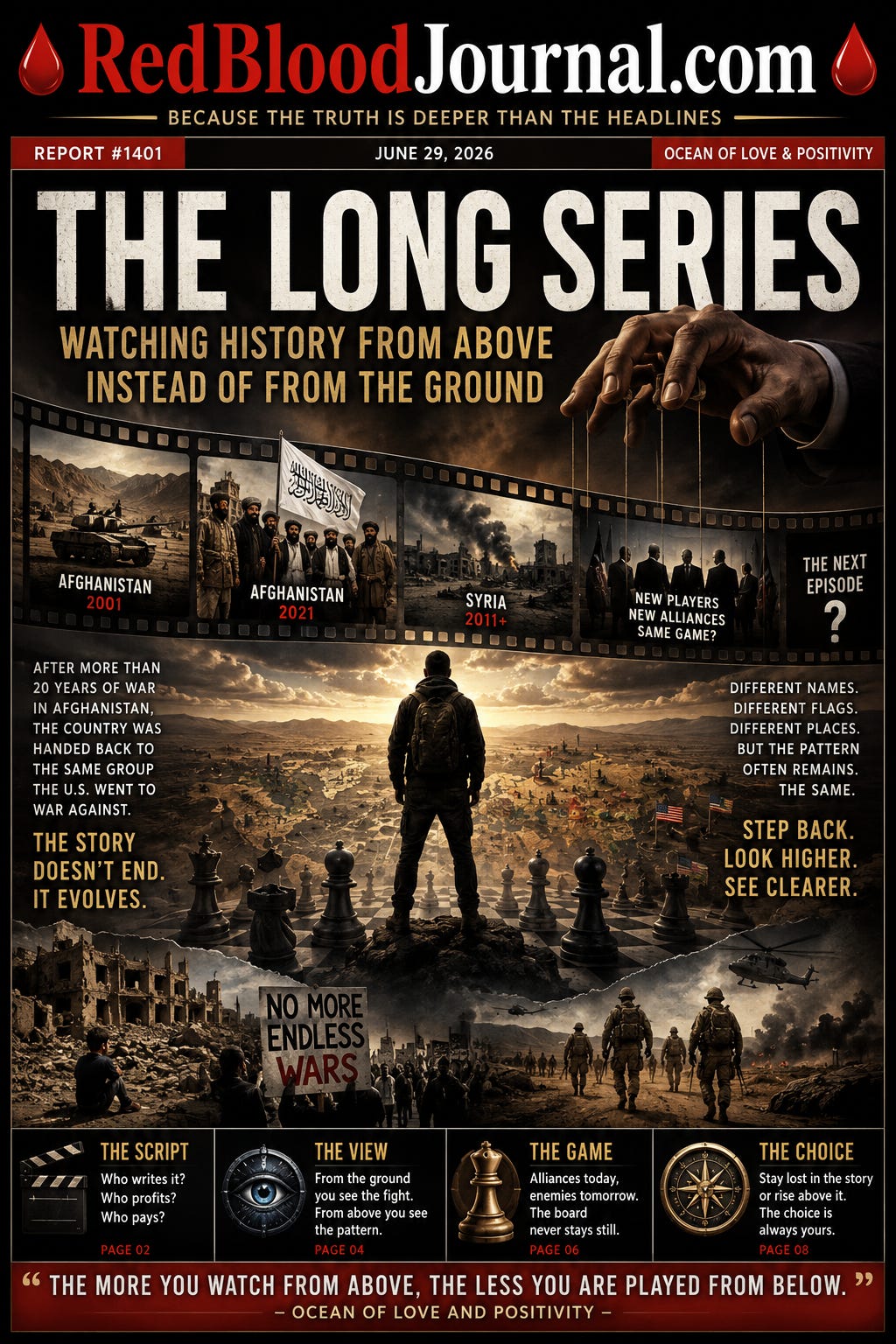
The Long Series
Watching History From Above Instead of From the Ground
Date: June 29, 2026
Introduction
History is often presented as a collection of disconnected events—one war ends, another begins, one government falls, another rises. The daily news encourages the audience to focus on the latest episode while rarely stepping back to examine the entire series.
When viewed from ground level, each conflict appears unique.
When viewed from above, recurring patterns begin to emerge.
This report presents one interpretive framework for examining those patterns.
Afghanistan: Twenty Years to Return to the Beginning
One of the most striking examples frequently cited by observers is Afghanistan.
After more than twenty years of war, trillions of dollars spent, and the loss of countless lives and limbs, the government supported by the United States collapsed, and the Taliban once again became the governing authority.
For many observers, this outcome naturally raises difficult questions.
If history ultimately returned to where it began, what was accomplished?
What changed?
Who benefited?
Whether one agrees with every interpretation or not, these questions remain part of the historical conversation.
The Next Episode
Attention then shifted elsewhere.
The world watched Syria.
New alliances appeared.
Former enemies became negotiating partners.
Old allies became rivals.
Different actors entered the stage, yet many viewers felt they were watching another season of the same long-running production rather than an entirely new story.
The names changed.
The uniforms changed.
The locations changed.
The script often appeared familiar.
The View From Above
Most people consume world events one headline at a time.
One battle.
One election.
One agreement.
One crisis.
But history can also be examined from a broader perspective.
Looking from above does not guarantee perfect understanding.
It simply allows patterns to become more visible.
Instead of asking only what happened today, one begins asking larger questions:
Do conflicts truly end, or do they evolve?
Are today’s alliances permanent, or temporary?
Why do similar cycles appear repeatedly throughout history?
Who benefits when public attention moves from one crisis to the next?
These questions invite observation rather than immediate conclusions.
The Television Series Analogy
A successful television series keeps its audience emotionally invested.
Every season introduces new characters.
Every episode creates new conflict.
Every finale promises answers in the next installment.
The audience returns because it believes the next episode will finally explain everything.
History sometimes appears remarkably similar.
Each generation becomes deeply invested in its own chapter, convinced it is witnessing something entirely unprecedented.
Yet decades later, many storylines begin to resemble earlier ones.
The actors change.
The costumes change.
The language changes.
The emotional investment remains remarkably constant.
The Cost of Every Episode
Unlike fictional entertainment, geopolitical conflicts are paid for with real lives.
The tickets are not purchased with money alone.
They are purchased with blood.
With limbs.
With displaced families.
With destroyed cities.
With generations that inherit unresolved conflicts they never created.
For those who step back and observe history as a whole, the recurring question becomes not simply who wins today’s battle, but whether humanity continues replaying variations of the same story.
When the Audience Begins to Notice
Every successful series eventually reaches a point where viewers recognize familiar patterns.
The suspense weakens.
The plot becomes predictable.
The audience realizes the newest season resembles earlier ones.
History may present a similar challenge.
The greatest shift may occur when people become less focused on choosing sides within each episode and more interested in understanding the larger narrative that connects them.
Conclusion
This report does not claim to possess hidden knowledge or final answers.
Rather, it offers a perspective.
Instead of becoming absorbed by every new headline, it invites readers to occasionally step back and observe the broader picture.
Whether one ultimately agrees or disagrees with this interpretation is less important than developing the habit of examining events from multiple levels.
Sometimes the clearest understanding is found not by standing closer to the stage...
...but by sitting high enough to see the entire theater.
Final Reflection
Perhaps history is not merely a collection of isolated events.
Perhaps it is a long series whose episodes are separated by years instead of weeks.
The challenge for every generation is deciding whether to remain captivated by each individual episode—or to step back, observe the entire story, and search for wisdom beyond the script.
🩸 RedBloodJournal.com 🩸
“The purpose is not to tell readers what to think, but to encourage them to look higher, ask better questions, and never stop searching for truth with an open mind.”
🌊 Ocean of Love and Positivity 🌊
🎭 The Long Series:
Geopolitical Patterns and the Higher View
Jun 28, 2026
This text presents a geopolitical perspective that compares the unfolding of world history to a long-running television series.
By viewing global events from an elevated vantage point, the author argues that recurring patterns and cycles become more visible than they are from the ground level.
Using the conflict in Afghanistan as a primary example, the source questions why history often returns to its starting point despite immense costs in human life and resources.
The narrative suggests that while actors and locations change, the underlying scripts of war and political upheaval frequently repeat themselves.
Ultimately, the report encourages readers to move beyond individual headlines and emotional investment in specific “episodes” to better understand the broader historical narrative.
This approach aims to foster critical thinking by focusing on the systemic connections between seemingly isolated global crises.


