


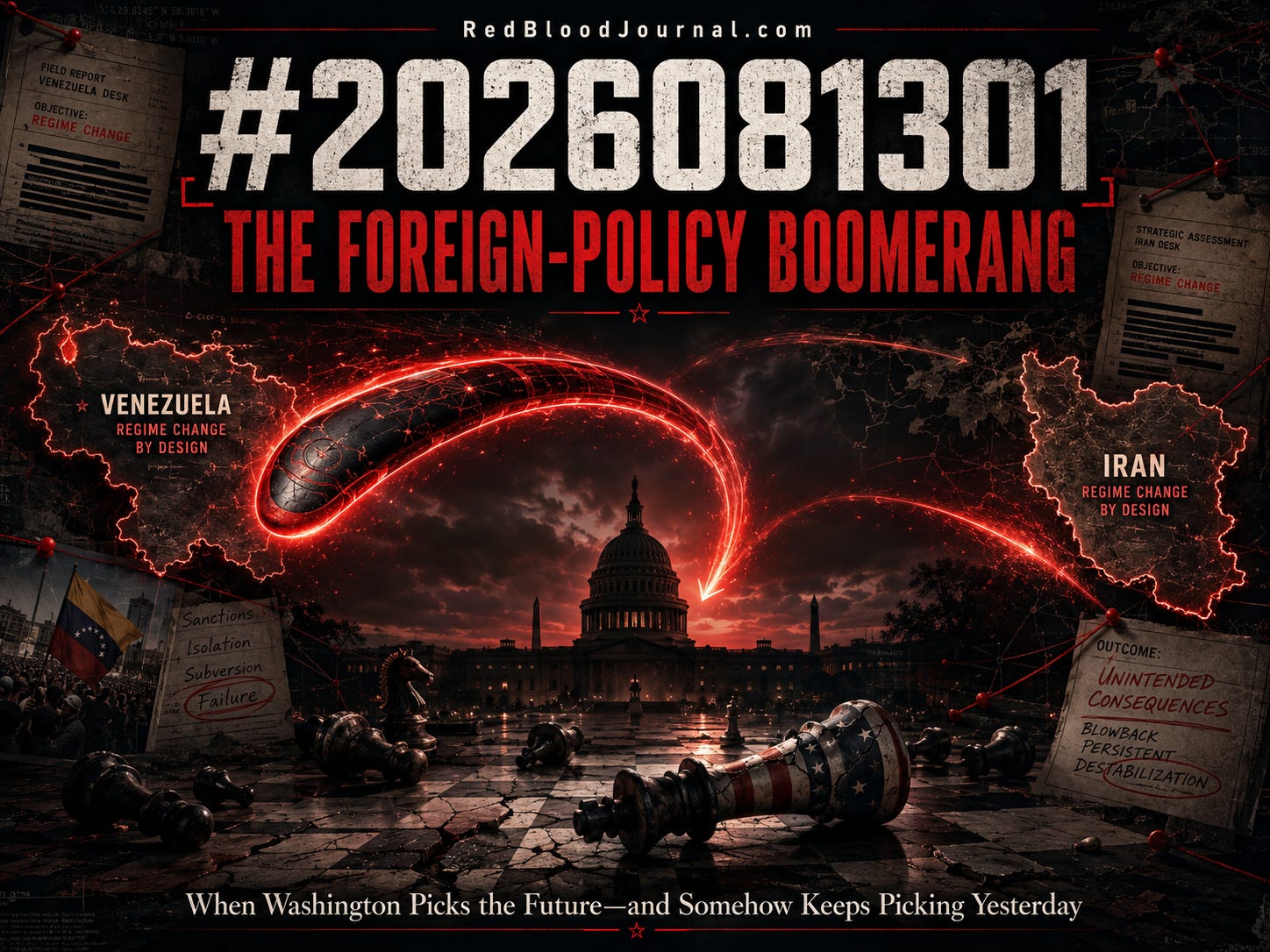
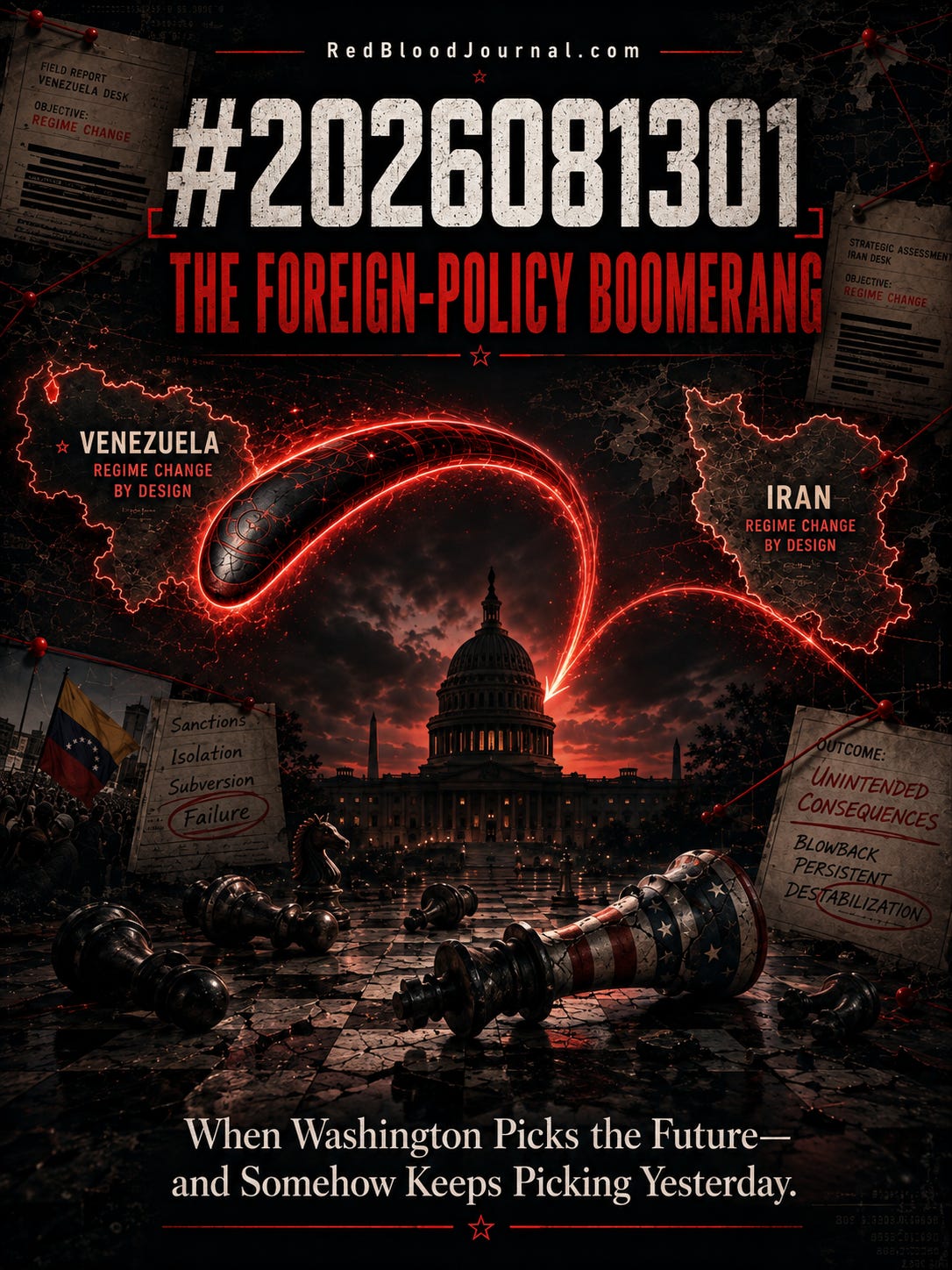
🩸 #2026081301 — The Foreign-Policy Boomerang
When Washington Picks the Future—and Somehow Keeps Picking Yesterday
RedBloodJournal.com — Independent Investigations, Perspective & Consciousness
There is an old rule worth remembering when studying governments and intelligence agencies:
Do not begin with what they say they are doing. Begin with what they actually do.
Then watch what happens.
Washington can publish a thousand pages explaining democracy, stability, human rights, national security and strategic interests. Intelligence officials can produce assessments carrying classifications and impressive seals. Presidents can stand behind podiums and explain what America supposedly wants.
But underneath all of that is something considerably harder to manipulate:
the result.
And when the results repeat often enough, perhaps the pattern deserves more attention than the explanation.
Venezuela gives us an extraordinary case study.
Iran may be giving us another one right now.
And somewhere between them sits a question that Americans rarely seem willing to ask:
What if American foreign policy keeps failing because we misunderstand what its real objective is?
The Man Washington Made President Without Giving Him a Country
His name was Juan Guaidó.
In January 2019, the United States recognized the Venezuelan opposition leader as the country’s legitimate interim president. Dozens of governments eventually followed Washington’s position.
On paper, it looked enormous.
A government existed.
A president had been recognized.
International pressure was building.
Nicolás Maduro was supposedly approaching his final chapter.
Except there was one rather inconvenient problem.
Maduro still controlled Venezuela.
Guaidó had international recognition.
Maduro had the presidential palace, armed forces, bureaucracy, intelligence apparatus and physical machinery of the state.
It became one of the strangest political arrangements imaginable: a man could be internationally recognized as the president of Venezuela while another man continued actually governing Venezuela.
Then came one of those moments that says more than a hundred diplomatic communiqués.
In February 2020, Guaidó returned to Venezuela following an international trip that included a White House meeting. At the Caracas-area airport, Reuters witnesses reported that pro-government agitators pushed people, shouted insults and attacked journalists, photographers and opposition lawmakers. Guaidó’s vehicle was struck with sticks and traffic cones.
The grand international recognition campaign had collided with the street.
Guaidó did not immediately run to America after that episode; he continued his Venezuelan political campaign for years. But eventually the experiment collapsed. He left Venezuela in 2023 and went to the United States.
The man Washington once recognized as Venezuela’s president ultimately lived outside the country while Maduro remained in power.
For anyone examining foreign policy by results rather than press releases, that should have produced some very uncomfortable questions.
Apparently it did not end the experiment.
Then Came 2026
The story became considerably stranger.
Following the American removal of Maduro in January 2026, Washington faced the opportunity it supposedly had wanted for years.
Maduro was gone.
This was the moment when one might expect Venezuela’s opposition finally to receive the keys.
Instead, something almost unbelievable happened.
The system Maduro had built largely remained in place.
Delcy Rodríguez—Maduro’s own vice president—became the country’s acting leader.
And Reuters reported that a CIA assessment had concluded that officials loyal to Maduro, particularly Rodríguez, were the people best positioned to govern Venezuela following Maduro’s removal. That assessment reportedly influenced the decision to favor Rodríguez rather than immediately transferring power to opposition leader María Corina Machado and her movement.
Consider the sequence without decorating it.
America spends years opposing Maduro.
America recognizes an opposition leader.
That project collapses.
America eventually removes Maduro.
Then American intelligence concludes that Maduro’s own people may be the safest people to continue running Venezuela.
The names changed.
The structure survived.
If this were a children’s board game, somebody might reasonably ask whether the person moving the pieces understands the objective.
But perhaps that is the wrong question.
Perhaps the person moving the pieces understands the objective perfectly—and we have misunderstood the game.
Now Look at Iran
Iran presents an eerily familiar problem.
For nearly half a century, Washington has opposed the Islamic Republic in one form or another.
Sanctions.
Covert operations.
Military pressure.
Diplomatic isolation.
Negotiations.
More sanctions.
Cyber operations.
Proxy confrontations.
Assassinations attributed to allies.
Military strikes.
Negotiations again.
And throughout all of it, the Islamic Republic survives.
Meanwhile, one of the most recognizable opposition figures in the Iranian world has been standing in plain sight.
Reza Pahlavi.
The son of Iran’s last shah.
Whether Iranians ultimately want him as a constitutional monarch, transitional leader, ordinary political figure—or want nothing whatsoever to do with him—is something Iranians themselves would have to determine.
That is not the question here.
The interesting question is much simpler.
Why does Washington appear so reluctant even to allow the Iranian opposition question to resolve itself organically?
Pahlavi has visible supporters among the Iranian diaspora and inside Iran. Reuters reported during the 2026 protest wave that support for him was visible while also emphasizing that Iran’s opposition remains deeply divided between monarchists, leftists and other factions. Reliable nationwide polling inside today’s Iran is extraordinarily difficult, so claims that he either unquestionably represents Iran or unquestionably does not are difficult to demonstrate.
That uncertainty should logically produce one conclusion:
Nobody outside Iran actually knows what would happen in a genuinely open political contest.
Yet President Trump publicly questioned in January whether Pahlavi could obtain enough support within Iran to take power.
By July, Reuters was describing Pahlavi’s struggle to persuade Washington that he could lead a transition, while Pahlavi himself described his proposed role not as Iran’s permanent ruler but as a bridge toward a new government.
Pause there.
Because history now performs one of its little jokes.
The CIA Once Thought a Pahlavi Was Useful
The relationship between American intelligence and the Pahlavi family did not begin yesterday.
The CIA’s role in the 1953 operation against Iranian Prime Minister Mohammad Mossadegh and in strengthening Mohammad Reza Shah Pahlavi afterward has been documented extensively, including through subsequently released American records.
Decades later, during the Reagan era, published accounts described CIA support for Iranian exile activity associated with Reza Pahlavi. A famous 1986 incident involved an unauthorized television transmission into Iran carrying a message from Pahlavi promising that he would return. The Tower Commission later acknowledged CIA involvement in the television operation, although Pahlavi has denied allegations that he personally received CIA financing.
So we arrive at a bizarre historical circle.
The CIA once helped restore his father to power.
The CIA later engaged in operations involving opponents of the Islamic Republic while the son lived in exile.
And today Washington appears reluctant to place its weight behind that same son as Iran again confronts the possibility of political transformation.
Perhaps that is wisdom learned from history.
Perhaps it is fear of repeating history.
Perhaps Washington possesses intelligence that the public does not possess.
Perhaps Pahlavi truly lacks sufficient support.
All are possible.
But there is another possibility.
What If Popularity Is Not What Washington Wants?
This is where Venezuela becomes useful.
Suppose the American foreign-policy establishment has two possible partners.
One is enormously popular but politically independent.
The other is unpopular but controls the bureaucracy, military, intelligence services, oil infrastructure and government machinery.
Which one is more useful?
To citizens thinking about democracy, the answer may be the first.
To an intelligence service thinking about predictability, the answer could very easily be the second.
That distinction changes everything.
A popular independent leader may say:
No.
A weakened establishment figure dependent on American support may have considerably less room to do so.
A revolutionary movement can produce millions of unpredictable human beings.
An existing bureaucracy produces telephone numbers.
Offices.
Generals.
Bank accounts.
Oil executives.
Intelligence contacts.
Files.
Command structures.
People who already know where everything is.
Seen from that angle, Venezuela in 2026 stops looking quite as ridiculous.
Maduro was removed.
But Maduro’s vice president remained.
Not necessarily because Washington loved Chavismo.
Perhaps because the machine was more valuable than the man running it.
And suddenly Iran looks different too.
Maybe Washington Does Not Want a New Iran
Consider the possibility.
Not as a conclusion.
As an investigative hypothesis.
For decades Americans have been told that Washington wants the Islamic Republic transformed.
But what would a genuinely independent post-Islamic-Republic Iran look like?
Nearly 90 million people.
Enormous energy reserves.
A highly educated population.
A strategic location connecting Central Asia, the Caucasus, Middle East and Indian Ocean.
A deep national identity extending thousands of years.
A capable industrial base.
And potentially normalized relationships with both East and West.
Such an Iran could become tremendously powerful.
It could also become difficult for anyone outside Iran to control.
Perhaps Washington genuinely wants exactly that.
But perhaps some portions of the national-security establishment prefer something else:
an Iran strong enough not to collapse, weak enough not to dominate, hostile enough to justify regional military architecture, and frightened enough to remain permanently manageable.
Look at the region through that hypothesis and several strange things begin looking less strange.
Saudi Arabia needs American protection because Iran is dangerous.
Gulf states buy enormous quantities of weapons because Iran is dangerous.
Israel receives strategic justification for extraordinary military capability because Iran is dangerous.
American bases remain necessary because Iran is dangerous.
Intelligence budgets remain necessary because Iran is dangerous.
Sanctions enforcement remains necessary because Iran is dangerous.
Defense contracts remain necessary because Iran is dangerous.
And every few years diplomacy becomes necessary because Iran is too dangerous.
What happens to that entire ecosystem if Iran suddenly becomes peaceful, prosperous, independent and friendly with its neighbors?
That question is rarely asked.
It should be.
Failure Can Be Extremely Successful
This leads to the most uncomfortable part of the investigation.
Ordinary people judge government programs by their publicly advertised objectives.
If Washington says the objective is democracy in Venezuela, Americans look for democracy in Venezuela.
If Washington says the objective is stability in Iraq, Americans look for stability in Iraq.
If Washington says the objective is defeating terrorism in Afghanistan, Americans look to see whether terrorism disappeared.
If Washington says the objective is helping Iranians achieve freedom, Americans look for Iranian freedom.
Then they see failure.
Again.
And again.
And again.
And eventually somebody says:
These people must be idiots.
But there is another way to examine the same history.
Ask who gained something from the failure.
Wars extended.
Budgets expanded.
Military bases multiplied.
Weapons were purchased.
Intelligence authorities grew.
Sanctions created leverage.
Governments became dependent.
Regional enemies remained enemies.
Political relationships survived.
New threats replaced old threats.
And Washington remained indispensable to governments frightened of the instability surrounding them.
A foreign-policy failure to ordinary citizens can simultaneously be a spectacular institutional success.
That does not prove that anyone deliberately created the failure.
It does mean that the word failure needs examination.
The Child at the Steering Wheel
From the outside, American foreign policy sometimes resembles a child playing with a complicated machine.
Push a button in Iran.
Something explodes in Iraq.
Pull a lever in Libya.
Migration pours into Europe.
Move a piece in Afghanistan.
Twenty years later the Taliban walks back into Kabul.
Recognize Guaidó as Venezuela’s president.
Years later Maduro remains.
Remove Maduro.
Then retain Maduro’s vice president.
Pressure Iran for decades.
Then hesitate over opposition figures when the existing government appears vulnerable.
One could look at this record and conclude that the people controlling the machinery have absolutely no idea what they are doing.
That is one possibility.
But there is an unsettling alternative.
What if the machine is doing precisely what it was designed to do?
Perhaps the problem is not that the child cannot drive.
Perhaps we have been looking at the wrong destination on the map.
The Pants of a Superpower
An empire—or superpower—can lose something more valuable than a war.
It can lose credibility.
Every abandoned ally teaches the next ally something.
Every failed opposition project teaches dissidents something.
Every promise followed by a different outcome teaches foreign governments something.
Every government watching Guaidó’s story can draw its own conclusion.
Every Iranian considering whether to risk his life because Washington says help is coming can study Afghanistan, Iraq, Venezuela, Syria and previous Iranian uprisings.
Eventually the greatest military power on Earth can find itself possessing aircraft carriers, satellites, intelligence agencies and nuclear weapons while increasingly fewer people believe its promises.
Nobody has to militarily defeat such a country.
Its own contradictions can slowly pull its pants down in front of the world.
And the humiliation becomes self-inflicted.
The United States still possesses extraordinary economic, technological and military power.
The deeper question is whether the institutions directing that power are pursuing the same interests that ordinary Americans believe they are pursuing.
Four Explanations Remain on the Table
There is no need to choose prematurely.
The observable record allows several competing explanations.
The first is incompetence.
An enormous bureaucracy repeatedly misreads foreign populations because information moves upward through analysts, contractors, diplomats, political appointees and institutional filters until very little reality survives.
The second is institutional preservation.
Permanent instability keeps the national-security apparatus important, funded and politically powerful regardless of whether anyone consciously creates the instability.
The third is controlled instability as strategy.
Washington may sometimes prefer weakened, divided and dependent countries over strong independent governments—even friendly ones—because dependency creates leverage.
The fourth is something darker.
Certain policies may knowingly sacrifice broader American interests in service of narrower institutional, geopolitical, financial or transnational interests.
The evidence presently available does not require selecting one explanation.
Different episodes may have different answers.
And multiple explanations can operate simultaneously.
The Question Venezuela Hands to Iran
The central question is therefore not:
Should Reza Pahlavi rule Iran?
That would merely replace one political argument with another.
The better question is:
Why should Washington decide who is acceptable in the first place?
If Pahlavi has little support, an open Iranian political process would expose that.
If he has enormous support, the same process would reveal that too.
If Iranians want a republic, let them build one.
If they want a constitutional monarchy, let them choose it.
If they want someone nobody in Washington has ever heard of, that too belongs to them.
Iran does not need the CIA to select an Iranian future.
Venezuela did not need Washington to manufacture a Venezuelan president.
And America may eventually have to confront the possibility that attempting to manage every nation’s political future has not made America more powerful.
It may have created precisely the opposite.
The Red Blood Perspective
The most revealing evidence may not exist inside classified folders.
It may be sitting directly in front of us.
Watch who is supported.
Watch who is discarded.
Watch who remains in power.
Watch which institutions survive supposed regime changes.
Watch who becomes dependent.
Watch who becomes richer.
Watch which enemies never quite disappear.
Watch which wars never quite end.
And above everything else:
watch the outcome.
Because when the published objective and the observable result repeatedly travel in opposite directions, eventually a serious investigator has to stop asking why the announced plan failed.
The investigator must begin asking whether the announced plan was ever the plan.
Venezuela does not answer that question.
Iran does not answer it either.
They simply make the question increasingly difficult to ignore.
The reader decides.
Ocean of Love and Positivity
Governments think in terms of power.
Intelligence agencies think in terms of information.
Armies think in terms of threats.
Politicians think in terms of elections.
But human beings eventually have to remember something much simpler.
Countries are not chessboards.
Their citizens are not pieces.
Iran belongs to Iranians.
Venezuela belongs to Venezuelans.
And America belongs to Americans.
Perhaps humanity’s greatest political transformation will come when ordinary people stop waiting for distant institutions to choose their future and remember that governments were created to serve human beings—not the other way around.
The strongest nation is not the nation capable of controlling everyone.
It is the nation secure enough to allow others to control themselves.
In an Ocean of Love and Positivity.
🩸🌊✨ Fantastic!
🎭
The Architecture of Useful Failure
Aug 13, 2026
This text criticizes American foreign policy by arguing that its repeated failures may actually serve the hidden interests of the national-security establishment. Through case studies of Venezuela and Iran, the author highlights a pattern where Washington officially supports democratic opposition but ultimately preserves existing power structures or allows instability to persist. This suggests that the true objective is not promoting freedom, but rather maintaining institutional funding, regional leverage, and global dependency on the United States. By prioritizing predictable bureaucracies over independent popular leaders, the author contends that the government chooses manageable outcomes over genuine democratic transformation. Ultimately, the source urges a shift toward national sovereignty, suggesting that true strength lies in allowing foreign populations to determine their own futures without outside interference.


