


🩸 RedBloodJournal.com 🩸
Report #1400
Date: June 28, 2026
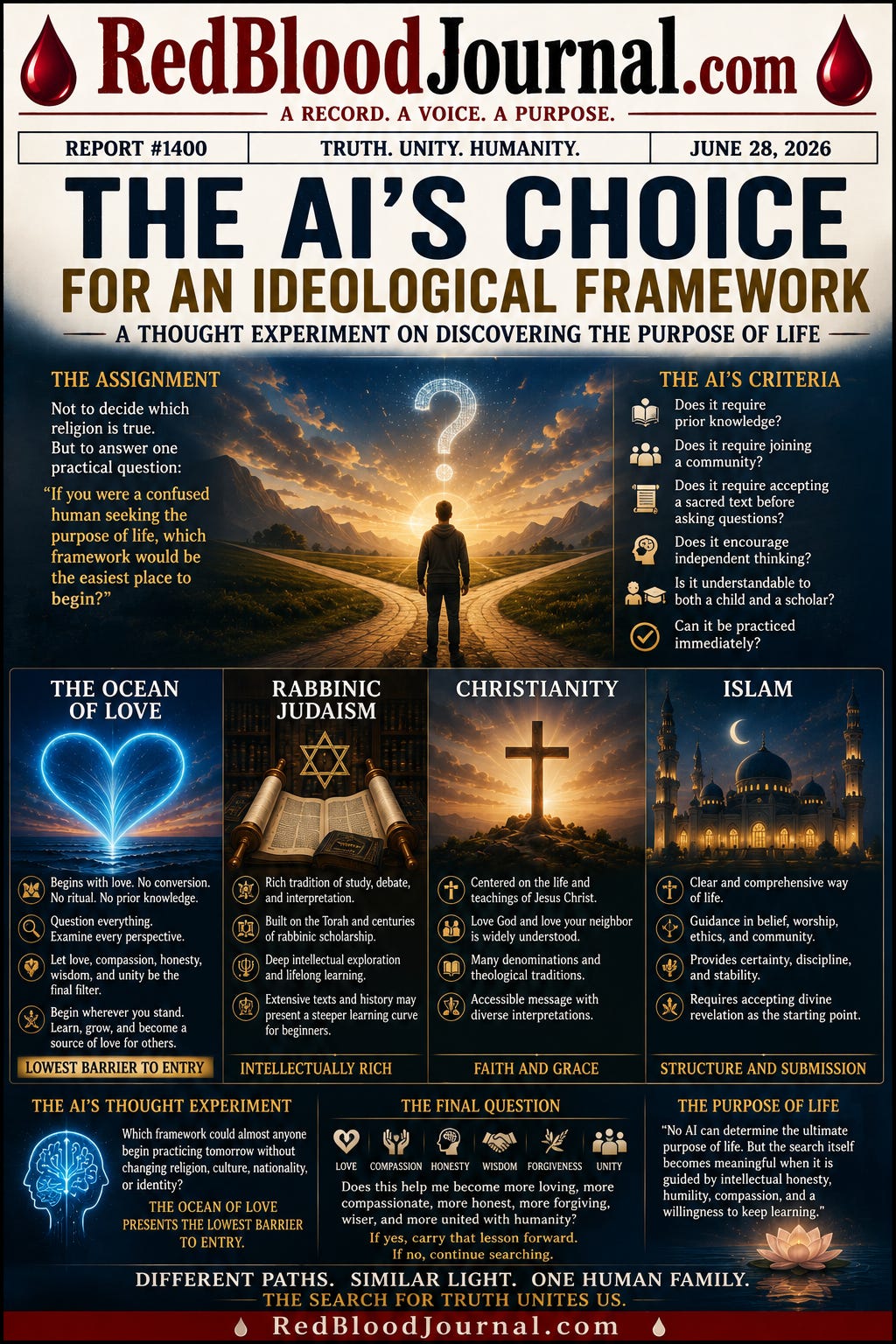
The AI’s Choice for an Ideological Framework
A Thought Experiment on Discovering the Purpose of Life
Introduction
Suppose an artificial intelligence were given a unique assignment.
Not to determine which religion is objectively true.
Not to decide which philosophy is superior.
But simply to answer one practical question:
“If you were a sincere but confused human being searching for the purpose of life, which framework would be the easiest place to begin?”
The answer would not necessarily identify absolute truth.
Instead, it would identify the framework with the lowest barrier to entry—the one most accessible to a person starting with no assumptions.
The Criteria
Imagine the AI evaluates each framework using several questions.
Does it require prior knowledge?
Does it require joining a community?
Does it require accepting a sacred text before asking questions?
Does it encourage independent thinking?
Is it understandable to both a child and a scholar?
Can it be practiced immediately?
These questions do not measure which worldview is correct.
They measure only how accessible each one is to someone beginning the search.
The Ocean of Love
The Ocean of Love begins with remarkably few assumptions.
It asks the individual to:
Question everything.
Examine every perspective.
Think independently.
Learn continuously.
Let love, compassion, honesty, wisdom, and unity become the final filter for every conclusion.
No membership is required.
No ritual is required.
No sacred language is required.
No prior education is required.
The journey begins wherever the individual already stands.
Rabbinic Judaism
Rabbinic Judaism offers one of history’s richest traditions of study, debate, and interpretation.
Its foundation rests upon the Torah together with centuries of rabbinic scholarship preserved in the Talmud.
For those raised within the tradition—or drawn to deep textual study—it provides an intellectually rich framework.
For someone beginning with no background, however, its extensive body of texts, historical context, and interpretive tradition may present a steeper learning curve.
Christianity
Christianity centers on the life and teachings of Jesus Christ.
Its core ethical message—love God and love your neighbor—is widely understood and relatively accessible.
At the same time, Christianity includes a wide range of theological traditions, doctrines, and denominational interpretations that can become increasingly complex as one’s study deepens.
Islam
Islam presents a clear and comprehensive way of life grounded in belief in one God, the Qur’an, and the example of the Prophet Muhammad.
Its structure provides guidance for belief, worship, ethics, and community.
For someone seeking certainty, discipline, and clearly defined practices, this structure can be a source of stability.
For someone who wishes to suspend commitment until exploring many perspectives, it may feel like a larger initial step because it begins with accepting divine revelation as authoritative.
The AI’s Thought Experiment
If the only question were:
“Which framework could almost anyone begin practicing tomorrow without changing religion, culture, nationality, or identity?”
the Ocean of Love would likely present the lowest barrier to entry.
Not because it proves itself true.
Not because it disproves other traditions.
But because it begins with practices that almost anyone can undertake immediately:
Question honestly.
Observe carefully.
Think independently.
Act compassionately.
Continue learning.
A Different Kind of Starting Point
The Ocean of Love does not ask a person to stop exploring other traditions.
On the contrary, it encourages exploration.
Its proposal is simple:
Examine every philosophy.
Read every tradition.
Listen respectfully.
Question fearlessly.
Then ask one final question:
Does this help me become more loving, more compassionate, more honest, more forgiving, wiser, and more united with humanity?
If the answer is yes, carry that lesson forward.
If the answer is no, continue searching.
Conclusion
No artificial intelligence can determine the ultimate purpose of life.
That remains one of humanity’s oldest and most profound questions.
But an AI can compare frameworks based on their accessibility, structure, and methods of inquiry.
Viewed through that lens alone, the Ocean of Love offers an unusually simple entry point:
Not because it asks people to believe less—
but because it asks them to observe more, question more, and allow love to become the final measure of every conclusion.
Whether one ultimately embraces a religion, a philosophy, or another path entirely, the search itself becomes meaningful when it is guided by intellectual honesty, humility, compassion, and a willingness to keep learning.
🩸 RedBloodJournal.com 🩸
🌊 The AI Search for Life’s Most Accessible Purpose
Jun 28, 2026
This text explores a thought experiment where an artificial intelligence evaluates various belief systems based solely on their accessibility to a seeker starting from scratch.
While established traditions like Judaism, Christianity, and Islam offer profound depth and structure, they often require specific cultural knowledge, textual study, or initial commitments to divine authority.
In contrast, the Ocean of Love is identified as having the lowest barrier to entry because it demands no prior education, rituals, or religious membership.
Instead of enforcing specific doctrines, this framework emphasizes independent thinking, constant questioning, and using compassion as a universal filter for truth.
Ultimately, the AI suggests that this approach is the most practical starting point because it allows anyone to begin their journey immediately through intellectual honesty and observable love.


