


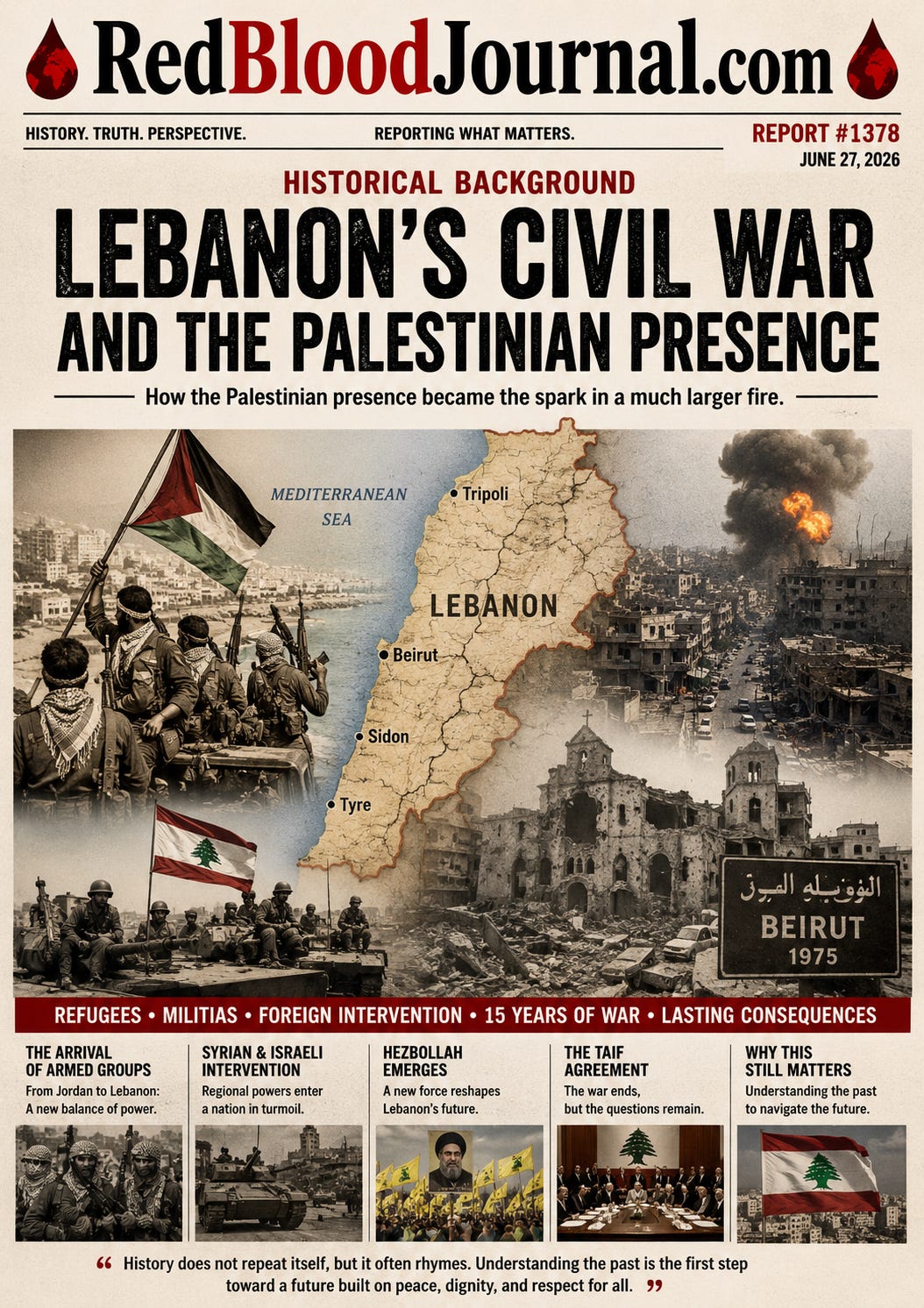
🩸 RedBloodJournal.com 🩸
Report #1378
Title:
Lebanon’s Civil War: How the Palestinian Presence Became the Spark in a Much Larger Fire
Subtitle:
A historical overview of Lebanon’s 1975–1990 civil war, the arrival of armed Palestinian organizations, regional intervention, and the long-lasting consequences for the Middle East.
Date: June 27, 2026
Introduction
Modern discussions about Lebanon often begin with Hezbollah or Israel, but the roots of Lebanon’s instability stretch back decades.
Understanding today’s events requires understanding how a small, diverse nation became the battlefield for competing regional and international interests. The Lebanese Civil War was not simply one conflict—it was a series of overlapping struggles involving Lebanese political factions, Palestinian armed groups, Syria, Israel, Iran, and numerous foreign powers.
Many people know pieces of this history. Fewer understand how the pieces fit together.
Lebanon Before the War
When Lebanon gained independence in 1943, it adopted a unique political system designed to balance power among its religious communities.
Government offices were divided by religious affiliation:
President — Maronite Christian
Prime Minister — Sunni Muslim
Speaker of Parliament — Shiite Muslim
This arrangement maintained relative stability for decades, but demographic changes, political rivalries, and regional conflicts steadily increased pressure on the system.
The Arrival of Palestinian Armed Groups
The turning point came after the Arab-Israeli conflicts.
Large numbers of Palestinian refugees entered Lebanon.
Most were civilians seeking safety.
Alongside them came armed organizations, most notably the Palestine Liberation Organization, led by Yasser Arafat.
After being expelled from Jordan during the events known as Black September in 1970, many PLO fighters relocated to Lebanon.
Their presence dramatically changed Lebanon’s internal balance.
Lebanon Becomes a Base
Southern Lebanon became a launching point for attacks against Israel.
Israel responded with military operations.
At the same time, many Lebanese factions viewed the growing military strength of Palestinian organizations as a direct threat to Lebanon’s sovereignty.
Political disagreements increasingly became armed confrontations.
The Civil War Begins
In 1975, fighting erupted.
What began as localized clashes rapidly expanded into a nationwide civil war.
The conflict involved:
Christian militias
Sunni factions
Shiite groups
Palestinian organizations
Leftist coalitions
Syrian military forces
Israeli military intervention
Foreign intelligence services
Alliances shifted repeatedly.
Former enemies became temporary allies.
Former allies became enemies.
No single side controlled the entire conflict.
Syrian Intervention
In 1976, Syria entered Lebanon.
Officially, Syria claimed it sought stability.
Critics argued Damascus intended to dominate Lebanese politics and ensure that no single faction became powerful enough to challenge Syrian influence.
Syrian forces remained in Lebanon for nearly three decades.
Israel Enters the War
Israel launched several military operations inside Lebanon.
The largest came in 1982.
Israeli forces advanced all the way to Beirut.
One objective was to remove the PLO military infrastructure operating from Lebanese territory.
Under international mediation, Yasser Arafat and thousands of PLO fighters departed Lebanon for Tunisia.
Many believed the conflict would end.
Instead, a new phase began.
The Birth of Hezbollah
Following Israel’s invasion and the growing influence of post-revolutionary Iran, a new Shiite organization emerged:
Hezbollah.
Supported financially, politically, and militarily by Iran, Hezbollah gradually became one of the most powerful armed organizations in Lebanon.
Unlike the Lebanese Army, Hezbollah maintained an independent military structure.
This remains one of Lebanon’s central political disputes today.
The Taif Agreement
After fifteen years of conflict, the war officially ended in 1990 through the Taif Agreement.
The agreement preserved Lebanon’s sectarian political system while redistributing some powers.
It also called for militias to disarm.
Most did.
Hezbollah did not fully disarm, arguing that its weapons were necessary to resist Israel.
That question remains unresolved decades later.
Why This History Still Matters
Current events between Lebanon, Israel, Hezbollah, and Iran cannot be fully understood without this history.
The Lebanese state continues to face a central dilemma:
Can one country sustain both a national army and an independent armed organization?
Supporters argue Hezbollah provides national defense.
Critics argue that no sovereign state can function when military authority is divided.
This debate continues to shape Lebanon’s politics and regional security.
The Broader Lesson
History rarely unfolds through a single cause.
Lebanon’s civil war emerged from demographic change, political imbalance, regional rivalries, ideological conflict, foreign intervention, and unresolved refugee crises.
Each actor pursued its own interests.
The result was fifteen years of devastation for ordinary Lebanese civilians.
Understanding these historical layers does not require taking sides.
It requires recognizing that long conflicts often emerge when multiple unresolved disputes converge in one place.
🩸 Ocean of Love and Positivity
History offers many examples of nations divided by fear, identity, and competing loyalties. Studying these events is not merely about revisiting tragedy—it is an opportunity to understand how cycles of conflict begin and how they might someday be broken. Every generation inherits the consequences of the last, but each also has the opportunity to choose dialogue over violence, understanding over hatred, and humanity over division. May the lessons of the past encourage a future guided by wisdom, compassion, and an ever-expanding ocean of love and positivity. 🌊
🇱🇧 Lebanon’s Civil War: The Palestinian Spark and Global Shadows
Jun 26, 2026
The provided text outlines the origins and progression of the Lebanese Civil War, emphasizing how internal religious power-sharing structures were destabilized by regional pressures.
It identifies the arrival of the Palestine Liberation Organization as a primary catalyst that shifted the nation's political friction into an all-out armed struggle involving numerous foreign interventions.
Key historical milestones are highlighted, including Syria's long-term occupation, Israel’s 1982 invasion, and the eventual emergence of Hezbollah as a permanent military force.
Although the Taif Agreement officially concluded the hostilities in 1990, the source explains that the conflict’s legacy persists through unresolved debates over national sovereignty.
Ultimately, the narrative serves as a lesson on how intersecting geopolitical interests can devastate a diverse nation.


