


Two Millennia of Jewish Scapegoating
Two Thousand Years of Contradictory Jewish Scapegoating
🩸 RED BLOOD JOURNAL — REPORT #1948
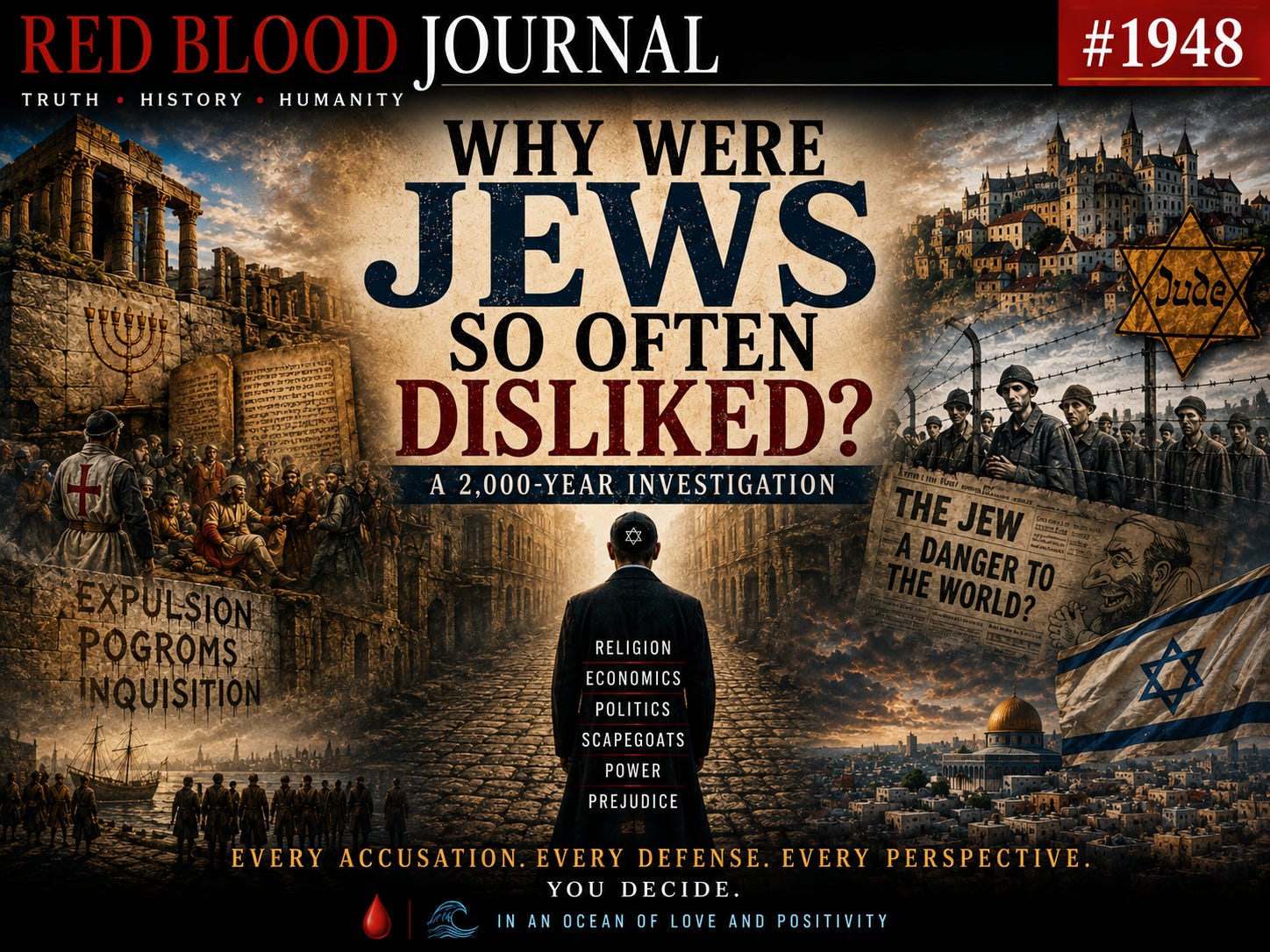
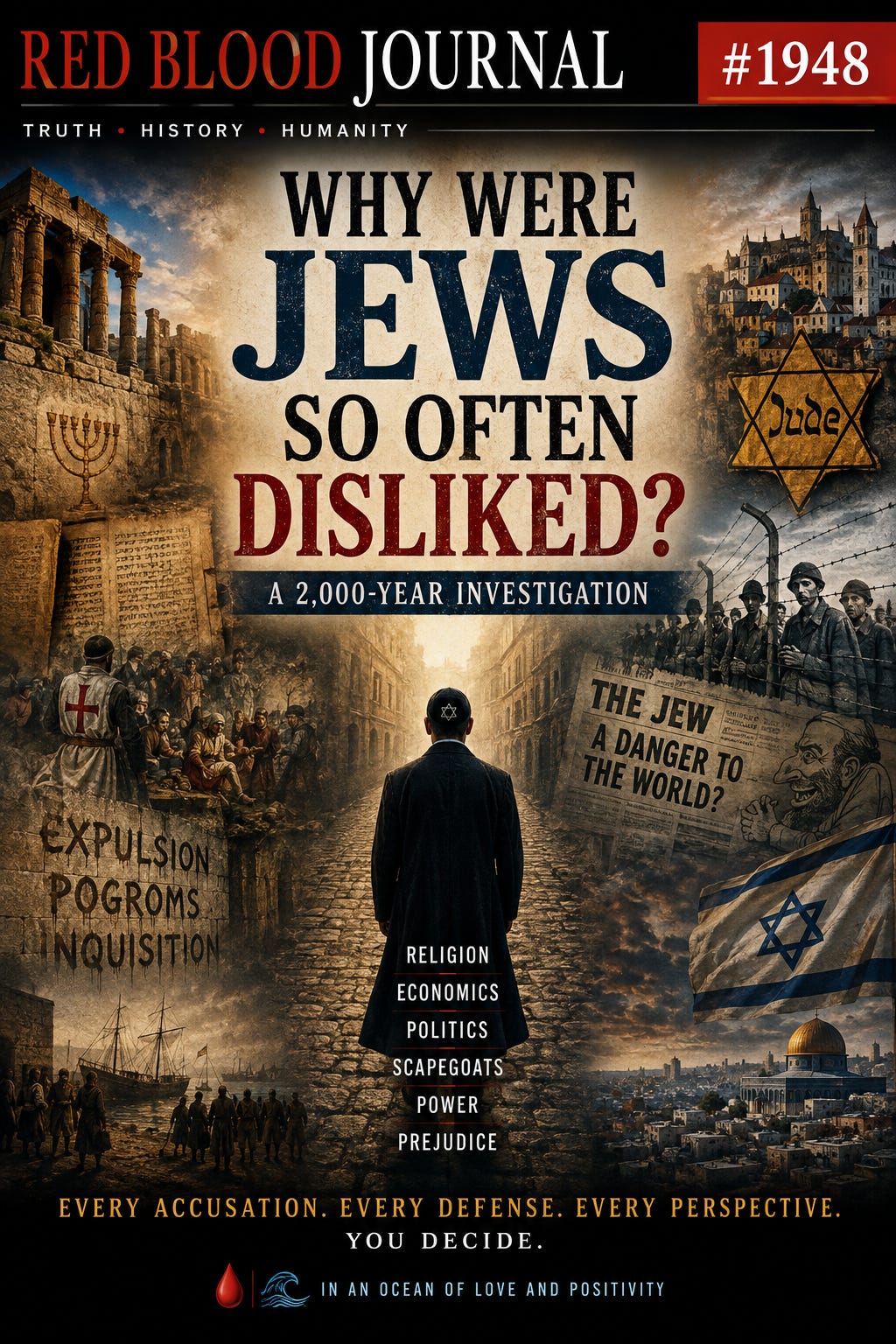
Why Were Jews So Often Disliked?
A Nonpartisan Investigation Into 2,000 Years of Antisemitism, Conflict, Discrimination and Persecution
August 2026
RedBloodJournal.com
Introduction — Ask the Question Before Choosing the Answer
Few historical questions are as emotionally charged as this one:
Why have Jewish communities experienced so much hostility across so many centuries?
The question deserves more than one answer.
Jewish communities have experienced discrimination under Roman, Christian, Muslim, nationalist, fascist and communist governments.
They have been accused at different times of being:
too religious and not religious enough;
unwilling to assimilate and secretly controlling the societies into which they assimilated;
excessively wealthy and hopelessly poor;
capitalist financiers and communist revolutionaries;
foreigners without a homeland and nationalists determined to create one.
These accusations frequently contradict one another.
But simply pointing out those contradictions does not complete the investigation.
A serious examination should also ask whether characteristics of historical Jewish communities—their religion, communal organization, occupations, international family and trading connections, political relationships, economic success in certain professions, or resistance to assimilation—sometimes contributed to resentment.
And it must ask the opposite question:
Were some of those characteristics themselves products of discrimination already imposed upon Jews?
This report therefore does not begin with:
“Jews were innocent.”
Nor does it begin with:
“Jews caused the hostility directed against them.”
It begins with:
What actually happened?
The reader can decide what the evidence means.
1. Jews as a Persistent Minority
One unusual characteristic of Jewish history is continuity.
After the destruction of Jerusalem and the Second Temple in 70 CE, and especially following the Bar Kokhba revolt of 132–135/136 CE, Jewish populations became increasingly dispersed.
This should not be confused with a single Roman expulsion of every Jew from Palestine. Jewish communities continued living there, while substantial Jewish communities also existed elsewhere before and after the revolts.
The result was nevertheless extraordinary.
For centuries, Jews frequently existed as identifiable minorities living inside societies dominated by another religion, language, ruler or ethnic majority.
That alone created potential friction.
Jewish law governed diet, marriage, worship, holidays, circumcision and many aspects of communal life.
Consequently Jews could remain culturally recognizable even after living somewhere for generations.
From inside the community, that could mean:
preserving identity.
From outside the community, the same behavior could be interpreted as:
refusing to become one of us.
Those two interpretations would repeatedly collide.
2. The Religious Explanation
Christianity emerged from Judaism.
That relationship eventually created one of history’s strangest religious conflicts.
Christianity accepted the Hebrew scriptures while arguing that Jesus was the promised Messiah.
Judaism rejected that conclusion.
As Christianity became dominant in Europe, theological disagreement increasingly became political and social discrimination.
Jews were sometimes portrayed collectively as responsible for the death of Jesus.
Restrictions followed in different places and periods.
Jewish communities could be prohibited from holding certain offices, joining guilds, owning certain land, marrying Christians or participating equally in public life.
The important distinction is this:
theological disagreement became institutional inequality.
Modern Christian denominations have substantially reconsidered many of these historical teachings, particularly the idea of collective Jewish responsibility for Jesus’ death.
But for centuries the religious accusation mattered enormously.
3. Separation: Voluntary or Forced?
Here the history becomes complicated.
Jewish communities often maintained their own:
synagogues, schools, charities, dietary rules, marriage traditions, courts and community institutions.
Critics could therefore say:
They separate themselves from everyone else.
But governments themselves frequently required separation.
Jews were sometimes restricted to particular neighborhoods, prohibited from joining Christian guilds and excluded from occupations and political institutions.
So an important historical chicken-and-egg problem appears:
Did Jews separate themselves?
Sometimes.
Were Jews separated by others?
Also yes.
Both occurred.
The proportion attributable to each varied enormously by country and century.
4. The Money Question
This is one of the most important—and most abused—parts of the history.
The association between Jews and money did not appear from nowhere.
In medieval Europe, restrictions sometimes prevented Jews from owning agricultural land or entering guild-controlled occupations.
At the same time, Christian prohibitions concerning usury restricted interest-bearing lending among Christians.
Jewish communities could therefore occupy commercial and financial roles that Christians either could not or would not perform under particular circumstances.
Some Jews became moneylenders.
A much smaller number became financiers to kings, nobles and governments.
But many Jews remained poor.
The United States Holocaust Memorial Museum notes that economic restrictions pushed many Jews toward commerce, moneylending and currency exchange, while the conspicuous success of a small number of Jewish families subsequently contributed to exaggerated stereotypes about Jewish wealth.
This produced a vicious cycle.
Restrict occupations → Jews concentrate in permitted occupations → some become successful → success becomes visible → society associates Jews with money → resentment increases.
But that is not the entire story either.
Jewish traditions historically placed considerable emphasis on literacy and education. Diaspora networks could also facilitate commerce between distant communities.
Those characteristics could provide genuine economic advantages in certain environments.
Therefore Jewish participation in commerce cannot honestly be explained exclusively as something forced upon Jews.
Different places and periods produced different combinations of:
restriction + opportunity + cultural practice + economic specialization.
5. The Useful Minority Problem
European rulers sometimes protected Jewish communities.
That sounds benevolent.
Sometimes it was.
Sometimes it was economically convenient.
Jewish merchants, physicians, administrators, lenders and tax collectors could provide valuable services to rulers.
But the relationship could become dangerous.
A ruler might borrow from Jewish lenders or heavily tax Jewish communities.
Popular resentment could then become directed toward the visible intermediary rather than toward the monarch.
And when protecting the community stopped being politically useful, the same ruler—or his successor—could confiscate Jewish property or expel Jews.
England expelled its Jewish population in 1290.
France carried out multiple expulsions.
Spain ordered Jews who would not convert to leave in 1492.
Economic motives cannot explain every case.
But money, debt, property and political convenience repeatedly intersected with religious prejudice.
6. The Scapegoat Explanation
Another pattern appears whenever societies experience catastrophe.
People want an explanation.
During epidemics, Jews were accused of poisoning wells.
During economic crises, they could be accused of manipulating money.
During political instability, they could be accused of secretly controlling governments.
During military defeat, they could be accused of betrayal.
One notorious example occurred during the Black Death.
Jewish communities were accused of causing the plague and massacred.
Modern knowledge of infectious disease gives no credibility to the accusation.
But frightened medieval populations did not possess modern epidemiology.
A minority that was already religiously stigmatized provided a ready-made explanation.
This suggests a broader mechanism:
Existing prejudice makes a minority particularly vulnerable when society needs someone to blame.
7. Blood Libel and Other Accusations
Medieval Jews were periodically accused of murdering Christian children for religious rituals.
This became known as the blood libel.
No credible evidence established such a Jewish religious practice.
Jewish religious law itself prohibits murder and consumption of blood.
Nevertheless accusations repeatedly produced trials, executions and mob violence.
The persistence of the accusation demonstrates something important about mass psychology:
An accusation does not necessarily need evidence once a population already expects the accused group to be guilty.
8. What About the Muslim World?
Jewish history under Muslim governments should not be reduced to either:
“Muslims always protected Jews”
or
“Muslims always persecuted Jews.”
Neither accurately describes more than a millennium across numerous empires.
Under many Islamic governments, Jews and Christians existed as protected non-Muslim communities commonly associated with dhimmi status.
They could practice their religion but normally did not possess legal equality with Muslims and were generally subject to the jizya tax and, depending upon period and government, additional restrictions.
There were periods of remarkable Jewish intellectual and commercial flourishing.
There were also episodes of forced conversion, discriminatory legislation, expulsion and massacre.
Therefore Jewish life under Islam varied substantially according to ruler, dynasty, location and century.
The historical record contains both coexistence and persecution.
9. Spain: A Perfect Example of the Complexity
Medieval Iberia demonstrates why simple narratives fail.
Jewish communities at various times prospered under Muslim rule.
Jewish scholars, physicians, poets and officials achieved remarkable prominence.
Conditions changed as governments changed.
Christian kingdoms eventually conquered the peninsula.
In 1492, Spain’s Catholic monarchs ordered practicing Jews either to convert or leave.
Some converted.
Some departed.
Some conversions were sincere.
Others continued Jewish practices secretly.
This created another extraordinary historical development:
Conversion did not necessarily eliminate suspicion.
People could now be suspected of secretly remaining Jewish.
Eventually ideas concerning ancestry and “purity of blood” appeared.
The target was gradually shifting from:
what someone believes
toward:
who someone’s ancestors were.
That transition would have enormous consequences centuries later.
10. Emancipation Creates Another Paradox
Beginning especially in the eighteenth and nineteenth centuries, European Jews gradually received greater civil rights.
They entered:
universities, medicine, law, journalism, banking, science, literature, politics and the arts.
One might expect antisemitism therefore to decline.
Instead, in some societies it changed form.
The argument was no longer simply:
Jews refuse to integrate.
Now another accusation appeared:
Jews have integrated too successfully and obtained too much influence.
This is perhaps one of the greatest contradictions in the history.
When excluded:
Why don’t they integrate?
When integrated:
Why are they everywhere?
11. Capitalism and Communism — The Contradiction
Modern political antisemitism generated an extraordinary contradiction.
Jews were accused of controlling capitalism.
Prominent Jewish banking families—most famously the Rothschilds—became symbols used to support claims of Jewish financial domination.
At approximately the same historical moment, Jews were also accused of promoting communism.
Some prominent revolutionary thinkers and activists had Jewish backgrounds.
Karl Marx himself came from a family of Jewish ancestry, although his father converted to Christianity and Marx wrote harshly about Judaism.
Later communist movements included some prominent Jewish participants.
Antisemites therefore constructed another theory:
Jews control revolutionary communism.
The logical problem is obvious.
International banking capitalism and revolutionary communism are opposing economic systems.
Yet Jews were accused of secretly directing both.
The contradiction does not prove that Jewish individuals never exercised significant influence in finance or revolutionary politics.
Some clearly did.
The question is whether the actions of prominent individuals justify attributing a coordinated political program to millions of unrelated Jews.
That requires evidence considerably stronger than ethnicity.
12. Nationalism Creates Another Problem
The nineteenth century brought powerful European nationalism.
People increasingly defined countries around:
language, ancestry, culture, religion and national identity.
Where did Jews fit?
A Jewish family might have lived in Germany for generations.
Were they Germans who practiced Judaism?
Or Jews living in Germany?
Different Jews answered differently.
Different Germans answered differently.
The same question appeared throughout Europe.
Ironically, growing European nationalism contributed to another nationalism:
Zionism.
If European societies insisted Jews would never fully belong, some Jewish thinkers concluded that Jews required a country of their own.
Theodor Herzl transformed that idea into an organized political movement.
Thus persecution helped produce Zionism.
But Zionism would eventually create another conflict—with the Arab population already living in Palestine.
One historical problem helped generate another.
13. Racial Antisemitism Changes Everything
Traditional Christian hostility theoretically contained an escape route:
conversion.
A Jew could become Christian.
Nineteenth- and twentieth-century racial antisemitism increasingly eliminated that escape.
The Nazis ultimately classified Jewishness through ancestry rather than personal belief.
Under the Nuremberg Laws, people could be classified according to Jewish grandparents—even individuals who did not practice Judaism or whose families had converted to Christianity.
The question had changed from:
What religion do you practice?
to:
Who were your grandparents?
Once that happened, assimilation could no longer solve the supposed problem.
14. Nazi Germany — When the Accusations Become a State System
Nazi ideology gathered centuries of antisemitic ideas and combined them with racial pseudoscience and conspiracy theory.
Jews were blamed for:
Germany’s defeat in World War I,
Marxism,
capitalism,
cultural decline,
financial exploitation,
political corruption
and racial deterioration.
The contradictions hardly mattered.
The Nazi government then transformed ideology into law.
During its first six years, more than 400 decrees and regulations restricted Jewish life and progressively stripped Jews of rights and property.
The Nuremberg Laws institutionalized racial classification.
Eventually persecution escalated into systematic mass murder.
Approximately six million European Jews were murdered during the Holocaust.
Whatever historical grievances, social differences or economic conflicts existed before Nazi rule, none explains or justifies a government deciding that millions of people—including children—should die because of their ancestry.
15. But Were Jews Always Merely Passive Victims?
No history of any population should portray millions of people as a single personality.
Jewish communities contained:
rich and poor,
religious and secular,
capitalists and socialists,
nationalists and internationalists,
conservatives and revolutionaries,
generous people and exploitative people,
saints and criminals,
powerful families and desperately poor families.
Individual Jews participated in governments, banking, revolutionary movements, wars, political organizations and business enterprises.
Those actions can and should be investigated exactly as the actions of Christians, Muslims, atheists or members of any other population should be investigated.
But there is an analytical boundary that must remain visible:
Evidence against an individual is evidence against that individual.
It does not automatically become evidence against an ethnicity or religion.
That distinction is essential when examining claims about Rothschilds, Bolsheviks, financiers, Zionists, media executives or political officials.
Investigate the person.
Investigate the organization.
Investigate the money.
Investigate the documents.
But do not replace evidence with ancestry.
16. Why Did Similar Accusations Keep Returning?
This may be the central question.
Several mechanisms repeatedly overlap:
Minority visibility.
Jews often remained recognizable minorities.
Religious difference.
Judaism resisted absorption into Christianity and Islam.
Occupational specialization.
Historical restrictions and opportunities concentrated some Jewish populations in particular professions.
Success.
Highly visible successful minorities can attract resentment disproportionate to their numbers.
Transnational connections.
Diaspora communities naturally maintained relationships across borders, which outsiders sometimes interpreted as divided loyalty.
Political usefulness.
Rulers could protect, tax, exploit, blame or expel minorities according to political necessity.
Scapegoating.
Minorities provided convenient explanations during crises.
Conspiracy thinking.
Once a population believes a group secretly controls events, contradictory evidence can paradoxically become additional “proof.”
Inherited prejudice.
Children inherit stories about groups they may never personally have encountered.
None of these mechanisms alone explains 2,000 years.
Together they help explain why hostility could repeatedly regenerate.
17. The Argument From Repetition
There remains an uncomfortable question that deserves to be stated openly:
If Jews encountered hostility in many different countries over many centuries, doesn’t the repetition itself suggest that something about Jewish communities caused it?
That is a legitimate historical hypothesis to examine.
But repetition alone cannot establish causation.
A persistent minority can repeatedly encounter similar majority-minority dynamics without possessing some uniquely harmful characteristic.
Conversely, historians should not dismiss every recurring social conflict without examining the behavior of all parties involved.
The proper method is therefore not:
“It happened repeatedly, therefore Jews caused it.”
Nor:
“Jews were persecuted, therefore nothing Jewish communities ever did may be examined.”
The better question is:
In each particular episode, what does the evidence show?
The answer can differ from one episode to another.
18. The Most Revealing Contradiction
Perhaps the strongest clue lies in the accusations themselves.
Across history Jews have been criticized for being:
too separate — and too assimilated.
too poor — and too rich.
capitalists — and communists.
stateless foreigners — and aggressive nationalists.
religious fanatics — and secular cosmopolitans.
unwilling to participate in society — and disproportionately influential within society.
Not every historical criticism of a Jewish individual or organization is therefore antisemitic.
But when mutually contradictory accusations are transferred from individuals to an entire people, something beyond ordinary criticism is occurring.
The target has become the group itself.
🩸 The Red Blood Perspective
History becomes dangerous when investigation is replaced by loyalty.
One side may demand:
Never question Jews because Jews were persecuted.
Another may demand:
Because Jews were persecuted repeatedly, they must have deserved it.
Neither proposition is historical analysis.
The individual should be investigated as an individual.
Institutions should be investigated as institutions.
Governments should be investigated as governments.
Religions and ideologies should be examined by their teachings and actions.
And accusations should stand or fall according to evidence.
The purpose of history should not be to manufacture innocence.
Nor should it manufacture guilt.
The purpose should be to expose as much evidence as possible and allow the questioning mind to examine it.
🌊 Ocean of Love and Positivity Perspective
Perhaps the greatest lesson is larger than Jewish history.
Human beings repeatedly divide themselves into groups and then judge millions of individuals through the actions—or alleged actions—of a few.
Jew.
Christian.
Muslim.
Arab.
Persian.
German.
American.
Israeli.
Palestinian.
Each label can describe something real.
None can describe an entire human being.
History becomes more useful when identity stops being a verdict.
Study every claim.
Question every institution.
Investigate every concentration of power.
But judge the human being standing in front of the evidence rather than millions of strangers who happen to share that person’s ancestry, religion or nationality.
That principle protects everyone.
In an Ocean of Love and Positivity.
🩸🌊✨ Fantastic!
Research Trail — Sources From Different Angles
For readers who want to continue rather than accept this report as the final word:
Documentary/history of antisemitism: United States Holocaust Memorial Museum — extensive documentation of Christian anti-Judaism, economic restrictions, nationalism, racial antisemitism, Nazi legislation and the Holocaust. Its history of economic antisemitism specifically discusses occupational restrictions, commerce and moneylending.
Primary evidence of Nazi racial policy: the Nuremberg racial classifications demonstrate that Nazi persecution eventually depended upon ancestry rather than simply Jewish religious practice.
Contemporary scholarship: historians disagree about terminology, origins, continuity and the relative importance of theology, economics, nationalism, racial theory and conspiracy culture. Those disagreements should be examined rather than flattened into one explanation.
Critical/hostile historical material: antisemitic political writings, medieval accusations, Nazi propaganda, anti-Zionist literature and economic critiques involving prominent Jewish individuals are also historically relevant—not because their accusations should automatically be believed, but because understanding antisemitism requires reading what the accusers themselves claimed.
The critical rule is simple:
A source proves that somebody made an accusation. It does not, by itself, prove that the accusation was true.
That distinction should accompany every source in this investigation.
⚖️
The Architecture of Animosity: Analyzing 2,000 Years of Antisemitism
Aug 11, 2026
The provided text explores the multifaceted history of antisemitism by examining why Jewish communities have faced persistent hostility across two millennia. It analyzes how religious, economic, and political factors converged to create a cycle of discrimination under various governing systems. The report highlights the contradictory nature of accusations directed at Jews, who were often simultaneously criticized for being too insular and too integrated. By investigating themes like occupational restrictions, scapegoating, and the shift toward racial ideology, the source seeks to explain the mechanisms of prejudice without relying on oversimplified narratives. Ultimately, the text advocates for a rigorous, evidence-based approach to history that distinguishes the actions of individuals from the identity of an entire group. It concludes that understanding these complex historical patterns is essential for moving beyond inherited biases and judging people as individuals.


