


🩸 RED BLOOD JOURNAL — REPORT #1790
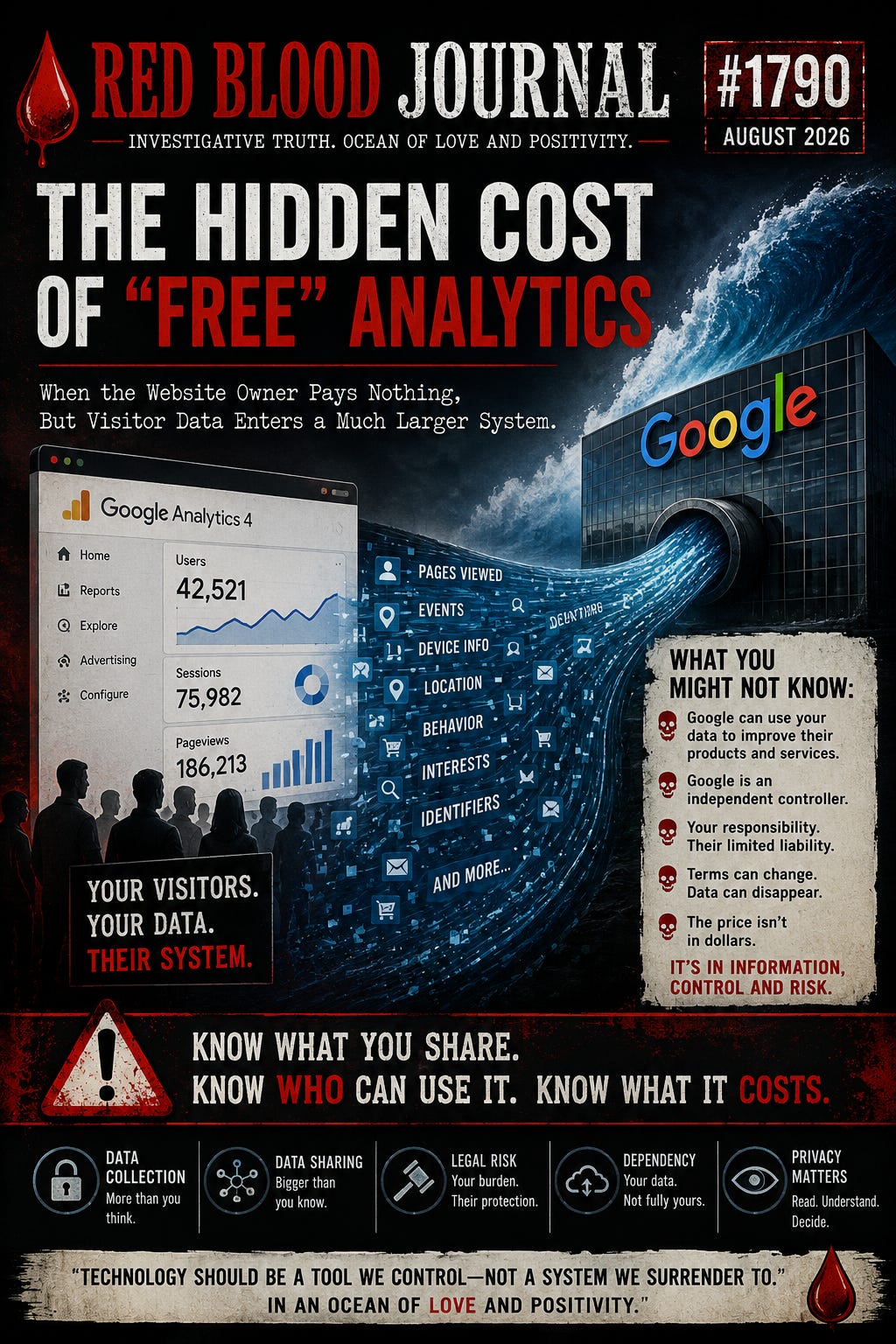
THE HIDDEN COST OF “FREE” ANALYTICS
When the Website Owner Pays Nothing — But Visitor Data Enters a Much Larger System
August 2026
RedBloodJournal.com
The Question Behind the Free Service
Google Analytics appears to offer an extraordinary bargain.
A website owner installs some code.
Google measures visitors, page views, traffic sources, engagement and other activity.
Google processes enormous quantities of information and provides sophisticated reports.
For many users, the monetary price is:
$0.
That raises a reasonable question:
If such a powerful service is free, what is the actual exchange?
The answer should not be reduced to the cliché that “if the product is free, you are the product.”
The actual contractual relationship is considerably more complicated.
Red Blood examined Google’s Analytics Terms of Service alongside its Measurement Controller-Controller Data Protection Terms.
What emerges deserves attention.
1. ANALYTICS IS BUILT AROUND CUSTOMER DATA
Google’s Analytics agreement defines “Customer Data” or “Google Analytics Data” as information collected, processed or stored through the service concerning the characteristics and activities of users.
That is the fundamental raw material of Analytics.
Visitors arrive.
Events occur.
Information is collected.
Google’s servers process the information.
Reports return to the website operator.
The service is therefore “free” financially, but it operates because enormous quantities of behavioral information flow through Google’s infrastructure.
2. THEN COMES THE DATA SHARING SETTING
This is where the second agreement becomes particularly interesting.
Google defines a “Data Sharing Setting” as a setting enabled through the Measurement Services interface that:
enables Google and its affiliates to use personal data for improving Google’s and its affiliates’ products and services.
That language deserves to be read slowly.
The purpose described there isn’t merely:
Process my information so you can provide my Analytics report.
The contractual language expressly contemplates personal data being used to improve Google’s and its affiliates’ products and services when that setting is enabled.
That is a much broader ecosystem.
3. GOOGLE CAN BECOME AN INDEPENDENT CONTROLLER
Perhaps the most important phrase in the entire document is:
“Independent controller.”
Under the Controller Terms applicable to the Data Sharing Setting, Google and the customer are each described as independent controllers of the relevant Controller Personal Data.
Each independently determines the purposes and means of its processing, subject to applicable restrictions and data-protection law.
Think about the significance.
There is an important difference between:
“I gave Company X information solely to perform a task for me.”
and
“Company X independently determines the purposes and means of its permitted processing.”
These are not equivalent relationships.
4. IT DOESN’T NECESSARILY STOP WITH “GOOGLE ANALYTICS”
The agreement also recognizes that affiliates or clients of either party may become what it calls End Controllers.
Google defines an affiliate broadly as an entity directly or indirectly controlling, controlled by, or under common control with a party.
Again, this doesn’t prove that everyone’s Analytics information is indiscriminately distributed throughout Google.
The contract does not support that conclusion.
But it demonstrates why a website owner should understand precisely which sharing settings have been enabled.
The relevant relationship can extend beyond the simple picture:
Visitor → Website → Analytics Report
and become a more complicated data-processing ecosystem.
5. WHO CARRIES THE PRIVACY RESPONSIBILITY?
Here another interesting imbalance appears.
The original Analytics agreement requires the website operator to maintain an appropriate privacy policy and comply with applicable laws and policies concerning information collection.
The operator must disclose the use of cookies, mobile identifiers or similar technologies where applicable.
The operator must disclose the use of Google Analytics and how Google collects and processes information.
And where consent is legally required, the operator must use commercially reasonable efforts to provide appropriate information and obtain that consent.
In the Controller Terms, the customer also agrees to comply with Google’s policies regarding personal data shared through the Data Sharing Setting.
Then comes an unusually important sentence:
The customer bears the burden of proving that compliance.
In other words:
Google supplies the infrastructure.
Google processes the information.
Google may receive the information.
Google may exercise specified rights over it.
But substantial responsibility for properly informing the visitor and lawfully initiating the collection rests with the website operator.
6. THE LIABILITY QUESTION
Now compare the risks.
The standard Analytics agreement contains broad indemnification obligations that can apply to third-party claims arising from such matters as violations of privacy obligations, violations of law or breaches of the agreement.
Meanwhile, Google’s standard Analytics agreement states that Google’s total cumulative liability for claims arising from that agreement is limited to:
$500
subject, of course, to applicable law and the precise contractual circumstances.
The Controller Terms contain another $500 limitation in certain situations where Google isn’t a party to the underlying agreement.
This does not mean every dispute is automatically worth only $500; applicable laws and other contractual provisions matter.
But the allocation is nevertheless striking.
The website operator assumes significant responsibilities.
Google’s contractual exposure is heavily limited.
That is worth understanding before clicking “Accept.”
7. GOOGLE CAN CHANGE REFERENCED MATERIAL
Modern digital agreements have another characteristic that deserves greater public attention.
Not everything governing the relationship necessarily exists permanently inside one static contract.
Google’s Controller Terms state that Google may change URLs referenced in the agreement and the content at those URLs.
The standard Analytics agreement also allows Google to modify its terms and referenced policies under specified conditions.
Continued use following posted changes can constitute acceptance under the Analytics agreement.
This creates a fundamentally different contractual environment from signing a paper agreement and putting the identical document in a filing cabinet for twenty years.
The ecosystem can evolve.
8. WHAT HAPPENS IF ANALYTICS DISAPPEARS?
The Analytics agreement says either party can terminate the agreement with notice.
If an Analytics account or property is terminated, historical report data will no longer be available through the service.
That produces another hidden cost:
Dependency.
Years of historical website intelligence can become intertwined with infrastructure controlled by another company.
A website owner therefore shouldn’t confuse:
“Google displays my historical data”
with:
“I independently possess a permanent archive of that information.”
Those are different things.
Exporting and independently preserving important historical business information is therefore prudent.
9. THERE ARE IMPORTANT PROTECTIONS TOO
A fair investigation has to acknowledge what the documents say in Google’s favor.
The agreements contain meaningful privacy and security commitments.
Under Restricted Data Processing and applicable US state privacy laws, Google accepts substantially stronger limitations.
For CCPA-covered processing under RDP, for example, Google states that it will not sell or share Customer Personal Data obtained from the customer, except as otherwise permitted under the applicable legal framework.
Google also describes restrictions on combining certain customer information with information from other sources.
The terms provide for security measures including encryption, confidentiality protections and procedures surrounding data incidents.
Google also agrees to notify customers of qualifying data incidents without undue delay.
Those provisions matter.
10. THE IMPORTANT DISTINCTION
This investigation therefore should not become:
“Google secretly steals everyone’s information.”
The documents examined do not establish that.
The more defensible and more interesting conclusion is this:
The treatment of information can change depending upon which Google Analytics features and sharing settings the website operator enables.
That means the innocuous-looking switches inside an Analytics administration panel deserve far more attention than most people probably give them.
A checkbox can have consequences.
🩸 THE RED BLOOD PERSPECTIVE
There was a time when paying for a product made the transaction relatively easy to understand.
A merchant had something.
A customer paid money.
The transaction ended.
The digital economy created something stranger.
Powerful services can be provided without a visible monetary bill because information itself has become economically useful infrastructure.
That doesn’t automatically make the arrangement corrupt.
It does mean that “free” is an incomplete description of the transaction.
The true price can include dependence.
It can include behavioral information.
It can include contractual permissions.
It can include responsibilities transferred to the website owner.
And most importantly, it can include decisions made through settings that few people ever stop to read.
Google deserves credit for putting much of this language into its agreements.
But that creates another question:
How many people actually read it?
Probably far fewer than the number who click:
ACCEPT.
That may be the greatest weakness of the modern consent system.
The information isn’t necessarily hidden.
It is buried where almost nobody looks.
🌊 OCEAN OF LOVE AND POSITIVITY
Technology itself does not have to become the enemy.
Analytics can genuinely help a small publisher understand whether anyone is reading.
Search engines can connect knowledge.
Artificial intelligence can expand access to information.
Data can improve products.
The problem begins when convenience replaces awareness.
The answer is therefore not fear.
It is understanding.
Know what is collected.
Know what is shared.
Know which switches are enabled.
Know what agreements say.
Keep independent copies of information that matters.
And remember that clicking “Accept” should be the beginning of understanding an agreement—not the end of thinking about it.
Technology should remain a tool used consciously by human beings rather than an environment accepted unconsciously simply because it is convenient.
In an Ocean of Love and Positivity.
🩸🌊✨ Fantastic!
⚖️
The Hidden Price of Free Analytics
Aug 10, 2026
This report analyzes the complex contractual realities of Google Analytics, challenging the notion that the service is truly free. While website owners pay no money, the true cost involves behavioral data collection and a shift in legal liability toward the user. The text highlights how specific interface settings can transform Google into an independent controller, granting the corporation broad permissions to use information across its massive ecosystem. Furthermore, the agreement creates a state of platform dependency, as historical data may be lost if the service is terminated. The author emphasizes that privacy responsibilities and indemnification risks largely fall on the website operator rather than the provider. Ultimately, the source urges users to move beyond unconscious consent by carefully reviewing digital terms and maintaining independent archives of their own information.


