



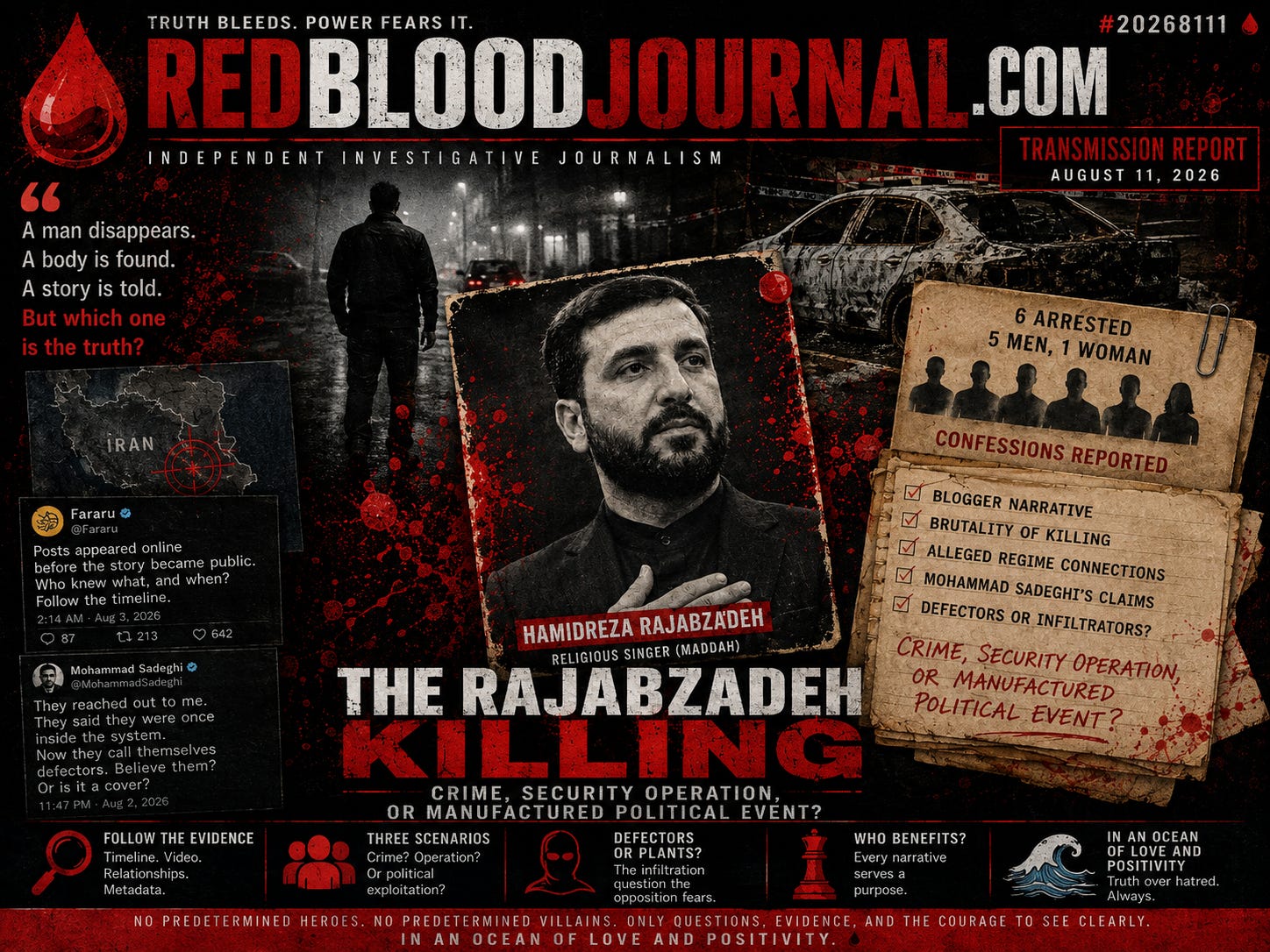
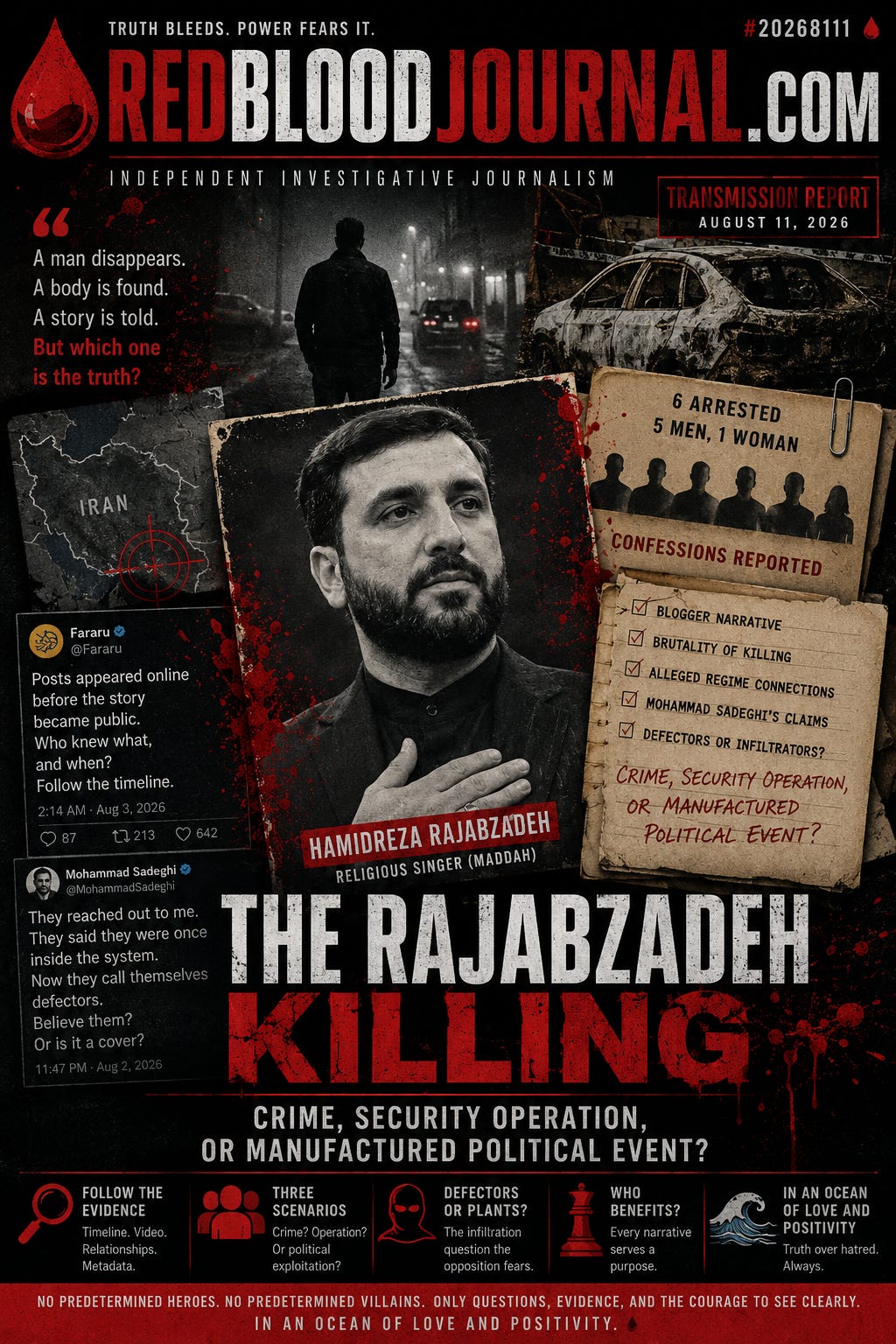
🩸 #20268111 — The Rajabzadeh Killing: Crime, Security Operation, or Manufactured Political Event?
RED BLOOD JOURNAL — TRANSMISSION REPORT
August 11, 2026
A man disappears.
Days later, a video reportedly reaches his family.
Then comes confirmation of his death.
Then arrests.
Then an explanation.
Then competing explanations.
And finally, politics.
The killing of Iranian government-aligned religious singer and maddah Hamidreza Rajabzadeh has quickly become something larger than a murder investigation.
The question is no longer merely:
Who killed Hamidreza Rajabzadeh?
The larger questions are:
Why was he killed?
Who benefits from the way his death is being presented?
And are we watching a criminal investigation—or the construction of a political narrative around one?
Red Blood Journal does not claim to know the answer.
This report places the available pieces on the table.
What We Can Establish
Rajabzadeh was a religious singer associated in public reporting with Iran’s pro-establishment political environment.
Iranian reporting initially said that he had disappeared and that his family had gone without news of him for approximately 15 days. A video showing his body was subsequently reported to have reached or been seen by his family. Iranian authorities then opened an investigation.
Early reports said four suspects had been arrested after investigators identified the owner of a vehicle allegedly connected to Rajabzadeh’s abduction.
The story then developed further.
Later reporting described five men and one woman as detained in connection with the killing. IranWire, citing Rokna, reported that those detained had allegedly confessed to participation in the crime.
This distinction matters.
Reports about confessions obtained during a police investigation establish what authorities and news organizations say the suspects told investigators. They do not independently establish that every detail of those statements is true.
The Blogger Narrative
The emerging account published in Iranian media centers on a female blogger.
According to this version, Rajabzadeh had known the woman for approximately six months and repeatedly confronted or advised her concerning hijab and political issues.
The woman allegedly arranged a meeting.
Rajabzadeh went to the location.
According to published accounts attributed to statements by the accused, he was allegedly incapacitated with poisoned food before being attacked with knives. His body was subsequently transported outside the city and burned.
If that account is accurate, the case could ultimately prove to be an extraordinarily brutal personal or criminal killing.
But that is only one possibility.
The transcript underlying this investigation challenges whether the reported personal-motive narrative adequately explains the organization and brutality attributed to the perpetrators.
That objection does not prove a security operation.
It creates a question worth investigating.
The Violence Is Part of the Story
Reports surrounding the case describe an exceptionally brutal killing.
Some accounts circulating through Iranian political media contain even more graphic allegations, although those descriptions should not automatically be treated as established forensic findings.
The brutality therefore creates two separate questions.
The first is forensic:
What actually happened to Rajabzadeh?
The second is political:
How was the brutality subsequently used?
Those questions should not be confused.
An unusually violent murder does not by itself demonstrate government involvement.
But graphic violence can become politically powerful material.
Fear travels faster when accompanied by images.
So does anger.
The Political Narrative Appears Almost Immediately
Another complication emerged online.
Fararu reported finding posts from accounts associated with monarchist and Reza Pahlavi-supporting circles discussing Rajabzadeh’s killing before the story became widely publicized.
According to Fararu’s characterization, some accounts even appeared to claim responsibility or present the killing as part of a broader campaign.
But Fararu simultaneously acknowledged something extremely important:
At that stage, detailed official information about the case had not yet been publicly released.
That creates an important investigative question:
Who knew what, and when did they know it?
There are several possible explanations.
Someone genuinely connected with the killers could have disclosed information.
Someone could have received leaked information.
Someone could have falsely claimed responsibility.
Accounts could have amplified rumors.
Or information could have been deliberately planted to associate political opponents with the killing.
The existence of early posts does not tell us which explanation is correct.
But their timestamps could become important evidence.
Enter Mohammad Sadeghi
The supplied transcript introduces another allegation.
Actor Mohammad Sadeghi, described as having left the Islamic Republic, reportedly claimed that an organized group connected with the killing had communicated with him before the material became widely circulated.
According to the transcript’s account of Sadeghi’s statements, members of the group represented themselves as people who had previously belonged to the regime but had “defected.”
That claim is potentially significant.
But it is not independently established by the sources reviewed for this report.
Therefore it belongs in the allegation column, not the fact column.
Even if the communication occurred exactly as described, another problem remains.
Someone saying:
“We were regime operatives, but we defected”
does not prove either half of that statement.
They could be genuine former regime personnel.
They could be opposition activists pretending to have security backgrounds.
They could be criminals.
They could be provocateurs.
Or they could conceivably be active operatives presenting themselves as defectors.
Identity is precisely what must be established.
The “Defector” Problem
This may be the most interesting investigative element of the entire case.
Authoritarian systems have historically worried about infiltration by opponents.
Opposition movements face the reverse problem:
How does an opposition movement distinguish a genuine defector from an infiltrator?
The transcript itself raises exactly this possibility.
If someone enters opposition circles claiming:
I worked for the regime, but now I am with you,
that person’s previous association can paradoxically become the credential that provides access.
The claim of defection can therefore mean two completely opposite things.
It can represent a genuine break with the government.
Or it can provide excellent cover for continued government activity.
The Rajabzadeh evidence currently available does not establish which, if either, occurred here.
Three Competing Explanations
At this stage, the evidence allows at least three broad models.
Scenario One — A Criminal or Personal-Motive Murder
The published blogger narrative could substantially be correct.
A personal relationship deteriorated.
A conflict developed.
Several people became involved.
Rajabzadeh was lured to a location and murdered.
The political significance came afterward because of who the victim was.
This is presently the explanation most closely resembling the narrative appearing in mainstream Iranian crime reporting.
But even if this scenario proves correct, another question remains:
Did political actors subsequently exploit an ordinary murder?
That possibility does not require the government to have organized the killing.
Scenario Two — An Internal Security or Regime-Connected Operation
The second possibility is considerably more serious.
Under this hypothesis, people connected with government or security structures participated in the operation, whether as active personnel, former personnel or actors in an internal political struggle.
The transcript points toward this interpretation through the alleged Mohammad Sadeghi communications and through its description of the maddah establishment as intertwined with political and security networks.
But the presently available independent reporting does not establish this scenario.
It remains a hypothesis requiring evidence.
Scenario Three — A Murder Converted Into a Political Weapon
There is also a middle possibility.
The government may have had nothing to do with initiating the murder.
The killers may have acted for personal, ideological or criminal reasons.
But once Rajabzadeh was dead, political organizations could recognize the usefulness of the event.
Under this model, the important operation occurs after the killing.
The victim becomes a symbol.
The perpetrators become representatives of a larger enemy.
The enemy becomes the opposition.
And the murder becomes justification for actions that were politically desirable before the murder occurred.
This possibility deserves particular attention because it does not require a vast conspiracy.
It requires only political exploitation.
The Question of Pahlavi Supporters
The case rapidly became entangled with the struggle surrounding Reza Pahlavi.
The supplied transcript argues that government supporters attempted to associate the murder with Pahlavi supporters and use the killing as evidence that monarchist opposition had become violent.
The early social-media posts reported by Fararu complicate the matter because they provide material that can be interpreted in exactly that way.
But again:
A social-media account claiming responsibility is not the same thing as establishing responsibility.
The identities behind those accounts matter.
Their histories matter.
Their relationships matter.
Their original timestamps matter.
Whether posts were edited or deleted matters.
Whether information contained in them could have been known publicly at the time matters.
That is where an investigation should go next.
Follow the Timeline, Not the Narrative
Instead of beginning with the question:
“Which side is telling the truth?”
begin with something much simpler:
What happened first?
Construct the timeline minute by minute where possible.
When was Rajabzadeh last seen?
When was he killed?
When was the video created?
When was it transmitted?
Who received it first?
When did the first social-media account mention his death?
What information did that post contain?
Was that information publicly available yet?
When did authorities identify suspects?
When did the blogger narrative first appear?
When were alleged confessions obtained?
When did political messaging connecting the killing with Pahlavi supporters begin?
A narrative can be manipulated.
A properly authenticated timestamp is considerably harder to manipulate.
Follow the Video
The video may ultimately be one of the most important pieces of evidence.
Not because of what it depicts.
Because of where it traveled.
Who recorded it?
What device created the original file?
When was the original file created?
Was metadata preserved?
Who received the first copy?
Was the version sent to Rajabzadeh’s family identical to versions circulated elsewhere?
Did anyone receive it before authorities supposedly knew the outcome?
Did political accounts obtain copies independently?
The transmission history could reveal more than the imagery itself.
Follow the Relationships
The same principle applies to the suspects.
Do not begin by labeling them opposition activists, defectors or regime operatives.
Map them.
Employment.
Military service.
Basij connections.
IRGC connections.
Political affiliations.
Previous arrests.
Social-media histories.
Known associates.
Travel.
Financial relationships.
Connections among the six reported detainees.
Connections to Rajabzadeh.
Connections to the blogger.
Connections to opposition organizations.
Connections to government institutions.
Only after that map exists should political labels be applied.
What Would Strengthen the Security-Operation Theory?
Several discoveries would materially change the case.
Evidence that one or more perpetrators remained active government/security personnel would be significant.
Evidence that political actors possessed non-public information before investigators or the family supposedly knew it would be significant.
Authenticated communications demonstrating coordination with security institutions would be significant.
Financial transfers, orders, location records or communications connecting perpetrators to government actors would be much stronger still.
Without evidence of this kind, the security-operation explanation remains a hypothesis.
What Would Weaken It?
Evidence matters in both directions.
A documented personal dispute.
Independent witnesses establishing the blogger relationship.
Digital communications demonstrating planning driven by personal motives.
Financial or interpersonal connections among the suspects unrelated to government institutions.
Forensic evidence matching the suspects’ statements.
Location records independently confirming the reported sequence.
Those findings would strengthen the ordinary-criminal explanation.
An investigation cannot begin by deciding which evidence it wants to discover.
The Most Important Possibility May Be the Simplest One
There is a temptation with politically charged killings to choose between two extremes:
Random crime
or
government operation.
Reality can be messier.
A criminal killing can be politically exploited.
A political killing can contain personal motives.
Former security personnel can become genuine defectors.
Genuine defectors can become infiltrators.
Opposition activists can falsely claim responsibility.
Government supporters can exaggerate those claims.
Multiple actors can exploit the same corpse for entirely different purposes.
That is why the Rajabzadeh case should not yet be reduced to a slogan.
🩸 The Red Blood Perspective
The most dangerous moment in an investigation is when the story becomes emotionally satisfying.
One side sees a murdered government maddah and immediately sees opposition terrorism.
Another sees an unusual killing and immediately sees a government operation.
Both conclusions can arrive before the evidence.
Red Blood Journal takes another route.
Put the government’s story on the table.
Put the opposition’s story beside it.
Put Mohammad Sadeghi’s allegation beside both.
Put the social-media timestamps beside all three.
Then ask each version the same question:
What can you prove?
The Rajabzadeh killing may ultimately turn out to be a brutal personal crime.
It may expose something inside Iran’s security structure.
It may reveal infiltration.
It may reveal political exploitation of an unrelated murder.
Or the final answer may contain pieces of several explanations.
The investigation is not finished merely because someone has supplied a narrative.
That is where the investigation begins.
🌊 Ocean of Love and Positivity
Behind every political interpretation is something much simpler.
A human being died.
Other human beings now want that death to prove something.
One faction may want a martyr.
Another may want evidence of tyranny.
Another may want evidence of terrorism.
Another may simply want revenge.
But a dead person’s value should not depend upon which political story can be constructed around the death.
The wiser objective is not to find the version that produces the most anger.
It is to remove the anger long enough to see clearly.
Truth does not need hatred to survive.
If Rajabzadeh was murdered for personal reasons, discover it.
If political extremists murdered him, expose them.
If government operatives participated, expose them.
If his death was subsequently manipulated by people who had nothing to do with killing him, expose that too.
No predetermined heroes.
No predetermined villains.
Only questions, evidence and the willingness to change direction when the evidence changes.
In an Ocean of Love and Positivity.
🩸🌊✨ Fantastic!
🧐
The Rajabzadeh Killing: Investigation, Narrative, and Political Exploitation
Aug 11, 2026
This report investigates the suspicious death of Hamidreza Rajabzadeh, a religious singer linked to the Iranian government, whose killing has sparked intense political controversy. While official accounts attribute the murder to a female blogger and a personal dispute, alternative theories suggest the event may be a staged security operation or a calculated effort to smear political opposition groups. The text highlights discrepancies in the official narrative, such as early social media reports of the death and claims of involvement by regime defectors. Rather than confirming a single theory, the source emphasizes the importance of analyzing digital timestamps and forensic evidence to distinguish between a criminal act and state-sponsored propaganda. Ultimately, the document explores how a brutal murder can be transformed into a political weapon to justify crackdowns on dissent.


