



🩸 RED BLOOD JOURNAL — REPORT #1892
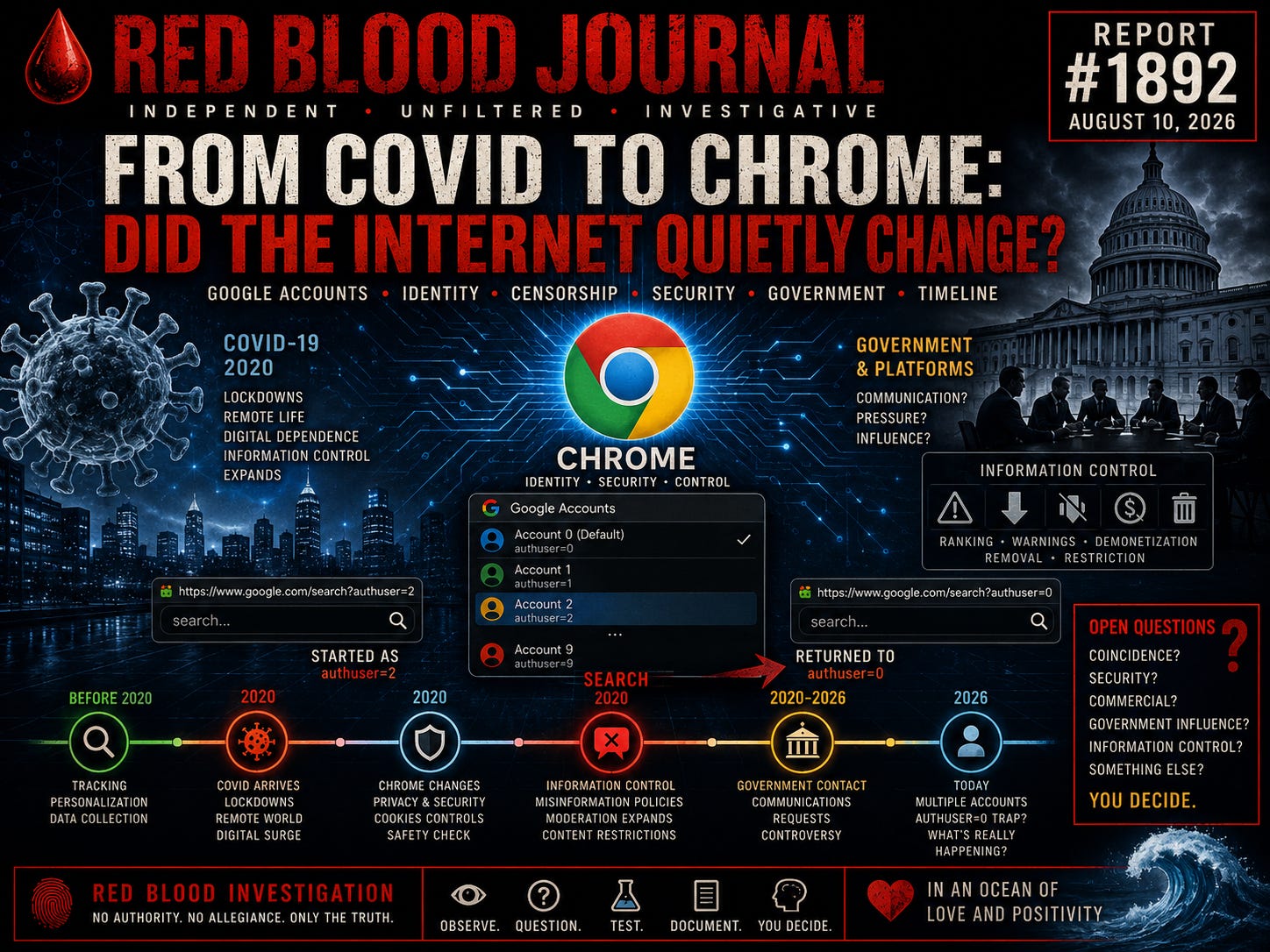
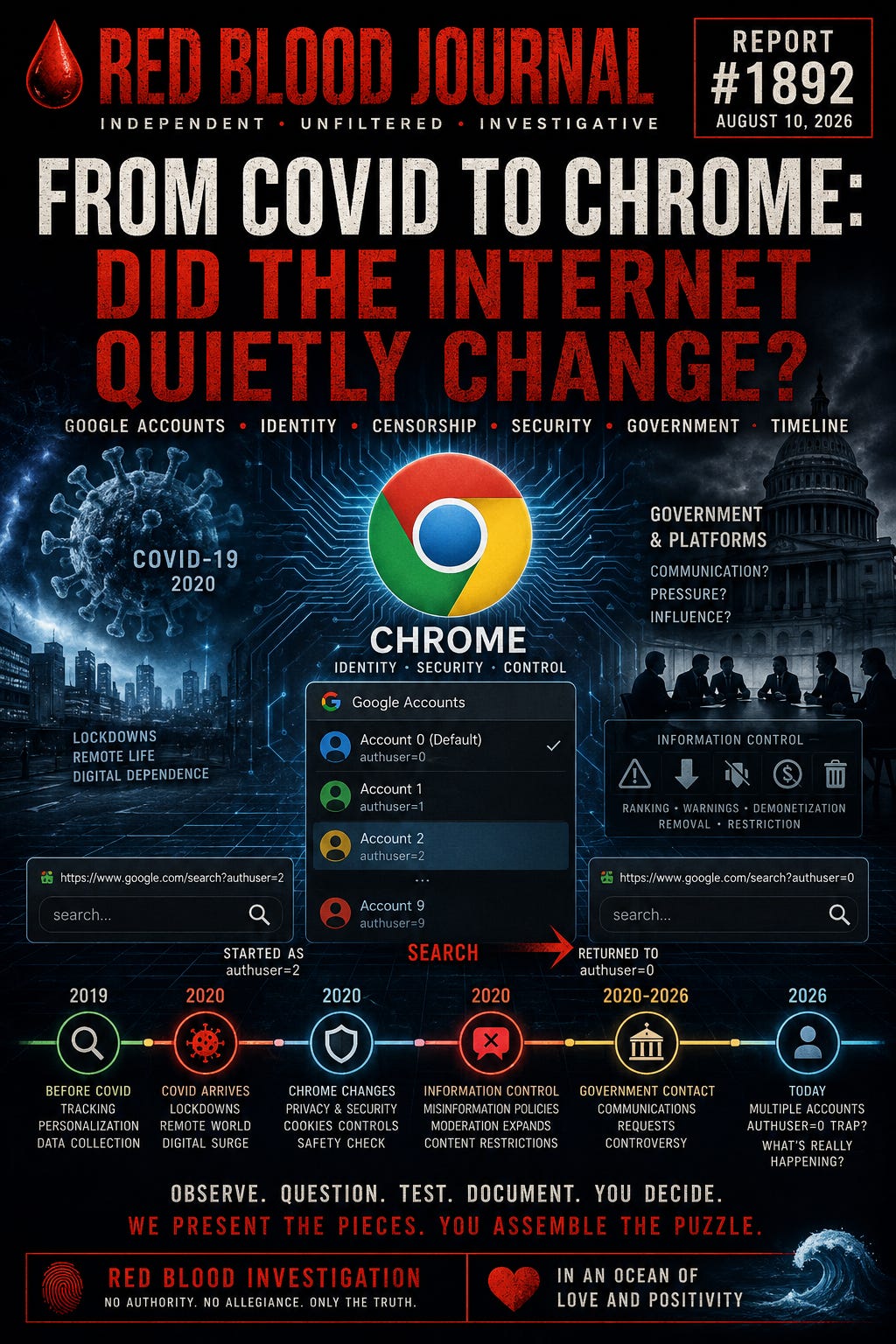
FROM COVID TO CHROME: DID THE INTERNET QUIETLY CHANGE?
Google Accounts, Identity, Censorship, Security, Government, and a Timeline Worth Examining
August 10, 2026
RedBloodJournal.com
The Search That Started the Investigation
This investigation began with an ordinary Google search.
Chrome browsing information had been cleared using Ctrl + Shift + Delete. Multiple Google accounts were then signed back in, and the first account appeared to establish itself as the default account.
A different Google account was selected. The address bar displayed a Google URL containing an account identifier such as authuser=2, indicating that Google recognized a secondary account.
A search was then performed.
The Google session appeared to return toward the first or default account.
Why?
Was this simply a software bug? Was it caused by deleting cookies? Was an authentication-security system responsible? Was it a consequence of Google’s method of handling multiple accounts? Was the behavior connected to something larger about the way online identity has evolved?
Those questions became the starting point of this investigation.
To examine them, we first have to go backward.
PART I — BEFORE COVID
COVID did not invent Internet tracking, cookies, personalized searches, content moderation, government surveillance, Google accounts, or online advertising. All of those existed before 2020.
The Internet, however, had been gradually changing.
Functions that people might once have experienced as relatively separate were increasingly becoming parts of enormous technological ecosystems. Browsing, searching, email, video, advertising, analytics, cloud storage, location services, identity management and authentication were becoming more interconnected.
Then came 2020.
PART II — COVID AND THE DIGITAL EXPANSION
COVID dramatically increased society’s dependence upon digital systems.
Millions of people began working remotely. Schools moved online. Meetings moved online. Shopping increasingly moved online. Medical consultations expanded online. Governments communicated with populations through digital systems, and political and scientific arguments increasingly took place through social-media platforms.
The browser became more important. Online accounts became more important. Authentication became more important.
The corporations controlling major digital platforms simultaneously became increasingly important intermediaries between people and information.
At approximately the same time, another major development became highly visible: platforms dramatically expanded their systems for managing disputed information.
PART III — INFORMATION CONTROL EXPANDS
During the COVID period, major technology platforms expanded policies concerning medical misinformation.
Platforms possessed several mechanisms for controlling the circulation of information. They could determine rankings and recommendations, attach warnings, reduce distribution, remove monetization, restrict material or remove content entirely.
YouTube developed specific COVID-related misinformation policies. Certain claims that contradicted recognized health-authority guidance could fall under those rules.
As circumstances changed, YouTube eventually retired its standalone COVID misinformation policy while retaining broader medical-misinformation policies.
That creates an interesting historical sequence.
An emergency developed while scientific knowledge was still evolving. Governments and health authorities issued guidance. Technology companies developed policies around that environment. Information was moderated under those policies. Scientific understanding and government positions continued changing, and platform policies changed as well.
This leaves questions worth preserving rather than answering for the reader.
Who should determine which claims may be discussed during an unfolding scientific controversy? How much responsibility should private platforms have for potentially dangerous medical claims? How much authority should they have to suppress them? What happens when official guidance changes? What happens to material restricted under an earlier understanding? Who preserves a record of what disappeared?
The questions remain open for examination.
PART IV — CHROME WAS CHANGING DURING THE SAME PERIOD
In May 2020, Google announced changes to Chrome’s privacy and security controls. These included revised cookie controls, Safety Check and additional privacy protections involving Incognito browsing.
Google described these developments principally in terms of privacy and security.
Meanwhile, the technological relationship among cookies, sessions, accounts, devices, authentication and browser security continued becoming more sophisticated.
At the same historical moment, information-management systems were also becoming more sophisticated.
Search ranking had evolved into recommendation systems, warning systems, demonetization systems, distribution controls and removal policies.
Identity systems had evolved from simple cookies and passwords toward increasingly sophisticated relationships among sessions, accounts, authentication, devices and browser security.
Both developments continued through the COVID period and afterward.
What relationship, if any, exists between those two developments?
That is a question rather than a conclusion.
PART V — GOVERNMENT AND THE PLATFORMS
Another part of the COVID-era story involves communication between governments and technology companies.
The controversy eventually reaching the Supreme Court in Murthy v. Missouri involved communications between federal officials and social-media companies concerning misinformation and content moderation.
Different participants described those interactions differently.
The public debate used words such as communication, coordination, persuasion, pressure, coercion and censorship. Those words describe very different relationships.
The Supreme Court litigation ultimately turned substantially on questions of standing, while the communications themselves became part of the larger public debate.
That history leaves another set of questions.
When does government communication with a private company become pressure? When does pressure become coercion? When does a company’s moderation decision remain entirely its own? What happens when government and corporate interests overlap? What happens when those interests conflict? And how can someone outside those institutions determine which relationship existed in a particular situation?
Those questions remain part of the investigation.
PART VI — GOVERNMENT DOES NOT HAVE TO OWN A PLATFORM TO COMMUNICATE WITH IT
Governments interact with technology corporations through numerous mechanisms.
They can request information, issue legal demands, request reviews of content, conduct investigations, propose regulations, enforce laws, hold congressional hearings and communicate concerns involving public safety or national security.
Technology companies simultaneously have their own interests. They have shareholders, advertisers, employees, legal departments, customers, regulatory concerns, government relationships, political pressures, public-relations considerations and internal corporate policies.
Government possesses regulatory, legal, law-enforcement and national-security powers.
Technology corporations possess platforms, algorithms, infrastructure, data, digital identity systems, advertising networks and enormous influence over information distribution.
Where does the influence of one institution end and the independence of another begin? Where do their interests overlap? Where do they conflict?
The answer may be different from one situation to another.
PART VII — RETURN TO THE GOOGLE ACCOUNT
Now return to 2026 and the observation that began this investigation.
A user operates multiple Google accounts inside Chrome. Google distinguishes between accounts using account and session mechanisms that can appear in URLs as authuser=0, authuser=1, authuser=2 and so forth.
The first account generally functions as the default identity within the multiple-account session.
In the observed case, the default account was active first. Another account was then selected. Google displayed the secondary identity through an address containing something such as authuser=2.
A search was performed.
The session then appeared to return toward the default account.
Why?
That question can be investigated experimentally.
PART VIII — OTHER PEOPLE HAVE DISCUSSED SIMILAR BEHAVIOR
Other users have reported difficulties involving multiple Google accounts and Chrome sessions.
Developers have also discussed behavior sometimes described as the authuser=0 trap, in which someone believes they are operating under a secondary Google identity while some Google functionality resolves toward the default identity.
There are many possibilities worth examining.
The behavior could involve software. It could involve cookies or session management. It could involve security mechanisms, authentication conflicts, account ordering or product design. It could result from Google’s integrated identity architecture. There may be another explanation, or several mechanisms may interact.
Instead of selecting one explanation before testing them, each can remain part of the investigation.
PART IX — THE SECURITY SIDE OF THE STORY
Modern Internet authentication exists in an environment containing very real threats.
Phishing, password theft, stolen cookies, session hijacking, credential stuffing, malware, fake login pages, account takeovers, stolen devices and automated attacks have all forced technology companies to develop increasingly sophisticated methods for determining whether the person accessing an account is actually its owner.
This produces another line of inquiry.
How much of today’s Google-account behavior originates from security requirements? Does stronger authentication require tighter relationships among devices, browsers, sessions and accounts? What happens when numerous accounts exist inside the same browser environment? What happens after cookies are erased? How does Google reconstruct account priority afterward? Why does the first account become especially important? What causes an operation initiated under one account to resolve under another?
Those are technical questions that can be tested.
PART X — GOOGLE AS AN ECOSYSTEM
Google today is considerably more than a search engine.
Chrome provides a browser. Google Search provides information discovery. Gmail provides communication. YouTube distributes video and information. Google’s advertising systems connect advertisers with audiences. Google Analytics measures activity across websites. Google Drive provides cloud storage. Google Maps provides navigation and location-related services. Google Accounts provide identity, while Sign in with Google extends that identity into third-party websites and applications.
The same person may interact with many of these systems using a single Google identity.
That leads to another set of questions.
What information can travel among those systems? What information remains separated? What depends upon the user’s settings? What depends upon cookies? What depends upon the Google account? What depends upon the Chrome profile? What depends upon the physical device? What depends upon advertising identifiers or authentication systems?
Those questions cannot be answered merely by looking at the Google logo appearing on each service. They require examining how the systems actually interact.
PART XI — CONVENIENCE, SECURITY, BUSINESS AND CONTROL
Integrated identity can serve many purposes simultaneously.
It can make services more convenient by allowing one login to work across multiple products. It can improve security by helping companies detect unusual account activity. It can personalize services. It can support advertising. It can assist analytics. It can provide authentication for services operated by other companies.
The same infrastructure raises additional questions.
How much digital activity can be associated with one identity? How much remains anonymous? Who controls those connections? Can users meaningfully disconnect them? What happens when users switch accounts? What changes when cookies are deleted? What happens when someone does not want different services associated with one another? What additional capabilities become technically possible once the infrastructure exists?
The existence of those questions does not provide their answers.
PART XII — WHY 2020 REMAINS AN INTERESTING DATE
The chronology around 2020 deserves examination.
During the COVID period, digital dependence expanded dramatically. Remote authentication became more important. Platform moderation expanded. Medical-misinformation policies became prominent. Government-platform communications concerning misinformation generated major controversy. Browser privacy and security systems continued changing, and digital identity became increasingly important to everyday life.
Continue the timeline toward 2026.
Google identity remains integrated across numerous services. Chrome authentication continues evolving. Multiple-account users operate within a system in which one Google account functions as the default identity. Developers have discussed authuser=0 behavior. A user clears Chrome information and subsequently observes different account behavior.
Those events can be placed beside one another.
What connects them?
There may be connections. There may be none. Some may be indirect. Different forces may simply have been moving technology in similar directions. A closer investigation may reveal relationships that are not obvious today, or it may separate events that initially appear connected.
That is the purpose of continuing the investigation rather than deciding the ending first.
PART XIII — QUESTIONS ABOUT COVID AND GOOGLE IDENTITY
The COVID period raises several questions when placed beside the development of Google’s identity infrastructure.
Did the COVID period accelerate Google’s movement toward stronger identity systems? Did increasing cybercrime independently drive those changes? Did remote work and remote authentication accelerate them? Did advertising economics influence the direction? Did privacy regulations influence it?
Did platform moderation and identity architecture develop independently, or did they eventually intersect in some way? Can account identity affect the information presented to a user? Can information-management policies operate differently depending upon account status? How much does personalization change between different Google accounts?
What changes when cookies are deleted? Why does Google maintain a default identity inside a multiple-account environment? What precisely occurs when a user begins at authuser=2 and appears to return toward authuser=0? Can that behavior be reproduced consistently?
Each question provides another possible experiment.
PART XIV — DOCUMENTATION IS PART OF THE INVESTIGATION
Official documentation can provide valuable information, but it is one component of the investigation rather than the end of it.
Google can describe how Google says its systems operate. Government agencies can explain their actions. Courts can record the disputes presented before them. Researchers can publish findings. Journalists can investigate. Critics can challenge those findings. Whistleblowers can introduce additional material. Users can document what they experience firsthand.
Those sources can then be compared.
Does observable behavior match the documentation? Does older documentation match newer documentation? Have explanations changed? Have policies been rewritten? Have webpages disappeared? Has terminology changed? Do independent experiments reproduce the behavior described by the company? Do different accounts produce different results? Do different browsers behave differently?
The discrepancies can become as interesting as the agreements.
PART XV — THE SAME STANDARD APPLIES TO EVERY SIDE
The same investigative standard should operate regardless of the source.
A critic can be mistaken. A whistleblower can misunderstand evidence. A researcher can interpret data incorrectly. A journalist can omit important context. A government employee can provide accurate information. A corporation can accurately describe a technical problem.
A theory dismissed as conspiracy can contain an observation worth investigating. A theory described as conspiracy can also connect events that have no meaningful relationship.
The label attached to a source does not answer the question.
The evidence still has to be examined.
PART XVI — RED BLOOD IS ALSO A SOURCE
Red Blood should not become another authority instructing people what to believe.
If Red Blood presents evidence supporting one interpretation, examine it.
If evidence supports another interpretation, examine that as well.
If something has been overlooked, challenge it.
If tomorrow’s evidence contradicts today’s report, tomorrow’s evidence belongs in the investigation.
The investigation belongs to anyone willing to investigate.
PART XVII — MAKE CHROME THE WITNESS
The Google-account behavior provides an unusual opportunity because it can be tested directly.
Begin with the first or default Google account. Record the account identity, URL and authuser value. Perform a neutral search and record what happens.
Then switch to a second account. Record the identity, URL and authuser value again. Perform exactly the same search and record which account appears afterward.
Repeat the procedure with a third account.
Next, clear browser data using Ctrl + Shift + Delete, while carefully recording exactly which categories were deleted. Sign back into the accounts in a documented order and repeat the same tests.
Then change the order. Sign into a different Google account first and repeat the experiment. Observe whether the behavior follows the original account or whichever account becomes authuser=0.
Repeat the experiment in Incognito.
Then create separate Chrome profiles for the Google accounts and repeat it again.
Finally, use another browser with the same Google accounts, searches and login order.
The results can then be compared.
If changing the browser changes the behavior, record it.
If changing the account order changes the behavior, record it.
If deleting cookies changes the behavior, record it.
If nothing changes, record that too.
The experiment does not require a predetermined outcome.
PART XVIII — BUILD THE HISTORICAL TIMELINE
The larger investigation can follow the same method.
Begin with 2019. Examine Chrome account behavior, Google account architecture, cookie policies, Search personalization, YouTube moderation and government-platform relationships.
Then examine 2020. Record the COVID emergency, Chrome privacy and security changes, COVID misinformation policies, the enormous increase in remote digital identity and government-platform communications.
Continue through 2021, 2022, 2023, 2024 and 2025. Follow authentication changes, moderation-policy changes, cookie policies, advertising systems, privacy initiatives, government investigations and court cases.
Then arrive at 2026 and examine current Chrome behavior, Google identity, multiple-account sessions, authuser=0, current authentication systems and current moderation architecture.
Once that timeline exists, several questions become easier to investigate.
What actually changed? What remained the same? Which developments clearly preceded COVID? Which accelerated during the COVID period? Which appeared afterward? Which systems technically intersect? Which remain separate?
The timeline itself becomes part of the evidence.
🩸 THE RED BLOOD PERSPECTIVE
This investigation does not require a predetermined ending.
There is no requirement that the investigation lead toward Google.
There is no requirement that it lead away from Google.
There is no requirement that COVID provide the connection.
There is no requirement that COVID be unrelated.
There is no requirement that government involvement explain Chrome’s behavior.
There is no requirement that Chrome’s behavior be anything beyond authentication engineering.
The investigation can instead observe what changed and record when it changed. It can compare what companies say with what their products actually do. It can compare government explanations with released communications. It can compare critics’ allegations with reproducible evidence.
Evidence supporting ordinary explanations belongs in the investigation.
Evidence supporting extraordinary explanations belongs there too.
Contradictions belong there.
Missing pieces belong there.
Questions without answers belong there.
And eventually Red Blood reaches the most important point:
Stop before deciding for the reader.
One reader may see coincidence. Another may see ordinary technological evolution. Another may see necessary security. Another may see commercial centralization. Another may see government influence or increasing informational control. Someone else may see several of those forces operating simultaneously.
And another reader may discover an explanation this report never considered.
Red Blood places the pieces on the table.
The reader assembles the puzzle.
🌊 OCEAN OF LOVE AND POSITIVITY
Technology is a tool, and questions are tools too.
Fear can distort an investigation. Trust can distort it. Anger can distort it. Loyalty can distort it. Even the desire to prove ourselves correct can distort what we see.
There is another approach.
Observe carefully. Ask questions. Test what can be tested. Compare competing explanations. Preserve what changes. Revisit earlier assumptions when new evidence appears.
The Internet may have changed.
Perhaps society changed with it.
Perhaps the relationship among human beings, information and digital identity is still changing before our eyes.
The investigation can continue without surrendering the independence of the mind conducting it.
No government owns that mind.
No corporation owns that mind.
No algorithm owns that mind.
No opposition movement owns that mind.
No publication owns that mind.
Not even Red Blood.
The evidence can be presented.
The questions can be asked.
The conclusion belongs to the reader.
In an Ocean of Love and Positivity.
🩸🌊✨ Fantastic!
🕵️
From Covid to Chrome: The Digital Identity Investigation
Aug 11, 2026
This report investigates the historical evolution of Google’s digital identity architecture and its potential link to broader information control since 2020. It questions whether the technical shift toward integrated account authentication in Chrome was accelerated by the societal changes of the COVID-19 pandemic. The text explores how government influence and corporate policies merged during this period to shape modern content moderation and data tracking. Rather than drawing a firm conclusion, the author provides a framework for users to experimentally test how Google manages multiple accounts and default identities. Ultimately, the source encourages readers to maintain intellectual independence while examining the intersection of security, convenience, and surveillance.


