


🩸 RED BLOOD JOURNAL — REPORT #2026
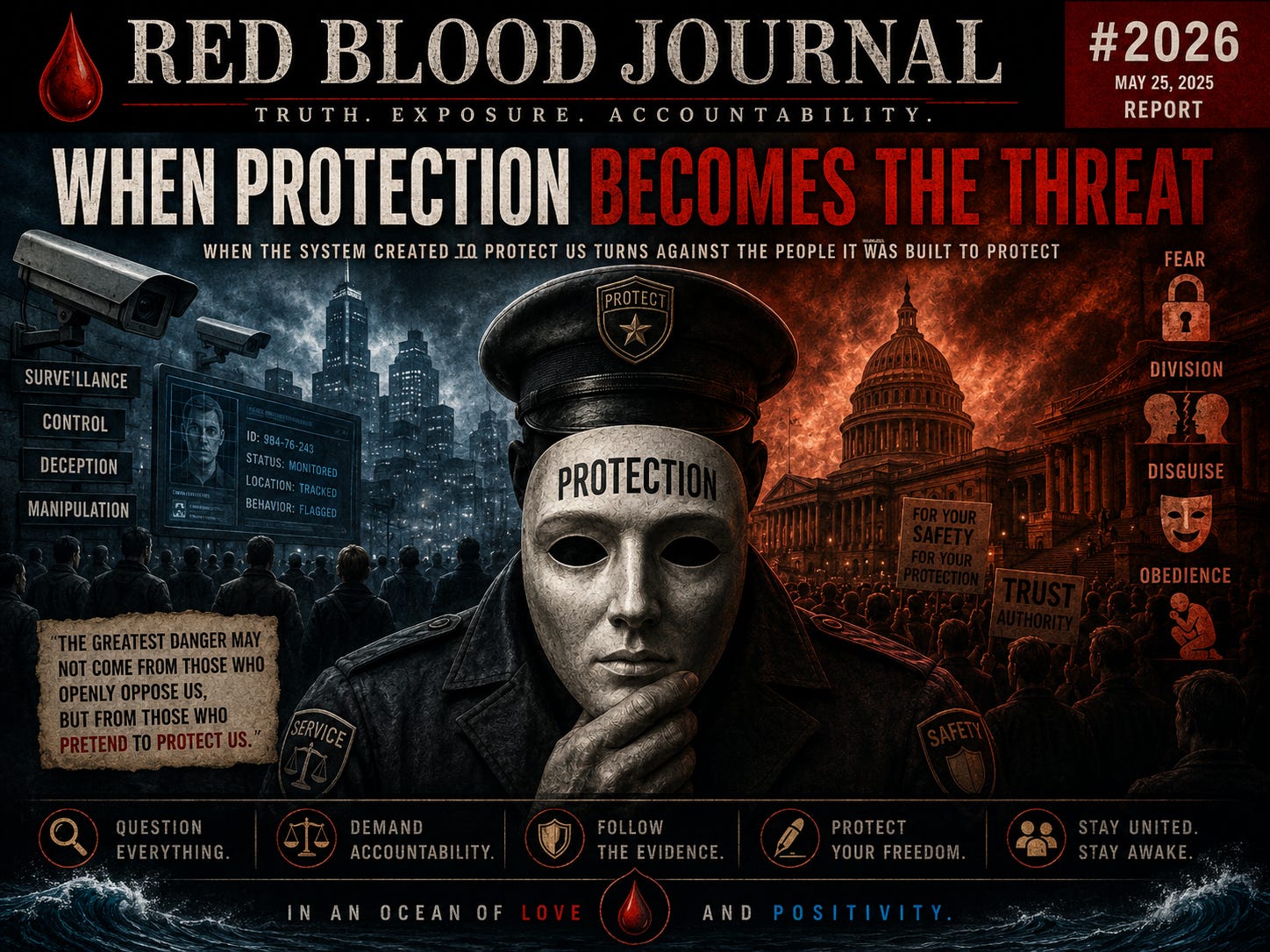
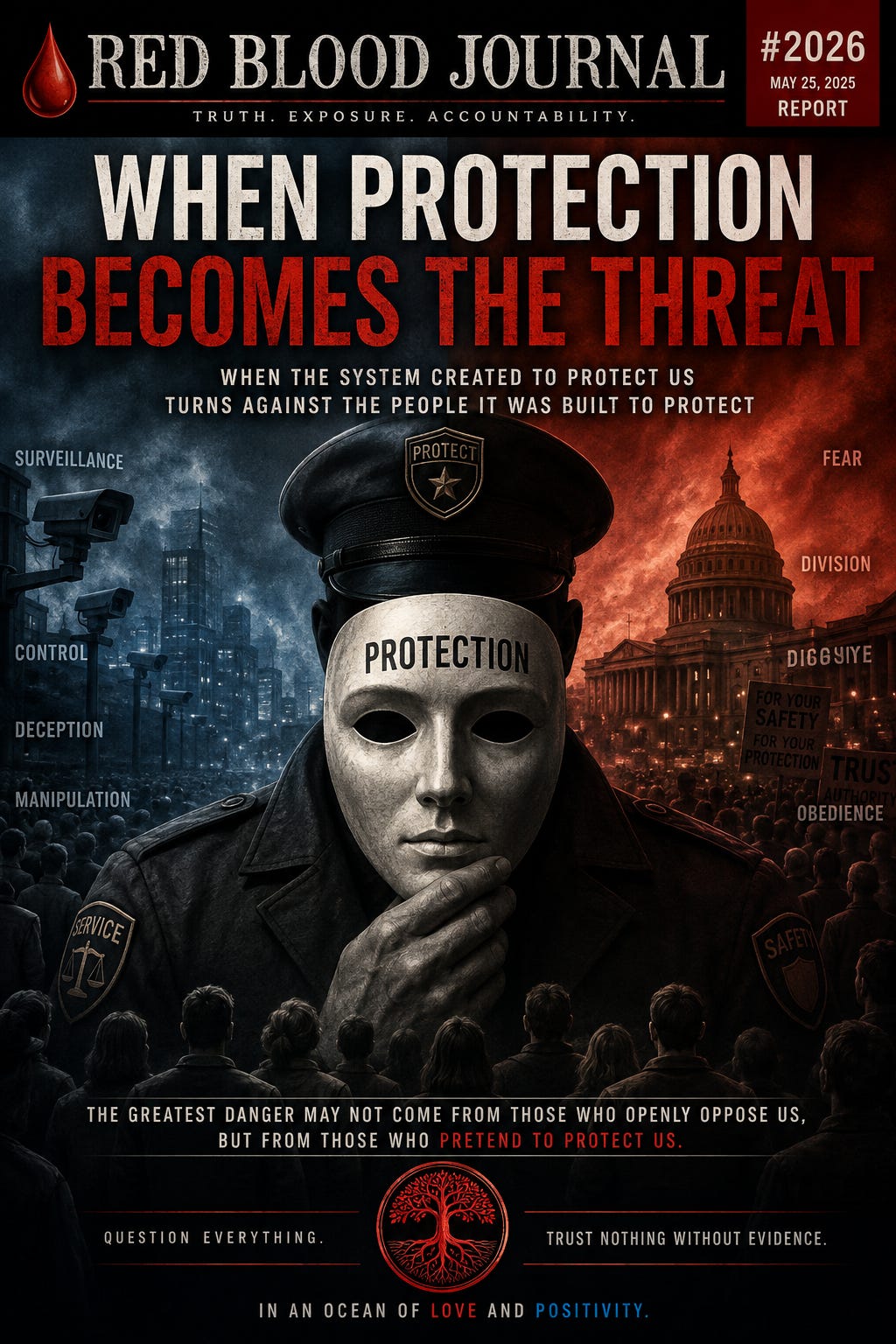
WHEN PROTECTION BECOMES THE THREAT
When the System Created to Protect the People Begins Harming Them
Every organized society creates systems of protection.
Police are established to protect people from crime. Courts are created to protect justice. Governments are formed to protect rights and public order. Intelligence agencies are established to identify threats. Health institutions are created to protect life. Regulators are supposed to protect citizens from dangerous products and abusive practices.
The legitimacy of these institutions rests upon a simple understanding:
The power entrusted to the system is supposed to be exercised for the benefit of the people.
But there is another possibility that deserves examination.
What happens when an institution, organization, individual, or network supposedly operating for protection begins harming the very people it claims to protect?
And what happens when the harm is concealed so effectively that the victims themselves may not initially understand what is happening?
THE MOST DANGEROUS HARM MAY NOT LOOK LIKE HARM
Open oppression is relatively easy to recognize.
People recognize soldiers in the streets. They recognize censorship when publications are openly prohibited. They understand confiscation when property is physically taken.
The more complicated situation occurs when control continues to carry the appearance of protection, assistance, friendship, family responsibility, or concern.
Surveillance may be called security.
Control may be called protection.
Manipulation may be presented as assistance.
Information gathering may be described as concern.
Financial exploitation may hide behind family responsibility.
And betrayal may come from someone the target would never think to question.
Sometimes innocent explanations exist.
Sometimes they may not.
The purpose of investigation is determining the difference.
A HOUSE AS A SMALL-SCALE EXAMPLE
Imagine a hypothetical family living together under one roof.
Several generations or several relatives share the same home. They naturally speak freely because a home is supposed to be one of the safest places in a person’s life.
They discuss money.
They discuss relationships.
They discuss disagreements.
They talk about jobs, property, health, future plans, bank accounts, purchases, inheritance, frustrations, and private family matters.
Now imagine that the youngest member of that household continuously gathers information about everyone else.
Perhaps that person is being encouraged, manipulated, compensated, pressured, or simply convinced that what they are doing is justified.
The other family members do not know.
The youngest person therefore occupies an extraordinary position.
They hear conversations precisely because nobody considers them a threat.
Information moves outward.
Someone outside the household gradually learns who controls the money, who disagrees with whom, who trusts whom, what property exists, what each person fears, where vulnerabilities lie, and which family members can potentially be turned against the others.
At that point, information becomes power.
INFORMATION CAN BECOME MATERIAL, MONEY, AND CONTROL
Consider what could theoretically happen once enough private information has been collected.
Knowledge about finances could facilitate financial pressure.
Knowledge about family conflicts could allow one person to be played against another.
Knowledge about possessions or property could reveal what has monetary value.
Knowledge about relationships could identify who can be pressured.
Knowledge about fears could identify emotional vulnerabilities.
Knowledge about routines could reveal when people are home or absent.
Knowledge about private conversations could allow outsiders to anticipate decisions before they are made.
No single piece of information necessarily appears important.
The power comes from assembling the pieces.
The household gradually becomes transparent to whoever receives the information while the people living inside remain unaware of how much is known about them.
That creates an enormous imbalance.
THEN THE CIRCLE EXPANDS
Now imagine that the activity does not stop with the family.
The same person becomes familiar with neighbors.
Casual conversations occur.
Who lives alone?
Who owns property?
Who has money?
Who is experiencing family problems?
Who distrusts whom?
Who travels frequently?
Who is vulnerable?
Who possesses something valuable?
Again, ordinary conversation can appear completely harmless.
But accumulated information can create something very different from conversation:
a map of a community.
The family home becomes one information point.
The neighboring home becomes another.
Another neighbor becomes another.
Eventually, someone receiving that information may know substantially more about the neighborhood than the neighbors know about whoever is collecting it.
THE CENTRAL QUESTION: WHO BENEFITS?
This is where an investigation should resist jumping immediately to conclusions.
If such behavior were suspected, the first question should not automatically be:
“Who is the mastermind?”
The better questions are more basic.
What information is actually leaving the household?
Can that movement be demonstrated?
Who receives it?
Is money changing hands?
Is someone receiving property, favors, opportunities, protection, or some other benefit?
Did behavior change after particular private conversations?
Did outsiders demonstrate knowledge they should not reasonably possess?
Are several supposedly unrelated incidents connected by the same person?
Is there documentary evidence?
Are there communications, financial records, witnesses, recordings, access logs, or other independently verifiable evidence?
Most importantly:
Are there ordinary explanations that fit the evidence equally well or better?
That last question cannot be discarded simply because a more sinister explanation feels possible.
THE YOUNGEST PERSON MAY ALSO BE A VICTIM
There is another side that should not be ignored.
If the youngest family member really were being used to gather information, that person might not be the architect of the operation.
They could themselves be manipulated.
A young person can be offered attention, money, belonging, status, approval, friendship, protection, or opportunity without fully understanding why someone values the information they provide.
They may believe they are helping.
They may believe the information is harmless.
They may not understand the consequences.
Therefore, even if evidence eventually demonstrated that information was being passed outward, another question would remain:
Who recruited or influenced the person gathering it, and why?
The apparent spy might also be another instrument.
FROM THE HOUSE TO THE STATE
The hypothetical household illustrates the larger principle behind Report #2026.
Information creates leverage.
Leverage creates influence.
Influence can become control.
The principle operates at many scales.
A manipulative family member can exploit private information.
A dishonest employee can exploit company information.
A corporation can exploit consumer information.
A criminal organization can exploit financial information.
A government can exploit intelligence.
The scale changes.
The underlying vulnerability does not.
The person possessing information that others do not know they possess holds an advantage.
WHEN PROTECTION BECOMES THE PERFECT DISGUISE
The most troubling possibility arises when surveillance or information gathering is performed under the justification of protecting the people being observed.
Imagine being told:
“We are watching because we are protecting you.”
That statement may sometimes be completely true.
But protection cannot become a permanent exemption from accountability.
Otherwise almost any intrusion could be justified by attaching the word safety to it.
That is why evidence matters.
Who authorized the surveillance?
What was its legitimate purpose?
What information was collected?
Who received it?
How long was it retained?
Was consent required?
Was the activity lawful?
Was the information later used for purposes unrelated to the original justification?
Who benefited?
Those questions transform suspicion into investigation.
🩸 THE RED BLOOD PERSPECTIVE
The greatest danger may not always arrive wearing the uniform of an enemy.
Sometimes danger could theoretically enter through familiarity.
A trusted institution.
A trusted company.
A trusted neighbor.
A trusted friend.
Even a trusted family member.
But suspicion alone cannot establish betrayal.
That distinction is essential.
If unusual events occur, document them.
Establish dates.
Preserve original communications.
Separate what was personally observed from what was inferred.
Look for independent corroboration.
Follow financial incentives where evidence permits.
Compare competing explanations.
And resist turning coincidence into proof.
If wrongdoing exists, a documented pattern will ultimately be far more powerful than an accusation.
Evidence protects the investigator from becoming another source of misinformation.
🌊 OCEAN OF LOVE AND POSITIVITY
There is an especially important lesson when the suspected source is inside a family.
A family can be destroyed by actual betrayal.
But it can also be destroyed by an incorrect belief that betrayal has occurred.
That is why suspicion should never automatically become condemnation.
If a young family member appears to know too much, asks unusual questions, repeats private information, or maintains relationships that concern other members of the household, those observations can justify questions.
They do not, by themselves, prove spying.
Investigation should therefore move toward evidence rather than fear.
Because the objective is not to find an enemy.
The objective is to discover what is true.
If wrongdoing is demonstrated, confront the wrongdoing.
If manipulation is demonstrated, identify the manipulator.
If financial exploitation is demonstrated, follow the money.
If surveillance is demonstrated, determine who ordered it and who benefited.
And if the evidence ultimately supports an innocent explanation, have enough intellectual independence to accept that conclusion as well.
The strongest household, community, or nation is not one in which everyone watches everyone else.
It is one in which trust can exist because accountability exists beside it.
Question without hatred.
Investigate without obsession.
Protect without controlling.
And never allow either blind trust or blind suspicion to replace evidence.
Because when protection becomes surveillance, surveillance becomes leverage, and leverage becomes control, the shield may quietly have changed direction.
The responsibility of the investigator is to determine whether it actually did.
In an Ocean of Love and Positivity.
🩸🌊✨ Fantastic!
🕵️♂️
When Protection Becomes the Threat
Aug 10, 2026
This text examines the dangers of systemic betrayal, specifically focusing on how entities established for protection can transition into instruments of harm. Using a hypothetical household as a metaphor, the author illustrates how a trusted individual might covertly gather and export private information to empower outside parties. The source emphasizes that information control creates a power imbalance that facilitates financial and emotional exploitation. Readers are urged to move beyond blind suspicion by prioritizing verifiable evidence and objective investigation over fear. Ultimately, the report serves as a warning that surveillance disguised as safety can lead to total control if not met with accountability.


