


🩸 RED BLOOD JOURNAL — REPORT #1782
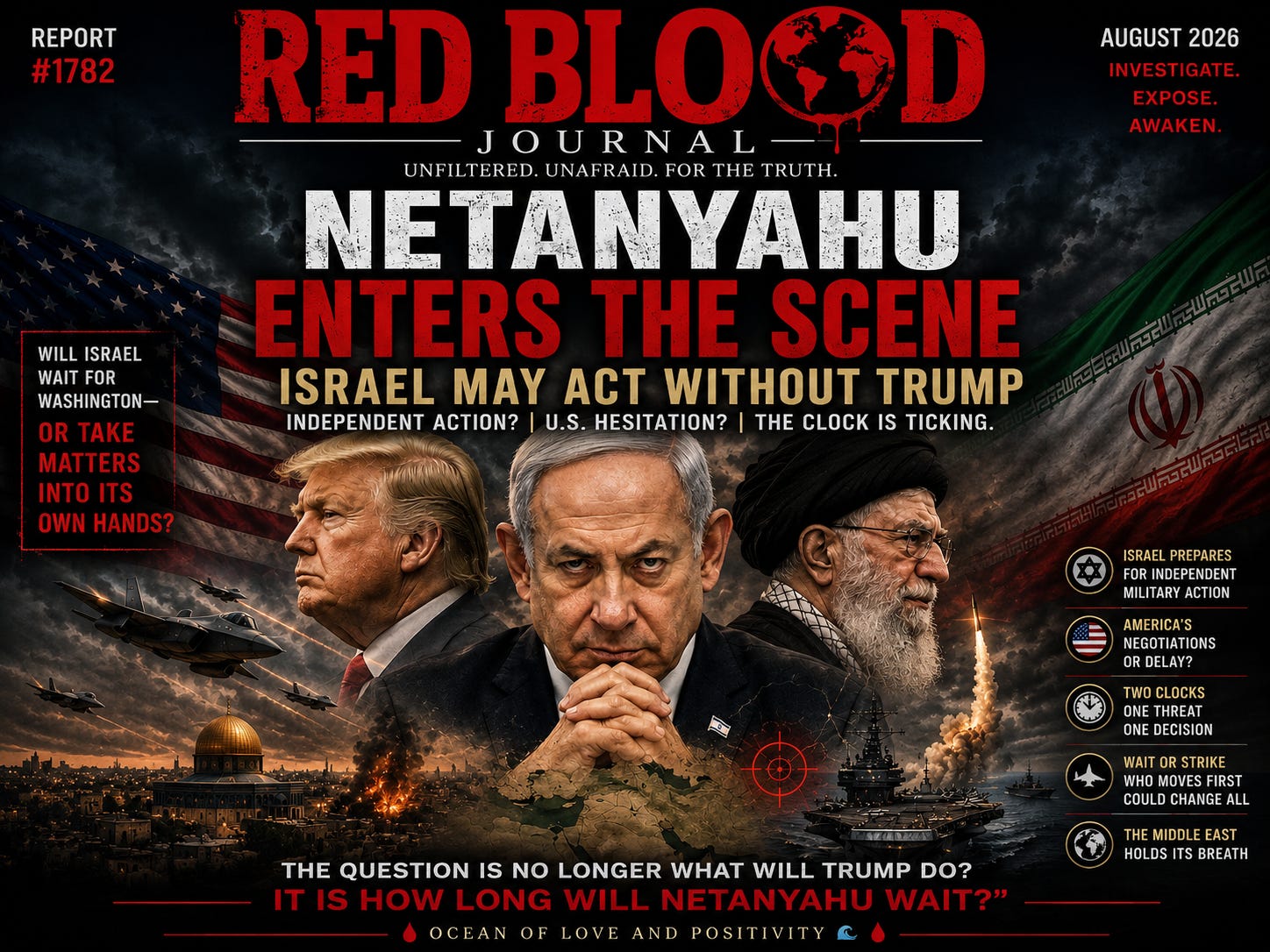
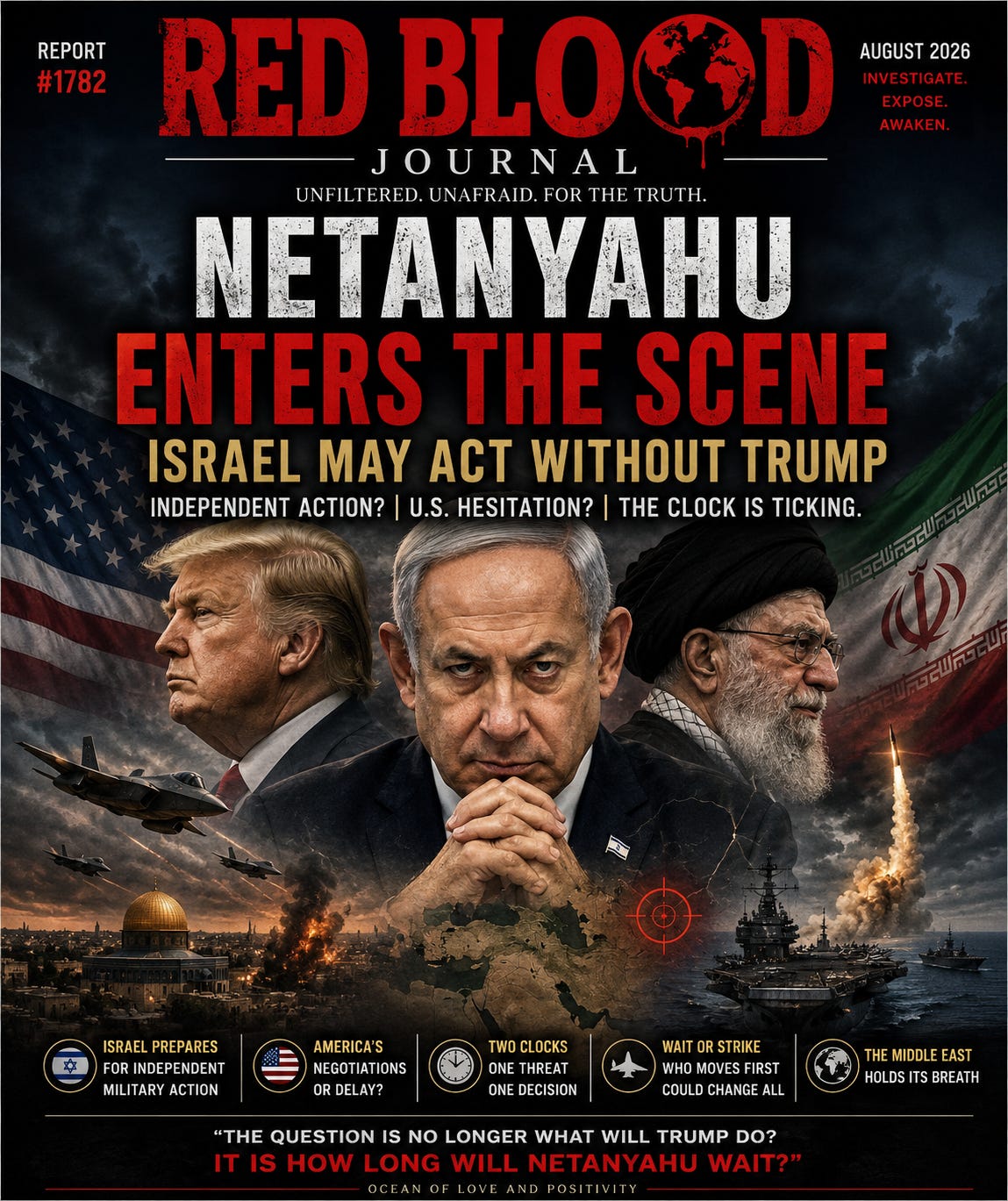
🇮🇱🇮🇷 Netanyahu Enters the Scene
Israel May Act Without Trump
August 2026
RedBloodJournal.com
For weeks, much of the attention surrounding the confrontation with the Islamic Republic of Iran has centered on Donald Trump.
Will Trump make a deal?
Will negotiations succeed?
Will the Strait of Hormuz reopen?
Will Washington escalate militarily—or continue searching for an agreement?
But according to the reports and commentary examined in this investigation, another possibility is moving into view:
Israel may decide that it no longer wants to wait.
And if that happens, Benjamin Netanyahu could suddenly become the central figure in the next chapter.
⚠️ A Night of Growing Tension
The source transcript describes an atmosphere in which observers believed the situation was shifting from relative calm toward renewed confrontation.
Attention focused on several developments simultaneously:
Trump’s unusual silence.
The CENTCOM commander’s reported visit to Israel.
Reports of heightened Israeli military readiness.
Continued disputes surrounding the Strait of Hormuz.
Uncertainty surrounding negotiations between Washington and Tehran.
Within Iranian social media, speculation quickly developed that Netanyahu might be preparing to enter the confrontation directly.
One commentator summarized the suspicion metaphorically:
While everyone was watching Trump, CENTCOM, oil, Hormuz and negotiations, Netanyahu was quietly sharpening his knife.
That is commentary—not proof of an impending attack—but it captures the central question emerging from the transcript:
What happens if Israel decides Trump’s timetable is too slow?
🇮🇱 Reports of an Independent Israeli Option
The most important development cited in the transcript is a report attributed to Israel’s Channel 13.
According to the transcript’s description of that report, Israel was preparing for the possibility of conducting military operations against Iran independently and unilaterally.
The underlying concern was straightforward.
If senior American officials increasingly favored finding a way out of the confrontation while Israeli security officials continued to perceive Iran as an immediate threat, the strategic interests of Washington and Jerusalem could begin separating.
Israel would then face a choice:
Wait for America—or act alone.
The transcript claims Israeli defense planners were considering precisely such a scenario.
🇺🇸 America and Israel May Be Looking at Different Clocks
This may be the most important element of the story.
Trump has reasons to keep diplomacy alive.
Washington must consider:
oil prices,
global markets,
American military commitments,
domestic politics,
negotiations,
shipping,
regional allies,
and the consequences of another major Middle Eastern war.
Israel’s calculations may be different.
From the Israeli perspective presented in the source, allowing negotiations to continue indefinitely could simply give Tehran additional time.
That creates two clocks.
The American clock:
Can an agreement still be reached?
The Israeli clock:
How much stronger could Iran become while everyone continues negotiating?
If those clocks continue separating, eventually the disagreement stops being diplomatic.
It becomes operational.
🔥 Israeli Frustration With Trump
The transcript repeatedly describes frustration among Israeli commentators with Trump’s changing public messages.
One Israeli journalist cited in the source complains about contradictory signals:
One day war appears imminent.
The next day it does not.
One day Hormuz will reopen.
The next day it will not.
One day the Iranian government appears near collapse.
The next day negotiations continue.
From this perspective, Trump’s unpredictability may be useful negotiating strategy.
But to Israeli officials who believe they face an immediate security threat, unpredictability can become dangerous.
The question therefore becomes:
How long will Israel allow Washington’s negotiations to determine Israel’s military timetable?
⚔️ Could Israel Really Move Without America?
According to the transcript, Israeli officials reportedly communicated that Israel did not necessarily require American approval or direct participation to conduct military operations against Iran.
That does not mean Israel would prefer to operate completely without American assistance.
There is an important distinction between:
Israel acting independently
and
Israel acting completely alone.
Even an Israeli-led operation could exist within a much larger American strategic environment involving intelligence, regional military deployments, missile defense, logistics, diplomacy and deterrence.
Therefore another possibility must be considered.
Perhaps the real question isn’t:
Will America or Israel attack?
Perhaps it is:
Who moves first—and what does the other country do afterward?
♟️ Netanyahu’s Leverage Over Trump’s Negotiations
The possibility of unilateral Israeli action itself creates leverage.
Trump can negotiate with Tehran while knowing that Washington may not be able—or willing—to indefinitely restrain Israel.
Tehran therefore potentially faces two negotiating counterparts simultaneously.
One sits across the diplomatic table.
The other does not necessarily have to remain at the table.
That creates an unusual strategic dynamic:
Trump can offer diplomacy while Netanyahu represents the possibility that diplomacy has an expiration date.
Whether this is coordinated strategy or simply competing American and Israeli priorities cannot be established from the transcript.
But either way, the pressure on Tehran could be similar.
🧩 Is Trump’s Hesitation Actually Part of the Strategy?
There is another possibility worth examining.
What appears to be hesitation may not necessarily be weakness.
Trump could be attempting to demonstrate that diplomacy was given every opportunity before further military action.
If negotiations ultimately collapse, Washington could then argue:
We tried negotiation first.
That would matter politically.
It would matter diplomatically.
And it could matter enormously if Israel subsequently acted.
The transcript itself raises speculation that certain temporary concessions to Tehran could even coexist with eventual Israeli military action.
There is not enough evidence in the source to establish such coordination as fact.
But it is a scenario worth watching.
🌍 Three Possible Paths
From the material presented, three broad scenarios emerge.
Scenario One — Trump reaches an agreement.
Diplomacy temporarily prevails and Israel postpones major action.
Scenario Two — Israel refuses to wait.
Netanyahu concludes that negotiations are allowing Iran to buy time and Israel launches an independent operation.
Scenario Three — Apparent disagreement masks strategic coordination.
Trump continues diplomacy while Israel maintains military pressure, giving Washington both a negotiating channel and a military lever.
The available source does not establish which scenario is actually unfolding.
But the possibility of independent Israeli action changes the entire equation.
🩸 The Red Blood Perspective
The most dangerous mistake in geopolitical analysis is watching only the person standing under the brightest spotlight.
Right now that person is Trump.
Every statement is analyzed.
Every deadline is examined.
Every negotiation becomes a headline.
But history frequently moves somewhere outside the spotlight.
While Washington negotiates, Israel calculates.
While Tehran bargains, Netanyahu calculates.
While markets watch Hormuz, militaries watch one another.
And therefore the real question may no longer simply be:
What will Trump do?
It may be:
How long is Netanyahu prepared to wait for Trump to do it?
If Israel concludes that waiting creates greater danger than acting, the entire sequence could change very quickly.
Trump may still control America’s clock.
But he does not necessarily control Israel’s.
🌊 Ocean of Love and Positivity
Behind every geopolitical calculation are ordinary human beings.
Iranian families.
Israeli families.
American families.
Arab families throughout the region.
They do not sit inside military command centers.
They do not negotiate international agreements.
They do not decide when missiles are launched.
Yet they are the people who ultimately experience the consequences.
The greatest victory would therefore not be proving which leader was stronger.
It would be finding a path where strength prevents destruction rather than producing it.
Investigate power.
Question governments.
Study motives.
But never allow political flags to erase the humanity standing beneath them.
Because governments can become enemies overnight.
People do not have to.
In an Ocean of Love and Positivity.
🩸🌊✨ Fantastic!
⏳
Netanyahu’s Knife: Israel’s Independent Clock Against Iran
Aug 9, 2026
Recent reports suggest a growing strategic divide between the United States and Israel regarding the threat posed by the Islamic Republic of Iran. While the Trump administration appears focused on a diplomatic timeline involving negotiations and economic leverage, Benjamin Netanyahu may be preparing for a unilateral military strike to prevent Iranian advancement. This tension creates a scenario where Israel might choose to act independently if they believe American diplomacy is merely providing Tehran with more time. The possibility of an independent Israeli operation serves as both a significant security risk and a potential point of leverage in ongoing international talks. Ultimately, the situation highlights a critical misalignment between Washington’s diplomatic clock and Jerusalem’s security requirements. Whether this friction is a coordinated strategy or a genuine fracture, it places Netanyahu at the center of a potential regional escalation.


