


🩸 RedBloodJournal.com
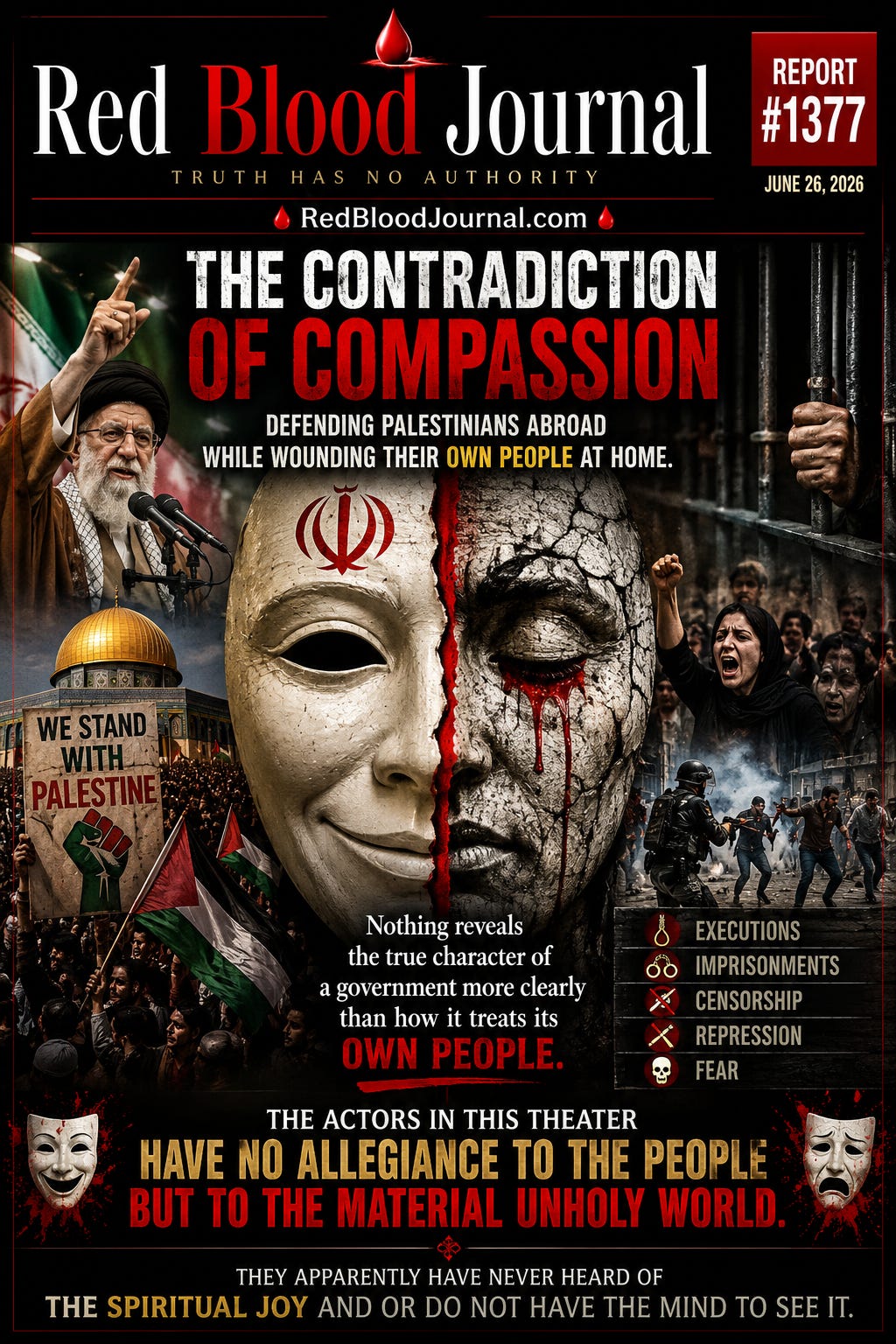
The Contradiction of Compassion
Nothing Reveals the True Character of a Government More Clearly Than How It Treats Its Own People
Report #1377
Date: June 26, 2026
Introduction
“Nothing reveals the true character of a government more clearly than how it treats its own people.”
Every government claims noble intentions. Some speak of justice, others of freedom, religion, security, or humanity. Yet beyond speeches and slogans lies a far simpler measure—how those in power treat the citizens whose lives they govern.
A government’s true character is not revealed by the enemies it condemns, but by the dignity, compassion, and justice it extends to its own people.
For more than four decades, the Iranian religious establishment has presented itself as one of the world’s strongest defenders of the Palestinian cause. Through official speeches, religious ceremonies, state media, and foreign policy, support for Palestine has been portrayed as both a political obligation and a sacred religious duty.
At the same time, countless Iranians have experienced political repression, imprisonment, executions, censorship, restrictions on personal freedoms, and violent responses to periods of civil unrest. These realities have been widely documented and debated for decades.
This contrast raises a question that extends far beyond Iran.
Can a government sincerely claim to defend humanity abroad while failing to protect the dignity of many of its own people?
Compassion Begins at Home
Every innocent life deserves protection.
The suffering of Palestinian civilians is real.
The suffering of Israeli civilians is real.
The suffering of Iranian civilians is equally real.
Compassion loses its moral strength when it becomes selective.
If justice is only demanded for one group while ignored for another, it ceases to be justice and becomes political strategy.
The first responsibility of every government is toward the people living under its own authority.
Only after fulfilling that responsibility can its claims of defending humanity elsewhere carry genuine moral weight.
The Political Stage
Politics has always resembled a theater.
Every government performs for multiple audiences.
One presents itself as the defender of the oppressed.
Another presents itself as the guardian of democracy.
Another claims to represent religion.
Another promises security.
Every actor reads a carefully prepared script.
The audience is encouraged to applaud one performance while condemning another.
Yet behind every performance remains the same unanswered question:
Who benefits from the conflict?
While governments compete for influence, ordinary families bury their loved ones.
While politicians give speeches, ordinary people struggle simply to survive.
The Contradiction
One of history’s recurring contradictions appears whenever leaders express enormous compassion for distant populations while showing far less compassion toward citizens living under their own rule.
If human life possesses equal value, then distance cannot determine compassion.
Nationality cannot determine compassion.
Religion cannot determine compassion.
Political allegiance cannot determine compassion.
Otherwise, compassion itself becomes another political tool.
The Material World and the Spiritual World
Throughout history, material power has often overshadowed spiritual wisdom.
Material power seeks control.
It seeks territory.
It seeks influence.
It seeks wealth.
The spiritual path seeks something entirely different.
It seeks inner peace before outer victory.
It teaches that compassion cannot be divided according to nationality or ideology.
A person who truly understands spiritual joy does not celebrate the suffering of enemies nor ignore the suffering of neighbors.
Love does not recognize political borders.
Truth does not require propaganda.
Compassion needs no permission.
Looking Behind the Curtain
The purpose of observing political contradictions is not to encourage support for one side over another.
It is to encourage independent observation.
Every government should be measured by exactly the same standard.
How does it treat its weakest citizens?
How does it respond to criticism?
How does it protect innocent life?
How does it preserve human dignity?
These questions reveal more than any speech ever could.
When citizens stop judging governments by slogans and begin judging them by their actions, the theater begins to lose its audience.
The Universal Standard
History remembers speeches.
Humanity remembers actions.
Every government eventually stands before the court of history.
Not because of what it promised.
But because of what it practiced.
Justice that changes according to political convenience is not justice.
Compassion that depends upon geography is not compassion.
Religion that speaks of mercy while neglecting mercy at home risks becoming performance instead of principle.
Conclusion
Perhaps the greatest lesson is not about Iran.
Nor Israel.
Nor Palestine.
It is about recognizing a universal principle.
The true character of any government is measured first by how it treats its own people.
Everything else is secondary.
The louder governments proclaim their virtue, the more important it becomes to quietly observe their actions.
Words may persuade.
Actions reveal.
History eventually records the difference.
Ocean of Love
The material world asks people to choose sides.
The spiritual world asks people to choose compassion.
When humanity learns to measure every government by the same moral standard—and every human life by the same value—the stage begins to disappear, and the actors gradually lose their audience.
The Ocean of Love does not ask what nation a soul belonged to.
It asks only one question:
How much love was carried through the journey?🩸
⚖️ The Selective Compassion of Sovereign Power
Jun 26, 2026
This report examines the ethical inconsistency of regimes that champion humanitarian causes abroad while simultaneously suppressing the rights of their own citizens.
Using the Iranian government’s support for Palestine as a primary example, the text argues that genuine compassion cannot be selective or determined by political borders.
The author posits that a government’s true character is revealed through its domestic actions rather than its international rhetoric or state-sponsored slogans.
By contrasting material power with spiritual wisdom, the source suggests that justice becomes a mere political tool when it is not applied universally.
Ultimately, the text calls for an independent standard of observation where every leadership is judged by how it protects the dignity of its own people.
This perspective encourages a shift from partisan allegiance toward a universal valuation of all human life.


