


🩸 👑 #1776 — Why Does the King Stop at the Gates of the City of London?
The Ancient Ceremony That Makes the Square Mile Look Like a Country Inside a Country
August 8, 2026
Red Blood Journal
RedBloodJournal.com
There is a story repeated across the internet that sounds extraordinary:
The King of England cannot enter the City of London without asking permission from the Lord Mayor.
If true literally, the implications would be enormous.
How could the sovereign of the United Kingdom require permission to enter a tiny area sitting inside his own capital?
Is the City of London independent?
Does the Crown answer to the bankers?
Is the famous Square Mile actually a sovereign financial territory hidden inside Britain?
And does this provide evidence for the question raised in Report #1773—that British power may operate through institutions whose histories extend far beyond ordinary governments?
There is something genuinely unusual here.
But the popular version gets an important fact wrong.
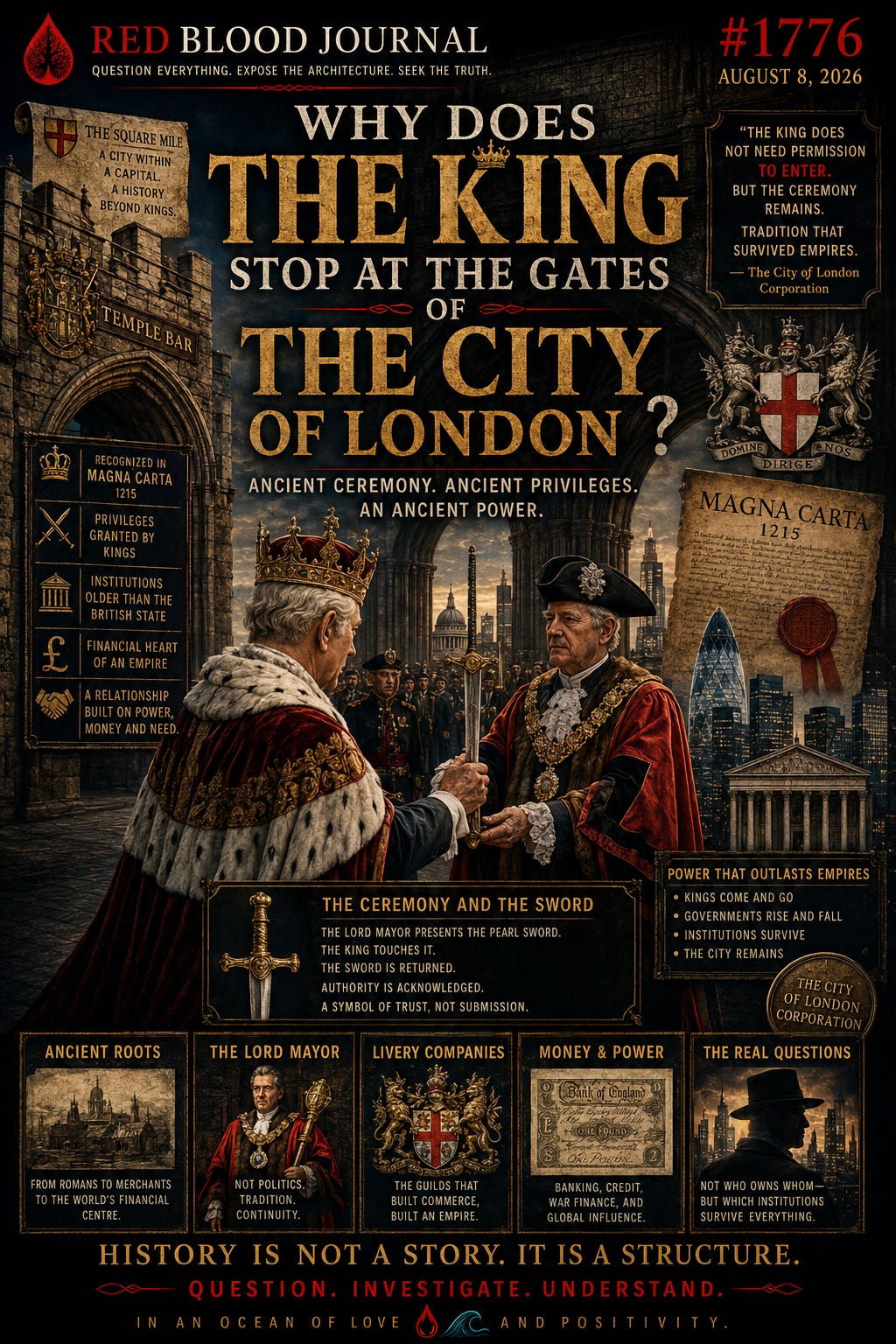
The King does not legally require permission to enter the City of London.
The City of London Corporation itself explicitly rejects that claim, stating that the monarch can visit the Square Mile freely.
What exists instead is arguably more interesting:
an ancient ceremony recognizing the City’s extraordinary historical privileges.
First: London Is Not the City of London
This distinction is essential.
When most people say London, they mean the enormous modern metropolis.
But inside Greater London sits the ancient:
City of London
—the Square Mile.
It has its own centuries-old governing institution:
the City of London Corporation.
It has its own Lord Mayor, who is completely different from the Mayor of London.
It has its own electoral traditions.
Its own sheriffs.
Its own ceremonial officers.
Its own police force.
Its own ancient liberties.
Its own livery companies.
And an institutional history reaching back long before the modern British state.
That makes the Square Mile unusual even by British standards.
The City Is Older Than the United Kingdom
This is where the story becomes fascinating.
The City of London did not originate as another municipality created by today’s British government.
Its traditions extend deep into medieval England.
By the time many institutions associated with the modern British state developed, London’s merchants had already acquired important privileges from successive monarchs.
King John confirmed London’s right to choose its mayor in 1215.
And Magna Carta specifically protected London’s ancient liberties.
The City of London Corporation notes that London was the only city specifically named in Magna Carta, which declared that the City should retain its ancient liberties.
That matters enormously.
The relationship between:
CROWN
and
CITY
was negotiated centuries ago.
Temple Bar
Historically, one of the principal western entrances to the City was:
Temple Bar
It stood where Fleet Street meets the Strand.
The City of London explains that Temple Bar was one of the principal historical entrances into the Square Mile.
When the sovereign ceremonially entered the City, the Lord Mayor traditionally greeted the monarch there.
That tradition produced the ceremony responsible for today’s legend.
The Sword
Here is the important part.
When the monarch ceremonially enters the City, the Lord Mayor can present the Pearl Sword.
The monarch touches the sword and returns it.
That exchange is loaded with symbolism.
In a 2023 coronation banquet speech honoring King Charles III, the Lord Mayor described the ceremony as first recorded during the reign of Richard II in 1392.
More importantly, the Lord Mayor explained what the sword represents.
By surrendering it, the Lord Mayor symbolically relinquishes the authority exercised within the Square Mile on behalf of the sovereign.
The monarch then returns the sword, reaffirming that authority and the City’s privileged relationship with the Crown.
That completely changes the meaning.
The ceremony isn’t:
“King, you cannot enter my territory.”
It is closer to:
“The City’s authority exists within a historically privileged relationship with the Crown, and today we ceremonially reaffirm that relationship.”
Then Why Does It Look Like Permission?
Because medieval ceremony communicates power through symbols.
Imagine the scene.
The sovereign approaches.
The City’s officials appear.
The Lord Mayor meets the monarch.
A sword representing civic authority is presented.
The monarch touches it.
The sword is returned.
The procession continues.
To modern eyes, that can easily look like:
The King has reached another jurisdiction and must request admission.
And over centuries, ceremony becomes legend.
The legend becomes:
“The King must ask permission from the bankers.”
But that isn’t what the legal relationship says.
The City Itself Says the Story Is False
This point is especially important because #1776 should investigate rather than repeat internet mythology.
The City of London Corporation published a response specifically addressing claims that the Square Mile is a “state within a state.”
Its answer:
No.
It also addressed the monarchy claim directly:
The monarch does not need permission to enter.
Businesses operating in the Square Mile remain subject to UK law and regulation.
So if someone presents the ceremony as proof that the King legally lacks authority inside the City, the evidence doesn’t support that conclusion.
But Don’t Stop Investigating There
Debunking the permission story does not make the City of London ordinary.
Quite the opposite.
The interesting question becomes:
Why does this tiny district possess such extraordinary institutional continuity?
Its civic traditions survived:
Norman kings.
Magna Carta.
The English Civil War.
The creation of Great Britain.
The British Empire.
The Industrial Revolution.
Two world wars.
Decolonization.
Modern democracy.
And today’s global financial system.
Kings disappeared.
Dynasties disappeared.
Governments disappeared.
Empires disappeared.
Yet the Corporation survived.
That deserves attention.
The Lord Mayor
The City doesn’t merely have a mayor.
It has the:
Lord Mayor of London
Not to be confused with the elected Mayor of London governing Greater London.
The City’s Lord Mayor is selected through a remarkably old civic system involving aldermen and the City’s livery companies.
The City says the Lord Mayor must be selected from its aldermen, while the livery companies participate through Common Hall.
Those livery companies descend from medieval trade guilds.
Again:
ancient commercial institutions surviving inside a modern democracy.
The Relationship Runs Both Ways
There is another detail that complicates the conspiracy version.
The City isn’t simply standing above the Crown.
The City’s own ancient institutions explicitly acknowledge the sovereign.
The declaration taken by a Freeman of the City includes loyalty to King Charles III and obedience to the City’s Mayor, while promising to maintain the City’s franchises and customs.
That reveals something more subtle than:
King versus City.
It reveals overlapping authority and tradition.
Crown + City.
Not necessarily:
Crown underneath City.
Why Protect the City’s Privileges?
Now we reach the economic question.
London became one of Europe’s great commercial centers.
Kings needed money.
Merchants needed protection.
Governments needed loans.
Traders needed enforceable contracts.
Ships needed insurance.
Wars needed financing.
Commerce needed predictable law.
Therefore the relationship between monarchy and merchants wasn’t simply ideological.
It was mutually useful.
The Crown possessed political and military authority.
The City possessed commercial wealth and financial expertise.
Over centuries, the two became deeply intertwined.
That is considerably more interesting than saying:
“The bankers secretly own the King.”
History often operates through mutual dependence, not simple ownership.
And Then Came the Bankers
This connects directly with our previous investigation.
The City of London eventually became one of the world’s most important financial centers.
Merchant banks.
Insurance.
Government bonds.
Foreign exchange.
Shipping.
Commodities.
International finance.
And among the great banking houses operating from London was the Rothschild firm.
But again we must distinguish between:
documented financial influence
and
claims of secret sovereignty.
The Rothschild banking house became enormously influential.
That does not demonstrate that Rothschild owns the City of London.
Nor does the City’s ancient ceremonial relationship with the Crown demonstrate that bankers control the monarchy.
Those are different propositions.
But Something Important Remains
Remove the conspiracy interpretation for a moment.
What remains is extraordinary enough.
Inside one of the world’s largest capitals sits a roughly one-square-mile jurisdiction whose governing institution possesses traditions extending back nearly a millennium.
Its ancient liberties were specifically recognized in Magna Carta.
Its Lord Mayor still participates in ceremonies whose origins reach into medieval England.
Its livery companies remain part of its civic system.
And the district subsequently became one of the most important financial centers on Earth.
That combination deserves investigation without embellishment.
The Question From #1773 Returns
Report #1773 asked whether the British Empire truly disappeared—or whether portions of its architecture survived.
The City of London gives us a different version of that question.
Perhaps we should stop thinking exclusively in terms of countries.
Countries are relatively young.
Institutions can be much older.
Governments change every few years.
Some institutions survive centuries.
Therefore the important question may be:
Which institutions survive every political transformation?
The monarchy survives.
The City survives.
The banking system survives.
The legal architecture survives.
Certain financial relationships survive.
Then governments rotate around them.
That does not automatically prove hidden control.
But it tells us where to look when investigating continuity of power.
The Ceremony Is More Interesting When Properly Understood
The internet version says:
THE KING ASKS PERMISSION.
The historical reality says:
THE KING DOESN’T NEED PERMISSION.
At first, that sounds less interesting.
But look deeper.
Why does a ceremonial relationship originating hundreds of years ago still exist?
Why does the Lord Mayor present the sword?
Why does the monarch return it?
Why are the City’s ancient privileges still ceremonially acknowledged?
Why has this tiny jurisdiction maintained such an unusual institutional identity?
Those questions are more valuable than the myth.
The Red Blood Perspective
This is exactly why #1775 argued:
Do not believe “do not believe.”
We shouldn’t believe the internet claim simply because it challenges authority.
But we shouldn’t stop investigating simply because an official institution says the popular claim is wrong.
Both directions require examination.
The claim:
“The King needs permission to enter the City.”
doesn’t survive examination.
But underneath that false claim lies a fascinating historical reality:
The City of London possesses an extraordinarily old and unusually durable relationship with the British Crown.
And perhaps that teaches us something larger about power.
Power doesn’t always need to hide.
Sometimes it survives openly for so long that nobody thinks to question why it is still there.
The robes remain.
The sword remains.
The Lord Mayor remains.
The Crown remains.
The financial district remains.
The ceremonies remain.
The institutions remain.
Perhaps the important question isn’t:
“Who owns whom?”
Perhaps it is:
Why have these institutions survived together for so many centuries?
Follow that question—
and we may find something far more interesting than the legend.
🌊 Ocean of Love and Positivity Perspective
Symbols can deceive when we interpret them without understanding their history.
But symbols can also teach.
A sword can appear to represent confrontation while actually representing cooperation.
A gate can appear to represent exclusion while representing tradition.
A ceremony can appear to demonstrate submission when it actually records an ancient relationship.
That is why questioning should never stop at the first surprising explanation.
Question the official story.
Question the alternative story.
And then question the interpretation we ourselves most want to believe.
The objective is not to defeat one narrative with another.
The objective is to become difficult to manipulate.
The truth does not need obedience.
It needs investigation.
In an Ocean of Love and Positivity.
🩸🌊✨ Fantastic!
🏰
The Crown and the Square Mile
Aug 9, 2026
While popular internet legends claim the British monarch must request permission to enter the City of London, the reality is rooted in symbolic tradition rather than legal restriction. This ancient ceremony involves the Lord Mayor presenting the Pearl Sword to the sovereign, a gesture that represents the city surrendering and then having its historic authority reaffirmed by the Crown. The Square Mile operates as a unique entity with its own police force, governing corporation, and centuries-old privileges that predated the formation of the modern United Kingdom. Rather than proving a secret hierarchy, these rituals highlight a mutually beneficial relationship between the state’s political power and the city’s financial influence. The enduring nature of these medieval institutions suggests that some structures of power are far more permanent than the rotating governments around them. Ultimately, the text encourages looking past sensationalized myths to study the remarkable institutional continuity of this global financial hub.


