


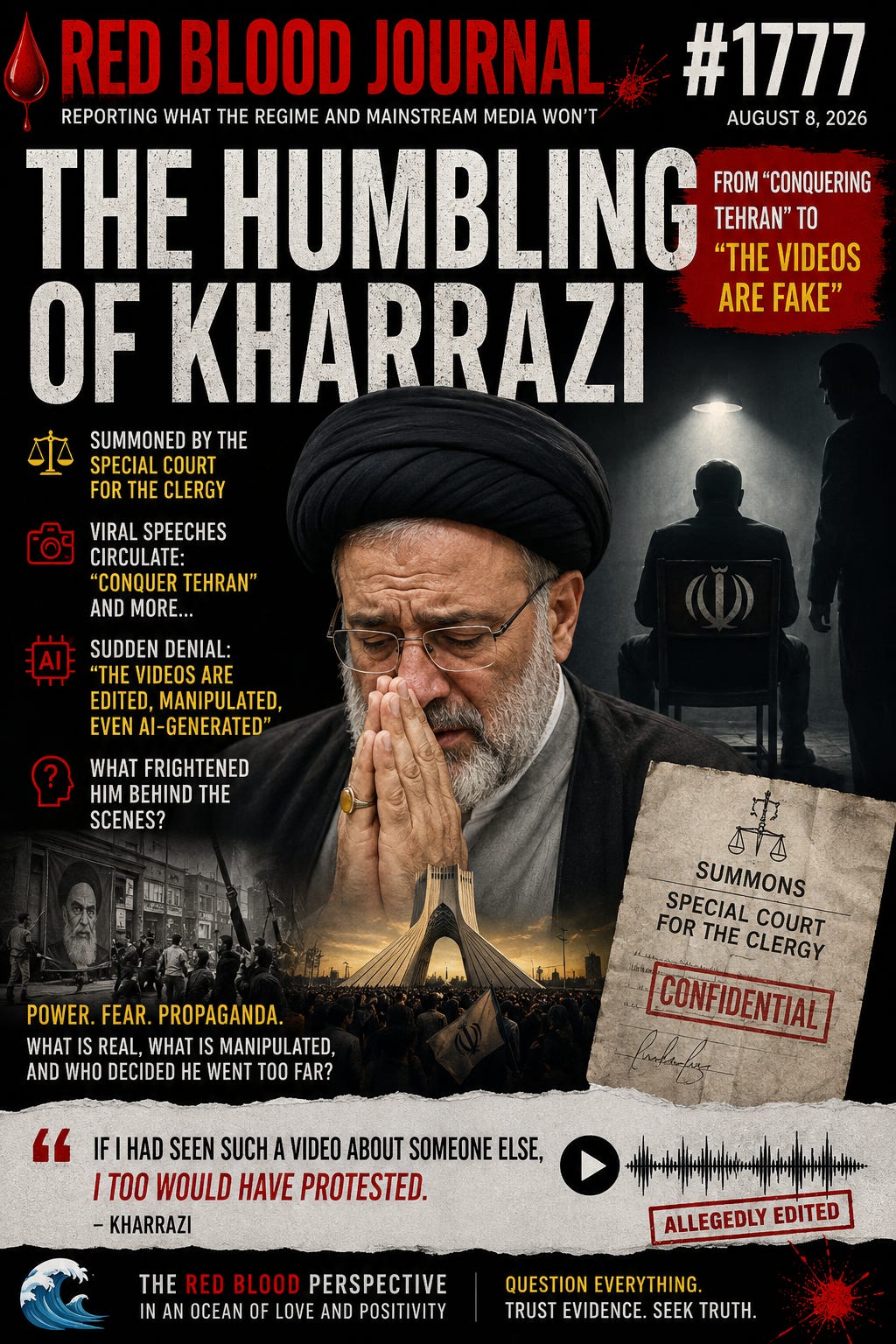
🩸 🇮🇷 #1777 — The Humbling of Kharrazi
From “Conquering Tehran” to “The Videos Are Fake”
Summons, Denials, Artificial Intelligence — and the Question of What Frightened Him
August 8, 2026
RedBloodJournal.com
Something remarkable happened to cleric Seyed Mohammad-Bagher Kharrazi.
Only a short time earlier, according to the material presented in the source transcript, Kharrazi appeared extraordinarily confident.
He spoke about political mobilization.
He spoke about gathering forces.
He spoke about Tehran.
He reportedly spoke about India and China.
And he presented himself as someone with access to Mojtaba Khamenei and a political project considerably larger than an ordinary religious movement.
Then suddenly, everything changed.
The revolutionary rhetoric disappeared.
The confidence disappeared.
And Kharrazi appeared before a camera explaining that the videos circulating of his speeches were supposedly manipulated, edited, fabricated, or produced using artificial intelligence.
What happened between those two versions of the same man?
⚖️ The Judiciary Enters the Story
According to the transcript, on Saturday Iranian judiciary spokesman Asghar Jahangir announced that Kharrazi’s case was being pursued through the Special Court for the Clergy.
The explanation was straightforward: because Kharrazi is a cleric, allegations involving him fall under the jurisdiction of that special court.
The spokesman said Kharrazi had been summoned and was facing criminal proceedings.
Details, he said, would be announced after the judicial process produced results.
Then came the remarkable part.
It apparently did not take long before Kharrazi appeared on camera.
The man whom the narrator describes as having previously called for the “conquest of Tehran” and spoken about confrontation extending toward India and China was suddenly explaining that what people had seen was not an accurate representation of what he had said.
The transformation was dramatic.
🤖 “The Videos Are Almost Fake”
Kharrazi’s defense centered heavily on manipulation of digital media.
He argued that material circulating online could be altered.
Voices could be fabricated.
Audio could be manipulated.
Videos could be edited.
Artificial intelligence could manufacture convincing material.
These are, in general, legitimate concerns in the modern information environment.
But Kharrazi used an unusual expression.
According to the transcript, he described one of the videos as being “almost fake.”
That immediately creates a problem.
A video can contain authentic material mixed with misleading edits.
A real recording can be presented without context.
Audio can be altered.
Different clips can be joined together.
But if someone says a recording is almost fake, the obvious question becomes:
Which portions are genuine?
And which portions were fabricated?
The transcript’s narrator seizes on precisely this contradiction.
🎥 Kharrazi Blames Editing and Artificial Intelligence
Kharrazi argued that people should recognize how easily modern technology can manipulate information.
He pointed specifically to:
edited video,
artificial voices,
altered audio,
unusual speech speed,
manipulated presentation,
and artificial intelligence.
His central defense was therefore not simply:
“I never said these things.”
It was broader.
He argued that the digital material circulating under his name could not automatically be trusted.
According to the transcript, Kharrazi complained that critics had reacted to the clips without first contacting him and determining whether the statements had actually been presented accurately.
He said respected religious figures and longtime acquaintances had condemned what they saw.
Yet, remarkably, he also said that their reaction was understandable.
Why?
Because if he himself had seen such a video attributed to somebody else, he suggested, he too might have protested.
That is one of the most revealing moments in the entire episode.
🩸 The Red Blood Question
Forget Kharrazi’s politics for a moment.
Forget whether someone supports him, opposes him, supports the Islamic Republic, or opposes the Islamic Republic.
There is a much simpler investigative question:
What exactly is authentic?
That question matters more than whether Kharrazi appeared frightened.
If the recordings were fabricated using artificial intelligence, it should increasingly be possible to examine the original recordings, identify cuts, compare complete speeches with circulated clips, and determine where manipulation occurred.
If sentences were removed from context, publish the complete context.
If audio was generated, identify the generated portions.
If words were rearranged, show the edits.
If the recordings are genuine, then the AI explanation collapses.
The burden should not be satisfied merely by saying:
Everything on social media can be fake.
That statement is true.
But it does not establish that this particular material is fake.
👁️ Was This a Forced Recantation?
The narrator of the source takes a much stronger position.
The narrator repeatedly describes Kharrazi as visibly frightened and interprets his appearance as effectively a forced confession or forced recantation.
According to that interpretation, something happened behind the scenes that transformed Kharrazi from a confident political agitator into a man desperately distancing himself from his own previous rhetoric.
The transcript even speculates that frightening material may have been shown to him.
But this distinction is important:
The transcript provides the narrator’s interpretation of Kharrazi’s demeanor; it does not independently establish what happened to him behind closed doors.
That leaves several possibilities.
Kharrazi may genuinely believe the viral material was deceptively edited.
He may have realized the political consequences of his statements.
He may have been instructed to retract them.
He may have been threatened.
Or some combination of genuine editing, political pressure and damage control may have occurred.
The available transcript alone cannot determine which explanation is correct.
What it clearly documents is the extraordinary contrast between the rhetoric attributed to Kharrazi before the controversy and his defensive posture afterward.
🔥 Why Kharrazi Had Become Dangerous
The political significance becomes clearer when the earlier rhetoric described later in the transcript is considered.
Kharrazi was not merely discussing theology.
According to the source, he had talked about organizing supporters and creating a political force.
He claimed familiarity with Mojtaba Khamenei.
He described plans associated with moving beyond the existing structure of the Islamic Republic toward what he called an “Islamic government.”
The transcript also attributes to him statements about mobilizing enough supporters to surround ministries and dramatically alter Iran’s political structure.
Those claims will become particularly important in later parts of this series.
Because if the recordings are authentic, the issue is no longer merely an eccentric cleric making bizarre speeches.
It becomes a question of power.
Who was Kharrazi speaking for?
Who, if anyone, was behind him?
Why invoke Mojtaba Khamenei?
How large was his actual following?
And perhaps most importantly:
Who decided that he had gone too far?
🧩 The Bigger Mystery
The temptation is to view Kharrazi’s reversal as comedy.
A fiery cleric talks about conquering Tehran and then appears before a camera insisting that circulating material is manipulated.
But beneath the spectacle lies something more important.
Authoritarian political systems often reveal themselves most clearly not when everyone agrees, but when insiders begin fighting among themselves.
The public sees speeches.
The public sees arrests.
The public sees resignations.
The public sees confessions.
The public sees sudden reversals.
What the public rarely sees is the conversation immediately before the camera begins recording.
And that may be where the real story of Kharrazi lies.
🩸 The Red Blood Perspective
The most important question is not whether Kharrazi should be believed or ridiculed.
The important question is whether his original statements were authentic.
Evidence should decide that.
If the recordings were manipulated, expose the manipulation.
If artificial intelligence generated his voice, demonstrate it.
If editing changed his meaning, release the complete speeches.
But if the recordings are authentic, another question becomes unavoidable:
Why did Kharrazi suddenly retreat?
And behind that question stands an even larger one:
What does his retreat reveal about the struggle occurring inside the Islamic Republic’s power structure?
A man can change his words overnight.
The struggle surrounding those words may be much harder to erase.
🌊 Ocean of Love and Positivity
Power struggles encourage people to choose teams.
One faction against another.
One politician against another.
One cleric against another.
But there is another way to observe the spectacle.
Watch without surrendering the mind to either side.
Question the accusation.
Question the denial.
Question the viral video.
Question the government statement.
Question the opposition interpretation.
And then return to the evidence.
Truth does not become truth because authority declares it.
Nor does something become true merely because it attacks authority.
The independent mind belongs neither to the government nor to its enemies.
It belongs to itself.
In an Ocean of Love and Positivity.
🩸🌊✨ Fantastic!
⚖️
The Humbling of Kharrazi: Rhetoric, Power, and Digital Deception
Aug 9, 2026
The provided text details the sudden political downfall and legal pursuit of Iranian cleric Seyed Mohammad-Bagher Kharrazi following the release of controversial speeches. While he previously utilized aggressive rhetoric regarding the “conquest of Tehran” and mobilization of forces, his tone shifted dramatically after being summoned by the Special Court for the Clergy. In a public reversal, Kharrazi claimed the viral recordings of his statements were “almost fake” and manufactured using artificial intelligence or deceptive editing. The source explores whether this transformation was a forced recantation or a desperate attempt at damage control amid internal power struggles. Ultimately, the narrative highlights the tension between digital misinformation and political accountability within the Islamic Republic’s hierarchy. It concludes by emphasizing the importance of evidentiary truth over political theater in understanding the reality of his retreat.


