


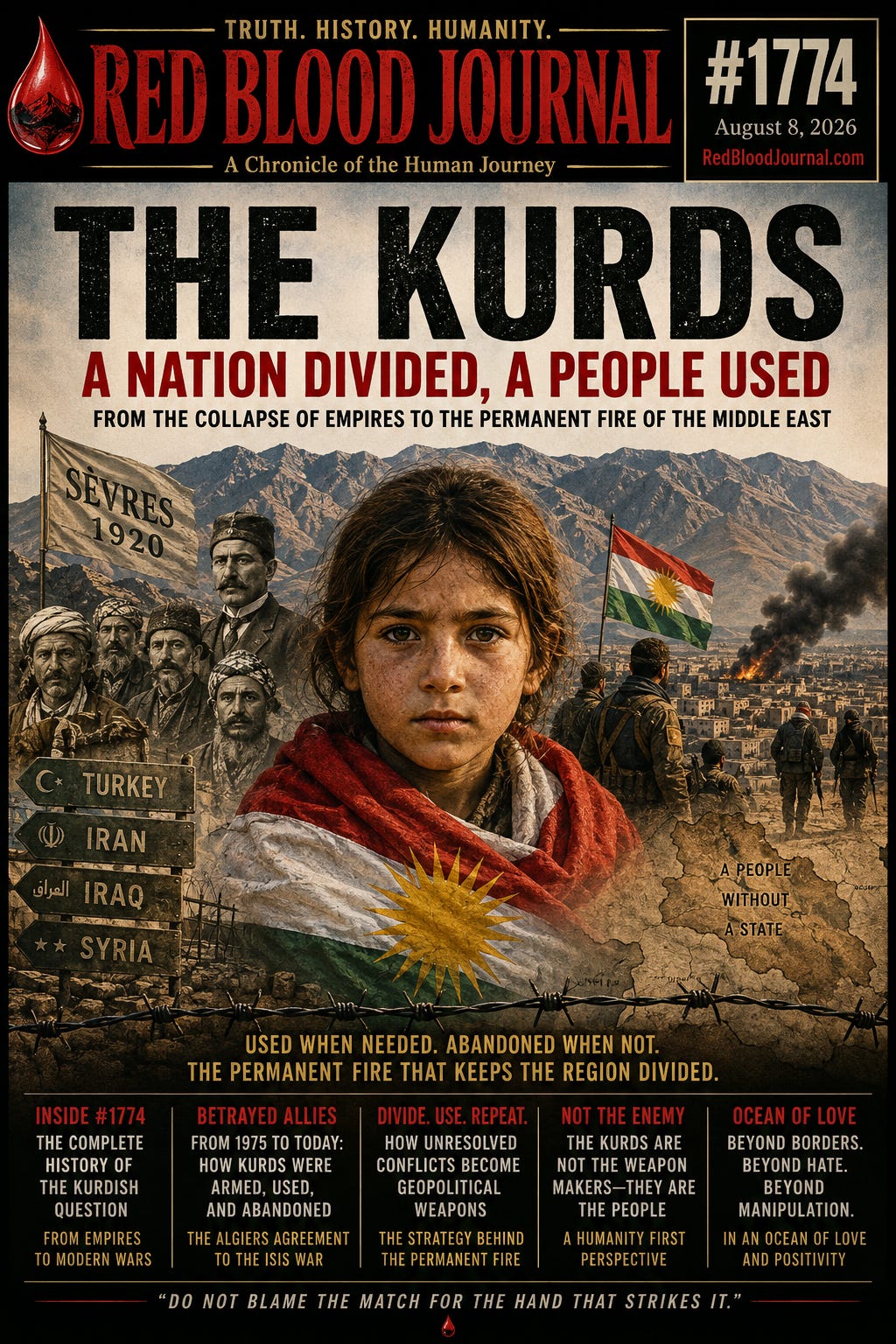
🩸 🏔️ #1774 — The Kurds: A Nation Divided, A People Used
From the Collapse of Empires to the Permanent Fire of the Middle East
August 8, 2026
RedBloodJournal.com
For more than a century, the Kurdish question has remained one of the Middle East’s most persistent unresolved political struggles.
The Kurds are one of the world’s largest ethnic populations without a sovereign nation-state of their own. Their historic homeland stretches across areas now belonging primarily to Turkey, Iran, Iraq, and Syria.
But the Kurdish story is larger than the absence of a country called Kurdistan.
It is also the story of borders.
Empires.
Broken promises.
Nationalism.
Rebellions.
Foreign intelligence.
Weapons.
Oil.
Regional rivalries.
And alliances that repeatedly changed when the interests of larger powers changed.
The central question of this report is therefore not simply:
Why don’t the Kurds have a country?
There is another question.
How did the unresolved Kurdish question become a geopolitical instrument that different governments could use against one another?
And behind that lies an even more uncomfortable possibility:
Can keeping ethnic and territorial disputes unresolved help keep an entire region divided, dependent, and permanently vulnerable to outside influence?
1. Who Are the Kurds?
The Kurds are an ethnic and linguistic people indigenous primarily to the mountainous region spanning southeastern Turkey, northern Iraq, western Iran, and northern Syria.
They are not a single political organization.
This distinction is extremely important.
There are Kurdish nationalists, conservatives, socialists, secularists, religious movements, tribal organizations, political parties, guerrilla movements, and ordinary people who may have little interest in any of them.
Even the Kurdish languages contain major dialect groups.
Therefore, there is no single political entity that can accurately be called “the Kurds.”
Different Kurdish organizations have frequently disagreed—and sometimes fought one another.
That fragmentation would later become enormously important.
Because when a population is divided between several countries and political organizations, every neighboring government gains potential leverage over somebody else’s Kurdish population.
2. Before the Modern Borders
For centuries, Kurdish communities lived within larger empires, particularly the Ottoman Empire and Persian empires.
Local Kurdish rulers, tribal confederations, principalities, and communities often possessed varying degrees of autonomy.
There was no modern sovereign Kurdish nation-state corresponding to today’s concept of Kurdistan.
But there was a recognizable Kurdish geographic and cultural region.
Then came the destruction of the old imperial order.
World War I changed everything.
3. The Ottoman Empire Falls
When the Ottoman Empire collapsed following World War I, Britain and France emerged as the dominant outside powers shaping much of the former Ottoman Middle East.
New borders appeared.
New governments appeared.
New mandates appeared.
And millions of people discovered that the political geography surrounding them had been fundamentally transformed.
Among them were the Kurds.
The postwar settlement briefly appeared to create an opening for Kurdish self-determination.
The 1920 Treaty of Sèvres contained provisions contemplating Kurdish autonomy and potentially independence under certain circumstances.
But Sèvres did not become the final political settlement.
The Turkish nationalist movement led by Mustafa Kemal Atatürk overturned much of the arrangement.
Three years later came the Treaty of Lausanne.
The Kurdish state envisioned as a possibility at Sèvres disappeared from the settlement.
The modern Turkish Republic emerged.
The Kurds remained divided.
4. Kurdistan Without Kurdistan
The new political map left major Kurdish populations principally inside:
Turkey
Iran
Iraq
and later
Syria.
This created the structural problem that would define Kurdish geopolitics for the next century.
A Kurdish movement inside one country could become useful to another.
Iran could pressure Iraq through Iraqi Kurds.
Iraq could potentially exploit Kurdish unrest inside Iran.
Syria could find Kurdish militants fighting Turkey strategically useful.
Turkey could work with Kurdish factions opposed to other Kurdish factions.
Outside powers could enter the same game.
The Kurdish question had become internationalized.
5. Oil Changes the Equation
Northern Iraq contained another ingredient that made Kurdish territory strategically important:
oil.
The region surrounding Kirkuk became one of the great petroleum centers of Iraq.
Suddenly the Kurdish question was not merely ethnic.
It intersected with energy.
Territory.
Pipelines.
Revenue.
Strategic geography.
And control of one of the Middle East’s most valuable resources.
A sovereign Kurdistan encompassing major oil-producing territories could potentially alter the economic and strategic balance of several surrounding countries.
That reality complicated Kurdish independence enormously.
6. Kurdish Revolts Become a Recurring Pattern
Throughout the twentieth century, Kurdish rebellions and nationalist movements appeared in several countries.
Some were suppressed brutally.
Others gained temporary autonomy.
Some received foreign assistance.
Some were abandoned.
And some Kurdish organizations became aligned with governments fighting other Kurdish organizations.
This is where the Kurdish story becomes especially revealing.
The Kurdish struggle was real.
But real grievances could also become useful geopolitical instruments.
7. Iran, Iraq and the Kurdish Lever
Perhaps one of the clearest historical examples occurred during the 1970s.
Iraq and Iran were regional rivals.
The Shah’s Iran supported Kurdish rebels fighting the Iraqi government of Saddam Hussein.
The United States also became involved in supporting the Iraqi Kurdish movement.
From the Kurdish perspective, powerful allies appeared to have arrived.
But geopolitical alliances are rarely permanent friendships.
They are arrangements of interests.
In 1975, Iran and Iraq reached the Algiers Agreement.
Iran obtained concessions from Iraq concerning their border dispute.
Iran then withdrew its support for the Kurdish rebellion.
American assistance effectively disappeared with it.
The Kurdish uprising collapsed.
The lesson was brutal:
The Kurds had been extremely valuable while they were useful against Baghdad.
Once Tehran and Baghdad reached an agreement, that value changed.
And the Kurds were left facing the consequences.
8. Saddam Hussein and the Kurdish Catastrophe
The consequences of Kurdish resistance in Iraq later became even more horrific.
During the Iran-Iraq War, some Kurdish groups cooperated with Iran against Saddam Hussein’s government.
Baghdad responded with the Anfal campaign during the late 1980s.
Thousands of Kurdish villages were destroyed.
Large numbers of civilians were killed or disappeared.
The chemical attack on Halabja in 1988 became the most internationally recognized symbol of the catastrophe.
Once again, Kurdish civilians found themselves trapped inside a conflict much larger than themselves.
The Iran-Iraq War was not fundamentally a Kurdish war.
Yet Kurdish territory and Kurdish alliances became part of its battlefield.
9. The Gulf War Changes Kurdistan Again
After Saddam Hussein invaded Kuwait in 1990, the United States led a coalition that expelled Iraqi forces.
Kurdish and Shiite uprisings subsequently erupted against Saddam’s government.
The Kurdish uprising was crushed, producing a massive refugee crisis.
International intervention and the establishment of a northern no-fly zone subsequently helped create an environment in which Iraqi Kurdistan developed substantial autonomy.
This eventually became the Kurdistan Regional Government.
For perhaps the first time in modern history, a large Kurdish population possessed something approaching a functioning Kurdish political homeland—even though it remained legally part of Iraq.
10. Then Came ISIS
The rise of ISIS transformed Kurdish forces once again.
When ISIS captured enormous territories across Iraq and Syria, Kurdish fighters became some of the most effective ground forces resisting it.
In Iraq, the Peshmerga fought ISIS.
In Syria, Kurdish-led forces became central partners of the United States-led campaign.
Western airpower, intelligence, training, weapons, and Kurdish ground forces became intertwined.
Once again:
The Kurds became strategically indispensable.
They fought.
They died.
They captured territory.
They helped destroy the physical ISIS caliphate.
But another old question remained.
What happens when their usefulness ends?
11. Turkey Sees a Different War
From Washington’s perspective, Kurdish-led forces in Syria were useful partners against ISIS.
Turkey saw the situation very differently.
Turkey has fought the PKK — Kurdistan Workers’ Party — for decades and considers it a terrorist organization.
Ankara viewed important Syrian Kurdish armed organizations as closely connected to the PKK.
Therefore, one NATO member—the United States—could support Kurdish-led forces that another NATO member—Turkey—considered a major security threat.
This reveals the extraordinary complexity of Kurdish geopolitics.
The same Kurdish fighter could be viewed as:
a counterterrorism partner by one government,
a separatist by another,
a revolutionary by another,
and a terrorist by another.
The label depended heavily upon who was looking across the battlefield.
12. Syria and the Kurdish Card
Syria adds another layer.
For years, Damascus had its own complicated relationship with Kurdish politics.
At various moments, regional governments tolerated or supported Kurdish movements operating against neighboring countries while simultaneously restricting Kurdish political ambitions within their own borders.
This pattern was not unique to Syria.
It became almost structural.
My Kurdish population is a domestic security problem.
Your Kurdish population may be a strategic opportunity.
That contradiction helps explain why Kurdish movements could simultaneously be suppressed in one country and supported across a nearby border.
13. The Kurdish Political Fragmentation
There is another uncomfortable part of the story.
Foreign powers did not create every Kurdish division.
Kurdish political organizations themselves have sometimes competed bitterly.
In Iraqi Kurdistan, rivalry between the Kurdistan Democratic Party (KDP) and the Patriotic Union of Kurdistan (PUK) eventually contributed to armed conflict during the 1990s.
Different Kurdish organizations developed different relationships with Turkey, Iran, Iraq, Syria, the United States, Russia, and other regional actors.
This fragmentation made Kurdish politics even easier for outsiders to penetrate.
When one Kurdish faction opposed another, an outside government could support whichever organization best served its immediate interests.
The Kurdish question could therefore become not merely:
Kurds against governments
but sometimes:
Kurds against Kurds—with outside powers standing behind different sides.
14. The Geopolitical Pattern
Once the twentieth and twenty-first centuries are viewed together, a recurring pattern becomes difficult to ignore.
A Kurdish movement becomes useful against a government.
Support arrives.
Weapons arrive.
Money arrives.
Training arrives.
Political recognition increases.
The regional balance changes.
Diplomatic priorities change.
The outside power’s interests change.
Support decreases.
The Kurdish movement discovers that strategic partnership was never necessarily a promise of permanent protection.
Then the cycle begins somewhere else.
This does not mean every Kurdish conflict was manufactured.
It means something subtler.
A genuine political grievance can become somebody else’s weapon.
15. A People Too Useful to Arm, Too Inconvenient to Unite
Here lies the central paradox of Kurdish history.
A powerful Kurdish military force can be useful.
A permanently independent Kurdistan is something entirely different.
A sovereign Kurdistan could potentially require territory currently belonging to several established states.
Turkey would face enormous territorial and security questions.
Iran would face them.
Iraq would face them.
Syria would face them.
Oil fields, water, borders, pipelines, trade corridors, military positions, and populations would all become part of the negotiation.
Therefore, many governments may find Kurdish forces useful under particular circumstances while opposing the larger nationalist objective some Kurds desire.
That creates a dangerous geopolitical equation:
Useful enough to support.
Too disruptive to fully liberate.
16. The Permanent Fire
This raises the central question of #1774.
Does the unresolved Kurdish question sometimes serve powers that benefit from a divided Middle East?
There is no need to imagine one secret organization directing every event.
History is usually more complicated.
Turkey pursues Turkish interests.
Iran pursues Iranian interests.
Iraq pursues Iraqi interests.
Syria pursues Syrian interests.
The United States pursues American interests.
Russia pursues Russian interests.
Israel pursues Israeli interests.
And Kurdish organizations pursue their own interests.
Each actor can behave according to its own strategic calculations while collectively creating a system in which conflict never completely disappears.
The result can resemble a fire that nobody extinguishes because, at different moments, somebody finds the flames useful.
17. Divide and Influence
A divided region is easier to influence than a unified one.
Ethnicity can become leverage.
Religion can become leverage.
Sectarian identity can become leverage.
Tribal rivalry can become leverage.
Nationalism can become leverage.
Minority rights can become leverage.
Even legitimate human suffering can become leverage.
The most effective geopolitical weapon therefore may not always be the missile.
Sometimes it is the unresolved grievance.
A grievance can recruit fighters.
A grievance can justify intervention.
A grievance can destabilize governments.
A grievance can attract foreign funding.
A grievance can divide populations that might otherwise cooperate.
And when the conflict becomes inconvenient, negotiations can temporarily lower the temperature.
The fire never needs to disappear.
It merely needs to remain available.
18. But the Kurds Are Not the Weapon Makers
This distinction cannot be emphasized strongly enough.
Saying that Kurdish movements have been used does not mean that Kurdish people caused the wars of the Middle East.
Those are completely different claims.
Millions of Kurds are ordinary human beings seeking what most people seek:
Family.
Security.
Employment.
Language.
Culture.
Dignity.
Freedom.
And a future for their children.
Kurdish grievances were not invented simply because foreign governments sometimes exploited them.
Repression was real.
Discrimination was real.
Mass killings were real.
Forced displacement was real.
Chemical warfare was real.
And Kurdish aspirations for autonomy or independence are real.
The geopolitical exploitation of suffering does not make the suffering imaginary.
19. The Question Nobody Likes Asking
Imagine something different.
Imagine Turkey, Iran, Iraq, Syria, and their Kurdish populations somehow reaching durable political arrangements in which Kurdish identity, language, security, representation, economic opportunity, and political rights were sufficiently protected that armed conflict largely disappeared.
What would happen?
One major source of regional instability would diminish.
A mechanism for governments to pressure their neighbors would disappear.
One avenue for intelligence operations would narrow.
One justification for military intervention would weaken.
One source of proxy warfare would become less useful.
Millions of people would become harder to recruit into somebody else’s geopolitical confrontation.
That does not prove that foreign powers deliberately prevent Kurdish peace.
But it suggests a much better investigative question.
Instead of asking only:
Who benefits from Kurdish independence?
Ask:
Who loses geopolitical leverage if Kurdish peace is achieved?
20. The Larger Lesson
The Kurdish story should therefore be studied as more than Kurdish history.
It is a case study in how great-power politics works.
A small nation or stateless people can believe a powerful government has finally recognized its suffering.
Sometimes that recognition may be sincere.
But governments also calculate.
Where is the enemy?
Where are the resources?
Where are the military bases?
Where are the pipelines?
Who controls the border?
Who can disrupt the rival?
Who can fight without requiring our soldiers to fight?
Those questions can transform an oppressed population into a strategic asset.
And strategic assets are valuable only while the strategy requires them.
🩸 The Red Blood Perspective
The Kurdish experience offers one of history’s clearest warnings about confusing foreign support with friendship.
When powerful governments suddenly become passionate defenders of an oppressed population living inside or beside the territory of a geopolitical rival, the humanitarian explanation deserves consideration.
But so does the map.
Look at the borders.
Look at the oil.
Look at the pipelines.
Look at the military bases.
Look at the competing powers.
Look at who supplies the weapons.
Look at who provides the intelligence.
And then watch what happens when the strategic objective changes.
Do not blame the match for the hand that strikes it.
Do not blame the firewood for whoever continues feeding the fire.
And do not mistake being armed by a powerful country for being permanently protected by that country.
Perhaps one of the most useful geopolitical assets is not winning a war.
Perhaps it is possessing a conflict that can be turned up or turned down whenever necessary.
The Kurdish question has repeatedly provided precisely that opportunity.
Not because Kurdish aspirations are artificial.
But because unresolved aspirations are exploitable.
That distinction changes everything.
🌊 Ocean of Love and Positivity Perspective
Now remove the borders from the map for a moment.
Before someone is Kurdish, Persian, Turkish, Arab, Syrian, Iraqi, Sunni, Shiite, Christian, Jewish or Yazidi, there is something simpler underneath:
a human being.
Governments teach populations to see the lines separating them.
History teaches us what happens when those lines become more important than the people.
Perhaps the greatest lesson of Kurdish history is therefore not that Kurdistan should defeat Turkey, Iran, Iraq, or Syria—or that those states should defeat Kurdish aspirations.
Perhaps the lesson is recognizing the mechanism that repeatedly converts human differences into weapons.
When ordinary people understand that mechanism, they become more difficult to manipulate.
A Kurdish mother losing her child does not experience a different grief from a Turkish mother.
A Persian father burying his son does not possess a different heart from an Arab father.
The uniforms change.
The flags change.
The governments change.
The graves remain.
Perhaps real Kurdish liberation would therefore mean more than drawing another border.
It would mean reaching the day when Kurdish suffering can no longer be purchased with weapons, promises, revenge, temporary alliances, or geopolitical calculations.
And perhaps genuine regional unity does not mean one government, one religion, one ethnicity, or one ideology.
It means something far more dangerous to anyone who profits from permanent division:
people who refuse to hate one another simply because someone powerful tells them whom to fear.
When that happens, the weapon disappears.
The fire loses its fuel.
And the people remain.
In an Ocean of Love and Positivity.
🩸🌊✨ Fantastic!
🗺️
The Kurdish Paradox: A People Used as a Geopolitical Lever
Aug 9, 2026
The Kurdish people constitute one of the largest ethnic groups globally without a sovereign state, residing primarily across the borders of Turkey, Iran, Iraq, and Syria. This text explores how their long-standing quest for autonomy and independence has been frequently exploited as a geopolitical tool by both regional and global powers. While various governments have provided Kurds with military support and resources, such alliances often dissolve once the strategic interests of those larger nations are satisfied. The narrative highlights a tragic cycle where genuine Kurdish grievances are utilized to maintain regional instability, making the population “too useful to arm but too inconvenient to unite.” Ultimately, the source argues that the unresolved status of the Kurdish question serves those who benefit from a divided and vulnerable Middle East. It concludes by suggesting that true liberation requires moving beyond ethnic and territorial divisions to prevent human suffering from being treated as a disposable political asset.


