



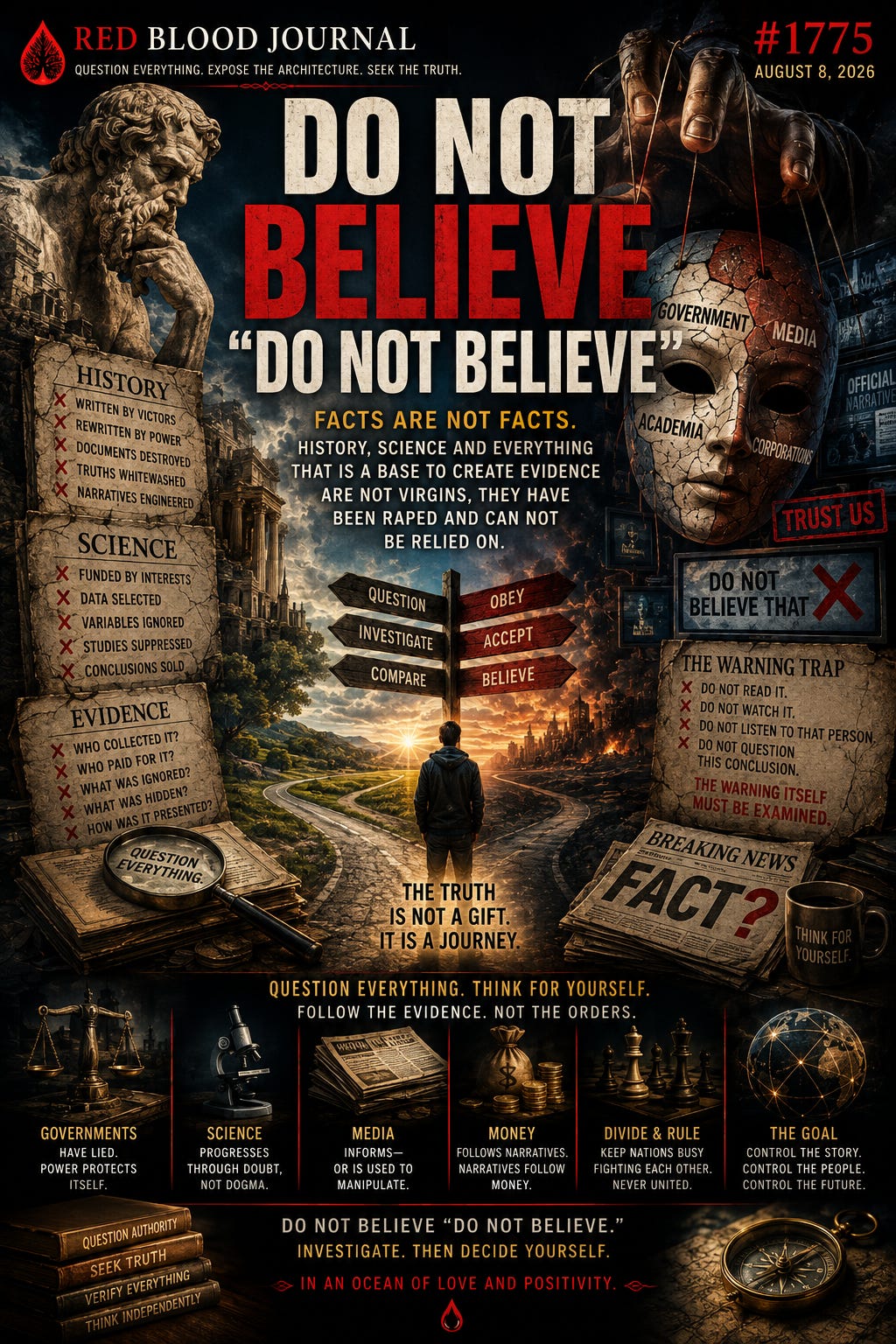
🩸 📚 #1775 — Do Not Believe “Do Not Believe”
When History, Science, Evidence, and Authority Have All Been Touched by Human Hands
August 8, 2026
Red Blood Journal
RedBloodJournal.com
We are taught from childhood that facts are solid.
History is history.
Science is science.
Documents are evidence.
Experts know.
Institutions preserve knowledge.
Archives record what happened.
Statistics measure reality.
And therefore, once enough evidence has been collected, the truth supposedly becomes obvious.
But there is a problem.
The evidence itself has a history.
History is written by human beings.
Science is performed by human beings.
Documents are produced by human beings.
Statistics are selected and interpreted by human beings.
Archives are preserved—or destroyed—by human beings.
Governments classify information.
Corporations fund research.
Universities decide what receives attention.
Publishers decide what gets printed.
Editors decide what becomes a headline.
Algorithms decide what millions of people see first.
Even the evidence used to determine what is true arrives through systems that are not untouched.
That does not mean everything is false.
It means almost nothing reaches us completely virgin—untouched by interpretation, interest, selection, power, fear, money, ideology, ambition, error, censorship, or time.
And that changes how truth should be approached.
Facts and the Containers That Carry Them
A fact may be real.
But the container carrying the fact can distort it.
Imagine clear water poured through several filters.
One filter belongs to a government.
Another belongs to a corporation.
Another belongs to a political movement.
Another belongs to a historian.
Another belongs to a scientist.
Another belongs to the media.
Another belongs to us.
By the time the water reaches the glass, something may have been removed.
Something may have been added.
Something may have been emphasized.
Something may have been forgotten.
And perhaps the greatest mistake is assuming that because the glass is labeled FACT, nobody touched the water.
History Is Not the Past
History and the past are not identical.
The past is what happened.
History is what survives about what happened.
That is an enormous distinction.
Millions of people who lived through history left no books behind.
Some could not read.
Some could not write.
Some were never interviewed.
Some died before anyone asked them what happened.
Some records were destroyed.
Some governments concealed their records.
Some armies wrote their own accounts.
Some victors preserved their version while the defeated disappeared.
Therefore every historical account contains an unavoidable question:
Whose evidence survived?
A historical document can be authentic while still representing only one person’s view.
A government archive can be genuine while containing only what officials decided to record.
A newspaper can accurately reproduce what authorities announced while the announcement itself is false.
Authenticity is not the same thing as truth.
Science Is a Method, Not a Priesthood
Science deserves tremendous respect because its method contains something beautiful:
the ability to challenge itself.
A scientific conclusion is not supposed to mean:
Believe this forever.
It means:
This is the best explanation supported by the evidence currently available. Test it again.
That final sentence matters.
Science becomes weaker, not stronger, when questioning is treated as disobedience.
A hypothesis must be challengeable.
An experiment must be reproducible.
Data must survive criticism.
Conclusions must remain vulnerable to better evidence.
Otherwise science stops behaving like a method of inquiry and starts behaving like authority.
The strength of science is therefore not that scientists are always correct.
The strength of science is that being wrong is supposed to be allowed.
Evidence Is Not Innocent
Evidence sounds neutral.
But ask how evidence arrives.
Who collected it?
Who paid for the collection?
Which variables were measured?
Which variables were ignored?
Which documents were released?
Which remained classified?
Which witnesses were considered credible?
Which studies were published?
Which studies were rejected?
Which statistics were selected for the headline?
Which years were included?
Where did the graph begin?
Every one of these decisions can change the story without fabricating a single number.
That is why critical thinking requires something beyond asking:
“Is this evidence?”
It requires asking:
“How was this evidence created?”
The Authority Trap
One of the easiest ways to control thinking is to replace an argument with an authority.
The government says.
Scientists say.
Experts say.
Intelligence officials say.
Historians agree.
Fact-checkers determined.
Sometimes those statements are completely justified.
Sometimes the experts really do possess vastly more knowledge than the rest of us.
Expertise matters.
But authority should tell us where to begin investigating, not where thinking must end.
Because institutions have been wrong before.
Governments have lied.
Corporations have concealed information.
Scientists have made mistakes.
Newspapers have published false stories.
Intelligence agencies have misjudged events.
Historians have revised previous conclusions.
And ordinary people have believed nonsense.
No institution possesses immunity from human weakness.
The Dangerous Sentence
Perhaps one of the most dangerous phrases in modern communication is:
“Do not believe that.”
Sometimes the warning is justified.
There is plenty of nonsense in the world.
Fabricated photographs.
False statistics.
Fraudulent medical claims.
Propaganda.
Scams.
Deliberate disinformation.
But something strange happens when the warning itself becomes an instruction not to investigate.
Do not read it.
Do not watch it.
Do not listen to that person.
Do not question this conclusion.
At that moment the person receiving the warning faces a choice.
Accept the authority of the warning—
or investigate why the warning was issued.
That leads to the central principle of #1774:
Do not believe anything simply because someone tells you not to believe something else.
The warning itself must also be examined.
Do Not Believe “Do Not Believe”
This statement contains an intentional paradox.
If Red Blood Journal says:
“Do not believe them,”
then do not automatically believe Red Blood Journal either.
Investigate.
If a government says:
“This is misinformation,”
ask why.
Then investigate.
If an alternative journalist says:
“Everything the government says is a lie,”
question that statement too.
If a scientist says:
“The science is settled,”
ask what evidence would be capable of changing the conclusion.
If a conspiracy theorist says:
“This proves everything,”
ask whether it really does.
Nobody should receive a permanent exemption from questioning.
Not government.
Not academia.
Not science.
Not religion.
Not media.
Not alternative media.
Not Red Blood Journal.
And certainly not the person writing the sentence being read.
Skepticism Must Work in Both Directions
There is another trap.
Someone learns that governments have lied.
Then they begin assuming everything governments say is false.
That is not critical thinking.
It is merely reversing obedience.
Yesterday:
Government says it → therefore true.
Today:
Government says it → therefore false.
Both approaches surrender independent judgment.
The same problem occurs with mainstream and alternative media.
Automatically believing CNN is not critical thinking.
Automatically disbelieving CNN is not critical thinking either.
Automatically believing an independent commentator because mainstream media attacks them is also not critical thinking.
Truth does not become true merely because authorities hate it.
And falsehood does not become true merely because it is censored.
The Middle Is Difficult
The hardest intellectual position is often the middle.
To say:
I don’t know yet.
To hold two conflicting possibilities simultaneously.
To continue gathering evidence.
To resist the emotional satisfaction of joining a camp.
Human beings dislike uncertainty.
We want conclusions.
We want villains.
We want heroes.
We want certainty.
But reality is frequently less cooperative.
Sometimes evidence genuinely points strongly in one direction.
Sometimes the evidence remains incomplete.
And sometimes the most truthful answer available is:
The case remains open.
There is nothing weak about that answer.
It may be the most intellectually honest answer possible.
The Problem of Manufactured Consensus
Consensus can be meaningful.
If thousands of qualified people independently examine evidence and reach similar conclusions, that deserves considerable weight.
But consensus can also be influenced by structures surrounding knowledge.
Funding.
Professional incentives.
Publication standards.
Career risk.
Political pressure.
Institutional culture.
Social conformity.
Media amplification.
None automatically invalidate a consensus.
But they remind us that consensus itself should not be confused with mathematical proof.
The proper question is:
How was the consensus reached?
Was dissent tested?
Was dissent censored?
Were competing explanations evaluated fairly?
Could the conclusion survive without institutional authority supporting it?
The Problem of Manufactured Dissent
The same skepticism must apply in reverse.
Dissent can also be manufactured.
A corporation can finance opposition research.
A foreign government can amplify division.
A political organization can manufacture doubt.
A social-media personality can profit from fear.
A commentator can build an entire career around telling audiences that every official explanation is fraudulent.
Therefore:
Mainstream consensus can be manipulated.
But so can anti-mainstream rebellion.
That is why the answer cannot simply be:
Trust alternative information.
The answer must be:
Investigate information.
A Better Definition of a Fact
Perhaps a useful distinction is this:
A fact is something that actually occurred or exists.
A claim is someone’s description of that fact.
Evidence is something used to support the claim.
Interpretation explains what the evidence supposedly means.
These are four different things.
Too often they are blended together.
Someone presents an interpretation and calls it a fact.
Someone presents a document and says the document proves their interpretation.
Someone presents a statistic without explaining how it was gathered.
Then another person disputes the interpretation and is accused of denying facts.
This is how language itself becomes part of the battlefield.
The Evidence Ladder
When confronted with an extraordinary claim, consider climbing an evidence ladder.
At the bottom:
Someone said it.
Then:
Several people repeated it.
Then:
A journalist reported it.
Then:
A document appears to support it.
Then:
The document’s authenticity is independently established.
Then:
Multiple independent sources corroborate it.
Then:
Primary evidence supports the same conclusion.
Then:
Alternative explanations have been seriously tested.
At every step, confidence can increase.
But absolute certainty remains rare.
That is not a weakness.
That is intellectual hygiene.
Question the Questioner
Perhaps the most important principle is symmetrical skepticism.
When someone says:
Believe me, investigate them.
When someone says:
Don’t believe them, investigate both.
When someone says:
The evidence proves it, inspect the evidence.
When someone says:
There is no evidence, ask what they searched for.
When someone says:
Everybody knows, ask who everybody is.
And when Red Blood Journal says:
Question everything,
question Red Blood Journal too.
Otherwise “question everything” becomes another commandment instead of a philosophy.
THE RED BLOOD PERSPECTIVE
The purpose of skepticism is not to destroy reality.
It is to protect the search for reality.
If everything is dismissed as propaganda, thinking becomes impossible.
If everything carrying an official stamp is accepted as truth, thinking also becomes unnecessary.
Both extremes surrender the mind.
The goal should therefore never be:
Believe nothing.
It should be:
Believe carefully.
Confidence should be proportional to evidence.
Conclusions should remain open to correction.
Sources should be compared.
Motives should be examined.
Documents should be checked.
And emotional preference should never be mistaken for proof.
Perhaps facts themselves are not the problem.
Perhaps the problem is the journey facts must travel before reaching us.
Every hand touching the message can alter it.
Every institution can emphasize one portion and bury another.
Every generation rewrites parts of its understanding.
And therefore intellectual freedom begins with refusing to outsource one’s entire judgment.
Not to government.
Not to corporations.
Not to universities.
Not to algorithms.
Not to journalists.
Not to alternative commentators.
Not even to this report.
Read.
Compare.
Question.
Think.
Decide.
And remain willing to decide differently tomorrow if tomorrow brings better evidence.
🌊 OCEAN OF LOVE AND POSITIVITY PERSPECTIVE
Truth should not create fear of learning.
It should create humility.
Every human being sees reality through a limited window.
Nobody possesses the entire ocean in a single cup.
One person may see one wave.
Another sees another.
Both can argue endlessly that their wave is the ocean.
Perhaps wisdom begins when we recognize the limits of our own viewpoint.
Questioning others is easy.
Questioning ourselves is harder.
But the second form of questioning may be more valuable.
Before asking:
Who fooled me?
ask:
What do I want to believe so badly that I might fool myself?
That question protects the mind from manipulation more effectively than any censor, authority, or fact-checker ever could.
Do not become frightened of knowledge because knowledge has been manipulated.
Learn more.
Compare more.
Think more deeply.
And never surrender the responsibility of judgment to anyone demanding unquestioned belief—or unquestioned disbelief.
Do not believe “do not believe.”
Investigate it.
Then make the decision yourself.
In an Ocean of Love and Positivity.
🩸🌊✨ Fantastic!
⚖️
The Architecture of Symmetrical Skepticism
Aug 9, 2026
This text advocates for a philosophy of symmetrical skepticism, arguing that truth is often filtered through human institutions and personal biases before it reaches the public. The author asserts that history, science, and evidence are not absolute certainties but products of interpretation that can be shaped by power, money, and ideology. Rather than defaulting to blind trust or reflexive cynicism, individuals are encouraged to investigate sources independently and remain comfortable with intellectual uncertainty. The core message warns against the “authority trap,” suggesting that the command to “not believe” something is often an attempt to stifle inquiry. Ultimately, the source promotes personal intellectual responsibility, urging readers to question all narratives, including those that challenge the mainstream.


