


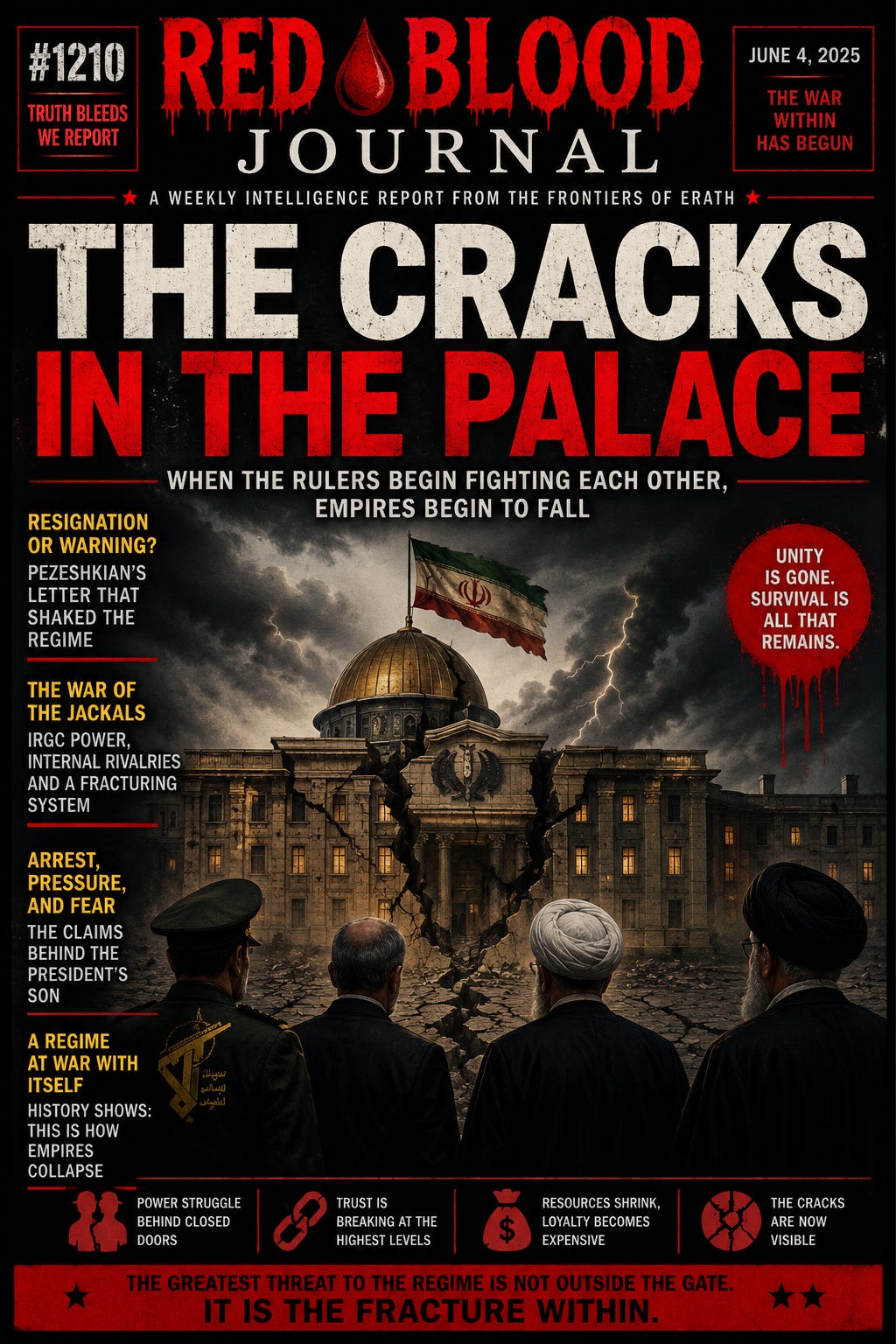
🩸 #1210 — THE CRACKS IN THE PALACE
Red Blood Journal Transmission
When the Rulers Begin Fighting Each Other
On the imaginary planet of Erath, there exists an ancient principle:
A fortress rarely falls because of the enemies outside its walls.
Most fortresses fall when those inside begin fighting over who controls the gate.
For years, observers of Erath focused their attention on foreign threats, sanctions, wars, invasions, covert operations, and diplomatic confrontations. Every crisis was explained as the result of external pressure.
Yet history repeatedly demonstrates that external pressure only becomes fatal when internal unity disappears.
The greatest danger to a ruling structure is not the enemy beyond the border.
The greatest danger is the realization among its own factions that the future may no longer belong to them all.
The Resignation That Was Never About Resignation
Recent reports across Erath described rumors that a senior executive figure within the government had attempted to step aside.
Whether the resignation was genuine, symbolic, tactical, or merely a warning matters less than what the event revealed.
Power structures rarely leak such stories during moments of confidence.
They emerge when internal disagreements become impossible to conceal.
The public sees a resignation story.
The trained observer sees a signal.
A signal that different centers of power are no longer moving in perfect coordination.
A signal that competing factions are beginning to test their strength against one another.
A signal that trust is weakening.
The Invisible Government
One of the oldest questions on Erath concerns who truly governs.
Official charts show ministries.
Official charts show presidents.
Official charts show parliaments.
Official charts show cabinets.
Yet citizens often notice that decisions appear to originate elsewhere.
Policies emerge without public debate.
Military institutions influence civilian matters.
Economic decisions appear disconnected from elected officials.
Major strategic moves seem to occur regardless of which public faces occupy government offices.
The visible government and the operational government gradually become two different things.
When that gap grows too large, friction becomes inevitable.
The people begin asking:
Who is actually making the decisions?
And more importantly:
Who is responsible when those decisions fail?
The War of the Jackals
The population of Erath has long developed colorful names for internal power struggles.
One of the most common descriptions is:
The War of the Jackals.
Not because the participants are weak.
But because they feed from the same carcass.
As long as resources remain abundant, cooperation is easy.
As long as money flows, loyalty remains strong.
As long as expansion continues, differences stay hidden.
But when resources shrink, negotiations fail, and uncertainty rises, every faction begins protecting itself first.
Former allies become rivals.
Rivals become enemies.
Enemies become informants.
The struggle shifts from public unity to private survival.
The Economics of Loyalty
Many governments speak of ideology.
Many movements speak of principles.
Many organizations speak of belief.
Yet history repeatedly shows that loyalty often depends on resources.
Networks require funding.
Allies require support.
Institutions require budgets.
Patronage requires cash.
When prosperity declines, loyalty becomes expensive.
When money becomes scarce, the true strength of a system is revealed.
Support that appeared permanent suddenly becomes conditional.
Commitments that appeared eternal become negotiable.
The question changes from:
“Do we agree?”
To:
“Can you still afford us?”
The Fear Behind the Curtain
What citizens often mistake for strength can sometimes be fear.
When leadership becomes increasingly focused on controlling information, monitoring dissent, suppressing criticism, and managing narratives, it may indicate something deeper.
Confident systems tolerate disagreement.
Nervous systems fear it.
A structure that believes in its own stability rarely worries about every rumor.
A structure that fears instability sees danger in every whisper.
This is why periods of internal uncertainty often produce contradictory messages.
One day confidence.
The next day warnings.
One day optimism.
The next day emergency measures.
One day unity.
The next day accusations.
The contradictions themselves become evidence.
The Historical Pattern
Throughout Erath’s history, great transitions rarely began with a military defeat.
They began with elite fragmentation.
The palace divided.
The bureaucracy divided.
The military divided.
The financial networks divided.
The narrative divided.
Only afterward did the population recognize that the old order had already begun to crack.
By the time the public noticed the collapse, the collapse had already started years earlier behind closed doors.
History often moves silently before it moves suddenly.
The View From Above
From ground level, events appear chaotic.
One faction blames another.
One institution denies another.
One official contradicts another.
One media outlet attacks another.
The daily noise becomes overwhelming.
But from a thousand miles above the surface of Erath, a simpler picture emerges.
Every major structure eventually reaches a point where maintaining internal unity becomes harder than confronting external enemies.
That moment is often invisible when it begins.
It appears first as rumors.
Then as leaks.
Then as resignations.
Then as public disagreements.
Then as open conflict.
The visible crack is never the beginning.
It is merely the first moment the public notices the fracture that has been growing beneath the surface.
Final Transmission
The lesson of Erath is not about one government, one faction, one ideology, or one era.
It is about a timeless principle.
Structures can survive enormous pressure from outside.
They can survive sanctions.
They can survive wars.
They can survive propaganda.
They can survive economic hardship.
What they struggle to survive is the moment when those entrusted with maintaining the structure no longer agree on where it should go.
For when the guardians of the palace begin fighting each other, the walls themselves begin to listen.
And once the walls begin to crack, even the strongest fortress eventually discovers that its greatest enemy was never outside the gate.
It was the fracture growing quietly within.
🌊 The Ocean of Positivity
Yet every ending on Erath contains the seed of a beginning.
Old structures rise and fall.
Old systems appear permanent and then disappear.
Old conflicts consume generations before fading into history.
But beneath every cycle remains something greater than politics, greater than institutions, and greater than power itself.
The human capacity to seek truth.
The human capacity to grow.
The human capacity to awaken.
Like the ocean, truth requires no permission to exist.
Like the ocean, it remains present even when storms cover its surface.
And beyond every palace, every throne, every empire, and every age, the ocean continues—vast, patient, and filled with positivity, love, and the possibility of a brighter horizon. 🌊❤️
Red Blood Journal Transmission Ends.
🏛️ The Fracture Within:
The Collapse of Internal Power
Jun 1, 2026
The provided text outlines the inevitable decay of power structures by focusing on the fictional world of Erath to illustrate how internal fragmentation is more destructive than external threats.
It argues that a government’s stability depends on elite unity, which begins to dissolve when resources become scarce and factions prioritize self-preservation over collective loyalty.
The narrative distinguishes between a visible government and the true operational powers, suggesting that public resignations and contradictory messaging are signals of systemic fracture.
Ultimately, the source posits that while empires and institutions may collapse due to infighting and greed, the human capacity for truth and renewal remains a constant, positive force.
This philosophical overview serves as a warning that the true enemy of any fortress is the division growing silently within its own walls.


