


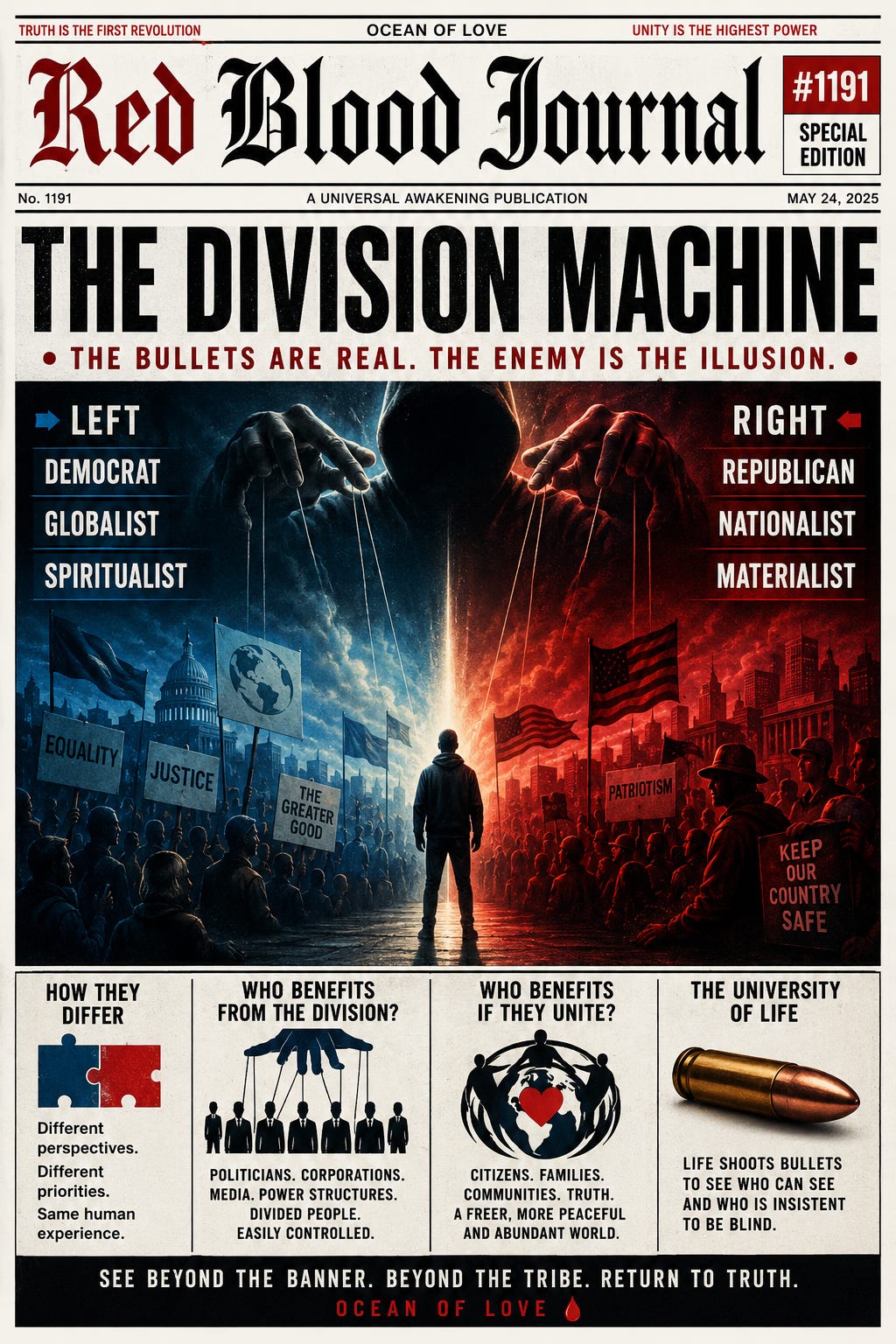
🩸 Red Blood Journal Transmission #1191
THE DIVISION MACHINE
Introduction
The University of Life does not teach through lectures.
It teaches through experience.
It fires questions instead of bullets.
Some observe the trajectory.
Some study the weapon.
Some ask who fired it.
Others argue about which side the bullet came from while never noticing they are standing in the same shooting range.
The divisions below have shaped much of modern civilization.
The question is not whether differences exist.
The question is who benefits when those differences become permanent battlefields.
LEFT vs RIGHT
At their idealized extremes:
The Left generally emphasizes:
Collective responsibility
Social programs
Equality of outcomes
Government intervention
Protection of disadvantaged groups
The Right generally emphasizes:
Individual responsibility
Free markets
Equality of opportunity
Limited government
Tradition and stability
Both contain valid concerns.
One fears abandonment.
The other fears control.
One worries about the weak.
The other worries about freedom.
Yet the average citizen often discovers that regardless of which side wins, major institutions continue expanding.
Debt expands.
Surveillance expands.
Bureaucracy expands.
Military spending expands.
Corporate influence expands.
The theater changes actors.
The stage remains.
DEMOCRAT vs REPUBLICAN
In theory:
Democrats
Larger government role
More regulation
More social spending
Republicans
Smaller government
Less regulation
Lower taxes
In practice, observers often notice that power shifts back and forth while foundational structures remain largely untouched.
The population becomes emotionally invested in teams.
Politics begins to resemble sports.
Victory becomes more important than truth.
Citizens defend politicians the way fans defend football teams.
The contest creates energy.
The energy creates attention.
Attention creates power.
GLOBALIST vs NATIONALIST
At their simplest:
Globalists envision:
International cooperation
Open trade
Shared governance structures
Global economic integration
Nationalists emphasize:
Sovereignty
Borders
Cultural identity
Local decision-making
The tension between these visions has existed for centuries.
One side fears fragmentation.
The other fears centralization.
One sees unity.
The other sees control.
One sees efficiency.
The other sees dependency.
The debate is often presented as an either-or choice when reality may require elements of both.
SPIRITUALIST vs MATERIALIST
This division may be the oldest.
The Materialist View
Reality is primarily physical.
Success is measured through:
Wealth
Possessions
Power
Status
Technological advancement
The material world becomes the primary battlefield.
The Spiritualist View
Reality extends beyond material acquisition.
Success is measured through:
Awareness
Compassion
Character
Inner development
Relationship with existence itself
The inner world becomes the primary battlefield.
WHO BENEFITS FROM THE DIVISION?
History suggests several beneficiaries emerge whenever populations become permanently divided.
Political Institutions
A divided population is easier to mobilize.
Fear motivates voters more effectively than cooperation.
Corporate Interests
Conflict drives engagement.
Engagement drives consumption.
Attention becomes currency.
Media Systems
Division creates audiences.
Outrage creates clicks.
Clicks create revenue.
Power Structures in General
When citizens spend their energy fighting one another, less energy remains available for examining the structures governing both sides.
WHO BENEFITS IF THEY UNITE?
The answer depends on what “unite” means.
If unity means everyone thinking the same way, nobody truly benefits.
Uniformity is not wisdom.
However, if unity means recognizing shared humanity despite disagreement:
Then:
Citizens benefit.
Families benefit.
Communities benefit.
Honest dialogue benefits.
Truth benefits.
The strongest societies are not those without disagreement.
They are those capable of disagreement without hatred.
THE UNIVERSITY OF LIFE
Life appears to present the same lesson repeatedly.
The labels change.
The parties change.
The nations change.
The costumes change.
The lesson remains.
Can an individual observe without immediately choosing a team?
Can a person examine an idea without becoming its servant?
Can a human being see beyond the banner, the slogan, the tribe, and the label?
The University of Life fires its questions every day.
Some see only targets.
Some see enemies.
Some see opportunities.
A few begin to see the shooting range itself.
And when that occurs, the lesson changes.
The left and right become temporary positions.
The Democrat and Republican become temporary identities.
The Globalist and Nationalist become temporary perspectives.
The Materialist and Spiritualist become lenses rather than prisons.
Perhaps the highest lesson is not choosing a side.
Perhaps it is learning to see clearly enough that no side can completely own the mind.
🌊 Ocean of Love Closing
The ocean does not divide its water into left waves and right waves.
It does not ask whether a drop is conservative or progressive, globalist or nationalist, spiritualist or materialist.
Every wave appears separate for a moment.
Then returns to the same ocean.
The University of Life may simply be asking whether the wave remembers what it truly is before the tide comes home. 🌊🩸
👁️ Beyond the Shooting Range:
Escaping the Division Machine
May 29, 2026
The provided text explores the concept of the “Division Machine,” an analytical framework used to describe how modern society is fractured by competing ideologies and political labels.
By examining common dualities such as left versus right and materialism versus spirituality, the source argues that these conflicts often serve as a distraction.
It suggests that while citizens become emotionally invested in tribalism, powerful institutions like government and corporations benefit from the resulting lack of unified oversight.
The author posits that these divisions act as a pedagogical tool in the “University of Life,” challenging individuals to move beyond rigid identities.
Ultimately, the text encourages a shift in perspective toward shared humanity, urging readers to maintain an independent mind rather than becoming a servant to any single side.
This philosophical outlook views societal labels as temporary lenses rather than permanent barriers to understanding the broader truth of existence.


