


🩸 RedBloodJournal.com
REPORT #1812
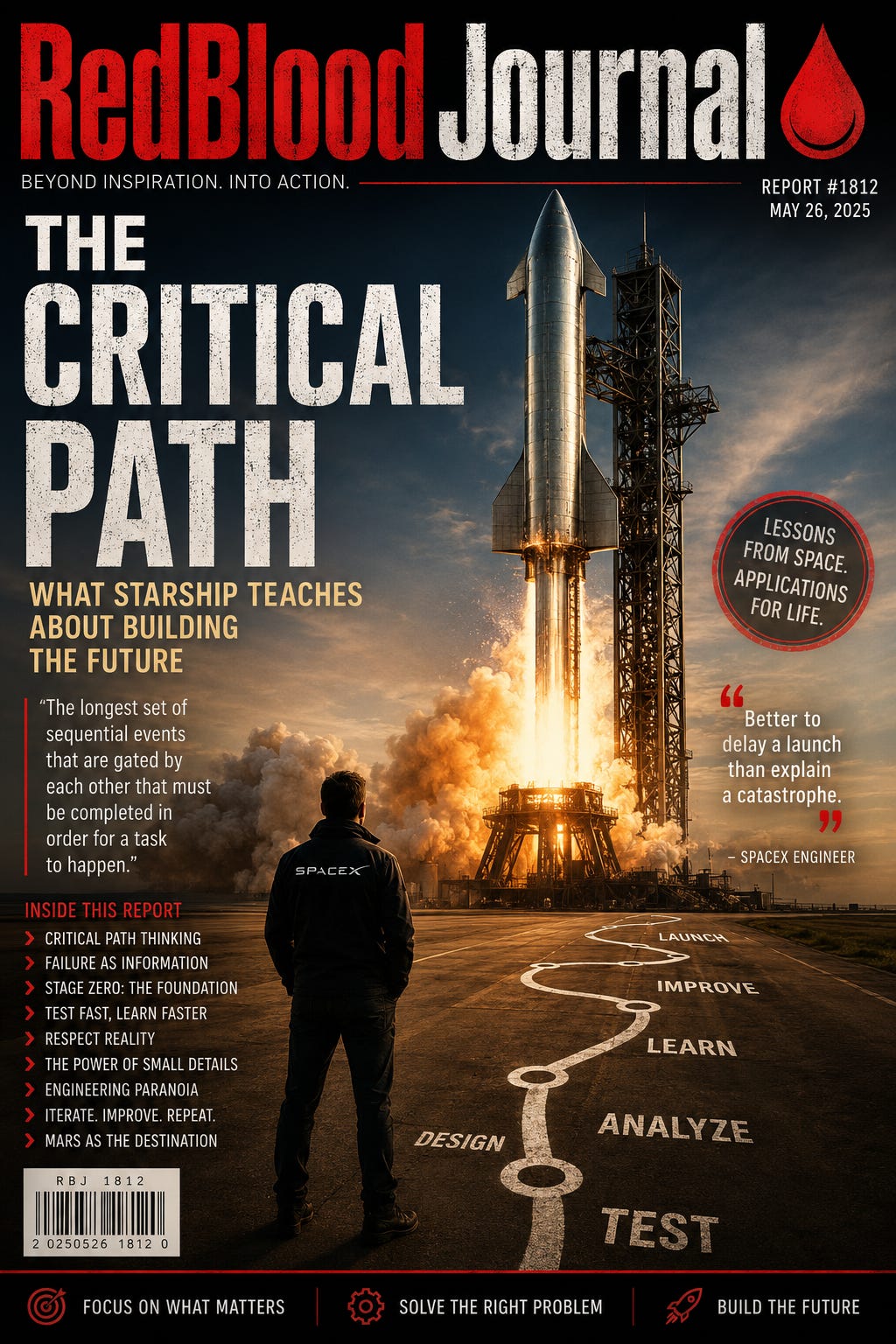
The Critical Path
What Starship Teaches About Building the Future
PROLOGUE
History often celebrates the moment a rocket leaves the launch pad.
The countdown.
The fire.
The roar.
The explosion of energy that captures headlines around the world.
Yet almost none of the story is visible.
Behind every successful launch are thousands of invisible decisions, thousands of failures, countless redesigns, and an engineering culture that understands one simple truth:
Progress belongs to those who solve the right problem—not necessarily the biggest one.
The Starship program offers far more than a lesson in aerospace engineering.
It offers a blueprint for solving any complex challenge.
The Meaning of the Critical Path
Engineers repeatedly refer to something called the critical path.
It is the sequence of dependent tasks that determines when a project can actually be completed.
A hundred teams may be working simultaneously.
Hundreds of problems may exist.
But only a handful truly determine whether the mission succeeds.
The temptation in every organization is to work on whatever appears urgent.
The discipline of great engineering is discovering what is actually important.
This distinction separates activity from progress.
Failure Is Information
Throughout the program, launch attempts are delayed.
Hydraulic systems behave unexpectedly.
Sensors report abnormal readings.
Chains fail.
Mechanical arms refuse to unlatch.
Static fire tests abort.
Entire launch campaigns pause because of seemingly minor anomalies.
To an outside observer, these appear to be failures.
To engineers, they are data.
Every unexpected event removes another unknown.
Each problem uncovered on the ground is one less problem discovered in the sky.
The philosophy is simple:
Better to delay a launch than explain a catastrophe.
Engineering Humility
One recurring theme throughout the documentary is humility.
The engineers repeatedly admit:
“We have never done this before.”
No simulation can perfectly recreate reality.
No computer model can predict every interaction between millions of moving parts.
The only way to discover the unknown is to confront it.
Instead of pretending certainty, they acknowledge uncertainty.
That humility becomes one of their greatest strengths.
Learning Faster Than Others
Perhaps the defining characteristic of the SpaceX culture is speed of learning.
The objective is not merely to build rockets.
The objective is to increase the rate at which knowledge is acquired.
Rapid testing.
Rapid repair.
Rapid redesign.
Rapid iteration.
A chain breaks.
Within thirty hours it is replaced.
A hydraulic system behaves unexpectedly.
Engineers redesign it overnight.
Problems become temporary visitors rather than permanent obstacles.
Stage Zero
One of the most fascinating concepts introduced is Stage Zero.
The launch pad itself is considered part of the rocket.
Without it, nothing flies.
This idea extends beyond engineering.
Every great achievement depends upon invisible infrastructure.
Families.
Schools.
Values.
Education.
Discipline.
Character.
These foundations rarely receive public recognition.
Yet they determine everything built upon them.
Strong foundations rarely make headlines.
Weak foundations always do.
Respecting Reality
One lesson appears repeatedly throughout the mission.
Nature cannot be negotiated with.
Heat remains hot.
Pressure remains pressure.
Gravity remains gravity.
Reality has no concern for optimism, deadlines, politics, or financial markets.
Either the engineering works—or it does not.
Reality is the final judge.
The Power of Small Details
Gigantic rockets often fail because of surprisingly small details.
A pressure fluctuation.
A vibration.
A sensor.
A chain link.
A hydraulic limit.
History often attributes success to vision.
Engineering reminds us that vision survives only through attention to detail.
Great achievements are rarely defeated by great enemies.
They are usually defeated by neglected details.
Controlled Paranoia
One engineer summarizes the philosophy perfectly:
“Always be paranoid.”
Not fearful.
Prepared.
Every assumption is questioned.
Every unexpected behavior is investigated.
Every anomaly deserves an explanation.
Confidence without verification becomes arrogance.
Verification creates confidence.
Learning Through Construction
The documentary repeatedly emphasizes an uncomfortable truth.
The first launch pad was intentionally imperfect.
It was built quickly.
Built cheaply.
Built simply.
Not because perfection was impossible—
but because learning was more valuable.
Waiting for perfection often guarantees that learning never begins.
The Human Side of Progress
Behind every rocket are ordinary people.
Families.
Interns.
Technicians.
Operators.
Engineers.
People drinking too much coffee.
Working impossible schedules.
Repairing machinery through the night.
Sharing victories.
Sharing disappointments.
Innovation is not built by machines.
It is built by people willing to endure uncertainty together.
The Mars Mindset
Although every discussion revolves around launch pads, chains, engines, satellites, and heat shields, the larger objective never disappears.
Mars.
The engineers understand that every bolt tightened today serves a destination decades away.
Long-term vision transforms short-term frustration into meaningful progress.
Purpose gives suffering direction.
Beyond Rockets
The lessons extend far beyond aerospace.
Businesses.
Governments.
Families.
Schools.
Hospitals.
Every complex system contains its own critical path.
The greatest mistake organizations make is solving visible problems while ignoring foundational ones.
Working harder cannot compensate for working on the wrong obstacle.
FINAL THOUGHTS
Perhaps the greatest lesson from Starship is not about rockets at all.
It is about how civilization advances.
Not through perfection.
Not through certainty.
Not through avoiding mistakes.
But through honest observation.
Relentless improvement.
Humility before reality.
The courage to fail publicly.
And the discipline to return tomorrow a little wiser than yesterday.
Every successful launch is only the visible tip of an invisible mountain built from countless corrections, thousands of small improvements, and millions of thoughtful decisions.
That may be the true critical path—not only to Mars, but to every meaningful achievement humanity will ever accomplish.
🩸 RedBloodJournal.com
“The future is not built by those who never fail. It is built by those who learn faster than failure can stop them.”
🚀 The Critical Path:|
Engineering the Future Through Failure
Jul 13, 2026
The provided text explores the Starship program not just as an aerospace endeavor, but as a profound blueprint for solving complex human challenges. It emphasizes the critical path, a discipline of identifying the most essential tasks rather than just the most urgent ones, to ensure genuine progress. The philosophy relies on engineering humility and the belief that failure is valuable data, allowing for a rapid cycle of learning and iteration. Beyond technical mechanics, the source highlights the importance of invisible infrastructure—the foundational values and support systems that sustain monumental achievements. Ultimately, the text asserts that civilization advances when people remain disciplined, pay attention to small details, and learn faster than their mistakes can hinder them. This long-term vision transforms immediate frustrations into a meaningful journey toward the future.


