


🩸 Red Blood Journal
REPORT #1816
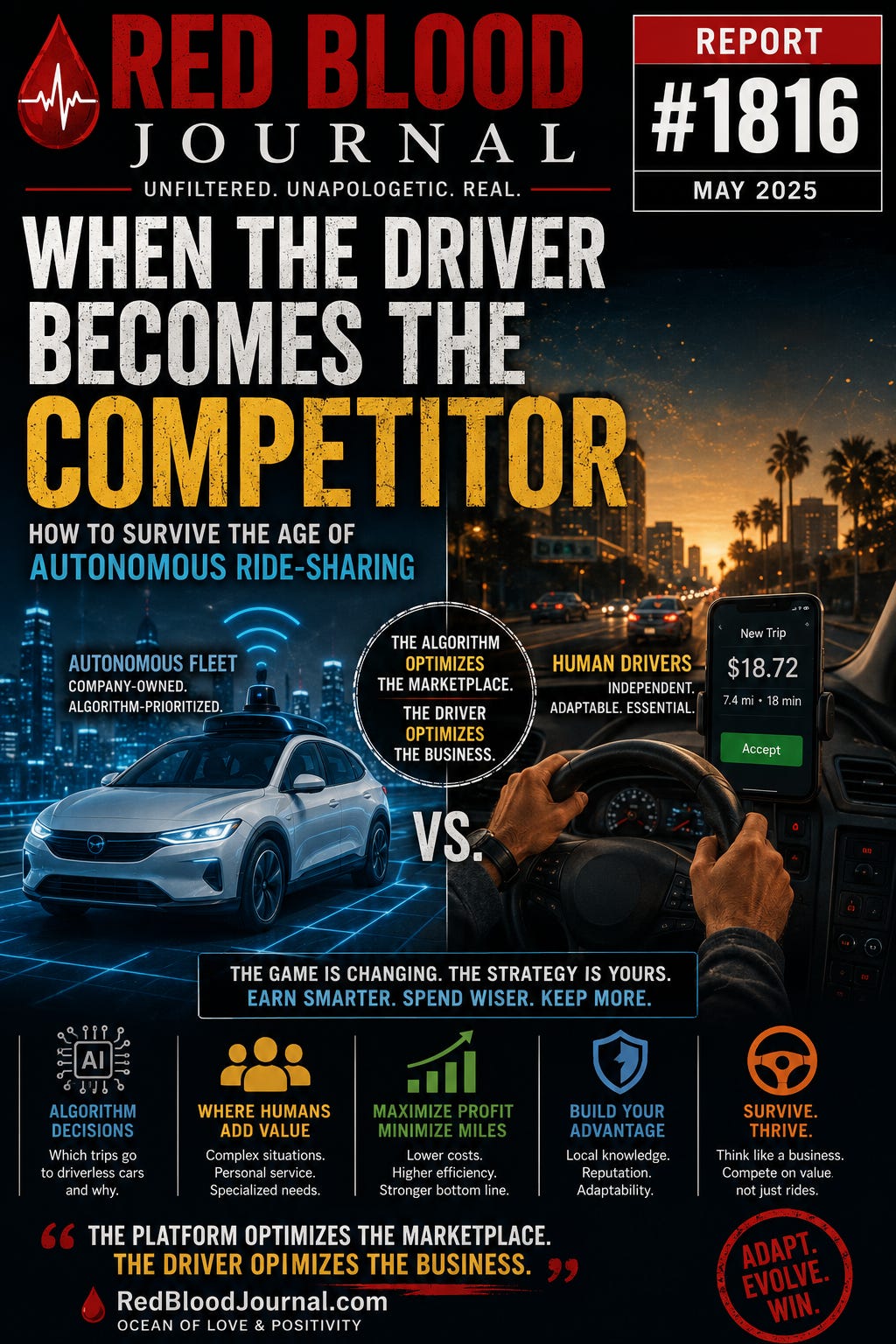
When the Driver Becomes the Competitor
How Human Drivers Can Survive the Age of Autonomous Ride-Sharing
RedBloodJournal.com
PROLOGUE
For more than a decade, ride-share companies have relied primarily on independent drivers using their own vehicles to build global transportation networks.
That relationship is now beginning to change.
As autonomous vehicle technology matures, many ride-share companies are investing in company-owned driverless fleets. This raises a fundamental economic question:
If a company owns both autonomous vehicles and contracts with human drivers, how should the algorithm decide which vehicle receives each trip?
The answer is unlikely to be based on fairness.
It will almost certainly be based on economics.
This report explores how a rational algorithm might allocate trips to maximize profitability and what strategies human drivers can adopt to remain competitive in an increasingly automated marketplace.
1. The Algorithm’s Objective
The purpose of a dispatch algorithm is not to maximize the income of individual drivers.
Its purpose is to maximize the efficiency and profitability of the transportation network.
Every assignment becomes an optimization problem.
Instead of asking:
“Which driver is closest?”
A future algorithm may increasingly ask:
“Which vehicle assignment produces the greatest long-term profit for the company?”
2. Why Company-Owned Autonomous Vehicles Matter
A human-driven vehicle is supplied by the driver.
A company-owned autonomous vehicle is supplied by the platform.
Although autonomous vehicles still incur significant costs—including purchase, depreciation, insurance, charging or fuel, maintenance, cleaning, software updates, and remote support—they eliminate the direct cost of paying a driver for each trip.
From the company’s perspective, that changes the economics of every ride.
3. Which Trips Would Likely Go to Driverless Cars?
If maximizing profit is the objective, autonomous vehicles would likely receive trips that are:
predictable,
repeatable,
operationally simple,
highly profitable,
low risk.
Examples include:
airport transfers,
highway routes,
commuter corridors,
suburban point-to-point travel,
well-mapped urban areas with proven autonomous performance.
These trips maximize utilization of company-owned assets.
4. Which Trips Would Likely Go to Human Drivers?
Human drivers provide value beyond simply moving a vehicle.
They solve problems.
A platform may continue assigning human drivers to:
complicated downtown pickups,
construction zones,
adverse weather,
large public events,
passengers requiring assistance,
elderly or disabled riders,
luggage-heavy airport pickups,
situations requiring human judgment.
Automation replaces routine work first.
Human adaptability remains valuable where uncertainty exists.
5. Human Drivers Become Flexible Capacity
Owning thousands of autonomous vehicles requires enormous capital investment.
Independent drivers provide something different.
They provide flexible capacity.
During holidays, concerts, sporting events, emergencies, or unexpected spikes in demand, human drivers allow the network to expand without requiring the company to purchase additional vehicles.
In this model:
Autonomous vehicles become the company’s fixed fleet.
Human drivers become scalable capacity.
6. The Company Will Seek Maximum Fleet Utilization
Every autonomous vehicle sitting idle represents unused capital.
A rational algorithm would attempt to:
minimize idle time,
reduce empty repositioning,
chain profitable trips together,
keep company-owned vehicles moving as continuously as possible.
The objective shifts from assigning the next trip to optimizing the entire fleet.
7. The New Economic Reality for Human Drivers
If company-owned vehicles receive many of the most predictable and profitable assignments, human drivers must compete differently.
The question is no longer:
“How can I complete more rides?”
It becomes:
“How can I generate more profit from every mile I drive?”
This distinction becomes increasingly important as automation expands.
8. Think Like a Business Owner
Successful drivers will increasingly operate as business owners rather than wage earners.
Track:
profit per mile,
profit per hour,
operating costs,
depreciation,
maintenance,
tire wear,
fuel or charging costs,
total vehicle utilization.
Revenue alone is an incomplete measure of success.
Profit is what remains after expenses.
9. Drive Fewer Miles for the Same Income
If gross earnings become increasingly constrained by marketplace dynamics, reducing unnecessary mileage becomes one of the driver’s greatest competitive advantages.
Focus on:
short pickups,
efficient routes,
productive destinations,
minimal empty repositioning,
lower vehicle wear.
Keeping more is often easier than earning more.
10. Become the Specialist
Automation excels at repetition.
Humans excel at judgment.
Drivers can differentiate themselves by serving markets where personal interaction still matters, including:
executive transportation,
elderly passengers,
accessible transportation,
airport assistance,
premium service,
hospitality-oriented rides,
complex event logistics.
These services create value beyond transportation alone.
11. Master the Local Market
Algorithms analyze historical data.
Experienced drivers observe real-time conditions.
Local knowledge remains valuable.
Understand:
airport patterns,
hotel activity,
entertainment districts,
commuter schedules,
school traffic,
convention calendars,
seasonal events.
Information reduces unnecessary mileage and improves efficiency.
12. Reduce Every Operating Cost
Every dollar not spent has the same effect on profit as an additional dollar earned.
Focus on extending the life of:
tires,
brakes,
suspension,
battery systems,
drivetrain components.
Drive smoothly.
Avoid unnecessary acceleration and braking.
Protect the asset that generates your income.
13. Diversify Beyond One Platform
Depending entirely on one algorithm increases business risk.
Consider complementary income sources where permitted, such as:
airport transportation,
executive transportation,
medical transportation,
event transportation,
delivery services,
private transportation businesses.
Diversification reduces dependence on a single company’s future decisions.
14. Reputation Remains a Human Advantage
Autonomous vehicles compete on consistency.
Human drivers compete on relationships.
Passengers remember:
professionalism,
courtesy,
reliability,
cleanliness,
helpfulness,
trust.
Exceptional service remains difficult to automate.
15. The Long-Term Transformation
The competition of the future may no longer be:
Driver versus Driver.
It may become:
Human Labor versus Company-Owned Capital.
The platform owns the autonomous fleet.
The driver owns experience, judgment, flexibility, and personal service.
Those strengths become increasingly valuable when used strategically.
Conclusion
The arrival of autonomous vehicles does not necessarily eliminate opportunities for human drivers.
It changes the rules of competition.
As automation assumes routine transportation, the role of the human driver may evolve toward specialized service, operational flexibility, and efficient business management.
Drivers who continue thinking only in terms of completed trips may struggle.
Drivers who think like business owners—protecting their vehicles, controlling costs, understanding their markets, and focusing on net profitability rather than gross revenue—are more likely to remain competitive.
Technology changes industries.
Successful people change with technology.
The platform will optimize the marketplace.
The successful driver will optimize the business.
Editorial Note
This report presents economic analysis and forward-looking scenarios. The allocation strategies discussed are hypothetical models based on operational and economic reasoning and should not be interpreted as descriptions of any specific ride-share company’s proprietary algorithms or future business plans.
🩸 RedBloodJournal.com
Ocean of Love & Positivity
🤖 Human Versus Machine:
Navigating the Autonomous Ride-Share Economy
Jul 13, 2026
This report examines the shifting landscape of the ride-sharing industry as companies transition from human contractors to company-owned autonomous fleets. The text suggests that future dispatch algorithms will likely prioritize driverless vehicles for predictable, high-profit routes to maximize corporate asset utilization. Consequently, human drivers may be relegated to complex environments, adverse weather conditions, or specialized services requiring empathy and judgment. To remain competitive, workers must evolve into strategic business owners who focus on net profitability and cost reduction rather than just ride volume. By diversifying their income streams and mastering niche markets, humans can offer a level of flexibility and personalized service that automation cannot currently replicate. Ultimately, the source argues that survival in an automated economy depends on human adaptability and efficient management of operational expenses.


