


🩸 Red Blood Journal
REPORT #1814
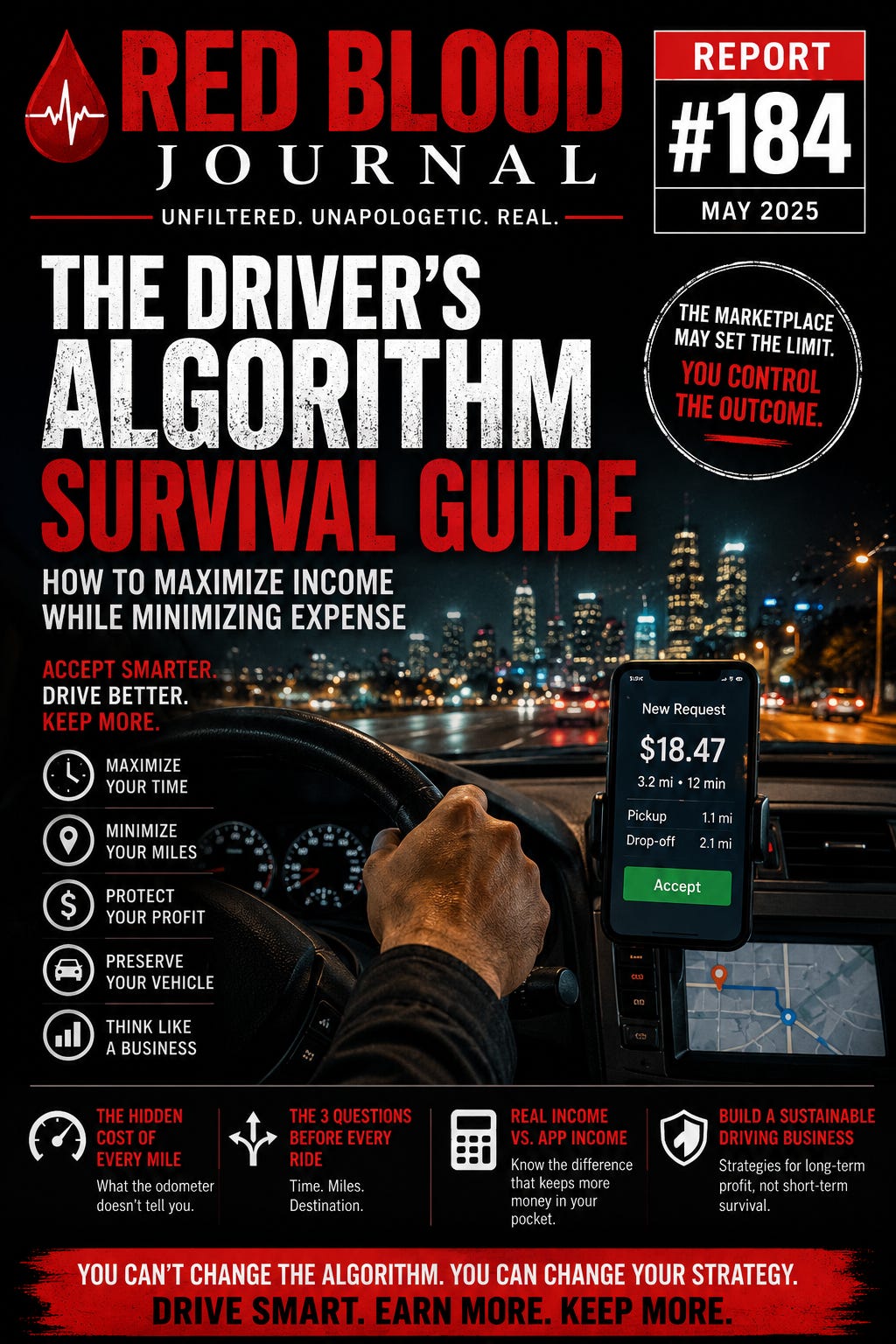
The Driver’s Algorithm Survival Guide
How to Maximize Income While Minimizing Vehicle Expense
RedBloodJournal.com
PROLOGUE
Every driver eventually discovers an uncomfortable truth.
Driving more does not necessarily mean earning more.
Many experienced drivers have independently reported a similar observation: despite different schedules, neighborhoods, and strategies, their active hourly earnings often seem to converge toward approximately the same level over time.
Whether this is the result of deliberate algorithmic design cannot be independently verified because the dispatch system is proprietary.
However, if the observation is correct, then the question changes.
Instead of asking:
“How do I earn more?”
The better question becomes:
“How do I keep more?”
This guide examines the marketplace from the driver’s perspective and presents practical strategies that may improve long-term profitability.
The First Rule
Stop Thinking Like an Employee
Employees are paid for time.
Drivers are paid with a business asset.
That asset is the vehicle.
Every mile has a cost.
Every minute has a value.
Every trip consumes part of the vehicle’s remaining life.
The objective is not simply to make money.
The objective is to preserve as much of that money as possible after all operating costs.
Gross income is not profit.
Understanding the Marketplace
Ride-share platforms optimize an entire transportation network.
Their objectives include:
Keeping enough drivers available.
Keeping passenger wait times low.
Maintaining predictable labor costs.
Remaining profitable.
Balancing supply with demand.
Drivers have different objectives.
Drivers seek:
Higher net income.
Lower vehicle expenses.
Less depreciation.
Greater long-term financial stability.
These objectives do not always align.
Understanding this difference changes how every trip should be evaluated.
The Three Questions Before Accepting Any Ride
Instead of asking:
“How much does this ride pay?”
Ask three questions.
Question 1
How much time will this entire job require?
Include:
driving to pickup,
waiting for the passenger,
transporting the passenger,
returning to another productive area if necessary.
The trip ends only when you are ready for another paying passenger.
Question 2
How many total miles will this job require?
Do not calculate only passenger miles.
Include:
pickup miles,
passenger miles,
repositioning miles,
return miles when applicable.
Those miles belong to your vehicle.
Not Uber’s.
Question 3
Where does this ride leave me?
Some destinations immediately generate another ride.
Others leave you twenty miles from meaningful demand.
A profitable destination can be worth more than a larger fare.
Why Mileage Matters More Than Most Drivers Realize
Every mile creates hidden expenses.
Including:
fuel or electricity,
tires,
brakes,
suspension,
transmission wear,
oil and fluids,
insurance exposure,
accident risk,
depreciation,
reduced resale value.
Many of these costs are invisible until the repair bill arrives.
The odometer never forgets.
Gross Income Is Not Net Income
Two drivers each complete a shift.
Driver A earns:
$180
Total miles driven:
90
Driver B earns:
$180
Total miles driven:
150
The app reports identical earnings.
Reality does not.
Driver A has consumed far less of the vehicle to produce the same income.
Over hundreds of thousands of miles, this difference becomes enormous.
The Most Valuable Ride Is Not Always the Highest Fare
Large fares often create hidden costs.
Examples include:
long pickups,
traffic congestion,
airport waiting,
remote drop-offs,
empty return trips.
A modest-paying ride completed efficiently may produce greater profit.
Profit depends on efficiency, not appearance.
Think Like an Investor
Imagine each mile costs real money.
Because it does.
Would you invest:
$25
to receive
$26?
Probably not.
Yet many drivers unknowingly do something similar every day by accepting inefficient trips.
The goal is to maximize return on every mile invested.
The Four Measurements Every Driver Should Track
Successful businesses measure performance.
Drivers should do the same.
Track:
1. Gross income
How much entered the account.
2. Net income
How much remains after operating expenses.
3. Total miles
Every mile the vehicle traveled while working.
Not merely passenger miles.
4. Real hourly income
Not active-hour income.
Real online hours from login until logout.
This reveals what the day was actually worth.
Hidden Time Is Real Time
The application may recognize only active driving.
Your life recognizes all working time.
Include:
waiting,
repositioning,
fueling,
charging,
cleaning,
airport queues,
traffic delays.
Time without a passenger is still time spent working.
Evaluate your business accordingly.
Do Not Chase Every Ride
Not every ride deserves acceptance.
Sometimes saying “no” protects the business.
Poor rides often include:
long pickups,
low fares,
heavy congestion,
remote destinations,
poor probability of another request.
One unprofitable ride can reduce the profitability of several good ones.
Why Short Trips May Be More Valuable
If active hourly earnings tend to converge over time, reducing unnecessary mileage becomes increasingly important.
Short, efficient trips often provide:
less depreciation,
lower fuel consumption,
quicker turnover,
greater flexibility,
higher opportunity to receive another nearby request.
The objective is not necessarily the shortest passenger trip.
The objective is the most efficient complete assignment.
Learn Your Market
Every city develops patterns.
Know:
airport demand,
commuter periods,
event schedules,
hotel concentrations,
business districts,
university schedules,
entertainment areas.
Knowledge reduces unnecessary mileage.
Experience eventually becomes more valuable than speed.
Think Beyond Today’s Earnings
Many drivers focus only on today’s deposits.
Successful operators think about:
next month,
next year,
the next 100,000 miles.
Vehicle longevity is part of income.
Every unnecessary mile today reduces tomorrow’s equity.
Separate Revenue From Wealth
Revenue enters your account.
Wealth stays in your pocket.
The two are not identical.
Higher revenue with excessive expenses often produces less wealth than moderate revenue earned efficiently.
The Business Formula
Instead of asking:
“How can I earn another five dollars?”
Ask:
“How can I avoid spending another five dollars?”
Income and savings have identical effects on profit.
Reducing waste is often easier than increasing revenue.
A New Way to Think
The application measures completed trips.
Your business measures:
profit,
efficiency,
vehicle preservation,
sustainability.
Those are not always the same thing.
The driver who understands this difference begins making decisions that compound over months and years.
Final Thoughts
No driver controls the algorithm.
Every driver controls decisions.
You cannot choose the marketplace.
You can choose how you operate within it.
Whether the observed earnings convergence is the result of marketplace dynamics or algorithmic design, one principle remains true:
The driver who minimizes unnecessary miles, protects the vehicle, understands the market, and evaluates every trip as a business decision is likely to retain more of each dollar earned than the driver who focuses only on gross revenue.
In the end, success is measured not by how much money passes through your account, but by how much remains after the engine has cooled, the shift has ended, and the costs have been paid.
Opinion and Analysis
This guide reflects economic analysis, practical driving experience, and observations reported by multiple drivers. It discusses hypotheses about marketplace behavior and algorithmic incentives but does not claim access to Uber’s proprietary dispatch or pricing systems. Readers are encouraged to compare these ideas with their own operating data and experiences.
🩸 RedBloodJournal.com
🚗 The Driver’s Algorithm Survival Guide
Jul 13, 2026
This guide instructs gig economy drivers to shift their perspective from that of an employee to a business owner focused on long-term profitability. It argues that gross income is a misleading metric, as true success depends on minimizing vehicle depreciation and hidden operating costs. By evaluating the total mileage and time required for each trip, drivers can avoid inefficient assignments that offer a poor return on investment. The text emphasizes that while drivers cannot control the platform’s dispatch algorithms, they can control their earnings by prioritizing resource preservation over high-volume revenue. Ultimately, the source provides a framework for tracking net income and understanding market patterns to ensure the vehicle remains a sustainable financial asset.


