


🩸 RedBloodJournal.com
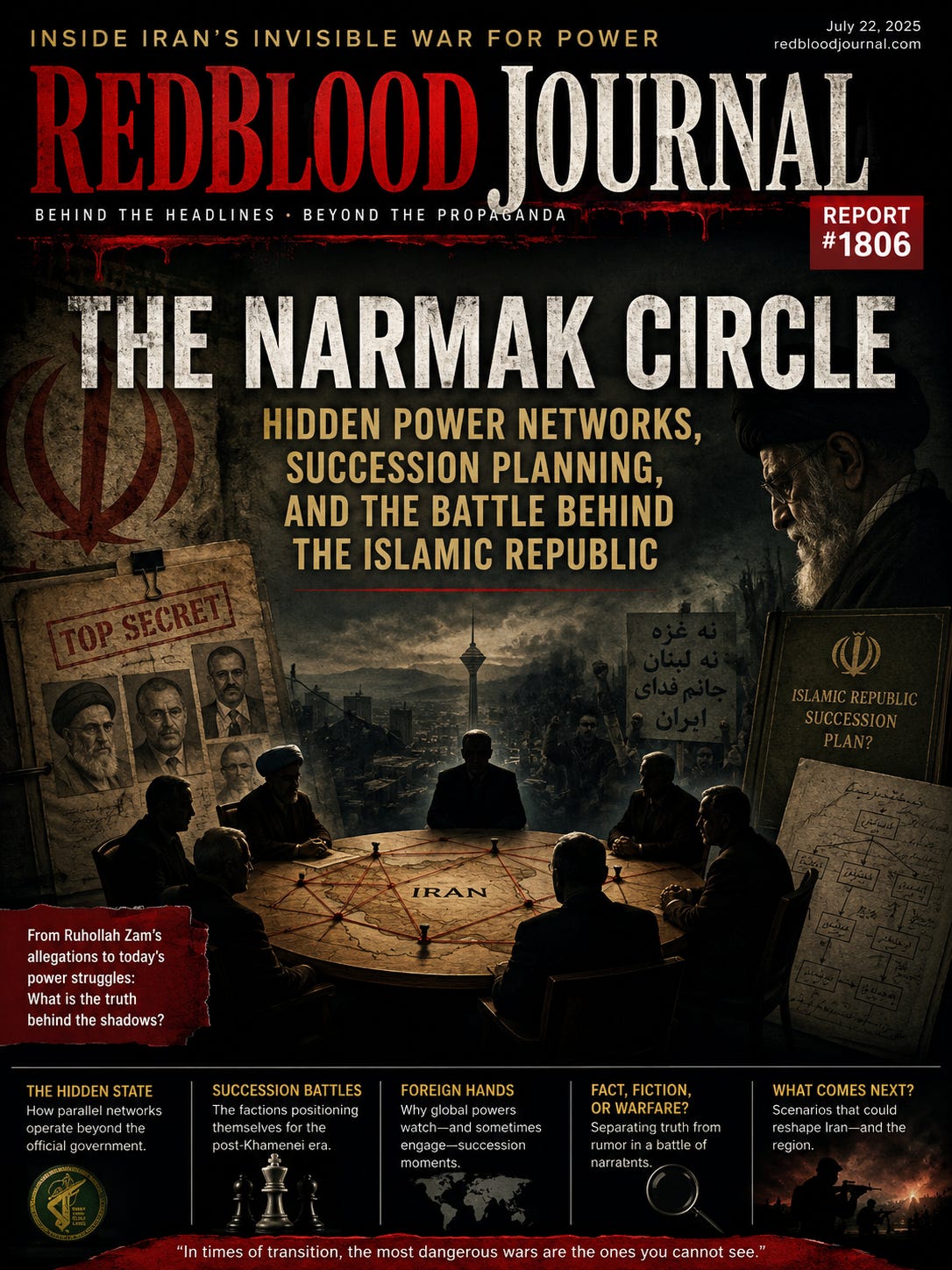
REPORT #1806 – The Narmak Circle
Hidden Power Networks, Succession Planning, and the Battle Behind the Islamic Republic
PROLOGUE
History often remembers governments through the speeches they delivered.
The real turning points, however, are frequently decided in conversations the public never hears.
Throughout modern history, intelligence agencies, military organizations, political factions, financial interests, and foreign governments have all attempted to influence succession inside rival states. Sometimes these efforts succeed. Sometimes they collapse under the weight of competing ambitions.
Whenever a nation reaches a moment of leadership transition, visible politics and invisible politics begin to separate.
Iran may now be entering such a moment.
The Idea Behind the “Narmak Circle”
The term “Narmak Circle” entered public discussion primarily through allegations made by the late Iranian journalist Ruhollah Zam, who claimed that a hidden network of influential political, security, and clerical figures had been preparing for the period after Ayatollah Ali Khamenei.
These allegations have never been independently verified.
Nevertheless, the idea itself raises an important political question that extends far beyond Iran:
When an aging political system approaches succession, who is actually preparing to inherit power?
Not necessarily those making speeches.
Often those quietly building relationships.
Visible Government vs. Invisible Government
Every political system has two structures.
The visible structure.
And the invisible structure.
The visible structure contains:
Presidents
Ministers
Parliament
Public debates
Elections
Official announcements
The invisible structure may include:
Security organizations
Military commanders
Intelligence services
Financial networks
Religious influence
Foreign relationships
Long-term succession planners
History repeatedly demonstrates that these invisible structures frequently outlast elected officials.
Governments change.
Networks often remain.
Succession Is the Most Dangerous Moment
Most governments are strongest while leadership remains stable.
They become vulnerable when leadership changes.
Questions immediately emerge:
Who controls the military?
Who controls intelligence?
Who controls communications?
Who controls financial assets?
Who has foreign backing?
Who can promise stability?
These questions frequently matter far more than ideology.
The Competing Centers of Power
Recent political developments suggest that multiple factions inside the Islamic Republic may hold differing views regarding Iran’s future direction.
Some observers describe broad divisions between:
Officials seeking negotiated de-escalation.
Security-oriented factions favoring continued confrontation.
Military institutions protecting their influence.
Clerical authorities preserving ideological legitimacy.
Political figures positioning themselves for a post-Khamenei era.
Exactly how these factions relate to one another is difficult to verify publicly, and many claims remain speculative.
What is evident is that succession periods often intensify competition within governing systems.
Foreign Powers Always Watch Succession
Leadership transitions rarely occur in isolation.
Major powers study them carefully.
Not because they can fully control them—
—but because uncertainty creates opportunity.
Throughout history, governments have quietly established contacts with opposition figures, military officers, diplomats, or influential insiders in rival states.
Such engagement does not guarantee outcomes, but it is a recurring feature of international politics.
The Risk of Hidden Assumptions
One recurring danger is assuming that a hidden plan, if it exists, will unfold exactly as intended.
Political systems are not machines.
Unexpected actors emerge.
Military events intervene.
Public opinion shifts.
Economic crises reshape priorities.
Even carefully prepared succession strategies can unravel.
History contains many examples where competing factions altered events in ways no planner anticipated.
When Factions Compete
The greatest danger during succession is often not external attack.
It is internal rivalry.
When competing groups believe they are acting to preserve the state, they may simultaneously weaken it.
Each faction may view itself as the rightful guardian of national stability.
The result can be confusion, paralysis, or escalation.
Looking Beyond Personalities
Whether one accepts or rejects specific allegations surrounding the so-called “Narmak Circle,” the broader lesson remains valuable.
Political transitions are rarely determined by a single individual.
They involve institutions, alliances, incentives, and relationships built over many years.
Understanding those underlying structures can offer a more durable perspective than focusing solely on public personalities.
CONCLUSION
Every nation tells one political story to its citizens.
Sometimes another story unfolds quietly beneath it.
Whether hidden networks ultimately shape events or not, history repeatedly reminds us that leadership transitions expose the deepest tensions within political systems.
The challenge for any observer is to distinguish between documented facts, informed analysis, and unverified claims—while recognizing that uncertainty itself is often part of the political landscape.
The coming chapters of Iran’s succession will likely be written not only by those speaking from podiums, but also by decisions made far from public view.
Only time will reveal which forces prove decisive.
RedBloodJournal.com
“Understanding history requires watching both the stage and the machinery behind the curtain.”
🕵️♂️
The Narmak Circle and the Machinery of Iranian Succession
Jul 13, 2026
This report explores the clandestine power dynamics potentially shaping the future of Iran during a period of leadership transition. It introduces the concept of the Narmak Circle, an alleged secret network of elite figures preparing for the era following the current Supreme Leader. The text emphasizes the distinction between a nation’s visible government and the invisible structures of military, security, and financial interests that often dictate historical outcomes. By examining the internal rivalries and institutional alliances within the Islamic Republic, the source highlights how succession periods expose a state’s deepest vulnerabilities. Ultimately, the document suggests that unseen networks and international interests may be more influential in determining political continuity than public-facing officials.


