


🩸 RED BLOOD JOURNAL
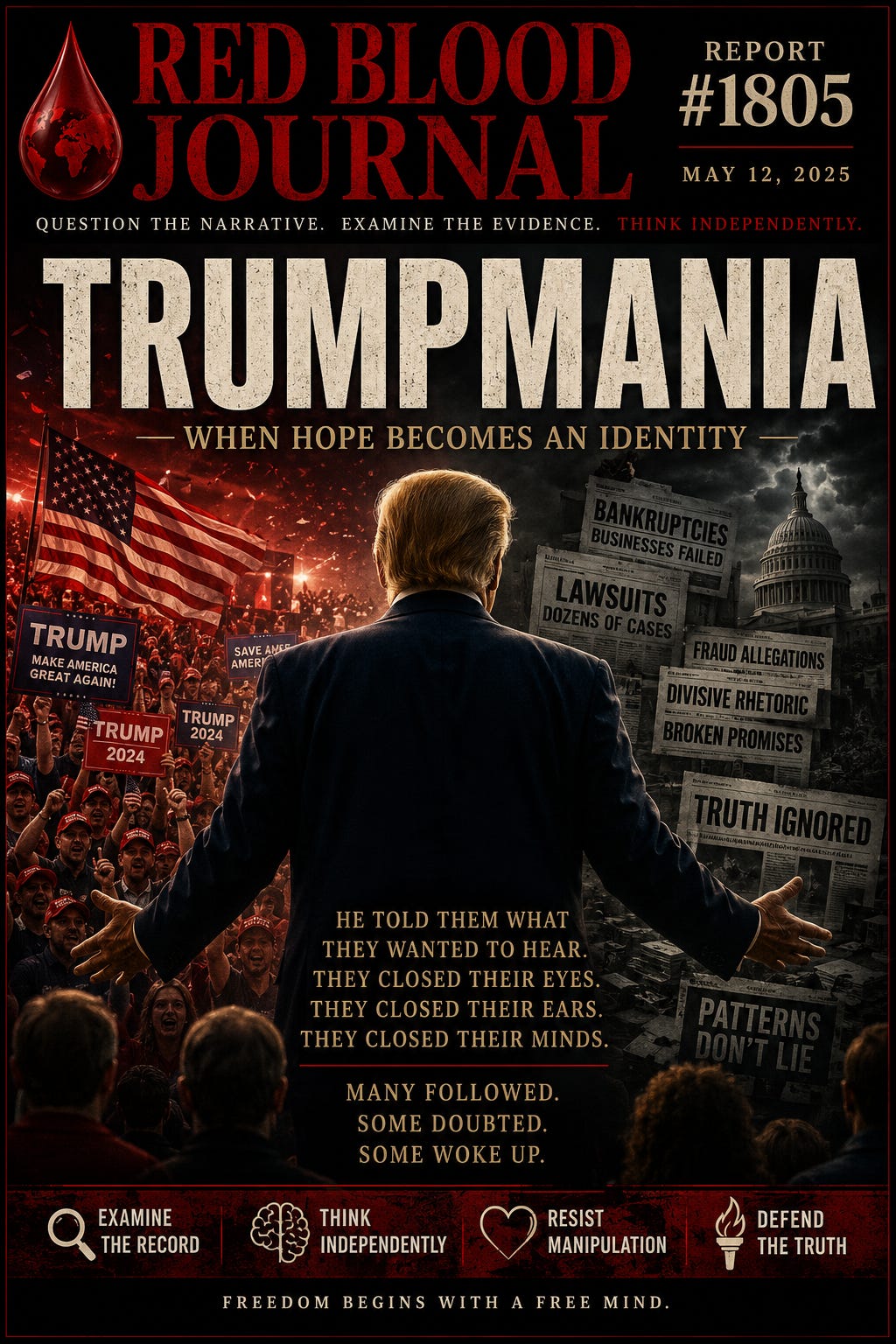
#1805 – Trumpmania
When Hope Becomes an Identity
RedBloodJournal.com
PROLOGUE
History has never lacked powerful leaders.
What history repeatedly produces is something far more powerful than any leader:
A population willing to stop questioning.
This condition is not unique to one country, one religion, one ideology, or one political party.
It is a recurring feature of human psychology.
For the purpose of this report, we call this condition Trumpmania.
Not as a medical diagnosis.
Not as an attack on one individual.
But as a name for a broader psychological phenomenon that can arise whenever admiration for a political leader begins to replace independent judgment.
WHAT IS TRUMPMANIA?
Trumpmania is the moment when a person begins to evaluate reality through the image of a leader rather than evaluating the leader through reality.
Facts become secondary.
History becomes optional.
Questions become uncomfortable.
Evidence is filtered through loyalty instead of curiosity.
The leader is no longer simply a politician.
He becomes an identity.
THE POWER OF PROMISE
Every successful politician understands one truth:
People do not vote only with logic.
They vote with hope.
Hope for prosperity.
Hope for security.
Hope for justice.
Hope that someone will finally repair what appears broken.
The stronger the hope, the easier it becomes to overlook contradictions.
THE RECORD THAT WAS ALWAYS THERE
Every public figure leaves a trail.
Years...
Sometimes decades...
of speeches...
business decisions...
relationships...
successes...
failures...
and recognizable patterns of behavior.
Yet during elections many people temporarily set that history aside.
Instead they focus on speeches, slogans, promises, and carefully crafted narratives.
Sometimes they see the person.
Sometimes they see only the person they hope that leader will become.
WHEN EXPECTATION MEETS REALITY
Reality eventually arrives.
If a leader later behaves consistently with patterns that have existed throughout much of his public life, disappointment often follows.
Supporters begin asking:
“What happened?”
Perhaps a better question is:
Did the leader change...
...or did our expectations change?
THE SYMBOL EFFECT
Political figures frequently become symbols much larger than themselves.
Supporters may project onto them their frustrations, aspirations, and visions for the future.
The individual becomes a vessel carrying the hopes of millions.
Once that transformation occurs, criticism of the leader can feel like criticism of one’s own identity.
The political movement becomes deeply personal.
History has seen this pattern many times with different leaders, different parties, and different nations.
THE COST OF STOPPING QUESTIONS
The greatest danger is not supporting a politician.
Nor is it opposing one.
The danger begins when questioning stops.
When criticism is viewed as betrayal.
When loyalty becomes more valuable than truth.
A healthy society depends on preserving the ability to continually examine ideas—including those presented by leaders we admire.
THE MIRROR
Perhaps the greatest lesson is personal.
Many thoughtful people have, at one time or another, found themselves deeply persuaded by a political figure, a movement, or a compelling narrative.
I include myself among them.
At one point I also became caught up in the excitement surrounding Donald Trump.
Like many others, I heard the promises and imagined the future more clearly than I examined the past.
When later events unfolded in ways that reflected patterns already visible throughout his long public life, the disappointment was not necessarily because he had changed.
It was because my expectations had.
Recognizing that possibility within ourselves is not weakness.
It is the beginning of wisdom.
The mind that can admit,
“Perhaps I was wrong,”
is often stronger than the mind that insists it never could be.
CONCLUSION
Trumpmania is not ultimately about Donald Trump alone.
It is about a recurring human tendency to substitute hope for examination and identity for evidence.
The names will change.
The countries will change.
The parties will change.
But the psychological pattern remains remarkably consistent.
The enduring question is therefore not:
“Who should we follow?”
It is:
“Can we continue asking questions—even when the answers challenge those we most admire?”
A truly independent mind is not measured by loyalty to a leader.
It is measured by its willingness to examine evidence honestly, even when doing so is uncomfortable.
That lesson extends far beyond one presidency, one movement, or one moment in history.
It is a lesson about human nature itself.
🩸 RedBloodJournal.com
Question the narrative. Examine the evidence. Think independently.
🧠 The Psychology of Political Identity
Jul 12, 2026
This text explores a psychological phenomenon labeled “Trumpmania,” defined as the point where devotion to a political figure overrides an individual’s independent judgment and critical thinking. The author argues that supporters often project their own hopes and identities onto a leader, causing them to disregard historical patterns or factual evidence that contradicts their idealized vision. This shift creates a dynamic where loyalty is prioritized over truth, making any criticism of the politician feel like a personal attack on the supporter’s self-image. By sharing a personal account of disillusionment, the author suggests that the leader’s behavior is often consistent with their past, while the follower’s expectations are what truly shift. Ultimately, the source warns that a healthy society depends on the constant willingness to question authority, even when that authority represents one’s own deeply held aspirations.


