


🩸 Red Blood Journal
REPORT #1815
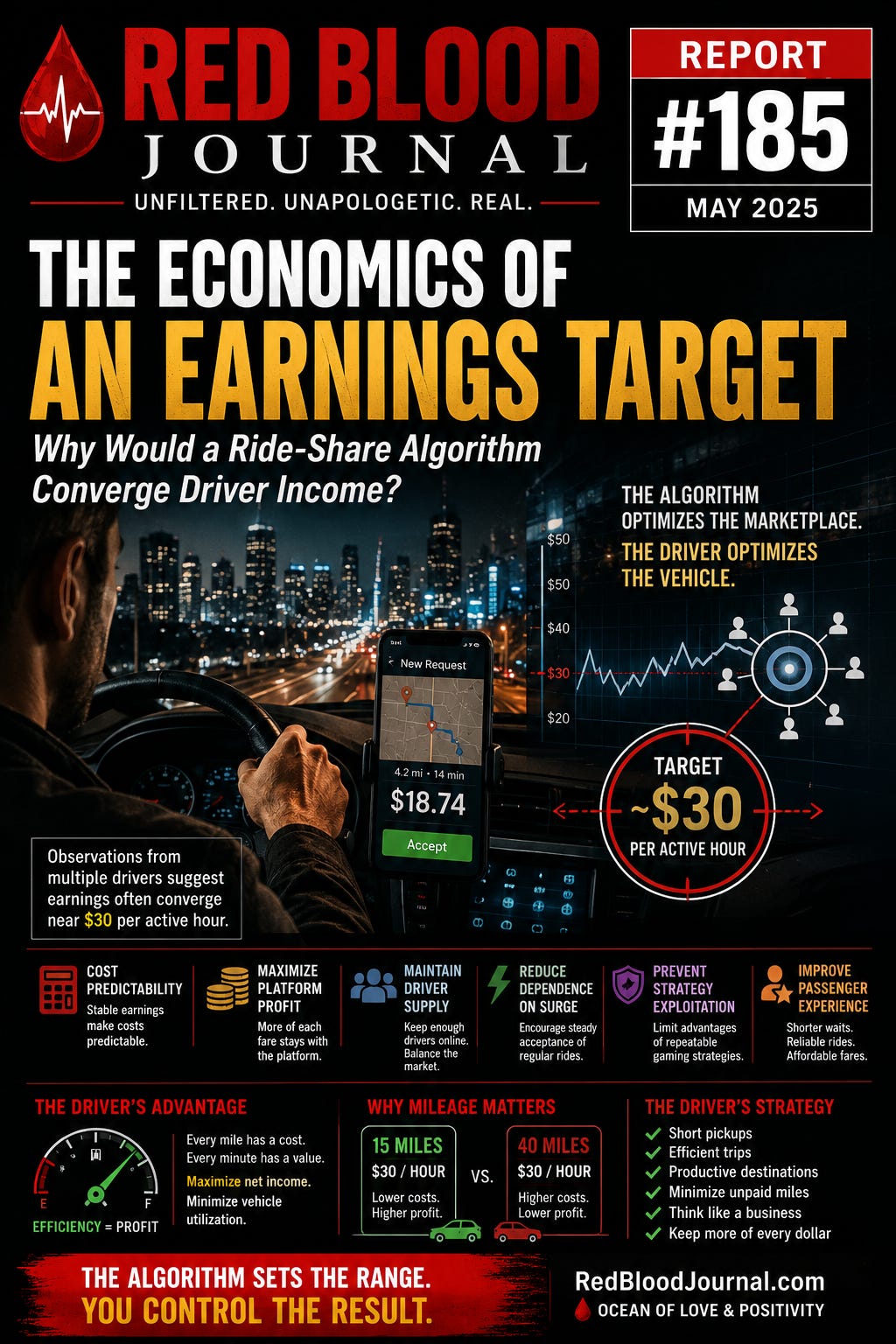
The Economics of an Earnings Target
Why Would a Ride-Share Algorithm Converge Driver Income?
RedBloodJournal.com
Executive Summary
This report examines an economic hypothesis developed from observations reported by multiple ride-share drivers.
The central observation is that, although California law establishes a minimum earnings guarantee, many drivers have independently reported that their active hourly earnings appear to converge toward an average of approximately $30 per active hour, regardless of differences in driving style, trip selection, or working hours.
Whether this pattern reflects deliberate algorithmic design cannot be independently verified because ride-share dispatch and pricing systems are proprietary. Nevertheless, if such earnings convergence exists, several economic incentives could explain why a platform would intentionally guide the marketplace toward a relatively stable earnings range.
Rather than viewing the dispatch system solely as a pricing engine, this report explores the possibility that it functions as a marketplace optimization system—balancing driver supply, passenger demand, operating costs, and platform profitability.
1. The Central Hypothesis
The premise of this report is not that California law limits driver earnings.
Instead, the hypothesis is that:
California law establishes a minimum earnings floor.
The platform’s algorithm establishes an effective earnings target.
Over hundreds of trips, drivers with different strategies often appear to converge toward a similar active hourly income.
If this observation is accurate, the algorithm is not attempting to maximize the earnings of each individual driver.
Its objective is to optimize the efficiency of the marketplace as a whole.
2. Cost Predictability
Driver compensation represents one of the largest controllable operating expenses for any ride-share platform.
Large variations in driver earnings create uncertainty in budgeting and financial forecasting.
Maintaining driver compensation within a relatively narrow range allows the platform to:
forecast labor expenses more accurately,
stabilize operating costs,
improve long-term financial planning,
present more predictable financial performance to investors.
Predictability itself has measurable economic value.
3. Maximizing Platform Profitability
Every passenger fare is divided between two participants:
the driver,
the platform.
If an algorithm determines that a driver is already earning near the marketplace target, additional passenger payments do not necessarily need to be distributed proportionally to the driver.
Instead, a larger percentage of future fares may remain with the platform.
From the driver’s perspective, hourly earnings remain relatively stable.
From the platform’s perspective, profitability increases without significantly reducing driver participation.
4. Maintaining Driver Supply
A ride-share marketplace functions only when sufficient drivers remain available.
The platform therefore seeks an equilibrium.
When earnings become too low
Drivers leave the platform.
Passenger wait times increase.
Service quality declines.
Customer satisfaction falls.
When earnings become too high
Large numbers of new drivers enter the marketplace.
Driver supply exceeds passenger demand.
Waiting time between trips increases.
Competition among drivers intensifies.
When earnings remain within a stable range
Most existing drivers continue working.
Fewer new drivers enter the market.
Passenger coverage remains consistent.
Economists refer to this balance as market equilibrium.
5. Reducing Dependence on Surge Pricing
Surge pricing benefits drivers but increases costs for both passengers and the platform.
If drivers learn to work only during surge periods, the platform loses flexibility.
Maintaining relatively stable average earnings encourages drivers to continue accepting ordinary requests instead of waiting exclusively for premium-priced trips.
This helps distribute driver availability more evenly throughout the day.
6. Preventing Strategy Exploitation
Experienced drivers constantly develop methods to increase profitability.
Common examples include:
minimizing long pickups,
prioritizing airport trips,
using destination filters,
declining low-paying offers,
positioning near anticipated demand.
If certain strategies consistently generated dramatically higher earnings, those methods would quickly spread through driver communities, online forums, and social media.
A continuously adapting algorithm could reduce these advantages over time, encouraging earnings to converge regardless of individual tactics.
7. Improving Passenger Experience
Passengers generally value three outcomes:
shorter wait times,
reliable pickups,
affordable transportation.
Maintaining an adequate supply of available drivers while controlling labor costs helps achieve those objectives.
The optimization process is therefore centered on marketplace efficiency rather than maximizing the income of any individual driver.
8. The Fundamental Conflict
The platform and the driver pursue different objectives.
The Platform Seeks
sufficient driver availability,
predictable operating costs,
maximum profitability,
stable passenger service.
The Driver Seeks
maximum earnings,
minimum operating expenses,
reduced vehicle depreciation,
efficient use of working time.
These objectives naturally create tension.
Understanding this difference helps explain why the platform and the driver often evaluate the same trip very differently.
9. Why Mileage Becomes the Driver’s Most Important Variable
If active hourly earnings tend to converge regardless of trip selection, then gross income becomes increasingly difficult for the driver to control.
Mileage does not.
Every additional mile contributes to:
depreciation,
fuel or electricity costs,
tire wear,
brake wear,
maintenance,
insurance exposure,
financing costs,
accident risk,
reduced resale value.
Consider two drivers.
Both earn approximately $30 during one active hour.
One drives 15 miles.
The other drives 40 miles.
The application reports identical earnings.
Their businesses do not.
The driver who travels fewer miles preserves more of the vehicle while retaining a greater percentage of gross income as actual profit.
10. The Driver’s Rational Strategy
If the earnings convergence hypothesis is correct, then the driver’s objective changes.
The goal is no longer simply to maximize gross revenue.
Instead, it becomes:
Maximize Net Income While Minimizing Vehicle Utilization
This generally favors trips that provide:
shorter pickup distances,
efficient passenger transport,
productive destinations,
minimal unpaid repositioning,
fewer unnecessary vehicle miles.
The focus shifts from earning more dollars to keeping more dollars.
11. Viewing the Algorithm as a Labor Allocation System
If earnings repeatedly converge despite different schedules, locations, and driving strategies, the dispatch system may function less as a traditional pricing engine and more as a labor allocation system.
Under this interpretation, the algorithm continuously balances three competing objectives:
Maintain enough drivers to satisfy passenger demand.
Keep driver earnings sufficiently attractive to encourage continued participation.
Minimize overall labor costs while maximizing marketplace efficiency.
Its objective is not necessarily to maximize the profitability of each individual trip.
Its objective is to optimize the overall transportation network.
Conclusion
If an earnings convergence near $30 per active hour is consistently observed across many drivers, one possible economic interpretation is that the platform is designed to stabilize the labor marketplace rather than maximize individual driver earnings.
From the platform’s perspective, such stability improves cost predictability, maintains driver availability, discourages easily repeatable profit strategies, and enhances long-term profitability.
From the driver’s perspective, however, the conclusion is fundamentally different.
When gross hourly earnings become relatively fixed, the greatest opportunity for improving profitability lies not in chasing larger fares but in reducing total operating costs.
The driver who minimizes unnecessary mileage, limits unpaid repositioning, protects the vehicle from excessive depreciation, and treats every ride as a business decision rather than simply another trip may retain substantially more profit over time.
The platform optimizes the marketplace.
The successful driver optimizes the vehicle.
Understanding the difference between those two objectives may be the most valuable strategy available to any ride-share driver.
Editorial Note
This report presents economic analysis and discusses hypotheses based on observations reported by multiple drivers. It does not claim knowledge of any ride-share company’s proprietary algorithms or internal operational decisions. Readers are encouraged to compare these concepts with their own driving records and independent observations.
🩸 RedBloodJournal.com
Ocean of Love & Positivity
⚖️ The Algorithm of Earnings Convergence
Jul 13, 2026
This report analyzes the economic theory of earnings convergence, suggesting that ride-share algorithms may steer driver income toward a standardized hourly average. By stabilizing pay, platforms can better forecast operating expenses and maintain a consistent supply of labor without overpaying for individual trips. The text argues that the system prioritizes marketplace efficiency and platform profitability over the financial maximization of any single driver. Because gross earnings are mathematically capped by this algorithmic target, drivers are encouraged to focus on minimizing vehicle expenses and mileage to protect their net profits. Ultimately, the source highlights a fundamental tension where the platform optimizes the network while the driver must optimize the vehicle to remain successful.


