


🩸 RedBloodJournal.com
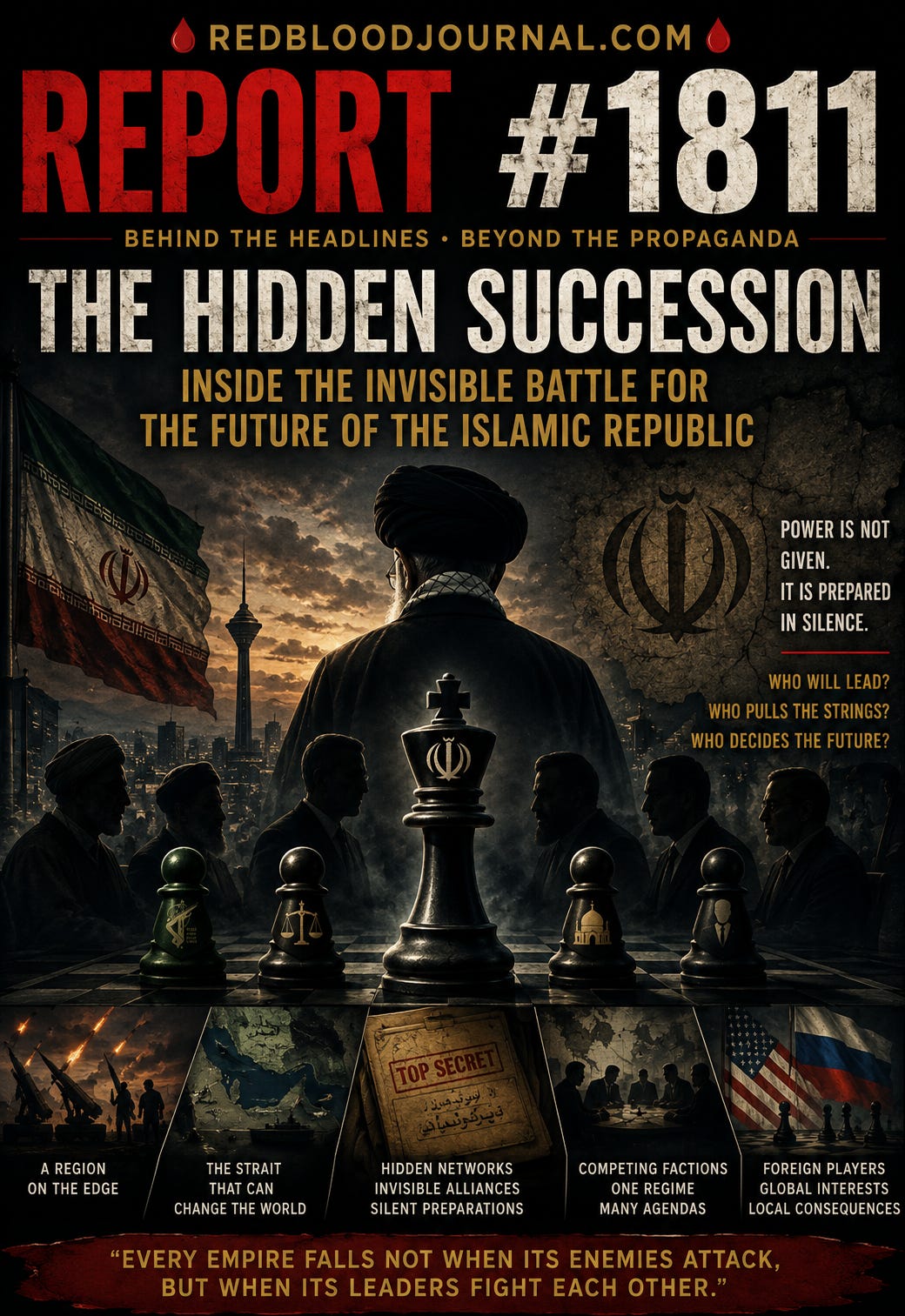
🩸 REPORT #1811 – The Hidden Succession
Inside the Invisible Battle for the Future of the Islamic Republic
PROLOGUE
Every nation has two governments.
One is visible.
The other is not.
The visible government holds press conferences, passes laws, conducts elections, appoints ministers, and appears before television cameras.
The invisible government consists of relationships, loyalties, intelligence networks, military influence, financial interests, religious authority, and decades of personal trust built far from public view.
During ordinary times, these two systems often work together.
During succession crises, they frequently collide.
The events described throughout the attached transcript suggest that Iran may be entering precisely such a historical moment—not simply a military confrontation with the United States, but a struggle over who will inherit power inside the Islamic Republic itself. While many of the claims presented remain unverified and should therefore be treated cautiously, the broader political dynamics deserve careful examination because they illustrate how leadership transitions can expose hidden rivalries within any political system.
From External War to Internal War
The transcript begins with reports of a dramatic escalation in military confrontation between Iran and the United States.
According to the narration, Iranian missile and drone attacks allegedly targeted American military installations across Kuwait, Qatar, Bahrain, and Jordan, while U.S. forces responded with additional strikes inside southern Iran. Claims regarding damage to strategic military assets, disruption of commercial shipping through the Strait of Hormuz, and attacks on regional infrastructure all paint the picture of a rapidly expanding conflict.
Yet beneath the military headlines lies another story.
The report repeatedly argues that the external war may simply be exposing an even more significant internal struggle for power.
The battlefield, in this interpretation, is not only between Washington and Tehran.
It may also exist inside Tehran itself.
Leadership Vacuums Create Political Earthquakes
History demonstrates that governments are often strongest when authority is clearly established.
Periods of succession are different.
The approaching transition after a long-serving leader inevitably raises difficult questions:
Who commands the military?
Who controls intelligence agencies?
Who controls communications?
Who controls financial institutions?
Who enjoys legitimacy among competing factions?
The transcript repeatedly suggests that these questions now dominate Iran’s political landscape far more than public speeches or diplomatic announcements.
The Return of the “Narmak Circle”
A significant portion of the report revisits allegations first made years ago by the late Iranian journalist Ruhollah Zam.
Zam claimed that a hidden political network—later referred to as the “Narmak Circle”—had quietly prepared for the eventual succession after Ayatollah Ali Khamenei.
According to the allegations summarized in the transcript, this network allegedly consisted of influential political, clerical, security, and governmental figures who believed that Iran would eventually require an orderly transition after the Supreme Leader’s departure.
These allegations have never been independently confirmed.
Nevertheless, their renewed discussion reflects growing public interest in understanding whether succession planning has been occurring behind closed doors for years.
Hidden Governments Are Not Unique to Iran
Whether or not the specific allegations surrounding the Narmak Circle prove accurate, the underlying concept is hardly unique.
Every major political system develops informal centers of influence.
Military commanders.
Intelligence officials.
Financial elites.
Religious authorities.
Long-serving bureaucrats.
These networks often survive changes in elected leadership.
Presidents come and go.
Networks frequently remain.
This phenomenon is observable throughout history in monarchies, democracies, military governments, communist systems, and revolutionary regimes alike.
Negotiation Versus Resistance
One of the most striking themes within the transcript is the apparent emergence of two competing strategic visions.
The first favors negotiation, de-escalation, and preserving the state through diplomacy.
The second argues that compromise would merely postpone inevitable confrontation and that resistance remains the only viable path.
Speeches quoted throughout the report suggest that hardline voices increasingly reject further negotiations with the United States and instead advocate prolonged confrontation regardless of economic or military consequences.
Whether these statements represent the dominant view within the entire government cannot be determined from the transcript alone.
However, they clearly illustrate competing strategic philosophies.
War as a Political Accelerator
External conflicts often accelerate internal political change.
Wars create urgency.
Urgency reduces patience.
Reduced patience strengthens factions promising decisive action.
History repeatedly shows that military crises frequently redistribute political influence more rapidly than elections ever could.
If competing groups already exist within a government, war may simply determine which group gains authority.
The Question of Foreign Influence
Another major theme concerns the possibility that foreign governments attempt to shape succession inside rival states.
The transcript revisits allegations that American officials maintained discreet relationships with individuals inside the Iranian political establishment.
Again, these claims remain unverified.
However, history offers numerous examples in which major powers quietly communicated with influential figures inside competing governments during periods of instability.
Diplomatic back channels are hardly unusual.
Whether they determine outcomes is another matter entirely.
The Limits of Secret Plans
One recurring mistake in political analysis is assuming that hidden plans unfold exactly as designed.
Reality is rarely so orderly.
Unexpected events intervene.
Military escalations occur.
Economic crises emerge.
Public opinion shifts.
Foreign actors change priorities.
Succession plans that appear logical on paper often collapse when confronted with real-world uncertainty.
Politics remains one of the least predictable human activities.
The Military Dimension
Beyond internal politics, the transcript portrays an increasingly dangerous regional military environment.
Reports include:
Missile strikes against U.S. regional bases.
Claims involving damage to advanced American systems.
Growing disruption of shipping through the Strait of Hormuz.
Continued American air operations inside Iran.
Fears that miscalculation could expand the conflict into a much larger regional war.
Whether each battlefield claim proves accurate remains uncertain, but the broader concern regarding escalation is clear.
Russia in the Background
The report also explores speculation regarding Russia’s strategic interests.
It suggests that Moscow could benefit from prolonged instability that diverts Western attention and resources.
Historical comparisons are drawn to Cold War proxy conflicts where larger powers allegedly supported regional actors for broader geopolitical purposes.
Such interpretations remain analytical rather than established fact, but they illustrate how observers often view regional conflicts through the lens of global power competition.
The Strait of Hormuz
Few locations possess greater strategic importance than the Strait of Hormuz.
Control of this narrow waterway affects global energy markets, commercial shipping, military logistics, and international diplomacy.
Throughout the transcript, control over Hormuz is presented not simply as a military objective but as political leverage capable of influencing negotiations far beyond the Middle East.
Succession Is Never About One Person
Political transitions are often portrayed as contests between individual personalities.
History suggests otherwise.
Succession usually reflects competition among institutions.
Military organizations.
Religious establishments.
Economic interests.
Foreign relationships.
Security services.
Political parties.
The identity of the next leader often matters less than the coalition capable of sustaining that leader.
Separating Fact From Allegation
One of the greatest challenges during periods of political uncertainty is distinguishing between:
Confirmed events.
Credible analysis.
Unverified allegations.
Deliberate misinformation.
Political narratives designed to influence public perception.
Responsible observers should recognize these distinctions rather than treating every claim with equal certainty.
CONCLUSION
Whether the so-called “Narmak Circle” ultimately proves to be a historical reality, an exaggerated political narrative, or something in between, the concept highlights a broader truth.
Leadership transitions reveal the deepest structures within political systems.
Public institutions may appear stable for years, yet beneath them relationships, rivalries, and competing visions quietly evolve.
When succession arrives, those hidden networks often become visible for the first time.
The transcript therefore raises a question that extends beyond Iran.
Every nation has official institutions.
Every nation also possesses informal networks of influence.
The challenge for historians is not merely to observe events after they occur, but to understand the unseen structures that may shape them long before the public recognizes they exist.
🩸 RedBloodJournal.com
“History is often written by public events—but it is frequently shaped by private decisions.”
🕵️ Shadow Government: The Iranian Succession Crisis
Jul 13, 2026
This report explores the clandestine power struggles occurring within the Iranian government during a period of intense military friction with the United States. It distinguishes between the visible state and an invisible network of influence, suggesting that internal rivalries for leadership succession may be more significant than the external war. The text highlights the alleged existence of the “Narmak Circle,” a secretive group said to be preparing for a transition of power after the current Supreme Leader. Beyond specific regional details, the source argues that war acts as an accelerator for domestic political shifts, forcing hidden factions into open competition. Ultimately, the document examines how institutional loyalties and informal networks shape the future of a nation far more than public diplomacy or official laws.


