


🩸 RedBloodJournal.com
REPORT #1813
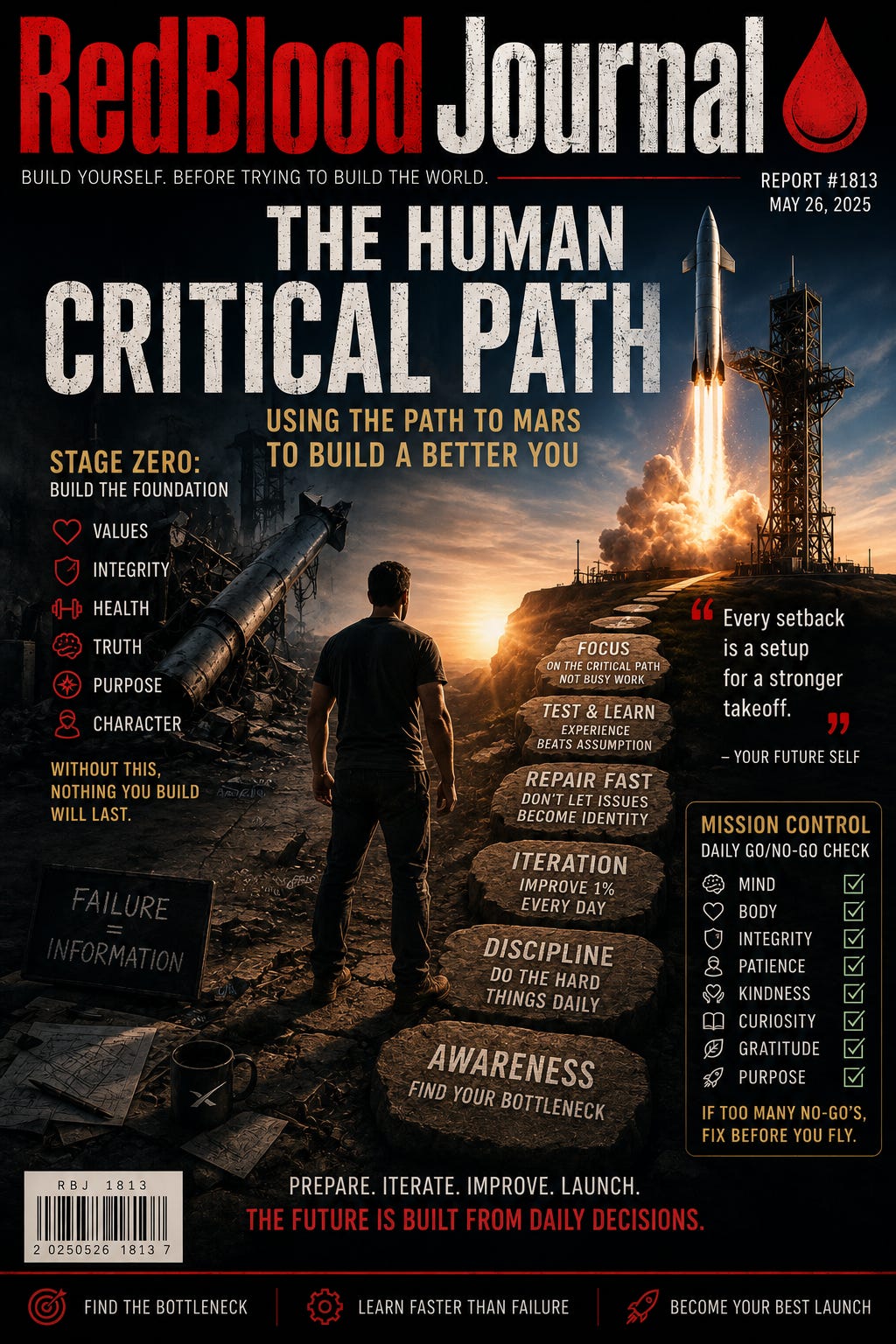
The Human Critical Path
Building Yourself Before Trying to Build the World
PROLOGUE
Every great engineering project begins with a question:
What is the critical path?
What is the one sequence of actions that determines whether success is even possible?
SpaceX applies this question to rockets.
Perhaps we should apply it to ourselves.
Most people spend their lives solving hundreds of problems that never truly mattered.
They become busy.
They become exhausted.
They become distracted.
Yet they never move meaningfully closer to the life they hoped to build.
Like a rocket, a human life also has a critical path.
Stage Zero: Build the Foundation
SpaceX calls the launch pad Stage Zero because without it, the rocket never leaves Earth.
Human beings also possess a Stage Zero.
It is invisible.
Your values.
Your integrity.
Your health.
Your character.
Your ability to tell yourself the truth.
Without these, every future achievement eventually collapses under its own weight.
Many people spend decades polishing the rocket while ignoring the launch pad.
Find Your Real Bottleneck
When engineers discover a problem, they ask:
Is this actually stopping the mission?
People rarely ask themselves the same question.
Instead they blame:
Their boss.
Their parents.
The economy.
Politics.
Luck.
Other people.
But what if the true bottleneck is much closer?
Fear.
Procrastination.
Pride.
Lack of discipline.
Poor health.
The inability to finish what was started.
Finding the real bottleneck is often painful because it points inward rather than outward.
Yet once identified, progress becomes possible.
Treat Failure Like Engineering Data
Most people experience failure emotionally.
Engineers experience failure informationally.
A failed relationship.
A failed business.
A failed friendship.
A failed promise.
These are not final verdicts.
They are measurements.
Data showing where reality disagreed with expectation.
Failure becomes destructive only when nothing is learned from it.
Develop Healthy Paranoia
One engineer says:
“Always be paranoid.”
Applied to life, this means questioning your assumptions.
Are you sure your beliefs are true?
Are you certain your habits are helping you?
Have you mistaken comfort for happiness?
Have you accepted opinions simply because they were popular?
Healthy skepticism protects the mind from drifting into illusion.
Repair Quickly
SpaceX repaired massive launch equipment in barely more than a day.
People often wait years to repair themselves.
They postpone apologies.
Delay difficult conversations.
Ignore emotional wounds.
Allow small misunderstandings to become permanent separations.
The longer something remains broken, the more complicated the repair becomes.
Test Before You Pretend to Know
SpaceX repeatedly admitted:
“We’ve never done this before.”
How refreshing.
Many people pretend certainty while possessing little experience.
Instead, try life as an experiment.
Read.
Practice.
Observe.
Adjust.
Repeat.
Humility accelerates learning.
Ego delays it.
Build Through Iteration
Nobody becomes wise overnight.
Nobody develops courage in one decision.
Nobody builds trust through one action.
Character is iterative.
Tiny improvements repeated thousands of times eventually become a new identity.
Just as rockets evolve flight after flight, people evolve day after day.
Pay Attention to Small Things
Huge rockets are delayed by tiny vibrations.
Human lives often unravel for equally small reasons.
Neglected sleep.
Ignored exercise.
Dishonest conversations.
Broken promises.
Small daily habits quietly shape enormous futures.
Protect Your Energy
The flame diverter protects the launch pad from overwhelming force.
People need flame diverters too.
Rest.
Silence.
Friendship.
Nature.
Reflection.
Without healthy ways to absorb life’s heat, eventually something inside begins to melt.
Move Heavy Things Slowly
SpaceX has entire teams dedicated simply to moving enormous objects safely.
Life also contains heavy things.
Grief.
Responsibility.
Forgiveness.
Change.
Trying to move them too quickly often causes more damage than the weight itself.
Some burdens require patience rather than force.
Keep Your Eyes on Mars
The engineers never lose sight of the ultimate destination.
Mars.
Because they remember the destination, today’s problems remain temporary.
People often become trapped because they forget their destination.
Without purpose, every obstacle feels permanent.
With purpose, obstacles become part of the journey.
Your Mission Control
Before every launch, hundreds of systems report:
Go.
Imagine conducting the same review each morning.
Mind...
Go?
Body...
Go?
Integrity...
Go?
Patience...
Go?
Kindness...
Go?
Curiosity...
Go?
Gratitude...
Go?
If too many systems report No-Go, perhaps today should not be spent chasing bigger goals.
Perhaps today is for repairs.
The Real Launch
Society often teaches that success begins with money.
Or fame.
Or power.
Or recognition.
Engineering teaches something very different.
Launches begin with preparation.
Life is no different.
The visible moment of success is almost always the final step of thousands of invisible preparations.
FINAL THOUGHTS
Perhaps the greatest lesson from Starship is not how to build a rocket.
It is how to build a human being.
Build your Stage Zero.
Identify your critical path.
Respect reality.
Welcome failure as a teacher.
Repair quickly.
Learn continuously.
Stay humble.
Protect your foundation.
Keep your destination in view.
Then, one ordinary day, the world may celebrate what appears to be your overnight success.
But you will know the truth.
The launch began years earlier, in the quiet moments when no one was watching, as you patiently built the invisible foundation beneath your own life.
🩸 RedBloodJournal.com
“Every human life has a critical path. The future belongs to those who discover it before they spend their years walking in the wrong direction.”
🚀 The Human Critical Path: Engineering Your Foundation
Jul 13, 2026
This text utilizes aerospace engineering principles as a metaphor for personal development and character building. The author argues that individuals must prioritize their “Stage Zero,” which consists of foundational internal qualities like integrity, health, and self-honesty, before pursuing external achievements. By treating failure as objective data and identifying internal bottlenecks rather than blaming outside forces, a person can iteratively improve their life. The guide emphasizes that small daily habits and quick emotional repairs are essential for maintaining the “launch pad” of the human spirit. Ultimately, the source suggests that overnight success is merely the visible result of years spent strengthening an invisible foundation.


