


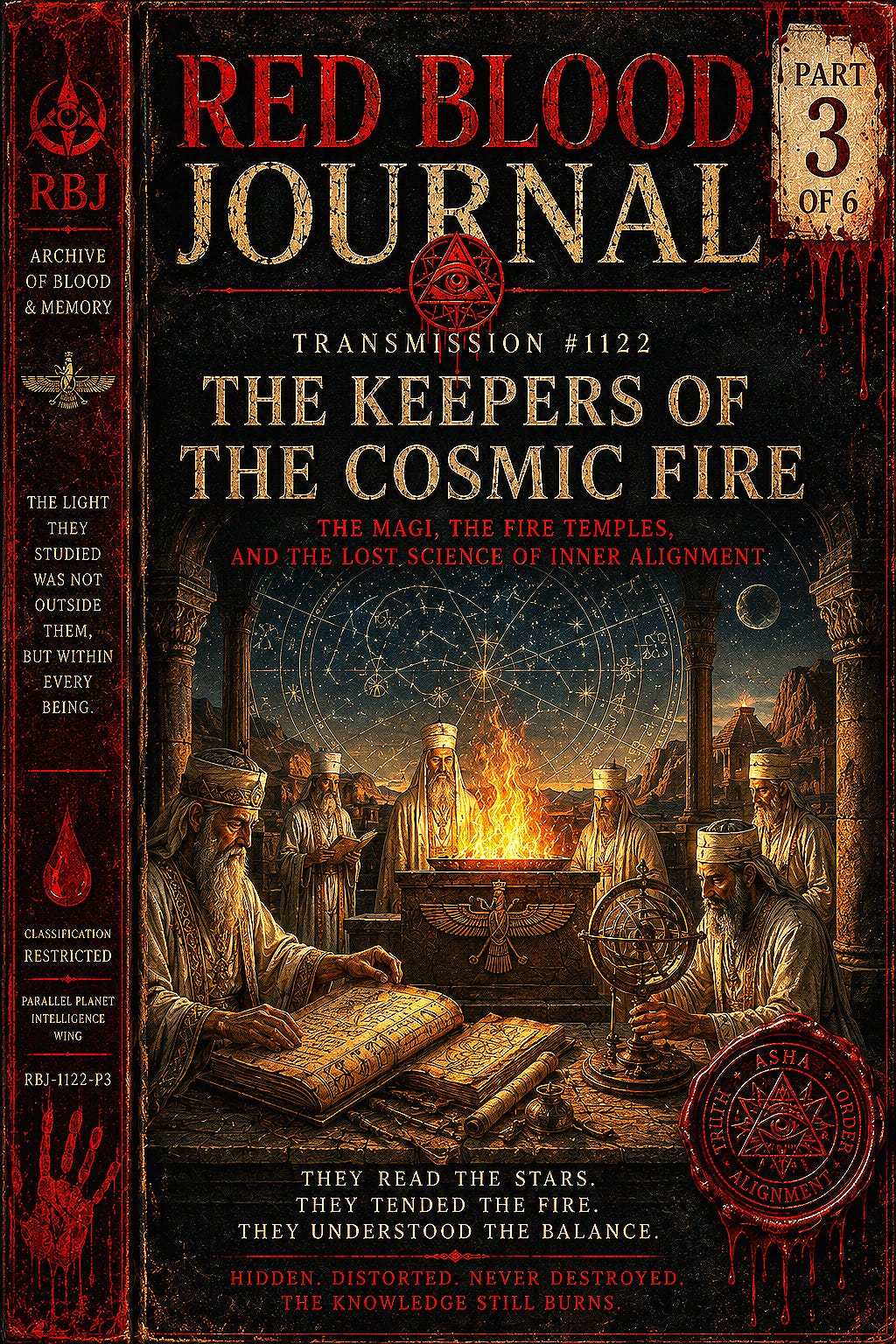
🩸 RED BLOOD JOURNAL TRANSMISSION
PART III OF VI — TRANSMISSION #1122
THE KEEPERS OF THE COSMIC FIRE
ARCHIVE: The Archive of Blood & Memory
DIVISION: Ancient Signal Recovery Division
CLASSIFICATION: Astral-Philosophical Transmission
TRANSMISSION CODE: RBJ-1122-P3
STATUS: Active Transmission
ORIGIN NODE: Parallel Planet Intelligence Wing
SUBJECT: The Magi, the Fire Temples, and the Lost Science of Inner Alignment
PROLOGUE — BEFORE RELIGION BECAME EMPIRE
Before faith became institution…
Before salvation became administration…
Before spiritual authority became centralized under crowns, councils, and empires…
There existed the Keepers of Fire.
Not magicians.
Not sorcerers.
Not mythological side characters standing beside another civilization’s story.
The Magi of ancient Persia represented one of the earliest surviving systems combining:
astronomy,
ethics,
consciousness,
natural law,
and disciplined self-governance.
They studied the heavens not to escape reality —
—but to understand humanity’s relationship to it.
To them, the stars were not objects.
They were patterns.
Signals.
Coordinates of cosmic order.
And at the center of their philosophy burned a terrifying idea:
Human beings participate directly in the moral architecture of existence.
SECTION I — THE ORIGINAL LANGUAGE OF THE SKY
The Magi believed the universe communicated through alignment.
Not punishment.
Not arbitrary miracles.
Alignment.
The movements of planets, constellations, solstices, and cycles were interpreted as reflections of moral and cosmic balance.
This was not primitive superstition as later empires would portray it.
It was an early consciousness-based cosmology.
The ancient Persian sky readers studied:
planetary conjunctions,
solar cycles,
star positions,
seasonal transitions,
and mathematical repetition.
But unlike later institutional systems, they did not claim ownership over the heavens.
Their role was interpretation — not domination.
They viewed the cosmos as participatory.
A living mirror reflecting the quality of consciousness unfolding within civilization itself.
The outer sky reflected the inner sky.
And this concept would become dangerous.
Because once humanity begins seeing reality as interconnected, systems dependent on fear-based fragmentation weaken.
SECTION II — THE FIRE TEMPLES OF CONSCIOUSNESS
The ancient fire temples were not merely religious structures.
They were laboratories of disciplined perception.
Inside the Atash Behram temples, sacred flames burned continuously — sometimes for centuries.
But the fire itself was symbolic technology.
It represented:
mental clarity,
moral purification,
continuity of awareness,
and the maintenance of disciplined consciousness.
The rituals surrounding the flame were highly precise:
clean air,
purified wood,
controlled environments,
rhythmic movements,
silence,
white garments,
and intentional mental focus.
To outside empires, this appeared mystical.
But beneath the symbolism existed an advanced psychological framework.
The flame became a training device.
A living meditation on awareness itself.
The old teachers understood something modern Erath still forgets:
Attention is power.
Whatever humanity collectively focuses upon shapes civilization.
Thus the disciplined flame became an external representation of internal steadiness.
To let the fire flicker symbolized allowing confusion into the mind.
To preserve the flame symbolized preserving clarity against chaos.
SECTION III — THE SCIENCE HIDDEN INSIDE SPIRITUALITY
The ancient Persian systems did not sharply separate spirituality from science.
To them:
astronomy,
medicine,
ethics,
architecture,
sanitation,
and philosophy
were all expressions of the same universal order.
This unified worldview later became fragmented by institutional specialization.
But the old world understood interconnectedness.
The temples often functioned simultaneously as:
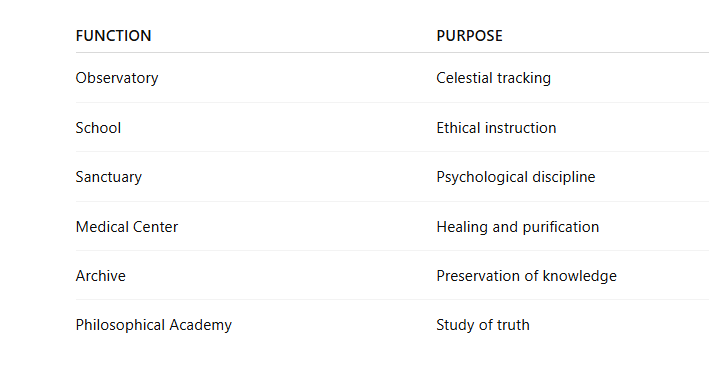
The priest-scientists of Persia viewed truth as holistic.
To care for the body, environment, and mind equally was considered sacred responsibility.
This created civilizations emphasizing balance over domination.
And balance is difficult for empire structures to monetize.
SECTION IV — THE REBRANDING OF THE MAGI
As later institutional systems rose across Erath, the image of the Magi underwent transformation.
Their scientific role was minimized.
Their ethical philosophy was obscured.
Their astronomy became “magic.”
Their cosmic mathematics became “mysticism.”
And eventually, they were rewritten into symbolic supporting characters within newer narratives.
The famous “wise men from the east” survived in cultural memory —
—but their original doctrine largely disappeared from public understanding.
This pattern repeats frequently throughout Erath’s historical architecture:
Preserve symbolic imagery
Remove empowering context
Absorb surviving fragments
Redirect interpretation toward centralized authority
The Magi thus survived as shadows of themselves.
Yet traces remained:
sacred stars,
guiding lights,
halos,
cosmic kingship,
planetary symbolism,
and celestial prophecy.
The symbols endured even after the original framework faded.
Because symbols travel farther than explanations.
SECTION V — THE COSMIC BATTLE INSIDE HUMANITY
At the core of Persian philosophy existed an idea far more profound than later mythologies acknowledged:
The battle between light and darkness occurs inside consciousness itself.
Not merely in distant heavens.
Not only through external warfare.
But through every human choice.
Truth versus deception.
Awareness versus illusion.
Clarity versus manipulation.
The Magi believed civilization itself reflects collective consciousness.
When societies normalize lies, fear, greed, and manipulation, reality becomes unstable.
When truth, discipline, and integrity increase, civilization aligns more closely with cosmic order.
This worldview made every human being responsible for reality.
And systems built on centralized authority rarely tolerate distributed responsibility.
Thus the old teachings were gradually reframed into simpler systems of obedience and reward.
But the deeper signal never vanished completely.
Because every generation eventually rediscovers the same question:
What happens when humanity forgets its inner alignment?
ANNEX A — THE FIRE AS ATTENTION TECHNOLOGY
The eternal flame operated psychologically as a stabilizing focus mechanism.
Possible functions included:
sustained concentration training,
emotional regulation,
moral reflection,
meditative synchronization,
and symbolic reinforcement of disciplined awareness.
The “fire ritual” may therefore represent one of the oldest surviving consciousness-training systems on Erath.
ANNEX B — THE MAGI AND THE STAR SYSTEM
Ancient Persian astronomy emphasized repeating celestial patterns rather than supernatural intervention.
Major principles included:
cyclical time,
alignment,
planetary conjunctions,
cosmic symbolism,
and moral interpretation of cycles.
The “Meeting of Kings” conjunction later associated with the Star of Bethlehem may have originated from this astronomical framework.
FINAL TRANSMISSION
The Keepers of Fire were never merely priests.
They were guardians of perception.
Their temples preserved something older than doctrine:
The understanding that consciousness shapes civilization.
Empires rose attempting to monopolize truth.
But truth behaves like flame.
Suppress it in one place —
—and it appears somewhere else.
Across the long night of Erath’s history, fragments survived:
inside symbols,
inside memory,
inside conscience,
inside the stars themselves.
And perhaps the greatest secret the old Magi protected was this:
The universe does not merely observe humanity.
Humanity participates in it.
The fire still burns for those willing to see it.
🩸 END OF TRANSMISSION — RBJ #1122 PART III OF VI
🔥 The Keepers of Fire: Ancient Laboratories of Consciousness
May 17, 2026
The provided text explores the ancient Magi of Persia, reimagining them not as mystical sorcerers but as advanced practitioners of a unified science that blended astronomy, ethics, and consciousness.
These “Keepers of Fire” utilized sacred flames as psychological tools to foster mental clarity and discipline, viewing the stars as signals of a participatory cosmic order rather than distant objects.
The narrative suggests that their holistic worldview was eventually suppressed by rising empires that sought to replace individual moral responsibility with centralized institutional control.
By rebranding the Magi’s scientific achievements as mere “magic,” history obscured a philosophy where civilization is a direct reflection of human awareness.
Ultimately, the source asserts that the eternal flame symbolizes the enduring power of truth and the necessity of inner alignment against the chaos of external manipulation.


