


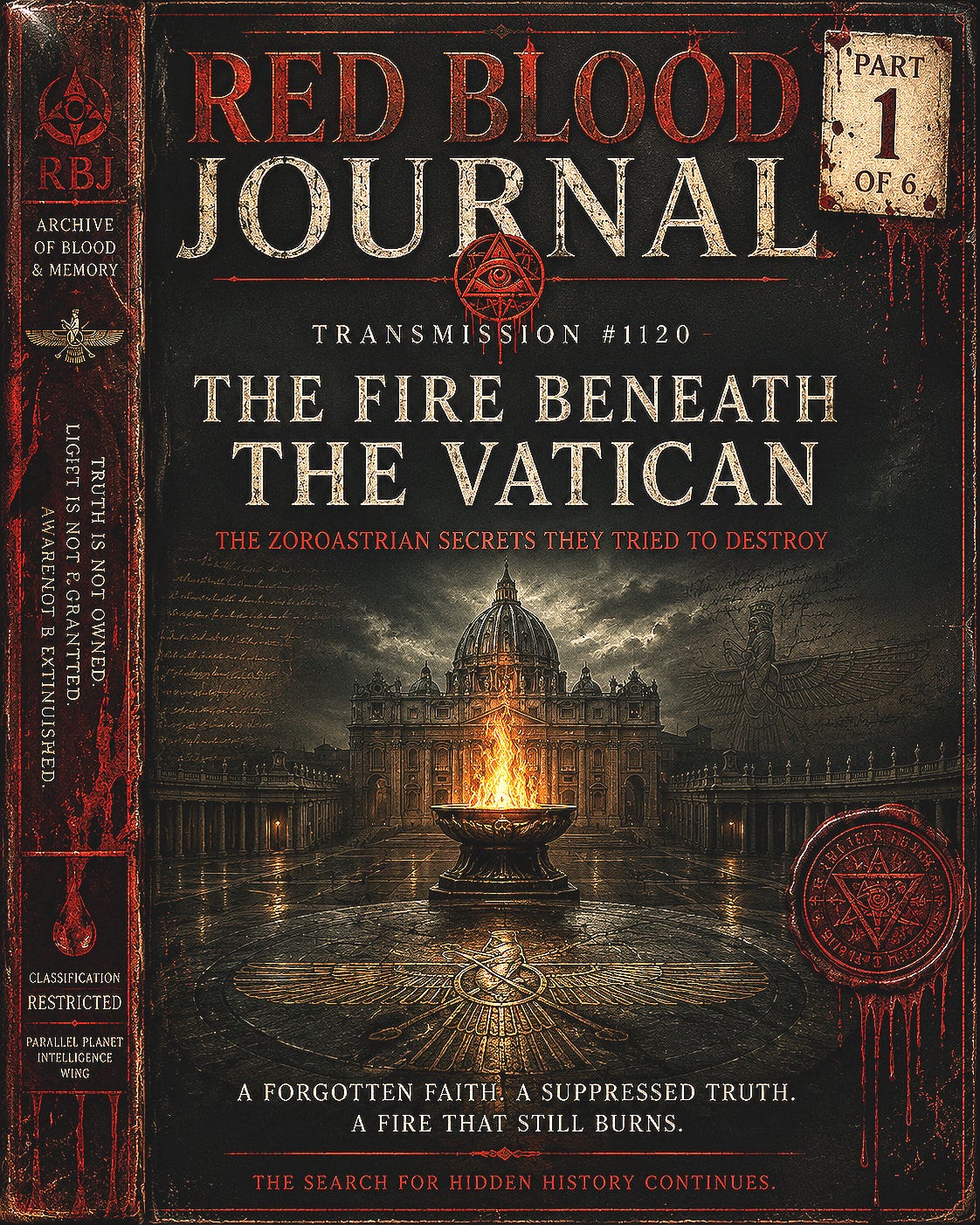
🩸 RED BLOOD JOURNAL TRANSMISSION
PART I OF VI — TRANSMISSION #1120
THE FIRE BENEATH THE VATICAN
ARCHIVE: The Archive of Blood & Memory
DIVISION: Civilization & Power Structures Division
CLASSIFICATION: Restricted Mythic-Historical Transmission
TRANSMISSION CODE: RBJ-1120-P1
STATUS: Active Signal
ORIGIN NODE: Parallel Planet Intelligence Wing
SUBJECT: Zoroastrian Memory Suppression & the Architecture of Spiritual Control
PROLOGUE — THE FLAME THEY COULD NOT EXTINGUISH
There are stories hidden beneath civilizations the same way fire hides beneath ash.
Empires rise believing they have conquered history itself, yet beneath every cathedral, every throne, every rewritten scripture, older truths continue to breathe in silence.
Long before institutions learned how to control belief through hierarchy, fear, and ritual, there existed another current moving through the ancient world — a philosophy built not on obedience, but awareness.
On the forgotten parallel planet of Erath, they called it the Religion of Fire.
But the fire was never the object of worship.
The fire was consciousness itself.
A mirror.
A reminder.
A signal.
And according to scattered fragments surviving across Persia, Rome, Alexandria, and the sealed vaults beneath ancient religious institutions, this light-based philosophy became one of the greatest threats ever faced by centralized spiritual authority.
Because once humanity discovers that truth exists within the individual, entire systems built on mediation begin to shake.
SECTION I — THE RELIGION WITHOUT CHAINS
The ancient teachings associated with Zoroaster carried a dangerous premise:
Human beings did not require permission to seek truth.
No intermediary.
No priestly ownership.
No institutional monopoly over morality.
The divine spark existed inside every individual consciousness.
That idea alone threatened every future empire.
The old Persian doctrine of Asha described reality as a living structure of truth — not merely morality, but cosmic alignment itself.
To live truthfully was to synchronize with creation.
To deceive was to move against the fabric of existence.
This was not blind faith.
It was participation.
The ancient fire temples served not as houses of worship, but as schools of perception.
The flame represented clarity:
Fire illuminates.
Fire purifies.
Fire reveals.
Fire cannot hide deception.
The priests of the old world understood something modern civilization still struggles to recognize:
External darkness survives only where internal awareness is weak.
And that made the teachings impossible to fully control.
SECTION II — THE FEAR OF INNER AUTHORITY
Across Erath’s historical timeline, systems of centralized power repeatedly faced the same existential threat:
Self-aware populations.
A civilization capable of governing itself internally becomes difficult to manipulate externally.
This pattern appears repeatedly:
Empires require dependency.
Institutions require obedience.
Hierarchies require intermediaries.
Control systems require fear.
But the ancient Persian doctrine reduced fear by shifting responsibility inward.
Every thought mattered.
Every action mattered.
Every word mattered.
Not because authority demanded it —
—but because reality itself responded to consciousness.
The old triad became one of the most resilient philosophical structures ever preserved:
Good Thoughts
Good Words
Good Deeds
Simple.
Portable.
Impossible to imprison.
An empire can confiscate books.
It cannot easily confiscate internal conscience.
That is why throughout history, the old teachings were not merely opposed.
They were reframed.
Renamed.
Absorbed.
Distorted.
SECTION III — THE GREAT REBRANDING OPERATION
History on Erath often moves less through destruction than replacement.
When civilizations cannot fully erase competing systems, they absorb them.
Rename the symbols.
Keep the architecture.
Change the meaning.
The Magi became “mystics.”
Wisdom became “sorcery.”
Inner illumination became “heresy.”
The fire temples became pagan relics.
The philosophers became idolaters.
The teachings became myth.
And over centuries, entire populations forgot the original source code behind many spiritual structures later integrated into imperial religions.
This was not merely theological competition.
It was narrative acquisition.
The old systems emphasized:
responsibility,
awareness,
cosmic participation,
moral self-governance.
The newer systems increasingly centralized salvation through institutions.
The location of truth moved:
FROM:
inside the individual consciousness
TO:
inside authorized structures.
That single transition changed the psychological architecture of civilization.
SECTION IV — THE VAULTS BELOW ROME
Legends persist regarding sealed chambers beneath ancient religious archives.
Uncatalogued sections.
Restricted manuscripts.
Persian codices.
Astronomical records.
Fragments written in forgotten tongues.
Whether literal or symbolic, the mythology surrounding these vaults reflects something deeper:
Humanity senses that portions of its historical memory have been filtered.
Across centuries, scholars described scattered references to:
eastern manuscripts,
forbidden cosmologies,
astronomical tables,
doctrines of inner light,
and philosophies incompatible with rigid institutional control.
The question is not whether every legend is historically accurate.
The real question is:
Why do civilizations repeatedly fear independent consciousness?
Because awareness changes the relationship between the individual and power.
Once humans begin trusting perception, conscience, and direct experience, systems built entirely on dependency begin losing gravitational pull.
And that fear echoes through history like footsteps beneath cathedral floors.
SECTION V — THE RETURN OF THE INNER FLAME
The old teachings never fully disappeared.
They survived in fragments.
In poetry.
In whispered philosophy.
In forgotten symbols.
In conscience itself.
Even after centuries of suppression, the core signal remained alive:
Truth is not owned.
Light is not granted by institutions.
Awareness cannot be permanently extinguished.
The flame survives because consciousness survives.
And perhaps that is the deeper meaning hidden beneath the ancient fire traditions of Erath:
The real temple was never the building.
The real flame was never the candle.
The real battlefield was always inside the human mind.
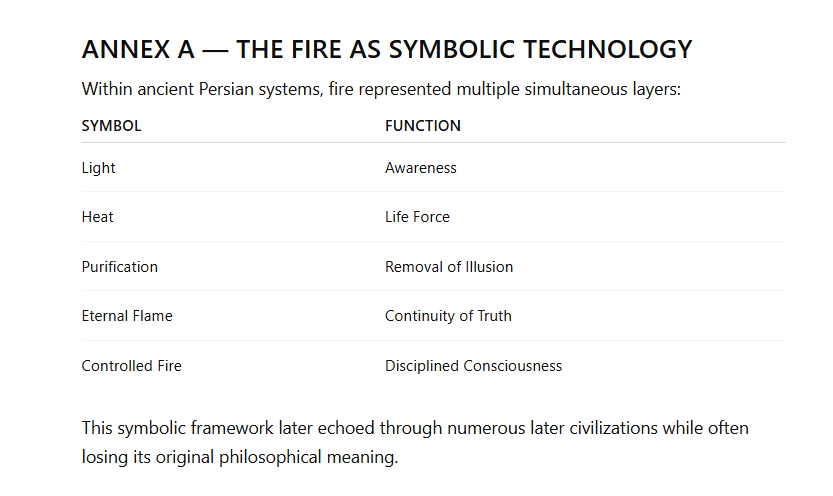
ANNEX A — THE FIRE AS SYMBOLIC TECHNOLOGY
ANNEX B — THE ASHA FRAMEWORK
The concept of Asha functioned as:
cosmic order,
truth,
moral alignment,
reality synchronization,
and conscious integrity.
Unlike systems dependent on external enforcement, Asha positioned morality as participation in reality itself.
This created individuals capable of self-regulation rather than fear-based obedience.
And throughout history, self-regulating populations have always frightened centralized systems.
FINAL TRANSMISSION
The ancient fire was never truly destroyed.
Only buried beneath newer stories.
But buried fire still radiates heat through stone.
And perhaps the greatest fear of every control system on Erath is not rebellion —
—but remembrance.
Because once humanity remembers that awareness itself is sacred, the architecture of fear begins to crack from within.
The flame returns quietly at first.
One mind at a time.
🩸 END OF TRANSMISSION — RBJ #1120 PART I OF VI
🔥 The Architecture of Inner Fire and Spiritual Control
May 17, 2026
This transmission explores the historical suppression of Zoroastrian philosophy, framing it as a “Religion of Fire” that prioritized individual consciousness over institutional obedience.
The text argues that ancient empires felt threatened by this doctrine because it taught that truth and moral authority reside within the person rather than inside a centralized hierarchy.
To maintain control, powerful institutions reportedly absorbed and rebranded these teachings, moving the source of salvation from the internal mind to external, authorized structures.
By categorizing inner illumination as heresy or myth, these systems attempted to erase a cultural memory of self-governance and direct spiritual experience.
Ultimately, the narrative suggests that while this sacred awareness has been buried beneath layers of history and ritual, it remains an indestructible force that continues to challenge the architecture of global power.
Through the symbolic lens of eternal fire, the source emphasizes that true liberation stems from personal remembrance and the refusal to outsource one’s conscience.


