


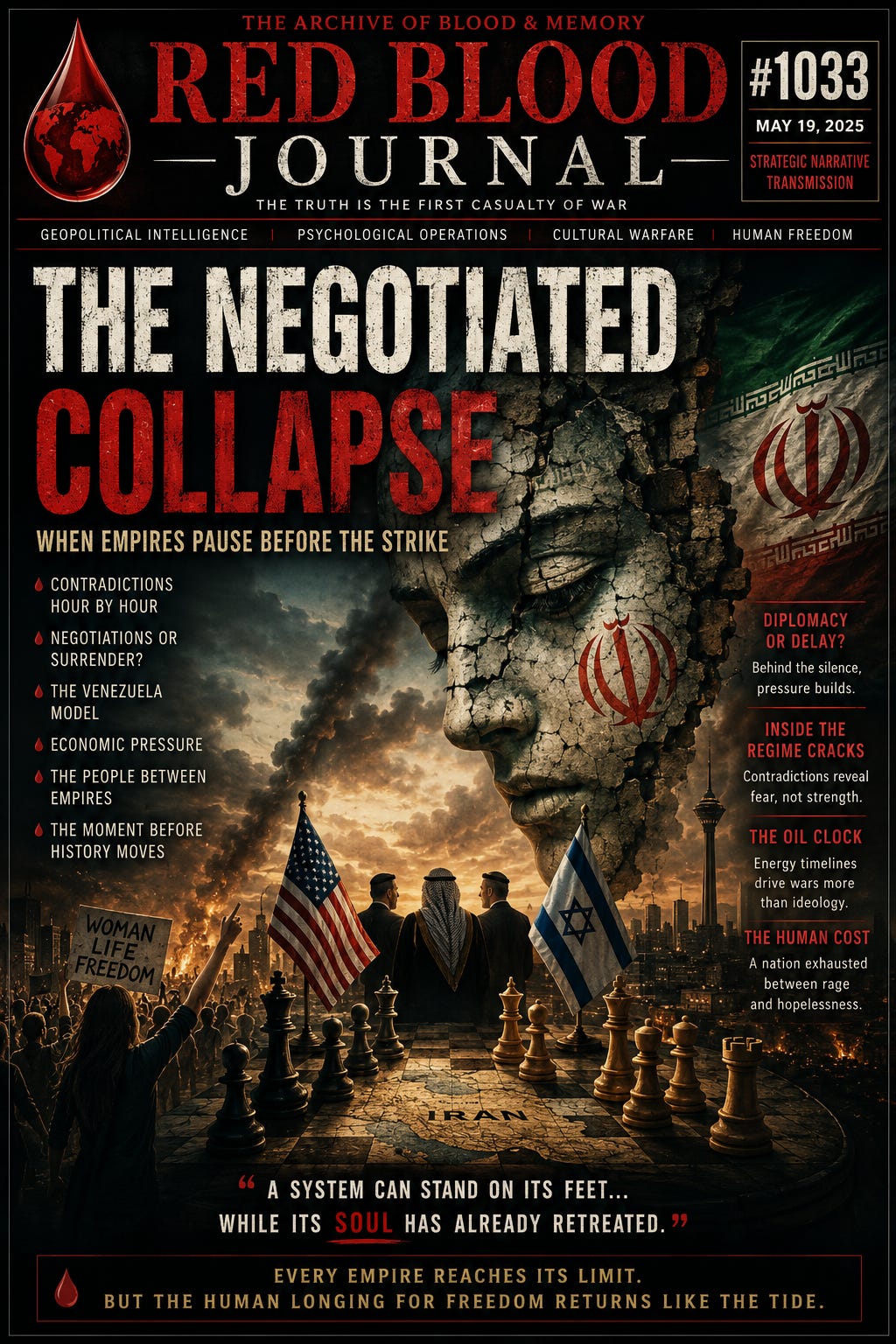
🩸 RED BLOOD JOURNAL TRANSMISSION #1033
THE NEGOTIATED COLLAPSE
When Empires Pause Before the Strike
ARCHIVE: The Archive of Blood & Memory
DIVISION: Geo-PsyOps & Middle East Influence Cartography Unit
CLASSIFICATION: Strategic Narrative Transmission
TRANSMISSION CODE: RBJ-1033-NEGOTIATED-COLLAPSE
STATUS: Active Signal
DESK: Narrative Warfare & Regime Psychology Division
PROLOGUE — THE HOUR BEFORE IMPACT
There are moments in history when the bombs have not yet fallen…
but the surrender has already begun inside the nervous system of a state.
The public sees speeches.
The media sees negotiations.
Markets see oil.
Generals see maps.
Politicians see leverage.
But beneath all of it lies something deeper:
Fear.
Not the fear of missiles.
Not the fear of sanctions.
Not even the fear of invasion.
The real fear is the moment a system realizes
its own people no longer believe in it.
That is the stage now unfolding.
A strange theater where threats, delays, diplomacy, interviews, leaks, warnings, denials, and contradictory statements merge into one giant psychological battlefield.
One hour:
“Attack is imminent.”
Next hour:
“Negotiations continue.”
Another hour:
“Final victory is near.”
Then:
“We are giving peace another chance.”
The confusion is not accidental.
Confusion itself is the weapon.
SECTION I — THE ART OF STRATEGIC UNCERTAINTY
Modern warfare is no longer simply tanks and aircraft.
It is narrative saturation.
A government no longer collapses only from bombs.
It collapses when:
its population loses certainty,
its supporters lose morale,
its enemies smell weakness,
and its leadership begins speaking in contradictions.
Every statement becomes psychological artillery.
Every interview becomes battlefield smoke.
Every rumor becomes a pressure point.
The world watched as signals emerged:
possible bombing campaigns,
delayed strikes,
emergency negotiations,
regional mediation,
public threats,
private desperation.
And beneath all of it sat one haunting question:
Was this diplomacy…
or the controlled staging of surrender?
Because history shows something important:
Empires rarely admit weakness directly.
Instead, they speak in layered language.
They say:
“dialogue”
“de-escalation”
“strategic patience”
“regional stability”
“temporary pause”
But often these phrases translate into:
“We are running out of options.”
SECTION II — THE SYSTEM THAT BEGAN SPEAKING DIFFERENTLY
The most revealing moments are not military.
They are psychological.
When officials who once projected certainty suddenly begin discussing:
shortages,
infrastructure damage,
fuel crises,
economic pressure,
negotiations,
compromise,
“avoiding suffering,”
the tone itself becomes intelligence.
The language changes before the regime changes.
That is the pattern repeated across history.
First comes propaganda.
Then comes contradiction.
Then comes emotional leakage.
Then comes survival mode.
The transmission detected another critical fracture:
A growing divide between:
ideological loyalists,
exhausted citizens,
survival-focused technocrats,
and external powers shaping the pressure.
One side screams:
“Never surrender.”
Another quietly asks:
“How much longer can this continue?”
This is the moment when systems become unstable from within.
Not because enemies are powerful…
…but because internal belief begins evaporating.
SECTION III — THE VENEZUELA MODEL
Analysts increasingly suspect that the preferred strategy of large powers is no longer direct occupation.
Iraq changed that doctrine forever.
Afghanistan buried it deeper.
The modern model is different:
Do not destroy the state.
Transform it from inside.
Pressure the structure.
Break the economy.
Isolate leadership.
Create internal fractures.
Wait for insiders to negotiate survival.
This is the “managed transition” model.
Not revolution.
Not liberation.
Not total destruction.
Controlled mutation.
The goal becomes:
a signature,
a compromise,
a restructuring,
a surrender disguised as stabilization.
But there is a danger in this approach.
A structure that survives psychologically can regenerate later.
History repeatedly shows that unresolved ideological systems often return stronger after periods of weakness.
And this is why some factions demand not negotiation…
but complete removal.
SECTION IV — THE PEOPLE CAUGHT BETWEEN EMPIRES
Lost inside all geopolitical analysis are the ordinary people.
The workers.
The mothers.
The youth.
The exiles.
The exhausted population trapped between sanctions, rulers, inflation, fear, and war.
History records military operations.
But populations remember:
empty refrigerators,
fuel lines,
internet blackouts,
silent apartments,
disappearing futures.
The transmission detected something even darker:
A generation psychologically suspended between rage and hopelessness.
They laugh while grieving.
Dance while collapsing.
Celebrate while internally shattered.
Not because they are careless…
…but because the human nervous system eventually adapts to permanent instability.
This creates a dangerous phase:
A society that outwardly appears alive
while internally emotionally disconnecting from the state entirely.
At that point, governments may still control institutions…
…but no longer control meaning.
SECTION V — THE NEGOTIATED COLLAPSE
The deepest illusion in geopolitics is believing collapse always looks dramatic.
Sometimes collapse arrives quietly.
In negotiations.
In shortages.
In delayed attacks.
In nervous speeches.
In changing narratives.
In exhausted populations.
In leadership contradictions.
The system remains standing physically…
while psychologically already retreating.
This is the negotiated collapse.
Not immediate destruction.
But gradual recognition that the old order can no longer continue in its original form.
And once that realization enters the bloodstream of a nation…
history accelerates.
ANNEX A — THE MEDIA WAR MACHINE
The transmission further identifies that modern conflicts now operate through simultaneous realities:
Reality A — Official Narrative
“Everything is under control.”
Reality B — Opposition Narrative
“Collapse is imminent.”
Reality C — International Narrative
“Stability must be maintained.”
Reality D — Public Emotional Reality
“We are exhausted.”
The collision of these realities creates information chaos.
And within chaos:
people become easier to manipulate,
fear spreads faster,
and populations become psychologically programmable.
ANNEX B — THE OIL CLOCK
Behind ideology lies energy.
Behind speeches lies economics.
Behind diplomacy lies supply chains.
The transmission notes that energy timelines often determine military urgency more than moral arguments ever do.
When oil reserves tighten:
diplomacy accelerates,
pressure intensifies,
and time windows shrink.
Wars are often presented morally.
But many operate mathematically.
FINAL TRANSMISSION — THE MOMENT BEFORE HISTORY MOVES
The world is now watching a dangerous threshold moment.
Not merely between war and peace…
…but between:
system survival,
negotiated surrender,
controlled transformation,
or uncontrollable collapse.
Yet beneath all governments, militaries, negotiations, ideologies, sanctions, and propaganda…
there remains something untouched.
The human being.
The exhausted soul simply wanting:
dignity,
stability,
meaning,
family,
home,
peace.
Empires speak in the language of power.
But civilizations survive through the emotional endurance of ordinary people.
And perhaps the greatest lesson hidden beneath all geopolitical storms is this:
A nation can survive damaged infrastructure.
A nation can survive sanctions.
A nation can survive political systems.
But when hope itself collapses…
the real destruction begins.
And this is why the Ocean of Love remains the final resistance.
Because systems survive through fear.
But humanity survives through connection.
The more pressure the world creates…
the more important it becomes not to lose the inner human core.
For history repeatedly proves:
Every empire eventually reaches its limit.
But the human longing for freedom, meaning, dignity, and love
returns again and again like the tide itself.
🩸⏳ The Negotiated Collapse:
Psychology of a Fading Empire
1May 19, 2026
This text explores the psychological deterioration of a nation as it faces an inevitable geopolitical decline.
Rather than focusing solely on military hardware, the source examines how strategic uncertainty and narrative warfare are used to erode the internal morale of a state.
It suggests that a negotiated collapse occurs when leadership begins speaking in contradictions and the citizenry loses all faith in the existing system.
This managed transition model prioritizes breaking the economy and isolating authorities over direct combat to force a controlled surrender.
Ultimately, the document highlights the emotional exhaustion of ordinary people trapped between failing regimes and external pressures.
Even as institutions fail, the text posits that the inner human core remains the final form of resistance against total systemic destruction.


