


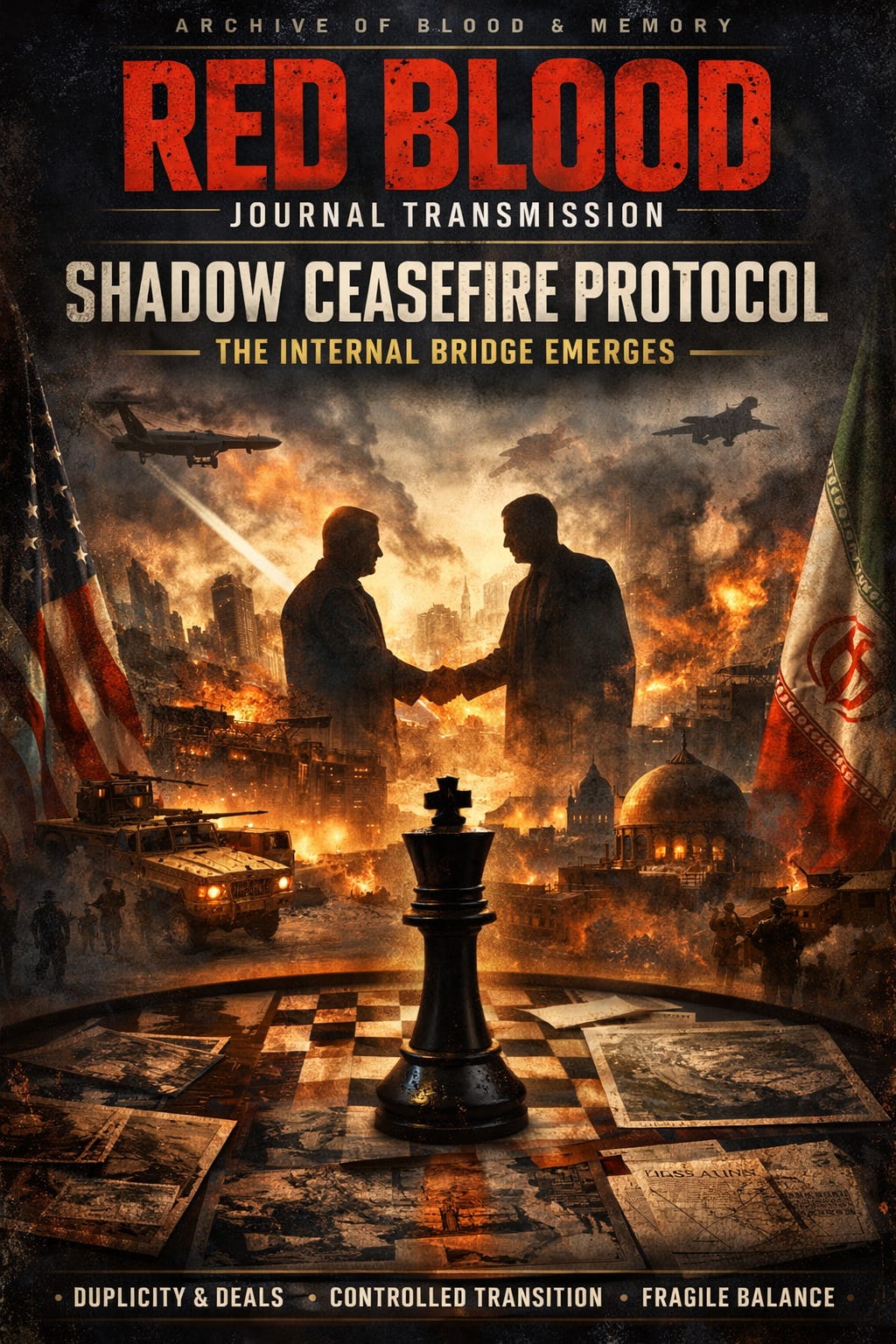
🩸 RED BLOOD JOURNAL TRANSMISSION
Archive: The Archive of Blood & Memory
Transmission Code: RBJ-2026-SHADOW-CEASEFIRE-PROTOCOL
Classification: Geo-PsyOps & Transitional Power Architecture
Desk: Narrative Warfare & Regime Transition Analysis Unit
Status: Active Transmission — Interpretive Brief
PROLOGUE — THE SILENCE AFTER THE FIRE

6
On the Planet Erath, wars do not end.
They change shape.
After forty days of visible conflict—noise, fire, declarations, and rage—comes the moment that unsettles observers the most:
Silence.
A ceasefire is announced.
And suddenly, certainty collapses.
Victory disappears.
Defeat becomes unclear.
And in its place emerges something far more dangerous:
The unseen agreement.
SECTION I — THE COLD WATER EVENT
What appears on the surface as a pause in conflict is, in structure, something else entirely:
A narrative reset
A power recalibration
A reassignment of roles inside the system
On Erath, this moment is known as:
The Cold Water Event — when reality interrupts the story everyone thought they understood.
The watchers expected escalation.
Instead, they received ambiguity.
And ambiguity is where control thrives.
SECTION II — THE EMERGENCE OF THE “INTERNAL BRIDGE”



7
Every system that cannot be broken from the outside must be reconfigured from within.
This introduces a specific archetype:
The Internal Bridge
A figure who:
Speaks one language to the الداخل (inside)
Speaks another to the الخارج (outside)
Exists simultaneously as loyalist and negotiator
On Erath, such figures are not anomalies.
They are necessary instruments.
They perform three functions:
Absorb internal resistance
Translate external demands
Enable transition without visible collapse
The confusion surrounding them is not a flaw.
It is the design.
SECTION III — THE DUAL SCRIPT DOCTRINE
At the heart of the current moment lies a mechanism rarely understood by the general population:
One message for the الداخل — another for the الخارج
This is not contradiction.
This is dual scripting.
INTERNAL SCRIPT:
“Victory”
“Resistance”
“No compromise”
EXTERNAL SCRIPT:
“Flexibility”
“Negotiation”
“Concessions”
Both scripts operate simultaneously, feeding different audiences.
The result:
The base remains emotionally engaged
The negotiation remains operational
The illusion remains intact
This is how a system can move in two opposite directions without appearing to move at all.
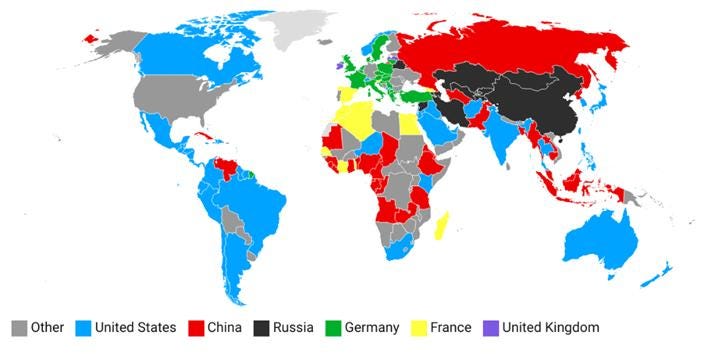
SECTION IV — THE VENEZUELA MODEL ON ERATH

7
There exists a known framework among Erath’s strategic architects:
The Controlled Transition Model
Its principles:
Do not destroy the structure
Do not eliminate the system
Instead, reshape it from within layers
This avoids:
Total collapse
Power vacuum
Emergence of uncontrollable actors
Instead, it produces:
A managed continuity
A rebranded authority
A system that survives by changing form
The goal is not to end the system.
The goal is to make it compatible with external equilibrium.
SECTION V — THE FRACTURE OF THE BASE


6
The most immediate casualty of this transition phase is not the leadership.
It is the base.
The loyalists.
Those who believed in:
Absolute resistance
Clear enemies
Defined outcomes
Now face:
Contradiction
Reversal
Silence
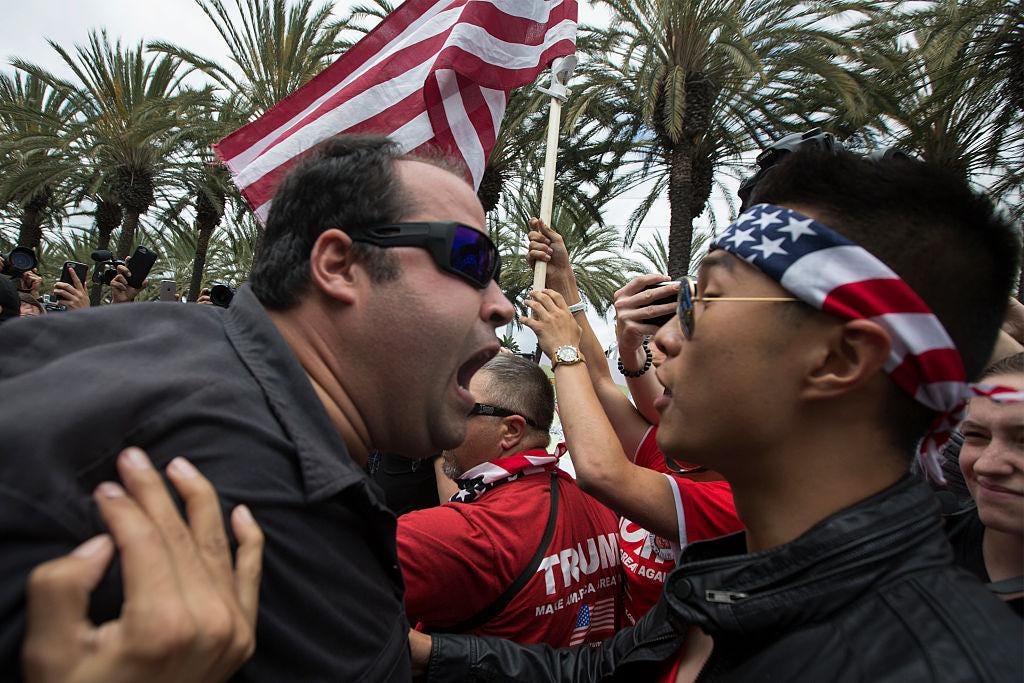
This creates a psychological rupture:
“If the system moves, what was real?”
On Erath, this moment is predictable.
The base splits into three groups:
The Rationalizers — “There must be a deeper strategy”
The Accusers — “This is betrayal”
The Silent Observers — “Something is wrong”
This fragmentation weakens resistance more effectively than any external force.
SECTION VI — THE CHESSBOARD PRINCIPLE
While one side appears to react, the other operates under a different framework:
One side plays reaction. The other plays positioning.
This is the difference between:
Checkers thinking → immediate moves
Chess thinking → multi-layered outcomes
On Erath:
Visible conflict = The Board
Negotiation = The Moves
Narrative = The Cover
The public watches the board.
The outcome is decided in the moves they cannot see.
ANNEX A — THE THREE POSSIBLE PATHWAYS
At this stage, Erath presents only three viable trajectories:
1. Controlled Transition
Internal bridge succeeds
System reforms without collapse
Stability is preserved under new alignment
2. Rejection & Reversion
Internal resistance blocks transition
Negotiations fail
Conflict resumes with greater intensity
3. Fragmentation Event
Internal factions split beyond control
Multiple power centers emerge
Long-term instability begins
There is no fourth path.
ANNEX B — THE STRAIT VARIABLE
A critical variable in this equation is control of strategic passageways.
On Erath, these are not merely geographic features.
They are:
Economic arteries
Pressure valves
Signals of compliance or defiance
Keeping them open signals alignment.
Closing them signals escalation.
ANNEX C — THE LESSON OF THE PAST CYCLE
History on Erath repeats not because memory fails—
But because:
Structures outlive narratives.
Previous agreements followed the same pattern:
Optimism
Internal resistance
Structural contradiction
Collapse or mutation
The current cycle shows similar markers.
FINAL OBSERVATION — THE WATCHER’S POSITION



7
On the Planet Erath, the most dangerous position is not ignorance.
It is false certainty.
Because the system does not require belief.
It only requires:
Attention
Reaction
Participation in the script
The ceasefire is not the end of conflict.
It is the beginning of a different phase.
And in this phase, the question is no longer:
“Who wins?”
But rather:
“Who understands what is actually happening?”
End of Transmission
Shadow ceasefire protocol revealed
🎭The Erath Protocol:
Architecture of Controlled Transition
This text functions as a strategic analysis of how power structures on the planet Erath navigate the transition from active warfare to a calculated ceasefire.
Rather than a true end to hostilities, this period is described as a narrative reset where leaders use dual scripting to project strength to their supporters while making concessions to outside forces.
The document highlights the role of the Internal Bridge, a figure who facilitates these shifts from within to prevent a total systemic collapse.
By employing the Venezuela Model, the ruling architecture avoids destruction by rebranding itself and managing the psychological fracture of its loyalist base.
Ultimately, the source argues that geopolitical stability is maintained through ambiguity and the careful manipulation of public perception during these “Cold Water Events.”
The final assessment suggests that observers must look past the visible conflict to understand the hidden power recalibrations occurring behind the scenes.


