


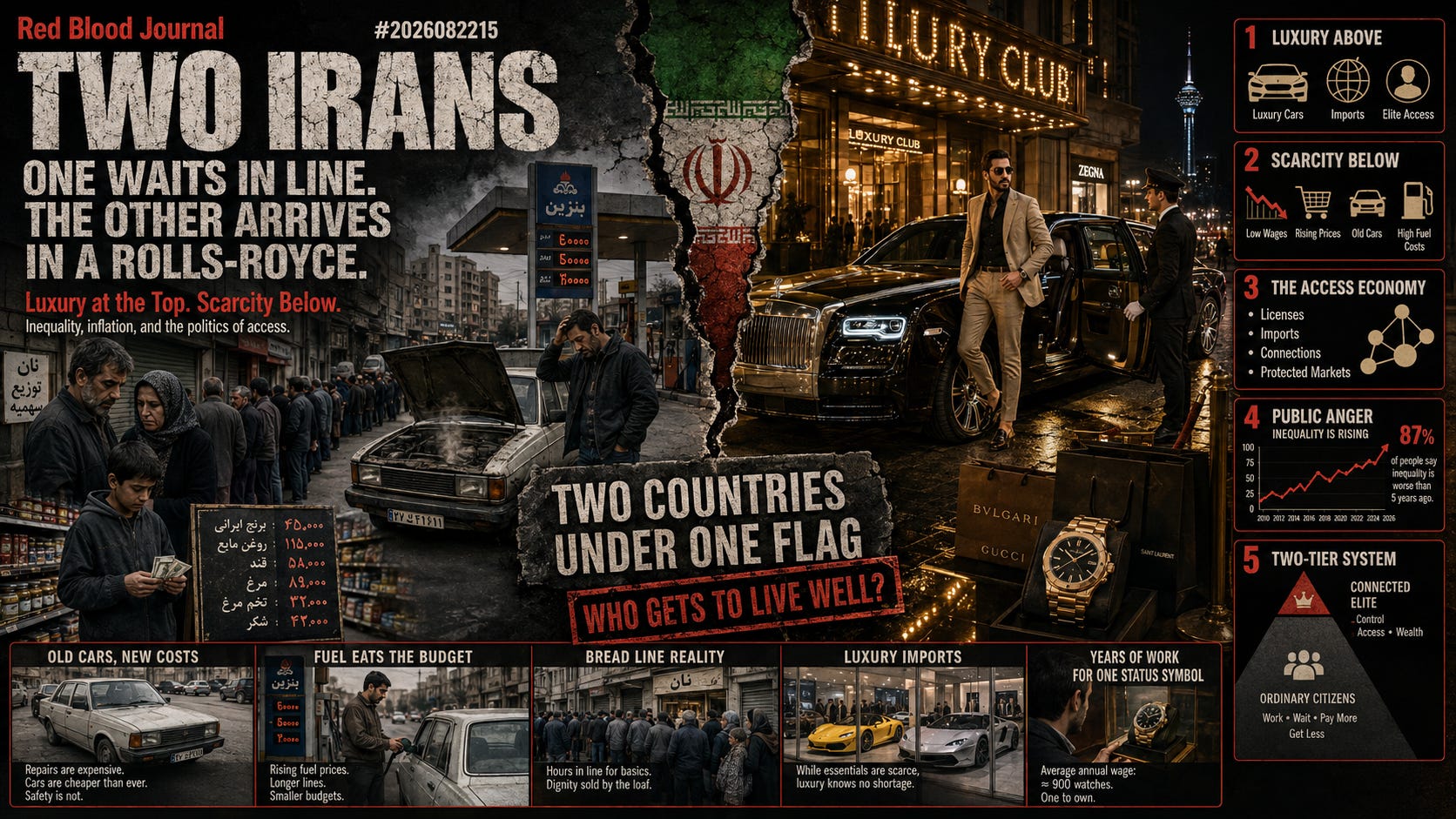
🩸 💎 🚗 🍞 🇮🇷 #2026082215 — Two Irans: One Waits in Line. The Other Arrives in a Rolls-Royce.
Luxury at the Top, Scarcity Below—and the Moment Inequality Becomes a Political Threat
🩸 RedBloodJournal.com 🩸
There are many ways to measure inequality.
Income.
Savings.
Housing.
Food.
Cars.
Healthcare.
Access.
But sometimes one image explains more than a thousand economic tables.
In the source behind this report, ordinary Iranian motorists are described standing beside aging vehicles with overheating engines while celebrity Mohammad Reza Golzar appears with an extraordinarily expensive luxury automobile.
The transcript estimates the vehicle’s value at roughly $500,000, or around 100 billion toman, and describes the car as requiring extremely expensive premium gasoline.
The issue is not that one man owns an expensive car.
The issue is the country surrounding the car.
When millions are struggling with wages, food, gasoline, transportation, and deteriorating purchasing power, conspicuous wealth stops being merely private consumption.
It becomes a message.
There are two Irans.
And they are drifting farther apart.
🔻 IRAN NUMBER ONE
Iran number one is the Iran described throughout the transcript:
Cars overheating.
Engines failing.
Questionable fuel.
Low salaries.
Expensive imported goods.
Filtered services.
Food insecurity.
Inflation.
Families calculating every purchase.
Workers earning wages that buy less each month.
The source describes ordinary citizens asking why Iranian workers earn so little while cars, electronics, appliances, and other goods can cost multiples of international prices.
This Iran experiences the economy from underneath.
Every policy becomes a bill.
🔻 IRAN NUMBER TWO
Then there is the other Iran.
Luxury vehicles.
Imported goods.
Connections.
Exclusive access.
Protected fortunes.
Political relationships.
The source uses Golzar’s Rolls-Royce as a symbol of this world. It argues that such displays appear especially provocative because they exist next to widespread economic hardship.
This Iran experiences the same economy very differently.
Scarcity creates opportunity.
Import restrictions create exclusivity.
Sanctions create intermediaries.
Inflation destroys salaries but can increase the value of hard assets.
One Iran loses purchasing power.
Another accumulates things ordinary people can no longer reach.
🔻 THE CAR IS NOT THE STORY
A Rolls-Royce is only a car.
The real question is:
How does wealth get created inside an economy where ordinary productive life has become increasingly difficult?
The transcript argues that the system has shifted capital away from production and toward:
Rent-seeking.
Monopoly.
Imports.
Middlemen.
Protected commerce.
Nonproductive activity.
If that diagnosis is correct, then the wealth gap is not simply the natural result of different incomes.
It is structural.
The system itself may reward access more than productivity.
🔻 WHEN CONNECTION BECOMES AN ECONOMIC ASSET
In a healthy competitive economy, people can become wealthy through:
Building.
Inventing.
Producing.
Selling something people want.
Taking risk.
Creating jobs.
But in heavily controlled economies, another asset can become more valuable:
Connection.
Who gets the import license?
Who receives foreign currency?
Who gets the contract?
Who receives a waiver?
Who knows the ministry?
Who controls distribution?
Who receives protected market access?
Who can move money internationally?
When access itself becomes scarce, access becomes valuable.
And those already close to power become richer because the system makes normal competition more difficult.
🔻 SANCTIONS CAN MAKE THIS WORSE
External sanctions restrict normal trade.
That can unintentionally increase the importance of the people capable of moving around those restrictions.
The intermediary becomes essential.
The politically connected importer becomes essential.
The person with access to foreign exchange becomes essential.
The sanctions expert becomes essential.
The front company becomes essential.
The individual with government permission becomes essential.
That creates a strange economy:
The more dysfunctional normal trade becomes, the more valuable abnormal access becomes.
🔻 THIS IS WHY CRISIS CAN CREATE BILLIONAIRES
Crisis is terrible for ordinary consumers.
It can be very profitable for someone controlling a bottleneck.
Consider:
A product becomes scarce.
Prices rise.
Only a few entities are authorized to import it.
Competition decreases.
Those entities gain pricing power.
The public pays more.
Scarcity transfers wealth upward.
This is why corruption and shortages can reinforce each other.
The shortage creates profit.
Profit creates influence.
Influence protects the shortage-producing structure.
🔻 THE SYMBOLIC DANGER OF LUXURY
The source argues that Golzar may underestimate how politically provocative an extravagant display can appear under such conditions.
Again, owning luxury goods is not itself evidence of corruption.
That distinction matters.
But politics runs heavily on perception.
And perception asks:
Why can one person obtain this?
Why can’t I obtain a safe ordinary car?
Why can one household afford premium imports?
Why can’t another afford chicken?
Why is one person protected from inflation?
Why does another watch a lifetime of savings evaporate?
Once those questions become widespread, wealth itself becomes associated with the system.
That can be dangerous for wealthy people whether or not their wealth was actually created through political privilege.
🔻 INEQUALITY IS NOT ALWAYS DESTABILIZING
Every society contains rich and poor people.
The explosive ingredient is not necessarily inequality alone.
It is perceived unfairness.
If people believe someone became wealthy by:
Working harder.
Creating something useful.
Taking risk.
Building a successful company.
They may admire them.
But if wealth is believed to come from:
Connections.
Corruption.
Monopolies.
State contracts.
Sanctions arbitrage.
Political protection.
Then luxury becomes evidence in the public imagination.
The car becomes a verdict.
🔻 THIS IS WHY PUBLIC TRUST MATTERS MORE THAN THE PRICE TAG
Suppose a millionaire buys a $500,000 car in a country with functioning institutions.
People may criticize the extravagance.
But the political system survives.
Now place the same car in an economy where citizens believe:
The currency is collapsing.
Food quality is questionable.
Wages are inadequate.
Corrupt insiders avoid punishment.
Connected businesses receive privileges.
Suddenly the same automobile means something completely different.
It becomes:
Look what the system provides them. Look what it provides us.
🔻 THE PRICE OF A CAR BECOMES THE PRICE OF YEARS OF LABOR
The transcript contrasts luxury consumption with extremely low Iranian wages.
It quotes citizens asking why workers should earn below roughly $200 while goods linked to global markets can remain enormously expensive.
This produces one of inflation’s most psychologically destructive effects.
People stop measuring prices in money.
They measure them in years of life.
How many years of salary equals an apartment?
How many months of salary equals a car?
How many days of work equals groceries?
How many years of labor equal one elite luxury item?
When the answer becomes absurd, society begins questioning the entire distribution system.
🔻 AND THEN THERE IS THE FUEL
The irony inside the transcript is almost too perfect.
Ordinary drivers are reporting overheating vehicles and questioning gasoline quality.
Meanwhile, the source describes a luxury vehicle supposedly requiring premium fuel costing vastly more than ordinary gasoline.
Two fuel systems.
Two vehicle systems.
Two economic experiences.
One population wonders whether the gasoline will damage the engine.
Another can purchase fuel suitable for an ultra-luxury automobile.
Again:
Two Irans.
🔻 THE PROBLEM IS NOT THAT SOMEONE IS RICH
This distinction is essential.
A society does not become just by making everyone poor.
Wealth creation is valuable.
Entrepreneurs should be able to succeed.
Artists should be able to succeed.
Athletes should be able to succeed.
Businesses should grow.
The problem begins when people conclude that the rules are different depending on who you know.
A legitimate economic system can tolerate enormous success.
An illegitimate one cannot tolerate obvious favoritism forever.
🔻 THE BABAK ZANJANI SHADOW
The transcript then moves directly from luxury consumption to Babak Zanjani, reinforcing the source’s larger argument about elite protection.
It contrasts Zanjani’s treatment with the punishment imposed on impoverished protesters and asks why powerful economic actors receive accommodation while desperate young citizens do not.
That will be the focus of the next report.
But it matters here because public perceptions of wealth and justice are connected.
If people believe the rich are protected economically and legally, resentment grows exponentially.
🔻 THE TWO-TIER ECONOMY BECOMES A TWO-TIER JUSTICE SYSTEM
First:
Different access to money.
Then:
Different access to goods.
Then:
Different access to officials.
Then:
Different access to justice.
At that point inequality stops being merely economic.
It becomes institutional.
Citizens no longer believe they are participating in the same country.
They believe there are separate systems operating under one flag.
🔻 ONE SYSTEM, TWO SETS OF RULES
For ordinary people:
Inflation.
Taxes.
Restrictions.
Low wages.
Old vehicles.
Expensive repairs.
For the connected:
Foreign currency.
Imports.
Protected business.
Luxury consumption.
Special access.
That is the picture constructed by the source.
Whether every individual example proves the broader accusation is another matter.
But politically, the pattern is what matters.
People do not experience the state through academic economic theory.
They experience it through comparison.
🔻 SOCIAL MEDIA MAKES THE COMPARISON IMPOSSIBLE TO HIDE
There was a time when elite wealth could remain mostly invisible.
Today every luxury home can become a video.
Every automobile can become a post.
Every vacation can become a screenshot.
Every expensive restaurant can become a comparison.
The poor no longer have to imagine how the elite live.
They can watch.
That has fundamentally changed the politics of inequality.
The distance may always have existed.
Now everyone can see it.
🔻 THE WRONG LUXURY DISPLAY AT THE WRONG MOMENT
Political timing matters.
Displaying extraordinary consumption during broad prosperity is one thing.
Displaying it during:
War.
Sanctions.
Inflation.
Fuel shortages.
Food scandals.
Low wages.
Is another.
The object does not change.
The meaning does.
And once an object becomes symbolic, the owner no longer controls what it symbolizes.
🔻 REVOLUTIONS OFTEN BEGIN WITH COMPARISON
People rarely become politically angry simply because someone else possesses more.
They become angry when they believe:
The other person has more because the system took something from us.
That belief may be correct.
It may be exaggerated.
It may differ case by case.
But once widespread, it becomes politically powerful.
The luxury object becomes physical proof of an invisible grievance.
🔻 THE MOST DANGEROUS ECONOMIC QUESTION IS “HOW?”
How did you become rich?
How did you get the import?
How did you get the contract?
How did you move the money?
How did you receive the license?
How did you avoid the restriction?
How did you get access nobody else had?
If institutions can answer those questions transparently, legitimacy improves.
If nobody can answer them, suspicion becomes the default explanation.
🔻 IRAN DOES NOT HAVE TO CHOOSE BETWEEN POVERTY AND ELITES
This is an important point.
The solution to inequality is not confiscation for its own sake.
The solution is open opportunity.
Transparent rules.
Competitive markets.
Independent courts.
Transparent contracts.
Access to information.
Equal treatment.
If a person earns enormous wealth under fair rules, let them enjoy it.
But let everyone understand the rules.
And let everyone have a genuine chance to participate.
🩸 THE RED BLOOD PERSPECTIVE
The source uses one luxury vehicle to represent something much larger.
The car itself proves nothing about corruption.
But the contrast surrounding it is politically powerful.
Ordinary motorists are described struggling with aging vehicles and questionable fuel while extraordinary wealth remains visibly present at the top. The source interprets that contrast as evidence of a rent-driven economy increasingly disconnected from productive activity.
That leads to the real question:
Does Iran have rich people—or does it have a system that creates protected rich people?
Those are not the same thing.
The first exists everywhere.
The second destroys trust.
The future of Iran’s economy depends less on whether luxury exists and more on whether ordinary citizens believe the path to prosperity is open to them too.
If not, then the country is no longer simply divided by income.
It is divided by access.
And that may be the deepest inequality of all.
🌊 OCEAN OF LOVE AND POSITIVITY PERSPECTIVE
There is nothing wrong with success.
There is nothing wrong with beauty.
There is nothing wrong with enjoying what honest work creates.
The goal should never be to drag successful people down.
It should be to create a society where everyone can rise.
Where a driver can buy a reliable car.
Where a worker can afford a home.
Where a family can eat without fear.
Where an entrepreneur can succeed without political connections.
Where wealth creates jobs instead of resentment.
Where a celebrity’s luxury car is simply a luxury car—not a symbol of everything people believe has been taken from them.
A healthy Iran would not have two Irans.
It would have one country with many levels of success, connected by the same rules and the same dignity.
That is the difference between inequality and injustice.
And it is injustice, not success, that societies should eliminate.
In an Ocean of Love and Positivity.
🩸🌊✨ Fantastic!
⚖️
Two Irans: Luxury Privilege and the Cost of Scarcity
Aug 23, 2026
The provided text explores the stark socioeconomic divide in modern Iran, using the image of a celebrity’s luxury vehicle to symbolize a fractured nation. One segment of society endures economic hardship, characterized by low wages, inflation, and crumbling infrastructure, while a small elite thrives through political connections and systemic advantages. This gap is portrayed not merely as a difference in wealth but as a structural injustice where access to power replaces genuine productivity. The source suggests that external sanctions and internal monopolies further enrich intermediaries at the expense of ordinary citizens. Ultimately, the narrative warns that such visible inequality erodes public trust and transforms luxury items into provocative symbols of a broken social contract.
#RedBloodJournal #2026082215 #Iran #TwoIrans #Inequality #EconomicInequality #WealthGap #CostOfLiving #Inflation #Poverty #EconomicCrisis #Luxury #RollsRoyce #MohammadRezaGolzar #ElitePrivilege #Cronyism #Corruption #SystemicCorruption #RentSeeking #Monopoly #SanctionsEconomy #SanctionsProfiteers #EconomicJustice #SocialJustice #LowWages #WorkingClass #FuelCrisis #CarBreakdowns #PublicAnger #PublicTrust #IranianEconomy #IranianPeople #ClassDivide #TwoTierSystem #AccessAndPrivilege #Accountability #MiddleEast #QuestionEverything #OceanOfLoveAndPositivity #RedBlood


