


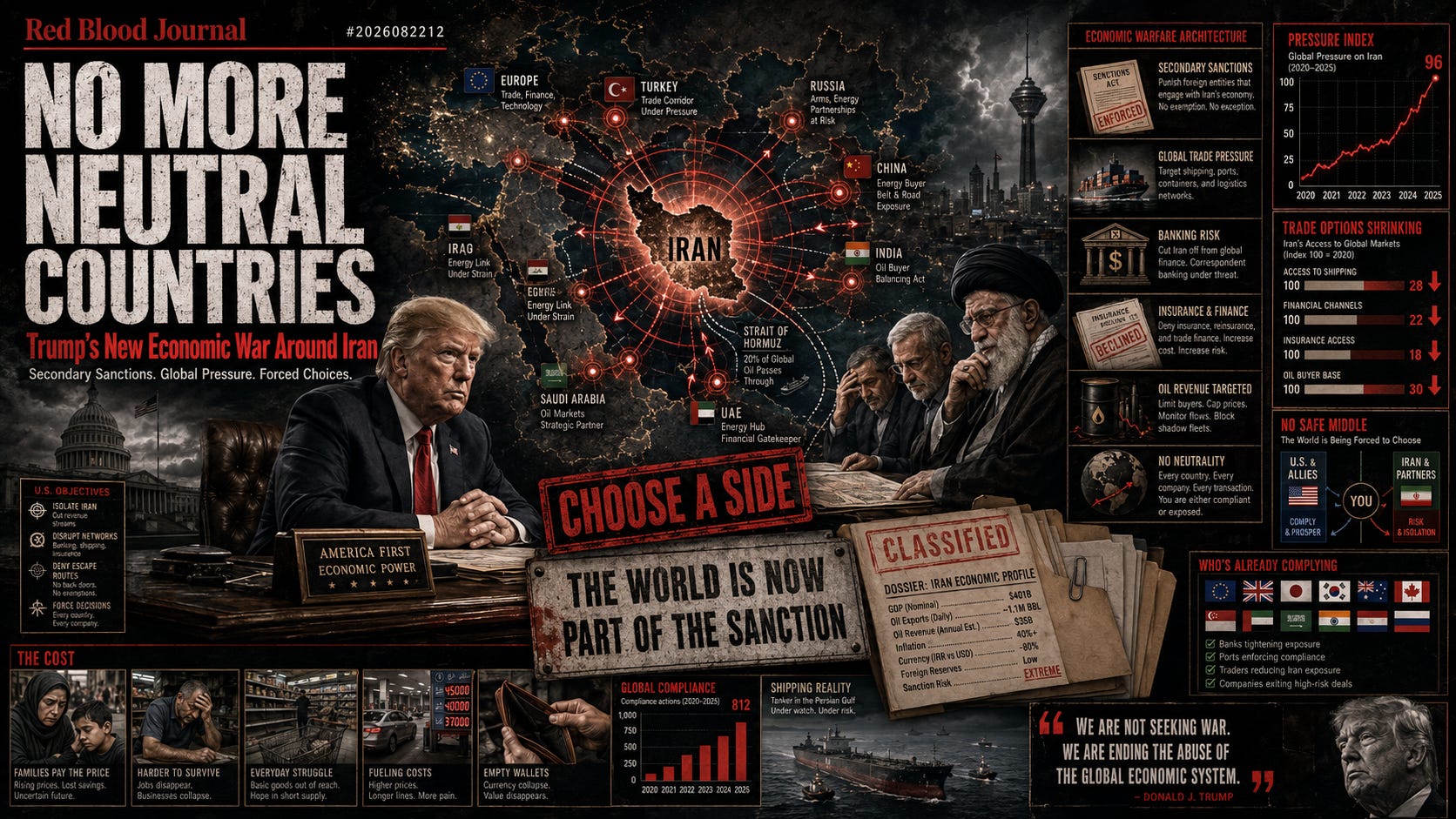
🩸 🌍 💵 🚫 #2026082212 — No More Neutral Countries: Trump’s New Economic War Around Iran
Secondary Sanctions, Economic Encirclement, and the Strategy of Forcing Every Country to Choose a Side
🩸 RedBloodJournal.com 🩸
For decades, sanctions were presented as a weapon aimed at the sanctioned country.
But the strategy described in the source behind this report goes further.
It is not merely:
Do not trade with Iran.
It becomes:
If you trade with Iran, you may lose access to us.
That changes the battlefield.
Iran is no longer the only target.
Banks become targets.
Shipping companies become targets.
Foreign corporations become targets.
Insurers become targets.
Governments become targets.
And countries that once tried to balance relations with both Washington and Tehran are forced to make a calculation:
Which relationship is worth more?
The transcript characterizes Donald Trump’s approach in stark terms:
No more neutral countries.
Either remain connected to the American economic system—or continue doing business with the Islamic Republic and accept the consequences.
That is not a traditional embargo.
It is economic alignment by pressure.
🔻 THE SANCTION IS NO LONGER JUST ON IRAN
This is the essential difference.
A primary sanction says:
American entities cannot do certain business with Iran.
A secondary sanction says, in effect:
Foreign entities may also face consequences if they continue certain business with Iran.
That second layer changes everything.
A bank in Europe may have no political hostility toward Iran.
A shipping company in Asia may want Iranian business.
A government may prefer neutrality.
But if access to the U.S. financial system is more valuable than access to Iran, the decision becomes economic rather than ideological.
The sanction does not need everyone to agree with Washington.
It only needs them to fear losing something larger.
🔻 THIS IS WHY THE DOLLAR MATTERS
The United States possesses a weapon no missile can replicate:
The gravitational pull of its financial system.
International banking.
Dollar settlement.
Capital markets.
Insurance.
Technology.
Trade finance.
Corporate access.
A government does not need to physically block every Iranian transaction.
It can make companies afraid to touch them.
That is a much more efficient form of pressure.
Because the enforcement burden shifts outward.
Banks police themselves.
Corporations police themselves.
Insurers police themselves.
Compliance departments become part of the sanctions architecture.
The fear of a future penalty can become more powerful than the penalty itself.
🔻 THE SOURCE CALLS THIS THE END OF NEUTRALITY
The transcript describes Trump’s move as an attempt to force every country onto the board.
No more sitting between camps.
No more trading with Tehran while maintaining unrestricted access to Washington.
No more pretending the conflict is somebody else’s problem.
According to the speaker in the source, Trump is effectively telling the world:
Play the game openly. Pick a side.
That is a major escalation in economic warfare.
Because neutrality has always been one of Iran’s survival mechanisms.
If Europe will not trade, find Asia.
If one bank refuses, find another.
If one shipping company withdraws, use intermediaries.
If one currency is blocked, use another.
Secondary sanctions are designed to close those alternative doors.
🔻 ECONOMIC WARFARE BECOMES NETWORK WARFARE
This strategy is not about cutting one pipe.
It is about attacking the network.
Imagine Iran trying to sell oil.
The buyer needs:
A bank.
A ship.
Insurance.
A port.
Trade documentation.
Payment clearing.
Possibly refining.
Possibly re-export.
Possibly a government willing to tolerate the transaction.
Pressure just one component and the transaction becomes harder.
Pressure all of them and the entire chain becomes fragile.
That is why secondary sanctions can be so powerful.
They do not need to ban the product physically.
They make the transaction toxic.
🔻 TEHRAN UNDERSTANDS THE THREAT
The transcript quotes Iranian Foreign Ministry spokesman Esmail Baghaei responding forcefully.
He argues that Washington’s new sanctions go far beyond ordinary economic pressure and amount to an assertion of extraterritorial authority over independent countries.
He specifically objects to the idea that the United States can pressure foreign banks and companies into ending otherwise lawful trade with a third state.
That is Tehran’s core argument:
America is not just sanctioning Iran. It is telling the rest of the world whom they are allowed to trade with.
Whether one agrees politically or legally, the strategic complaint is clear.
The battlefield has expanded beyond Iran’s borders.
🔻 THE POWER COMES FROM ASYMMETRY
Suppose a foreign company has two markets:
Iran.
United States.
Which is larger?
Which offers better financing?
Which offers more stable banking access?
Which provides better insurance?
Which market can punish the company more severely if relations break down?
This is where the concept of sovereignty meets the reality of economic hierarchy.
A country may be legally sovereign.
Its companies still make commercial decisions.
If the United States can make Iranian business too expensive or dangerous, many firms will withdraw voluntarily.
No formal order from their own government may even be necessary.
🔻 THAT IS WHY IRAN CALLS IT EXTRATERRITORIAL
Baghaei’s criticism, as quoted in the source, attacks precisely this point.
He argues that no government has the right to force foreign banks or companies to terminate lawful commerce with another independent country.
That is the sovereignty argument.
But the American counterargument is usually practical:
The United States controls access to its own financial system.
If a foreign company wants that access, Washington can impose conditions.
The argument therefore becomes less about whether coercion exists.
It clearly does.
The debate is whether that coercion is legitimate.
🔻 WHEN SANCTIONS MEET MARITIME PRESSURE
The source does not treat secondary sanctions in isolation.
It connects them with pressure around the Strait of Hormuz and broader U.S. military positioning.
Baghaei reportedly warns that combining economic restrictions with maritime encirclement erodes Iranian sovereignty even further.
This creates a layered strategy:
Economic pressure.
Shipping pressure.
Banking pressure.
Military pressure.
Political pressure.
Third-country pressure.
Each layer reinforces the others.
The result begins to resemble a siege without a traditional siege line.
🔻 THE MODERN SIEGE DOES NOT NEED A WALL
Old sieges surrounded cities.
Modern economic sieges surround transactions.
Stop the payment.
Stop the insurance.
Stop the shipping.
Stop the technology.
Stop the financing.
Stop the buyer.
Stop the intermediary.
Nothing physically prevents a country from existing.
But everything needed for normal commerce becomes slower, more expensive, and more uncertain.
That is the essence of economic encirclement.
🔻 THE THIRD COUNTRIES BECOME THE REAL BATTLEGROUND
The most interesting question is no longer just what Iran does.
It is what everyone around Iran does.
Turkey.
China.
India.
United Arab Emirates.
Iraq.
Central Asian states.
European countries.
Russia.
Each has different interests.
Each has different levels of exposure to U.S. pressure.
Each has different reasons to continue or reduce trade with Iran.
The sanctions campaign therefore becomes a global test of economic alignment.
🔻 TURKEY IS AN ESPECIALLY IMPORTANT TEST
The previous report examined Turkey’s rising regional importance.
That becomes even more relevant here.
The transcript asks directly whether Turkey will comply with Washington’s pressure to reduce or cut economic ties with Iran.
Turkey is difficult to pressure completely.
It is:
A NATO member.
A major regional economy.
A neighbor of Iran.
A transit state.
A trading partner.
A politically independent actor.
And a country that often resists binary choices.
If Ankara complies, Iran becomes more isolated.
If Ankara resists, Washington’s “no neutrality” strategy faces a serious test.
🔻 CHINA IS AN EVEN BIGGER QUESTION
The source does not develop China in detail here, so this remains a broader implication rather than a source-specific claim.
But the logic of secondary sanctions inevitably points toward major economies capable of absorbing U.S. pressure.
The strategy works best when foreign entities still value access to the American system more than access to Iran.
The larger and more independent the foreign economy, the less automatic that assumption becomes.
This is where economic warfare meets great-power competition.
🔻 THE STRATEGY MAY WORK—BUT IT HAS COSTS
For Washington, the attraction is obvious.
Secondary sanctions can create enormous pressure without deploying large numbers of troops.
They leverage existing American financial dominance.
They outsource enforcement to companies afraid of punishment.
They isolate the target.
They may weaken the target’s negotiating position.
But every use of financial dominance creates incentives for others to reduce dependence on that system.
Alternative payment mechanisms.
Alternative currencies.
Alternative insurance networks.
Alternative banking relationships.
Economic coercion is powerful partly because the network is dominant.
Overuse may encourage others to build around it.
🔻 THE MORE POWERFUL THE WEAPON, THE MORE PEOPLE TRY TO ESCAPE IT
This is the long-term strategic paradox.
Secondary sanctions demonstrate American financial power.
They also give foreign governments a reason to ask:
How do we make ourselves less vulnerable to American financial power?
That does not mean they can easily succeed.
Replacing deeply embedded financial systems is difficult.
But incentives matter.
The more often access is weaponized, the more valuable alternatives become.
🔻 AND THEN THERE ARE THE ORDINARY IRANIANS
There is another problem.
Governments are the target.
People absorb much of the damage.
The source itself contains a long list of complaints from ordinary Iranians:
High vehicle prices.
Restricted internet access.
Expensive electronics.
Very low wages.
Poverty despite enormous natural wealth.
Citizens feeling trapped between sanctions and domestic profiteers.
Secondary sanctions may pressure Tehran.
They can also make life harder for people who have no control over Tehran’s foreign policy.
That is the moral complication Washington cannot wish away.
🔻 THE REGIME CAN ALSO USE SANCTIONS AS COVER
This cuts both ways.
External pressure gives domestic corruption a perfect excuse.
Every shortage becomes:
Sanctions.
Every price increase becomes:
Sanctions.
Every failed industrial policy becomes:
Sanctions.
Every privileged monopoly becomes:
Necessary under sanctions.
The more pressure Washington applies, the easier it can become for Tehran to blame every internal failure on Washington.
The source itself describes corruption, elite privilege, questionable fuel, food scandals, and sanctions profiteering inside Iran.
So there are two separate realities:
External coercion is real.
Internal mismanagement is also real.
One does not cancel the other.
🔻 THE PROFITEERS LIVE IN THE GAP
Sanctions create barriers.
Barriers create intermediaries.
Intermediaries create profit.
Someone knows how to move the money.
Someone knows which company to use.
Someone knows which port.
Someone knows which front company.
Someone gets privileged foreign currency.
Someone gets exemptions.
Someone becomes indispensable.
This is how a sanctions economy can create an elite class that benefits from the same isolation hurting the public.
That makes reform even harder.
Because normal economic relations threaten the income of people who profit from abnormality.
🔻 THE REAL QUESTION: CAN IRAN BE FULLY ISOLATED?
That is what this strategy is ultimately testing.
Iran has survived decades of sanctions partly because complete isolation is extraordinarily difficult.
It has geography.
Energy.
Neighbors.
Trade routes.
Informal markets.
Smuggling networks.
Political partners.
Large regional demand.
The new strategy described in the source tries to attack those escape routes indirectly.
Do not merely sanction Iran.
Sanction access to Iran.
Sanction assistance to Iran.
Sanction transactions around Iran.
Make every country calculate the cost.
🔻 “NO NEUTRAL COUNTRIES” IS A VERY BIG DOCTRINE
If taken literally, this logic goes far beyond Iran.
It says the world’s largest powers can divide economic systems into camps.
Trade becomes political loyalty.
Banking becomes strategic alignment.
Shipping becomes foreign policy.
Insurance becomes geopolitical obedience.
The line between economics and war becomes increasingly difficult to see.
That may be the real importance of this moment.
🔻 WHAT HAPPENS TO SOVEREIGNTY IN A NETWORKED WORLD?
Traditional sovereignty means governments control territory.
But modern states depend on systems extending far beyond territory.
Banks.
Cloud computing.
Payment networks.
Semiconductors.
Shipping.
Insurance.
Data infrastructure.
Energy markets.
A country can control its border and still remain deeply vulnerable to decisions made elsewhere.
That means sovereignty today is not simply about land.
It is about access.
And countries with the power to deny access possess a new kind of geopolitical weapon.
🔻 IRAN MAY BE THE TEST CASE
The transcript presents Washington’s policy as an unprecedented escalation toward forcing third countries to choose.
If that characterization is accurate, Iran may become the test case for a much broader question:
Can one dominant economic system force the rest of the world to participate in isolating a country without formally declaring war?
If the answer is yes, sanctions have become something larger than sanctions.
They have become architecture.
🩸 THE RED BLOOD PERSPECTIVE
The phrase “no neutral countries” should get attention.
Because it reveals the deeper logic of secondary sanctions.
The target is no longer simply Iran.
The target is every pathway Iran might use to remain connected to the global economy.
The source portrays Trump’s strategy as forcing those pathways to choose between Washington and Tehran.
Iran calls that extraterritorial coercion.
Washington calls it leverage.
Businesses call it compliance risk.
Ordinary Iranians call it another price increase.
All four descriptions can be true simultaneously.
The real investigative question is therefore not merely:
Will the sanctions hurt Iran?
They will.
The better question is:
Who will they hurt most—and who will profit from the new barriers they create?
That answer determines whether the policy produces political change, entrenched corruption, greater suffering, or some combination of all three.
🌊 OCEAN OF LOVE AND POSITIVITY PERSPECTIVE
The world should be connected by choice, not fear.
Trade should make war less attractive.
Finance should help societies grow.
Energy should improve human life.
The purpose of diplomacy should be opening doors, not discovering increasingly sophisticated ways to close them.
Iran’s government should be accountable for what it does.
Washington should also be accountable for the human consequences of the pressure it applies.
And other countries should not have to become permanent pieces on somebody else’s geopolitical chessboard.
A truly strong nation should not need every neutral country to become an enemy of its enemy.
Strength is having enough confidence to leave space for neutrality.
Enough wisdom to distinguish governments from citizens.
Enough patience to recognize that humiliation rarely creates durable peace.
The future does not have to be:
Choose us or choose them.
Perhaps the better choice is:
Choose people.
In an Ocean of Love and Positivity.
🩸🌊✨ Fantastic!
⚖️
No More Neutral Countries: The Strategy of Economic Encirclement
Aug 22, 2026
The provided text examines a shift in American foreign policy characterized by the aggressive use of secondary sanctions to eliminate global neutrality regarding Iran. This strategy leverages the dominance of the U.S. financial system to force third-party nations and private corporations to choose between American market access and Iranian trade. By targeting the entire logistical and financial network—including banks, insurers, and shipping firms—the policy transforms traditional embargos into a form of comprehensive economic encirclement. While this approach aims to isolate Tehran and limit its survival mechanisms, the source notes that it also raises significant questions about national sovereignty and the weaponization of global trade. Furthermore, the report highlights the humanitarian consequences for ordinary citizens and the potential for domestic corruption to thrive within a restricted economy. Ultimately, the text portrays this “no more neutral countries” doctrine as an escalation of geopolitical pressure that test the limits of international cooperation and economic loyalty.
#RedBloodJournal #2026082212 #Iran #Trump #UnitedStates #USIran #Sanctions #SecondarySanctions #EconomicWarfare #MaximumPressure #EconomicPressure #NoNeutralCountries #ChooseASide #GlobalTrade #DollarPower #FinancialSystem #Banking #Shipping #Insurance #TradeFinance #EconomicEncirclement #Containment #ExtraterritorialSanctions #Sovereignty #IranEconomy #SanctionsProfiteers #EconomicCrisis #Turkey #China #India #Russia #MiddleEast #Geopolitics #GlobalEconomy #EconomicLeverage #CoerciveDiplomacy #IranianPeople #QuestionEverything #OceanOfLoveAndPositivity #RedBlood


