


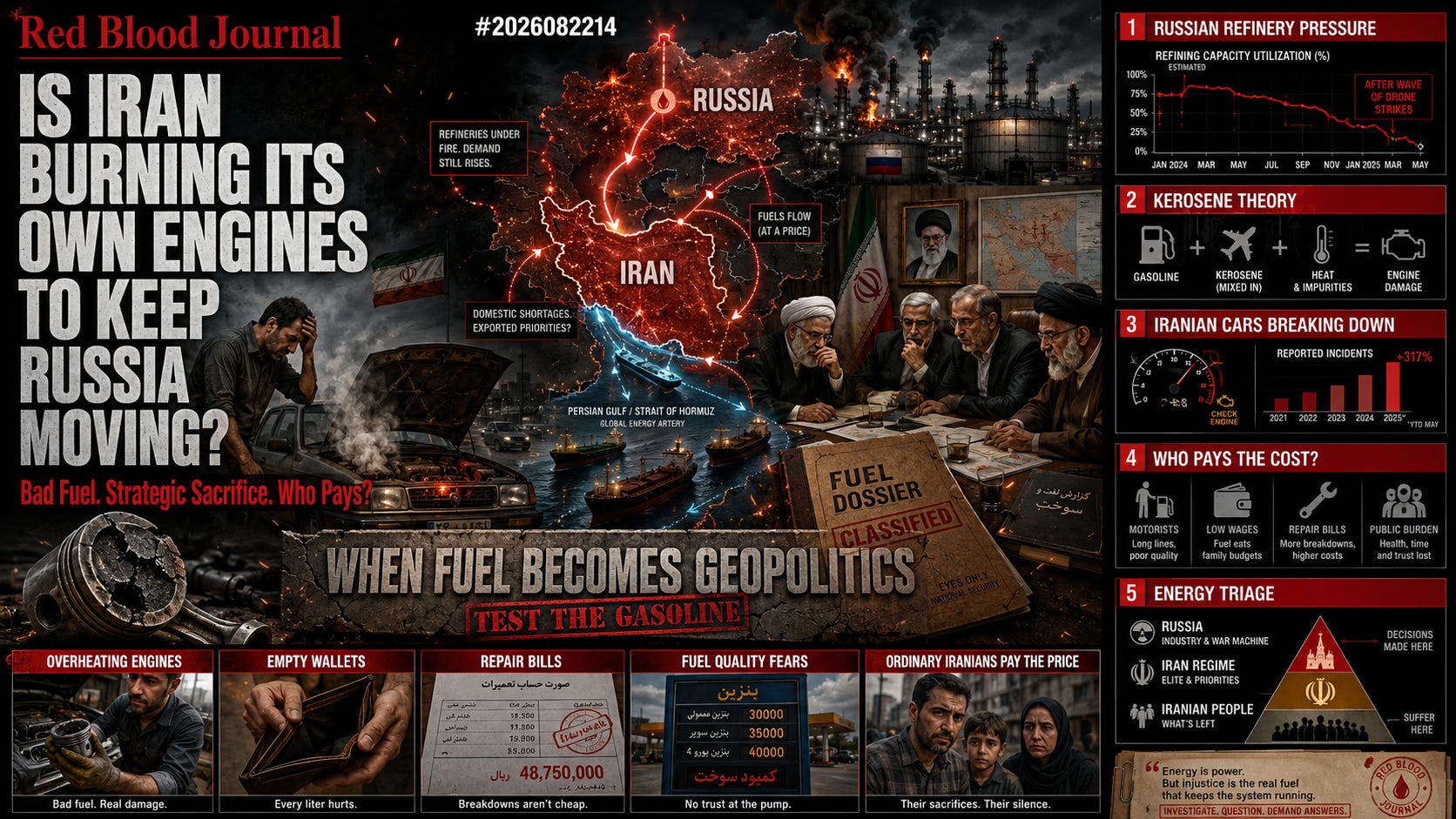
🩸 ⛽ 🇮🇷 🇷🇺 #2026082214 — Is Iran Burning Its Own Engines to Keep Russia Moving?
The Kerosene Theory, Russian Refinery Damage, and the Suspicion That Iranian Drivers Are Paying for Someone Else’s Fuel Crisis
🩸 RedBloodJournal.com 🩸
A strange allegation appears near the end of the source behind this report.
Iranian drivers are already reporting overheating vehicles, engine knock, damaged pistons, and suspicious fuel quality.
Then the theory gets bigger.
Much bigger.
According to a social-media claim cited in the transcript, Iran may be stretching its domestic gasoline supply with lower-quality fuel components — possibly including kerosene — while Russia itself faces refinery pressure after Ukrainian attacks.
The suggestion is explosive:
Could Iranian motorists be damaging their own engines because Tehran is helping Moscow manage a fuel shortage?
The source does not prove that.
There is no laboratory evidence in the transcript establishing systematic kerosene blending.
There is no verified supply-chain document proving Iranian gasoline is being altered specifically for Russia.
But the allegation is detailed enough — and serious enough — to deserve separation from rumor.
Because if even part of it were true, the implications would reach far beyond bad gasoline.
They would reach into the political relationship between Tehran and Moscow.
🔻 THE CLAIM BEGINS WITH RUSSIA
The transcript cites a user arguing that Ukrainian attacks on Russian refineries have damaged Russia’s fuel-production capacity.
The theory continues:
If Russian gasoline production falls far enough, Russia needs relief somewhere.
One way to create that relief would be to reduce pressure on Russian domestic supply by obtaining fuel, components, or logistical support elsewhere.
The source then alleges that Iran could be helping absorb part of that strain.
That is the proposed geopolitical connection.
Ukraine hits Russian refining.
Russia experiences greater fuel stress.
Iran helps compensate.
Iranian drivers receive worse fuel.
Again:
That chain is alleged, not proven.
But it produces a very important investigative question:
Has Iran’s domestic fuel policy changed in response to Russian needs?
🔻 THE KEROSENE ALLEGATION
The source specifically describes a claim that kerosene may be mixed into gasoline to increase available volume.
The user cited in the transcript argues that this could help prevent fuel shortages or station closures while stretching limited gasoline production.
The same claim says the altered fuel could produce:
Higher combustion temperatures.
Engine damage.
Catalytic-converter damage.
Head-gasket problems.
Piston damage.
And increased pollution.
Those are technical assertions from the source.
They require independent testing.
But notice the political accusation underneath them.
The theory is not merely:
Iran has bad gasoline.
It is:
Iranian consumers may be sacrificing their vehicles because the state is prioritizing another geopolitical relationship.
That is much more explosive.
🔻 WHOSE FUEL CRISIS IS THIS?
This becomes the central question.
If gasoline quality has deteriorated inside Iran, why?
There are several possibilities.
Poor refining.
Domestic shortages.
Sanctions.
Low-quality additives.
Distribution problems.
Cost-cutting.
Corruption.
Emergency blending.
Or geopolitical diversion.
The Russia theory is only one of them.
But it deserves examination precisely because Tehran and Moscow now have deep strategic reasons to assist one another.
🔻 SANCTIONS HAVE BROUGHT IRAN AND RUSSIA CLOSER
The transcript does not provide a full history of Iran–Russia relations, so this report should not pretend it does.
But within the source’s framework, the broader logic is obvious:
Both governments operate under major Western pressure.
Both have reasons to cooperate outside normal Western-controlled markets.
Both face restrictions involving finance, energy, technology, shipping, and trade.
That creates mutual dependence.
And mutual dependence can produce uncomfortable trade-offs.
The question is whether ordinary Iranians are being asked to absorb any of them.
🔻 THE DRIVER HAS NO SAY IN FOREIGN POLICY
Imagine the theory is correct.
A government makes a strategic energy decision.
Officials calculate national alliances.
Ministries adjust supply.
Refineries alter production.
Fuel gets blended differently.
Then an ordinary driver fills a tank.
The engine overheats.
The piston melts.
The repair bill arrives.
That driver never voted on the fuel arrangement.
Never negotiated with Russia.
Never ordered weapons.
Never designed sanctions policy.
Yet the cost lands in his driveway.
That is why infrastructure decisions become political.
🔻 THE SOURCE DESCRIBES SERIOUS VEHICLE DAMAGE
Earlier in the transcript, mechanics are described claiming that gasoline combustion characteristics have changed.
One mechanic says increased heat at the piston crown can melt the piston at its weakest point.
The source specifically describes an M254 Mercedes engine with a damaged piston and attributes the problem, in the mechanic’s opinion, to altered fuel combustion.
That does not prove national fuel contamination.
One damaged engine cannot establish national causation.
But paired with reports of multiple overheating cars, it provides a reason for independent fuel analysis.
🔻 THE ROADSIDE PATTERN MAKES THE QUESTION HARDER TO IGNORE
The transcript describes reports of many vehicles stopped along roadsides with hoods open and drivers trying to cool overheating engines.
One cited field report claims more than 30 vehicles were stopped across roughly 15 kilometers.
Social-media observations are not scientific evidence.
There may be reporting bias.
Heat can cause breakdowns.
A viral story can make ordinary failures suddenly appear coordinated.
But if the number of similar failures is truly increasing, the proper response is not dismissal.
It is measurement.
🔻 TEST THE FUEL
This mystery can be solved.
Not with speeches.
Not with Telegram arguments.
Not with geopolitical speculation.
With laboratories.
Collect gasoline samples from multiple stations.
Different cities.
Different brands.
Different refinery sources.
Analyze:
Hydrocarbon composition.
Octane.
Methanol.
Kerosene-range fractions.
Sulfur.
Volatility.
Water.
Contaminants.
Then compare results against previous fuel specifications.
If nothing changed, eliminate the theory.
If something changed, identify what.
This is what investigation looks like.
🔻 TEST THE ENGINES TOO
Fuel samples alone are not enough.
Mechanics could document:
Vehicle make and model.
Mileage.
Failure date.
Fuel station used.
Engine codes.
Combustion damage.
Piston condition.
Catalytic-converter failure.
Injector deposits.
Knock sensor activity.
Coolant condition.
ECU data.
If hundreds of unrelated vehicles show the same failure signature after filling from related fuel sources, the evidence becomes stronger.
Until then, the story remains suspicion.
🔻 THE SOURCE MAKES AN EVEN BIGGER CLAIM ABOUT RUSSIAN CAPACITY
The transcript’s cited user argues that if Ukraine damages another substantial portion of Russian gasoline-production capacity, Russian transportation could face major disruption.
The same user suggests that reducing Iranian domestic gasoline consumption by around 20 percent could help ease Russian pressure.
Those numerical claims are not independently verified in the source.
But they reveal the logic of the allegation:
Iran is not merely suffering its own shortage.
Iran may be absorbing part of Russia’s shortage.
That is the claim that needs evidence.
🔻 IF TRUE, THIS WOULD BE A POLITICAL DISASTER
Because ordinary Iranians are already under economic pressure.
Cars are expensive.
Parts are expensive.
Wages are low.
Fuel policy is politically sensitive.
Transportation is essential.
If motorists discovered that their engines were being damaged because domestic fuel standards were weakened to support Moscow, the anger would not simply be about gasoline.
It would become:
Why is Russia being protected before Iran?
That question would cut directly into national legitimacy.
🔻 IRANIAN NATIONAL INTEREST OR REGIME INTEREST?
This distinction appears repeatedly throughout the source.
A government may define strategic interest differently from its population.
The state may value:
Military alliances.
Sanctions partnerships.
Weapons cooperation.
Geopolitical survival.
The citizen may value:
A functioning car.
A stable salary.
Clean air.
Affordable food.
Safe fuel.
Both are called “national interest.”
But sometimes they collide.
🔻 THE RUSSIA RELATIONSHIP DESERVES THAT TEST
Every foreign partnership should face one basic question:
What does the Iranian public receive from it?
Not the government.
Not military institutions.
Not sanction intermediaries.
Not connected companies.
The people.
If cooperation with Russia lowers costs, expands trade, improves infrastructure, and strengthens Iran without harming citizens, that is one calculation.
If it shifts Russian problems onto Iranian households, that is another.
🔻 THIS IS WHERE SECRECY BECOMES DANGEROUS
Fuel systems are technical.
Most people do not know what enters refinery streams.
They do not see government supply agreements.
They do not see export volumes.
They do not see blending decisions.
They simply trust that the gasoline sold at the pump meets standards.
If that trust disappears, everything becomes suspicious.
Every knock.
Every overheated engine.
Every repair bill.
Every tanker leaving a refinery.
That is how secrecy creates conspiracy theories.
Sometimes the theories are false.
Sometimes secrecy prevents the public from discovering they are true.
🔻 TRANSPARENCY COULD END THE STORY QUICKLY
Iranian authorities could publish:
Fuel composition standards.
Refinery production data.
Recent changes to blending formulas.
Methanol usage.
Kerosene blending policies, if any.
Fuel exports.
Imports.
Quality-control testing.
Independent laboratory results.
Then allow outside technical experts to examine the numbers.
If there is nothing unusual, transparency protects the government.
If there is a problem, transparency protects the public.
Secrecy protects only uncertainty.
🔻 THERE MAY BE A SIMPLER EXPLANATION
It is important not to become trapped by the most dramatic theory.
Iran has many reasons for poor fuel quality that do not require Russia.
Sanctions complicate refining technology.
Older infrastructure can fail.
Domestic demand can exceed supply.
Cheap blending components can be tempting.
Regulatory oversight can weaken.
Corruption can influence procurement.
Heat can stress aging vehicles.
Multiple ordinary failures can appear coordinated when shared online.
The Russia explanation must compete against all of those alternatives.
🔻 BUT THAT DOES NOT MAKE IT UNWORTHY OF INVESTIGATION
The correct response to an unproven theory is not automatically:
Impossible.
It is:
Show the evidence.
That principle cuts both ways.
Those alleging Russian-linked fuel manipulation need evidence.
Those denying it should release data.
The public deserves more than competing narratives.
🔻 THE POLLUTION QUESTION MAY BE JUST AS IMPORTANT
The transcript claims that the alleged fuel alteration could significantly increase particulate pollution.
Even if vehicle destruction is exaggerated, changes in fuel chemistry can affect emissions.
That means the possible consequences include:
Engine damage.
Air quality.
Respiratory exposure.
Fuel economy.
Catalytic-converter lifespan.
Urban pollution.
A fuel-quality investigation therefore concerns much more than mechanics.
It concerns public health.
🔻 THE REAL STORY MAY BE REGIONAL ENERGY TRIAGE
Perhaps the most useful way to frame this allegation is not:
Iran is secretly destroying cars for Russia.
That goes beyond the evidence.
The stronger investigative question is:
Are Iran and Russia increasingly managing sanctions-era energy shortages as one interconnected system?
If so, who gets priority?
Russian consumers?
Iranian consumers?
Military users?
Export markets?
Government-linked companies?
Those allocation decisions would reveal the true hierarchy of the alliance.
🔻 ALLIANCES ARE MEASURED BY WHO SACRIFICES
Countries often describe relationships as strategic partnerships.
But the real test is:
Who pays when resources become scarce?
If Russia sacrifices for Iran, that says one thing.
If Iran sacrifices for Russia, that says another.
If ordinary people in both countries sacrifice while political and commercial elites remain protected, that says something else entirely.
🩸 THE RED BLOOD PERSPECTIVE
The Russia–Iran fuel theory in the source is not established fact.
It is a claim that deserves testing.
The transcript alleges that kerosene or other lower-quality components may be entering Iranian gasoline and connects that possibility to Russian refinery disruption and fuel shortages.
That is serious enough to ask:
What changed in Iranian gasoline?
When did it change?
Which refineries are involved?
What is being exported?
What is being imported?
What fuel specifications are currently being used?
And are Iranian consumers carrying costs created by Tehran’s strategic relationship with Moscow?
The answer may be no.
If so, publish the data.
But if the answer is yes, then the story is not about gasoline.
It is about a much larger question:
When governments call one another strategic partners, whose interests come first?
Russia’s?
The Islamic Republic’s?
Or the Iranian people’s?
🌊 OCEAN OF LOVE AND POSITIVITY PERSPECTIVE
Nations can cooperate without sacrificing their citizens.
Iran and Russia can trade.
Iran and America can trade.
Iran and Europe can trade.
Iran and China can trade.
The purpose of international relationships should be improving the lives of ordinary people, not turning them into resources for geopolitical competition.
A driver should be able to stop at a gas station and trust the fuel.
A family should not need to understand refinery chemistry to protect its savings.
A worker should not lose an engine because governments somewhere else are fighting an economic war.
Foreign policy becomes meaningful only when it eventually reaches the citizen as something positive.
Cleaner fuel.
Better jobs.
Safer roads.
More prosperity.
More freedom.
Less fear.
That is what a strategic partnership should look like from the street.
In an Ocean of Love and Positivity.
🩸🌊✨ Fantastic!
⛽
The Kerosene Theory: Iran, Russia, and the Fuel Crisis
Aug 23, 2026
The provided text examines unverified allegations that Iran is blending kerosene into its domestic gasoline to stretch supplies while supporting Russia’s fuel needs amidst Ukrainian refinery attacks. This theory suggests that Iranian motorists are suffering engine damage and vehicle failures as a direct result of their government prioritizing a geopolitical alliance over citizen welfare. While the source notes a lack of laboratory proof, it highlights reports from mechanics regarding melted pistons and overheating engines as evidence of declining fuel quality. The narrative explores the strategic dependency between Tehran and Moscow, questioning whether ordinary people are unknowingly funding foreign policy through costly car repairs. Ultimately, the text calls for transparency and scientific testing to determine if these infrastructure issues are caused by corruption, sanctions, or a secret energy redistribution favoring Russia.
#RedBloodJournal #2026082214 #Iran #Russia #IranRussia #FuelCrisis #Gasoline #BadFuel #FuelQuality #FuelContamination #Kerosene #Methanol #EngineDamage #CarBreakdowns #Overheating #EnergySecurity #EnergyCrisis #RussianRefineries #UkraineWar #RefineryStrikes #FuelShortage #Oil #Sanctions #SanctionsEconomy #StrategicPartnership #IranianEconomy #EconomicPressure #PublicHealth #AirPollution #Transportation #SupplyChain #TehranMoscow #ForeignPolicy #NationalInterest #IranianPeople #Geopolitics #MiddleEast #QuestionEverything #OceanOfLoveAndPositivity #RedBlood


