


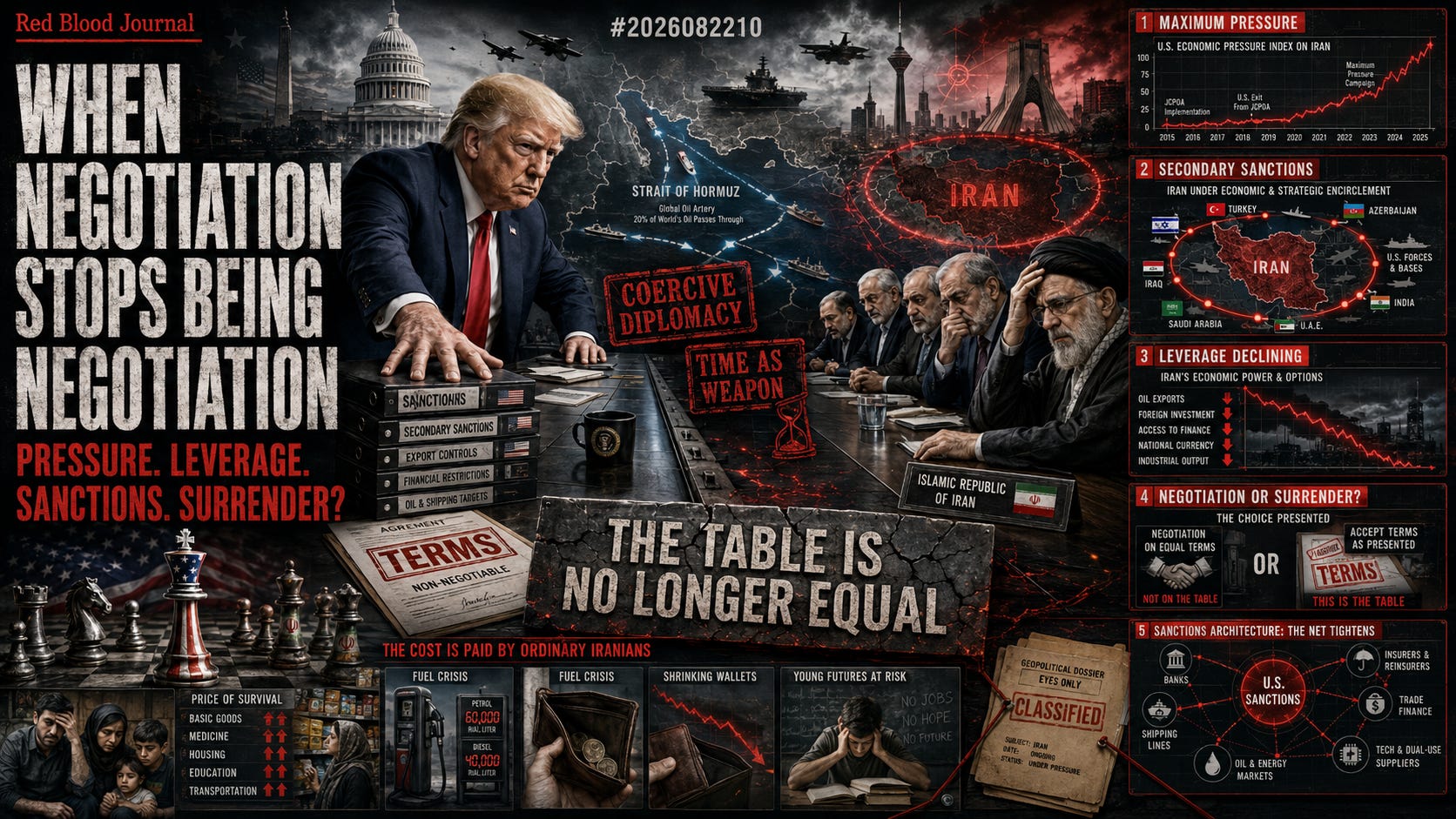
🩸 🇺🇸 🇮🇷 ⚖️ #2026082210 — When Negotiation Stops Being Negotiation
Trump’s Pressure Campaign, Iran’s Shrinking Leverage, and the Question of Whether the Next Deal Is Really a Surrender
🩸 RedBloodJournal.com 🩸
There comes a point in every negotiation when the word negotiation can become misleading.
Two sides may still sit at a table.
Diplomats may still use careful language.
Officials may still talk about agreements.
But if one side believes time, money, military pressure and economic exhaustion are all working in its favor, then the bargaining relationship changes.
The source behind this report describes precisely that possibility between Washington and Tehran.
According to the transcript, Donald Trump portrays Iran as economically depleted, militarily weakened and increasingly desperate for an agreement. Yet he also says Tehran is still not ready to accept what he considers the correct deal.
That raises a difficult question:
If Washington believes Iran has almost no leverage left, what exactly is left to negotiate?
🔻 TRUMP’S MESSAGE IS NOT SUBTLE
The transcript quotes Trump making a series of sweeping claims about Iran.
He says Iran has little money.
He says it lacks meaningful naval and air power.
He says some military and police personnel are not being paid.
He cites extreme inflation.
And he says the United States has complete control over the area surrounding the Strait of Hormuz.
These are political claims from Trump and should not automatically be treated as independently verified facts.
But their strategic meaning is clear.
Trump is telling Iran:
I believe your position is getting weaker every day.
If that is genuinely Washington’s assessment, then it explains why the United States might be unwilling to compromise quickly.
A side expecting its opponent to weaken has little reason to rush.
🔻 TIME BECOMES A WEAPON
In ordinary diplomacy, time can help both parties cool tensions.
In coercive diplomacy, time can be part of the pressure itself.
Every additional week may mean:
More inflation.
More shortages.
More economic uncertainty.
More strain on government finances.
More internal political arguments.
More public frustration.
More pressure on Iran’s ability to fund regional commitments.
If Washington believes all of those trends favor the United States, then delay itself becomes leverage.
The negotiating table remains open.
But the clock sits on one side of it.
🔻 PEZESHKIAN WANTS RELIEF WHILE WASHINGTON WANTS CONCESSIONS
This is where the previous report connects directly to this one.
The source portrays Masoud Pezeshkian as increasingly concerned that the war and economic crisis cannot continue indefinitely. It also describes Mohammad Bagher Ghalibaf warning that military strength cannot save a system whose people are hungry and whose economy no longer functions.
That creates a bargaining problem.
Iranian officials who want relief may need negotiations urgently.
But urgency is weakness at a negotiating table.
The more urgently one side needs an agreement, the easier it becomes for the other side to demand more.
🔻 “THEY WANT A DEAL”
The source quotes Trump saying Iran strongly wants an agreement but is not yet prepared to accept the “right” one.
The key word is right.
Right according to whom?
Washington?
Tehran?
Both?
That distinction determines whether this is diplomacy or coercion.
For Trump, a “right” agreement may mean Iran accepts conditions the United States considers necessary.
For Tehran, those same conditions may be interpreted as dismantling strategic independence.
At some point the dispute stops being about the wording of a treaty.
It becomes a dispute over how much sovereignty Iran is expected to surrender in exchange for relief.
🔻 THE SOURCE ITSELF SAYS “NEGOTIATION” MAY NOW MEAN “ACCEPTANCE”
Near the end of the transcript, the discussion becomes explicit.
The speaker argues that the meaning of negotiation has effectively changed and says:
“The meaning of negotiation is acceptance.”
The implication is that Washington has already determined the broad outcome and is waiting for Iran to accept it rather than bargain over it.
That is the most important claim in this section of the source.
Because if true, then the strategic phase has changed.
The question would no longer be:
What agreement can both sides construct?
It would become:
How much pressure is required before Tehran accepts Washington’s terms?
🔻 WHAT HAPPENS WHEN ONE SIDE LOSES ITS BARGAINING CHIPS?
Iran historically possessed several forms of leverage.
Energy.
The Strait of Hormuz.
Regional allies.
Missile capability.
Proxy forces.
Geography.
Its nuclear program.
The possibility of escalation.
But the transcript portrays several of those assets as weakened or under pressure.
It references Hezbollah having its “backbone” damaged and Syria being transformed, while also presenting Iran as increasingly isolated economically and strategically.
Again, the source is presenting an interpretation.
But if Iran’s leverage has in fact declined across multiple theaters, the negotiating mathematics changes dramatically.
A bargaining chip is only useful if the other side fears you might use it.
🔻 HORMUZ MAY NO LONGER BE THE SAME CARD
For decades, the Strait of Hormuz represented one of Iran’s most powerful strategic threats.
The logic was simple.
If Iran were attacked or pushed too far, it could threaten shipping through one of the world’s most important energy corridors.
That threat potentially imposed enormous costs on everyone.
But the transcript quotes Trump claiming that the United States now exercises complete control over the broader Hormuz area and that this control extends beyond the water itself.
The narrator interprets this as possibly pointing toward a wider land-and-sea containment strategy.
That interpretation goes beyond Trump’s direct words.
But the larger strategic question is legitimate:
What happens if Iran can no longer credibly threaten Hormuz the way it once could?
One of its largest bargaining tools becomes smaller.
🔻 THEN THE PRESSURE MOVES TO THIRD COUNTRIES
The source next describes another dimension of Trump’s strategy:
Economic pressure not only on Iran, but on countries and companies doing business with Iran.
The transcript characterizes the approach as an effort to eliminate neutrality:
Choose the United States or choose the Islamic Republic.
That is where secondary sanctions become extraordinarily powerful.
Washington does not need every foreign country to agree politically.
It only needs banks, insurers, shipping companies and major corporations to fear losing access to the American financial system.
The pressure moves outward.
Iran becomes more difficult to trade with.
Not necessarily because trade itself disappears.
But because the cost and risk of touching Iran rises.
🔻 TEHRAN CALLS THAT EXTRATERRITORIAL COERCION
The transcript quotes Foreign Ministry spokesman Esmail Baghaei condemning Washington’s secondary sanctions.
He argues that no government has the right to force foreign banks or companies to stop lawful commerce with a third country and says such measures lack a basis in international law.
This is the central Iranian legal and sovereignty argument.
Washington says:
We control access to our markets and financial system.
Tehran says:
You are using that power to dictate the economic behavior of other sovereign states.
Both descriptions can exist at the same time.
The legal arguments are complicated.
The political reality is simpler.
The country controlling the larger financial network possesses more leverage.
🔻 SANCTIONS ARE NOT JUST ABOUT MONEY
Their real power is uncertainty.
A company considering trade with Iran must ask:
Will this transaction be sanctioned next month?
Will a bank process the payment?
Will an insurer cover the shipment?
Will the United States blacklist an intermediary?
Will future restrictions trap the money?
Will executives face penalties?
Even before sanctions completely prohibit a transaction, uncertainty can make companies walk away.
That is how pressure compounds.
Risk becomes expensive.
Iran does not merely lose transactions.
It can lose willing counterparties.
🔻 THIS IS ECONOMIC ENCIRCLEMENT
The transcript links secondary sanctions with maritime pressure and describes the combination as an attack on Iranian sovereignty.
From Washington’s perspective, this may be coercive diplomacy.
From Tehran’s perspective, it can look like siege warfare without the siege engines.
No army needs to occupy Tehran.
Make financing difficult.
Make shipping difficult.
Make insurance difficult.
Make imports expensive.
Make exports risky.
Make every third country calculate whether Iran is worth the trouble.
The battlefield becomes the international banking system.
🔻 BUT THERE IS A MORAL PROBLEM
Economic pressure is often designed to influence governments.
Ordinary citizens usually absorb much of the impact.
They experience:
Higher prices.
Currency depreciation.
Medicine shortages.
Expensive imported goods.
Reduced employment.
Lower wages.
Deteriorating infrastructure.
That raises an uncomfortable question.
At what point does pressure on a government become collective punishment of the population beneath it?
A policy can succeed strategically while producing enormous human consequences.
Both things can be true.
🔻 AND THIS IS WHERE TEHRAN HAS ITS OWN RESPONSIBILITY
The Iranian government cannot blame every economic failure on Washington.
The same transcript that criticizes sanctions also describes:
Corruption.
Elite privilege.
Poor fuel quality.
Food-safety scandals.
Monopolies.
Sanctions profiteering.
Low wages.
Expensive vehicles.
Connected insiders.
And an economy increasingly separated from ordinary citizens.
External pressure and internal failure can coexist.
In fact, they can feed each other.
Sanctions create scarcity.
Scarcity creates black markets.
Black markets enrich insiders.
Insiders gain political power.
Reform becomes harder.
The public becomes poorer.
Then the government blames sanctions.
The cycle repeats.
🔻 TRUMP MAY BE BETTING ON THAT CYCLE
If Washington believes internal weaknesses are multiplying the effect of external pressure, it may not need to force a rapid confrontation.
It can wait.
That is perhaps the most dangerous interpretation of the strategy described in the source.
Not invasion.
Not necessarily another immediate military strike.
Pressure.
Containment.
Isolation.
Time.
Let Iran’s internal contradictions amplify the external squeeze.
If that is the strategy, it explains why Trump could simultaneously say Iran desperately wants a deal and then refuse to offer one on terms Tehran considers acceptable.
🔻 BUT THE STRONGER SIDE CAN ALSO MISCALCULATE
This is where history becomes dangerous.
A government under extreme pressure does not always surrender rationally.
Sometimes it escalates.
Sometimes hardliners gain power.
Sometimes humiliation produces nationalism.
Sometimes leadership believes one dramatic military move can reverse the balance.
Sometimes an accident triggers a war nobody intended.
Therefore, a strategy designed to force surrender can also create desperation.
And desperate governments can be unpredictable.
🔻 THE DIFFERENCE BETWEEN A DEAL AND A DIKTAT
A durable agreement requires something more than signatures.
Both sides must be able to live with the outcome.
If one side experiences the agreement purely as humiliation, the political incentive to overturn it remains.
That is one of the oldest problems in diplomacy.
An agreement can end today’s conflict while manufacturing tomorrow’s.
The stronger party may obtain almost everything.
But if the weaker party believes it has lost everything, resentment becomes part of the agreement.
That is not peace.
It is an intermission.
🔻 WHAT WOULD A REAL NEGOTIATION LOOK LIKE?
A genuine negotiation would identify the interests beneath the slogans.
Washington may want:
Security.
Nuclear restrictions.
Regional stability.
Protected shipping.
Limits on hostile military activity.
Tehran may want:
Sanctions relief.
Economic normalization.
Sovereignty.
Security guarantees.
Access to international markets.
Recognition that Iran will continue existing as an independent state.
The difficult work is finding the overlap.
Not deciding which side deserves humiliation.
Because humiliation has never been a reliable foundation for long-term peace.
🔻 THE PEOPLE OF IRAN SHOULD NOT BE THE BARGAINING CHIP
The transcript includes ordinary Iranians asking why they must pay extreme prices, earn tiny wages, live under restrictions and remain trapped between war profiteers and political confrontation.
Those people are the most important party in the entire negotiation.
Yet they are not sitting at the table.
Washington negotiates with Tehran.
Tehran negotiates with Washington.
But the Iranian family buying food absorbs the result.
The driver buying gasoline absorbs the result.
The worker whose salary loses value absorbs the result.
The student whose future disappears absorbs the result.
That should never be forgotten.
🩸 THE RED BLOOD PERSPECTIVE
The source presents a disturbing possibility:
Washington may no longer believe it needs to negotiate from equality.
Trump’s rhetoric portrays Iran as deeply weakened and increasingly desperate.
The transcript itself goes further and argues that “negotiation” may now effectively mean Iranian acceptance of predetermined demands.
That may or may not accurately describe the full diplomatic reality.
But it identifies the central question:
At what point does negotiation become surrender?
And there is a second question just as important:
If Iran accepts because its population can no longer bear the pressure, who actually won?
Washington?
The Iranian government?
Or nobody?
Because a geopolitical victory that leaves millions of ordinary people poorer, angrier and more hopeless may eventually create the next crisis.
🌊 OCEAN OF LOVE AND POSITIVITY PERSPECTIVE
A lasting peace should not require one people to kneel before another.
Iran does not need victory over America.
America does not need victory over the Iranian people.
What both populations need is something much less dramatic:
Normal relations.
Trade.
Security.
Travel.
Opportunity.
No nuclear fear.
No regional proxy wars.
No sanctions profiteers.
No endless military threats.
No children growing up believing another nation is their permanent enemy.
Governments come and go.
Flags remain.
Civilizations remain.
People remain.
The purpose of diplomacy should be to allow those people to live.
A strong agreement should not answer the question:
Who surrendered?
It should make that question irrelevant.
That would be the real victory.
In an Ocean of Love and Positivity.
🩸🌊✨ Fantastic!
⚖️
The Brink of Surrender: Coercive Diplomacy and Iranian Leverage
Aug 22, 2026
The provided text explores a shifting diplomatic landscape where American pressure may be transforming traditional negotiations into a demand for Iranian surrender. According to the source, the United States views Iran as economically depleted and strategically isolated, leading Washington to use time and sanctions as tools of coercion rather than compromise. This strategy leverages secondary sanctions and maritime control to force Tehran into accepting predetermined terms, a process the author describes as economic encirclement. While the Iranian leadership faces internal accusations of corruption and mismanagement, the civilian population bears the brunt of this high-stakes geopolitical friction. Ultimately, the text questions whether a deal born of humiliation and desperation can ever foster a durable peace or if it merely sets the stage for future conflict.
#RedBloodJournal #2026082210 #Iran #UnitedStates #Trump #USIran #IranUSRelations #Diplomacy #Negotiations #Surrender #CoerciveDiplomacy #MaximumPressure #Sanctions #SecondarySanctions #EconomicPressure #MilitaryPressure #StraitOfHormuz #Hormuz #IranWar #WarAndPeace #Tehran #Washington #Geopolitics #MiddleEast #IranEconomy #EconomicCrisis #RegimePressure #RegimeSurvival #Sovereignty #EconomicWarfare #Containment #Isolation #RegionalPower #Hezbollah #Syria #IranianPeople #Peace #Accountability #QuestionEverything #OceanOfLoveAndPositivity #RedBlood


