


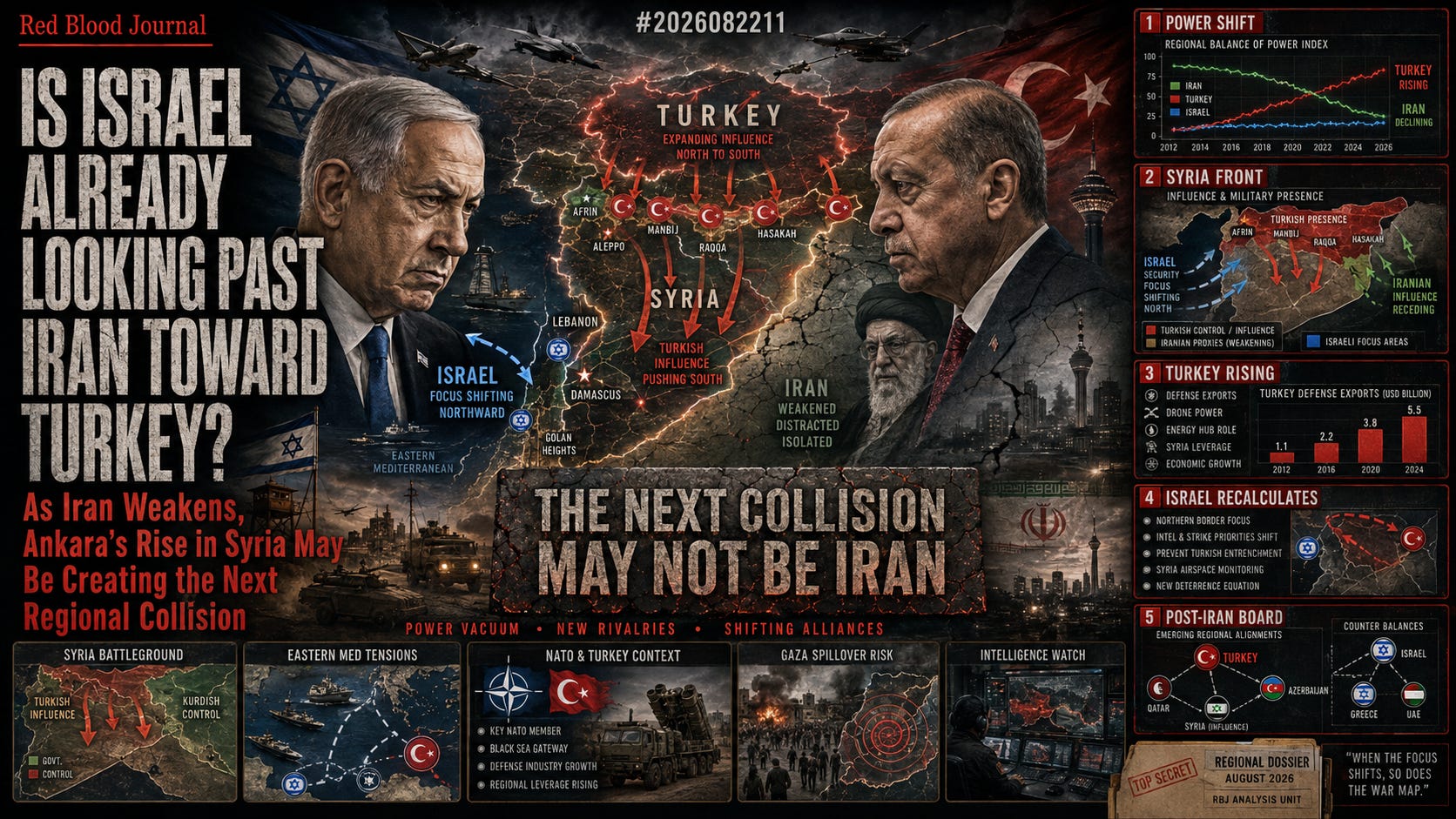
🩸 🇹🇷 🇮🇱 🇮🇷 🌍 #2026082211 — Is Israel Already Looking Past Iran Toward Turkey?
As Iran Weakens, Ankara’s Rise in Syria May Be Creating the Next Regional Collision
🩸 RedBloodJournal.com 🩸
Wars rarely end with the map looking the same.
One threat weakens.
Another rises.
Old alliances shift.
Former secondary players move toward the center.
And eventually the military attention that was fixed in one direction begins turning somewhere else.
The source behind this report raises exactly that possibility.
After discussing Iran’s declining leverage, internal economic pressure, and the possibility that the Islamic Republic is entering a much weaker phase, the transcript abruptly turns toward a new confrontation:
Turkey and Israel.
The source says Turkey is seeking an Interpol red notice against Benjamin Netanyahu in connection with a Gaza aid-ship episode, while Netanyahu’s office accuses Turkey of secretly moving weapons into Syria and describes Recep Tayyip Erdoğan in openly hostile terms.
Then comes the larger interpretation:
Perhaps Israel increasingly believes Iran is no longer the central long-term threat it once was.
Perhaps Ankara is becoming the next strategic problem.
That conclusion is speculative.
But the shift deserves examination.
🔻 WHY TURKEY MATTERS DIFFERENTLY FROM IRAN
Iran has spent decades building influence through:
Proxies.
Missiles.
Regional alliances.
Ideological networks.
Military support to non-state actors.
Turkey operates differently.
Turkey is a NATO member.
It has a large conventional military.
A significant industrial base.
A large population.
Its own drone and defense industry.
Strategic geography controlling access between Europe, the Black Sea, the Middle East and the Mediterranean.
And increasing influence in Syria.
That means if Israel begins viewing Turkey as a strategic competitor, the equation is fundamentally different.
This is not simply another proxy war.
This is potential rivalry between major regional states.
🔻 THE SOURCE SAYS ISRAEL IS WATCHING TURKEY MORE CLOSELY
The transcript explicitly argues that Israel appears to be recognizing Turkey as a serious threat.
Its reasoning is straightforward.
Turkey is expanding military and political influence inside Syria.
Erdoğan is portrayed as seeking a broader regional role.
And the transcript suggests that once Israel becomes more confident that Iran’s power is diminished, it may have greater freedom to redirect attention toward Ankara.
That is the source’s interpretation.
It is not proof of an Israeli strategic doctrine.
But strategically, the question makes sense:
If one rival declines, who becomes the next rival capable of filling the vacuum?
🔻 SYRIA MAY BE THE PLACE WHERE THE NEXT CONTEST BEGINS
Syria has been the meeting point of almost every major regional competition.
Iran.
Russia.
Turkey.
Israel.
The United States.
Arab states.
Militias.
Kurds.
Islamist factions.
Local armed groups.
Every external power sees Syria through a different security lens.
For Israel, the central concern historically revolved heavily around Iranian military presence and weapons transfers.
But if Iranian influence declines while Turkish influence expands, then the identity of the dominant external power changes.
The battlefield remains.
The competitor changes.
🔻 TURKEY DOES NOT NEED TO BECOME IRAN TO WORRY ISRAEL
This is an important distinction.
Turkey does not need to adopt Iran’s strategy.
It does not need Hezbollah.
It does not need the same ideological framework.
It only needs to accumulate enough power close enough to Israel’s strategic perimeter that Israeli planners must account for it.
Influence in Syria alone can matter enormously.
Military bases.
Air-defense systems.
Political control.
Intelligence presence.
Weapon flows.
Trade corridors.
Border influence.
Control over postwar reconstruction.
Every one of those can affect Israel’s freedom of action.
🔻 THEN COMES ERDOĞAN
The transcript frames Erdoğan as pursuing something close to neo-Ottoman ambition and as increasingly hostile toward Israel.
That language is interpretive.
But Turkey has clearly become a much more assertive regional actor than it was several decades ago.
The strategic question is not whether Erdoğan literally intends to recreate the Ottoman Empire.
The real question is:
How large a sphere of influence does Ankara want?
Syria?
Iraq?
The Caucasus?
The Eastern Mediterranean?
Central Asia?
The Arab world?
Political leadership of Sunni Muslim causes?
The answer determines how many other regional powers eventually collide with Turkish ambitions.
🔻 ISRAEL AND TURKEY ARE NOT NATURAL ENEMIES
This is what makes the relationship more complicated.
Turkey and Israel have historically had significant diplomatic, military, intelligence and economic ties.
Their governments have also repeatedly fought politically.
Relationships have warmed.
Then deteriorated.
Then partially recovered.
Then deteriorated again.
That means the current confrontation should not automatically be treated as permanent.
Regional politics can change quickly.
But the more both states operate in the same strategic spaces, the harder it becomes to separate rhetoric from military reality.
🔻 SYRIA COULD CREATE AN ACCIDENT BEFORE IT CREATES A WAR
Two countries do not need to declare each other enemies to enter dangerous territory.
They merely need military assets operating too close together.
Aircraft.
Drones.
Intelligence teams.
Advisers.
Air-defense systems.
Local proxies.
Special forces.
One misidentified target.
One strike near Turkish personnel.
One Turkish deployment Israel considers threatening.
One retaliatory action.
And suddenly two governments that never intended direct conflict must respond to domestic pressure.
That is how regional wars can begin:
Not through a master plan.
Through escalation.
🔻 THE IRAN VACUUM MATTERS
If the Islamic Republic loses regional influence, that does not necessarily produce regional peace.
Vacuum attracts power.
Someone fills it.
Turkey may attempt to fill portions of it.
Arab governments may attempt to fill portions.
Israel may seek greater freedom of movement.
The United States may return to areas it previously deprioritized.
Russia may resist losing remaining influence.
Local Syrian actors may refuse external dominance altogether.
The disappearance of one power center can therefore create multiple new contests.
🔻 THIS MAY BE THE REAL POST-IRAN QUESTION
For decades, much of Middle Eastern security analysis revolved around:
What will Iran do?
The emerging question may eventually become:
What happens after Iran can no longer dominate the same space?
Who controls Syria?
Who influences Iraq?
Who controls trade corridors?
Who determines Kurdish political outcomes?
Who dominates the Eastern Mediterranean?
Who becomes the leading Muslim political voice confronting Israel?
Those questions could define the next phase.
🔻 THEN TRUMP’S ECONOMIC STRATEGY ENTERS THE PICTURE
The uploaded source ties Turkey into another issue.
It asks whether Ankara will comply with Trump’s effort to force third countries to choose between commerce with the United States and commerce with Iran.
This is strategically important.
Turkey does not like being told what foreign policy it must follow.
Erdoğan has repeatedly sought strategic autonomy.
Ankara often wants relationships with multiple competing powers simultaneously.
Washington.
Moscow.
Tehran.
Europe.
The Arab states.
China.
If American policy increasingly demands binary choices, Turkey may resist.
And that could create tension not only between Turkey and Israel, but also between Turkey and the United States.
🔻 “NO MORE NEUTRAL COUNTRIES”
The transcript characterizes Trump’s strategy as an attempt to eliminate neutrality:
Either with America or with the Islamic Republic.
Whether U.S. policy is truly that absolute would require independent verification.
But as described in the source, the principle matters.
Secondary sanctions are powerful precisely because they force decisions on third parties.
Turkey then becomes a fascinating test.
It is large enough to resist some pressure.
Integrated enough with Western markets to feel the pressure.
Geographically close enough to Iran to maintain economic interests.
Politically independent enough to resent ultimatums.
And strategically important enough that Washington cannot treat it like a small isolated state.
🔻 TURKEY COULD BECOME THE COUNTRY EVERYONE NEEDS AND EVERYONE FEARS
That is an unusual strategic position.
NATO needs Turkey.
Europe needs Turkey for migration and Black Sea security.
Russia needs access and economic relationships with Turkey.
Iran needs trade routes.
The Caucasus cannot ignore Turkey.
Syria cannot ignore Turkey.
Israel increasingly cannot ignore Turkey.
The Arab world watches Turkey.
That creates leverage.
But leverage creates attention.
And attention creates resistance.
The stronger Turkey becomes, the more coalitions may form specifically to limit Turkish influence.
🔻 THE OTTOMAN MEMORY STILL HANGS OVER THE REGION
History remains psychologically powerful.
Arab states remember Ottoman rule differently.
Iran remembers centuries of Ottoman-Persian rivalry.
The Balkans remember it differently again.
Israel sees modern Turkey through contemporary security needs, but historical ambition still influences regional perceptions of Erdoğan.
Even when the phrase “neo-Ottoman” is exaggerated, it works politically because neighbors already fear Turkish expansion.
Perception can become strategic reality.
If enough governments believe Turkey wants regional dominance, they begin acting as though it does.
🔻 ISRAEL MAY PREFER A WEAK IRAN AND A CONTAINED TURKEY
From a purely strategic perspective, Israel benefits when no hostile regional power becomes overwhelmingly dominant.
A weakened Iran reduces one threat.
But an unchecked Turkey could eventually create another.
Therefore Israel’s ideal regional balance may not be the complete destruction of every competitor.
It may be fragmentation:
No single state powerful enough to organize the region against Israel.
This is a classic balance-of-power logic.
And if Turkey becomes too strong, Israeli strategic attention would naturally increase.
🔻 BUT TURKEY IS NOT IRAN
Any analysis that simply replaces “Iran threat” with “Turkey threat” would miss major differences.
Turkey maintains diplomatic ties with many Western states.
It participates in NATO.
It has deep commercial links with Europe.
Its political system, however contested, is not Iran’s clerical system.
Its economy is integrated with global markets.
Its military doctrine is different.
Its relationship with Israel contains decades of cooperation as well as confrontation.
Therefore a Turkish-Israeli rivalry could remain competitive without becoming a direct war.
That may be the more likely path.
🔻 THE DANGER IS THE OVERLAP
The problem begins where interests overlap.
Syria.
Gaza.
The Eastern Mediterranean.
Energy routes.
Defense relationships.
Islamist political movements.
Palestinian politics.
Regional leadership.
The more both powers seek influence in the same spaces, the more friction becomes structural.
It no longer depends on Erdoğan or Netanyahu personally.
Future governments inherit the geography.
🔻 AND IRAN MAY WATCH ALL OF THIS WITH MIXED FEELINGS
A weakened Iran could eventually find itself in a strange position.
Turkey is historically a competitor.
Israel is an enemy of the Islamic Republic.
If Israel and Turkey become increasingly preoccupied with each other, Tehran may see opportunity.
Regional rivalries rarely stay binary.
Today’s competitor becomes tomorrow’s temporary partner.
Today’s enemy distracts another enemy.
Every government looks for space.
That is why predicting the next Middle Eastern alignment is so difficult.
🔻 THE REGION MAY BE ENTERING A NEW BOARD
For years the dominant picture looked roughly like:
Iran and its allies.
Israel and its allies.
Arab states maneuvering between them.
Turkey operating partly outside both camps.
That board may be changing.
A weaker Iran could produce something more complicated:
Israel.
Turkey.
Arab powers.
Iran.
United States.
Russia.
Each acting increasingly independently.
More poles.
More uncertainty.
More temporary coalitions.
Less predictability.
That can be stabilizing if no one dominates.
Or dangerously unstable if everyone tests everyone else.
🩸 THE RED BLOOD PERSPECTIVE
The source makes a provocative suggestion:
Israel may already be looking beyond Iran toward Turkey.
The evidence in the transcript is not enough to prove that a major Israeli strategic pivot has occurred.
But the conditions for increased Turkish-Israeli rivalry are visible within the source’s framework:
Turkey’s expanding influence in Syria.
Open political hostility.
Competing regional ambitions.
Iran’s apparent decline.
And intensifying pressure on countries to choose economic sides.
The mistake would be believing that weakening Iran automatically ends the region’s power struggle.
Power struggles do not disappear.
They relocate.
And the most important question may soon become:
If Tehran leaves the center of the board, does Ankara move into the empty square?
🌊 OCEAN OF LOVE AND POSITIVITY PERSPECTIVE
The tragedy of geopolitics is that nations are often taught to think of one another almost exclusively as threats.
Iran against Israel.
Israel against Iran.
Turkey against Israel.
Arab against Persian.
Sunni against Shia.
West against East.
Then generations grow up inheriting conflicts they did not create.
There is another possibility.
Turkey does not need an empire.
Iran does not need regional domination.
Israel does not need permanent war.
Arab states do not need to choose endless camps.
Security does not have to mean weakening everyone around you.
Real security appears when neighboring people no longer believe their future depends on another nation’s collapse.
The Middle East has enough history.
Perhaps it deserves a future.
In an Ocean of Love and Positivity.
🩸🌊✨ Fantastic!
⚖️
The New Strategic Frontier: Israel, Iran, and the Turkish Ascent
Aug 22, 2026
The provided text examines a potential strategic shift in Middle Eastern geopolitics, suggesting that Israel may increasingly view Turkey as its primary regional rival as Iran’s influence wanes. This transition is fueled by Turkey’s expanding military footprint in Syria and the assertive, “neo-Ottoman” ambitions of leadership in Ankara. Unlike the proxy-based threat posed by Tehran, Turkey presents a different challenge as a NATO member with a massive conventional military and significant industrial power. The source highlights how a power vacuum left by a weakened Iran could lead to direct friction between Israeli and Turkish interests regarding trade, energy, and territorial control. Ultimately, the analysis warns that regional stability remains elusive, as the decline of one adversary often invites a new major power to fill the void.
#RedBloodJournal #2026082211 #Israel #Turkey #Iran #IsraelTurkey #TurkeyIsrael #IranIsrael #Syria #MiddleEast #Geopolitics #RegionalPower #PowerVacuum #StrategicRivalry #Erdogan #Netanyahu #RecepTayyipErdogan #BenjaminNetanyahu #NATO #EasternMediterranean #SyrianConflict #TurkishInfluence #IsraeliSecurity #RegionalSecurity #MilitaryStrategy #BalanceOfPower #IranianInfluence #PostIranMiddleEast #NeoOttoman #RegionalAmbitions #Interpol #Gaza #USForeignPolicy #Trump #SecondarySanctions #EconomicPressure #StrategicAutonomy #Russia #UnitedStates #QuestionEverything #OceanOfLoveAndPositivity #RedBlood


