


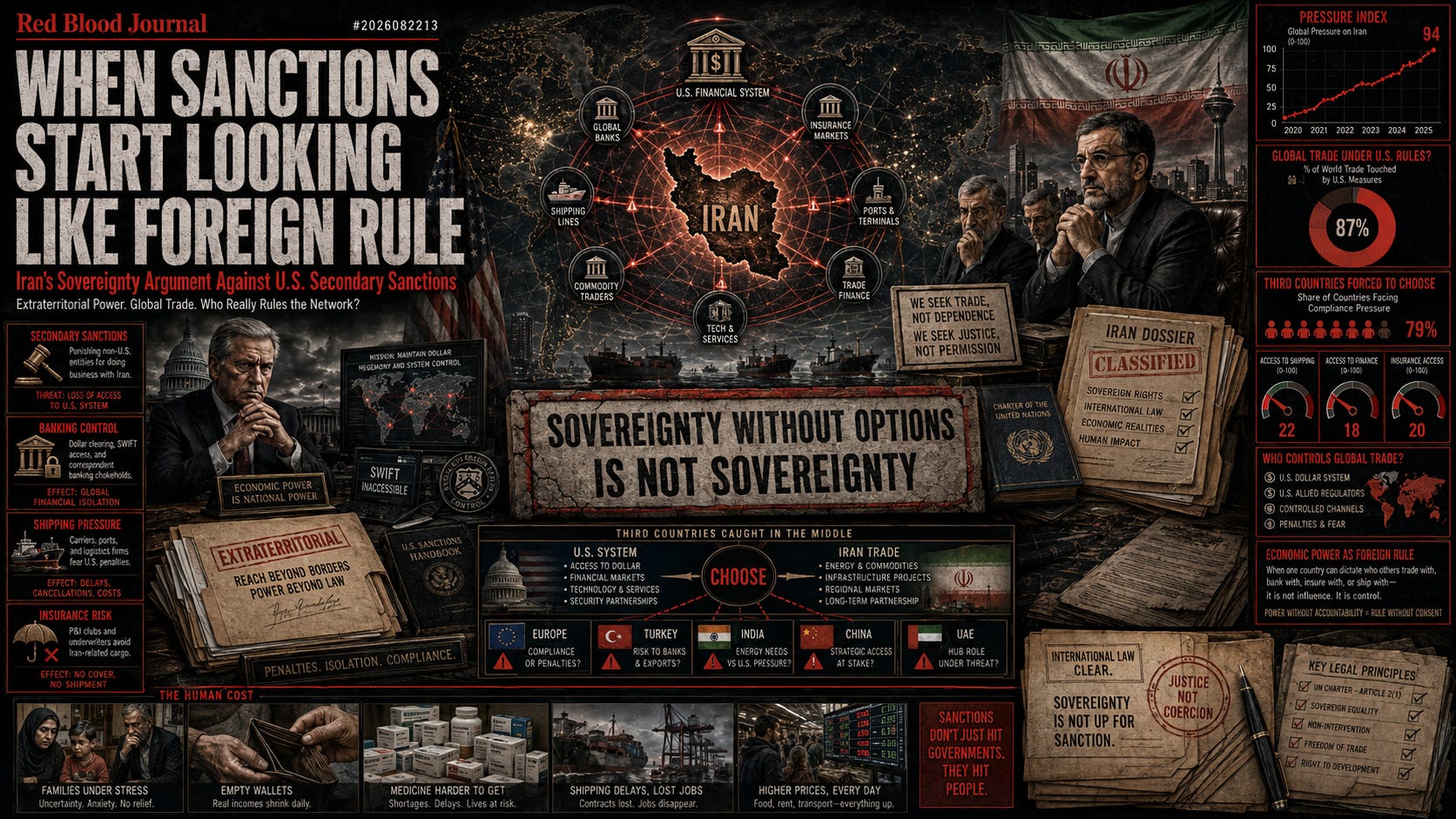
🩸 ⚖️ 🌍 🇮🇷 #2026082213 — When Sanctions Start Looking Like Foreign Rule
Iran’s Sovereignty Argument Against U.S. Secondary Sanctions—and the Question of Who Really Controls Global Trade
🩸 RedBloodJournal.com 🩸
There is a point where sanctions stop looking like a dispute between two countries.
They begin reaching into the decisions of everyone else.
A bank in Europe.
A shipping company in Asia.
An insurer in the Gulf.
A trading firm in Turkey.
A refinery in India.
A government that may have no desire to join Washington’s confrontation with Tehran.
That is the central issue raised in the source behind this report.
Iran’s Foreign Ministry spokesman Esmail Baghaei is quoted arguing that the latest U.S. measures go far beyond normal sanctions. According to the transcript, he describes them as an attempt to impose American authority beyond American territory by pressuring foreign banks and companies to stop trade with Iran.
His argument raises a question bigger than Iran:
If one country can determine which other countries are allowed to trade with one another, where does national sovereignty end?
🔻 THE ARGUMENT IS NOT THAT AMERICA CANNOT SANCTION IRAN
Every country controls access to its own markets.
Washington can decide which Iranian entities American companies may deal with.
It can freeze assets under U.S. jurisdiction.
It can prohibit transactions involving American persons or institutions.
The more controversial issue begins when the sanction reaches someone who is not American.
A foreign bank.
A foreign shipping company.
A foreign government.
A foreign corporation.
That is where secondary sanctions enter the picture.
And that is where Tehran says the United States is crossing from economic policy into extraterritorial control.
🔻 BAGHAEI’S ARGUMENT IS SIMPLE
According to the transcript, Baghaei says no government has the right to force foreign banks or corporations to stop otherwise lawful trade with a third country.
He argues that these measures have no legitimate basis in international law and amount to an assertion of authority over independent states.
In plain language:
Washington is making decisions for companies and countries outside Washington.
That is Tehran’s complaint.
The United States may respond that it is not forcing anyone.
It is simply saying:
If you want access to our market, our banking system, our currency, or our institutions, you must follow our rules.
But that distinction becomes less meaningful when access to those systems is enormously valuable.
🔻 “YOU ARE FREE TO CHOOSE” CAN STILL BE COERCION
Imagine being told:
You are completely free to trade with Iran.
But if you do, you may lose:
Dollar clearing.
Access to American banks.
Access to American customers.
Insurance relationships.
Financing.
Technology.
Investment.
Correspondent banking.
The choice technically exists.
But the cost of making one choice may be overwhelming.
This is the architecture of secondary sanctions.
No troops are required.
No occupation is required.
The larger network itself becomes leverage.
🔻 ECONOMIC POWER CAN BE MORE EFFECTIVE THAN TERRITORIAL POWER
Traditional empires controlled land.
Modern power can control access.
Payment networks.
Capital.
Insurance.
Shipping.
Technology.
Data.
Clearing systems.
International finance.
A government can remain formally independent while its corporations discover that certain economic choices are practically impossible.
That is why Baghaei’s sovereignty argument deserves examination even by people who strongly oppose the Islamic Republic.
The question extends far beyond Tehran:
How sovereign is any country whose economy depends on infrastructure controlled elsewhere?
🔻 THE MODERN BORDER IS NOT ALWAYS A BORDER
A country can guard every inch of its territory and still remain vulnerable.
Its oil may require foreign buyers.
Its shipping may require insurance.
Its banks may require correspondent institutions.
Its airlines may require spare parts.
Its factories may require foreign machinery.
Its technology sector may require chips.
Its currency transactions may require international clearing.
Economic sovereignty therefore depends increasingly on networks that do not stop at national frontiers.
The government controlling the largest parts of those networks has extraordinary influence.
🔻 THIS IS WHY THE DOLLAR IS STRATEGIC
The dollar is not simply money.
It is infrastructure.
When international transactions pass through dollar-based systems or institutions exposed to American law, Washington gains influence over economic activity that may begin and end outside the United States.
That influence becomes a geopolitical weapon when access is conditional.
A sanctioned country therefore faces two problems.
The first is direct U.S. restrictions.
The second is the fear those restrictions create among everyone else.
Often the second problem is larger.
🔻 A FOREIGN BANK DOES NOT NEED TO HATE IRAN
It only needs a compliance department.
That may be one of the most important aspects of modern sanctions.
A European bank does not need to agree with American foreign policy.
Its executives merely need to ask:
What happens if we process this payment?
Could we be fined?
Could we lose access to American institutions?
Could regulators investigate us?
Could the transaction later become prohibited?
Could our shareholders face risk?
And then the bank says:
No Iranian transaction is worth this trouble.
Washington has achieved the desired result without directly ordering the bank to do anything.
🔻 THIS IS HOW POWER BECOMES SELF-ENFORCING
The strongest system is one that does not have to police every participant.
Participants police themselves.
Banks overcomply.
Insurers overcomply.
Shipping companies avoid risk.
Multinational corporations withdraw.
Lawyers advise caution.
Investors leave.
The fear of sanctions spreads beyond the sanctions themselves.
This phenomenon can isolate a country more effectively than a formal embargo.
🔻 IRAN CALLS IT ECONOMIC COLONIALISM
The transcript goes further.
Baghaei reportedly argues that when these measures are combined with maritime pressure, they erode national sovereignty and resemble a return to classical forms of domination.
That is deliberately strong language.
But the historical analogy is worth unpacking.
Traditional colonialism physically controlled territory.
Modern coercion may not require possession of territory at all.
Control the routes.
Control the banks.
Control the insurance.
Control the market access.
Control the technology.
The flag never changes.
The options do.
🔻 BUT IRAN’S SOVEREIGNTY ARGUMENT HAS A CONTRADICTION
Tehran demands that other countries respect Iranian sovereignty.
That principle should apply universally.
A government cannot credibly demand freedom from foreign coercion while denying its own citizens political, economic, or informational freedom.
This matters.
The sovereignty of a government is not automatically identical to the sovereignty of the people.
A state can resist Washington and still dominate its own population.
Those two facts are not mutually exclusive.
Iran can be subjected to external coercion.
Iranians can simultaneously be subjected to internal coercion.
Both deserve scrutiny.
🔻 WHO IS SOVEREIGN: THE STATE OR THE CITIZEN?
This is where the issue becomes deeper.
Governments usually speak of sovereignty as:
Borders.
Flags.
Diplomatic recognition.
National independence.
But citizens experience sovereignty differently.
Can they choose what to read?
Where to travel?
What to buy?
What to say?
What internet platforms to use?
What political leaders to support?
The transcript itself contains ordinary Iranians asking why they must face filtered foreign platforms, extremely expensive imported goods, very low wages, and distorted domestic markets.
So there are at least two sovereignty questions:
Can America dictate Iran’s external economic choices?
And:
Can Tehran dictate every internal economic and political choice of Iranians?
A serious discussion should ask both.
🔻 WASHINGTON ALSO FACES A CONTRADICTION
The United States frequently speaks about a rules-based international order and national sovereignty.
Yet secondary sanctions derive much of their power from using American economic dominance to influence conduct outside American territory.
That does not automatically make them illegal.
International sanctions law is complicated and depends on the measures involved.
But politically, the contradiction is visible.
Washington says states must follow rules.
Tehran asks:
Whose rules?
And who gets to write them?
🔻 POWER OFTEN BECOMES LAW BEFORE LAW CATCHES UP
International politics has always contained this tension.
Legal equality says states are sovereign.
Material reality says they are not equally powerful.
A small country and a superpower may each possess one vote in an international forum.
They do not possess equal leverage over banks, shipping lanes, technology, markets, or military force.
That gap between legal equality and practical inequality is where secondary sanctions operate.
🔻 THE QUESTION IS NOT WHETHER AMERICA HAS POWER
It clearly does.
The better question is:
What limits should exist on how that power is used?
Can access to a dominant financial system be conditioned on foreign-policy compliance?
Can a country penalize foreign companies for transactions entirely outside its territory?
How far can sanctions extend before they become de facto regulation of global commerce?
What protections exist for humanitarian trade?
What recourse do third countries have?
These are not Iranian propaganda questions.
They are governance questions for an interconnected world.
🔻 THE WORLD MAY RESPOND BY BUILDING ALTERNATIVES
Every time a country discovers that access to a system can be withdrawn, it has an incentive to reduce dependence on that system.
Alternative currencies.
Alternative payment networks.
Alternative shipping arrangements.
Alternative insurance.
Regional clearing systems.
Direct bilateral settlement.
None of these are easy substitutes for the dominant global infrastructure.
But pressure creates motivation.
That is the long-term risk of financial weaponization.
The weapon works because everyone uses the network.
If enough countries begin building around the network because they fear the weapon, the network slowly loses some of its exclusivity.
🔻 THERE IS ANOTHER PROBLEM: THE PEOPLE PAY FIRST
Governments talk about sovereignty.
Ordinary citizens talk about prices.
Sanctions can reduce government revenue.
They can also raise:
Food costs.
Transportation costs.
Medicine costs.
Technology costs.
Housing costs.
Industrial costs.
When currencies weaken, every imported item becomes more expensive.
The government may survive.
The family budget may not.
That is why the human consequences cannot be separated from the sovereignty argument.
🔻 SANCTIONS CAN ALSO STRENGTHEN THE VERY NETWORKS THEY ARE SUPPOSED TO WEAKEN
The more difficult legitimate trade becomes, the more valuable unofficial channels become.
Front companies.
Intermediaries.
Connected importers.
Smugglers.
Political insiders.
Foreign-exchange brokers.
The person who knows how to evade the restriction suddenly becomes valuable.
This can produce a sanctions elite.
Ordinary businesses lose access.
Connected businesses gain power.
The source elsewhere describes precisely this broader Iranian problem: rent-seeking, monopolies, privileged wealth, and sanctions profiteering existing beside public poverty.
External pressure and domestic corruption can therefore become partners without intending to.
🔻 THAT IS THE PARADOX
Washington wants sanctions to weaken the Iranian state.
But sanctions can sometimes increase the importance of the state-controlled or politically connected networks capable of navigating them.
Tehran blames Washington for economic suffering.
But Tehran’s own corruption can magnify that suffering.
Then each side points at the other.
The citizen sits between them.
🔻 A MARITIME DIMENSION MAKES THE SOVEREIGNTY QUESTION EVEN BIGGER
The transcript connects the sanctions dispute to American pressure around the Strait of Hormuz.
It quotes Trump claiming broad control over the Hormuz region, while Baghaei characterizes maritime pressure combined with sanctions as a severe erosion of Iranian sovereignty.
If economic restriction and maritime control operate simultaneously, Tehran’s concern becomes obvious.
The state is pressured from both directions:
Trade access from outside.
Physical routes around its borders.
This begins to look less like an isolated sanctions dispute and more like comprehensive containment.
🔻 CONTAINMENT WITHOUT OCCUPATION
That may be the defining feature of modern power.
A country can be contained without being invaded.
Its military remains.
Its government remains.
Its flag remains.
Its borders remain.
But its choices narrow.
That is the strategic objective of coercive pressure:
Reduce the opponent’s options until the remaining option is the one you wanted.
That is why the previous report asked whether negotiation eventually becomes surrender.
This report asks the question underneath it:
Who had the power to remove the alternatives?
🔻 SOVEREIGNTY IS MEANINGLESS WITHOUT OPTIONS
A government may technically possess the legal right to make a decision.
But if every alternative carries overwhelming punishment, the practical freedom to decide has shrunk.
This does not mean sanctions and military occupation are equivalent.
They are not.
But it does mean sovereignty exists on a spectrum between legal authority and practical freedom.
That gap deserves much more attention.
🩸 THE RED BLOOD PERSPECTIVE
Iran’s accusation should not be accepted automatically simply because Tehran makes it.
Nor should it be dismissed automatically because Washington calls the policy sanctions.
The source presents a real conceptual issue.
Baghaei argues that U.S. secondary sanctions pressure foreign banks and companies into abandoning commerce with Iran and therefore extend American authority beyond American territory.
That raises a legitimate question:
When economic power becomes powerful enough to dictate third-country behavior, has foreign policy become a form of external governance?
The answer matters far beyond Iran.
Today the target may be Tehran.
Tomorrow it could be another state.
And whatever power becomes normalized against an enemy may eventually be used somewhere else.
The standard therefore should not be:
Do we like the government being sanctioned?
The standard should be:
What rules should apply to everyone?
That is how principles remain principles.
🌊 OCEAN OF LOVE AND POSITIVITY PERSPECTIVE
Sovereignty should ultimately belong to people.
Not banks.
Not sanctions architects.
Not clerics.
Not presidents.
Not intelligence agencies.
Not billionaires.
People.
Iranian citizens should not be trapped between a government that restricts them internally and foreign powers that restrict their country externally.
American citizens should not be asked to carry endless foreign conflicts.
Other nations should not have to choose permanent economic camps simply to participate in normal trade.
The strongest international system would not be one where the most powerful country can force everyone else to obey.
It would be one where common rules are trusted enough that force becomes less necessary.
That requires accountability from Tehran.
Accountability from Washington.
And respect for the people who absorb the consequences of both governments’ decisions.
A sovereign country should be free.
And sovereign people should be freer still.
In an Ocean of Love and Positivity.
🩸🌊✨ Fantastic!
⚖️
The Architecture of Economic Coercion and National Sovereignty
Aug 22, 2026
This text explores the controversial nature of U.S. secondary sanctions and their impact on global economic sovereignty. While primary sanctions restrict domestic entities, these secondary measures pressure foreign banks and corporations to sever ties with Iran by threatening to revoke their access to the American financial system. The author highlights the Iranian perspective, which views this reach as a form of extraterritorial control and economic colonialism that bypasses traditional international law. However, the narrative also identifies a dual struggle for sovereignty, noting that Iranian citizens are simultaneously squeezed by external American pressure and internal government restrictions. Ultimately, the source questions whether the dominance of the U.S. dollar has turned global trade infrastructure into a geopolitical weapon that undermines the independence of all nations.
#RedBloodJournal #2026082213 #Iran #Sanctions #SecondarySanctions #ExtraterritorialSanctions #EconomicWarfare #EconomicCoercion #Sovereignty #NationalSovereignty #ForeignRule #GlobalTrade #DollarPower #FinancialSystem #Banking #Shipping #Insurance #TradeFinance #EconomicEncirclement #Containment #MaximumPressure #USIran #UnitedStates #Washington #Tehran #InternationalLaw #GlobalEconomy #FinancialPower #EconomicLeverage #CoerciveDiplomacy #IranEconomy #SanctionsProfiteers #EconomicCrisis #StraitOfHormuz #Hormuz #IranianPeople #HumanCost #Geopolitics #MiddleEast #QuestionEverything #OceanOfLoveAndPositivity #RedBlood


