


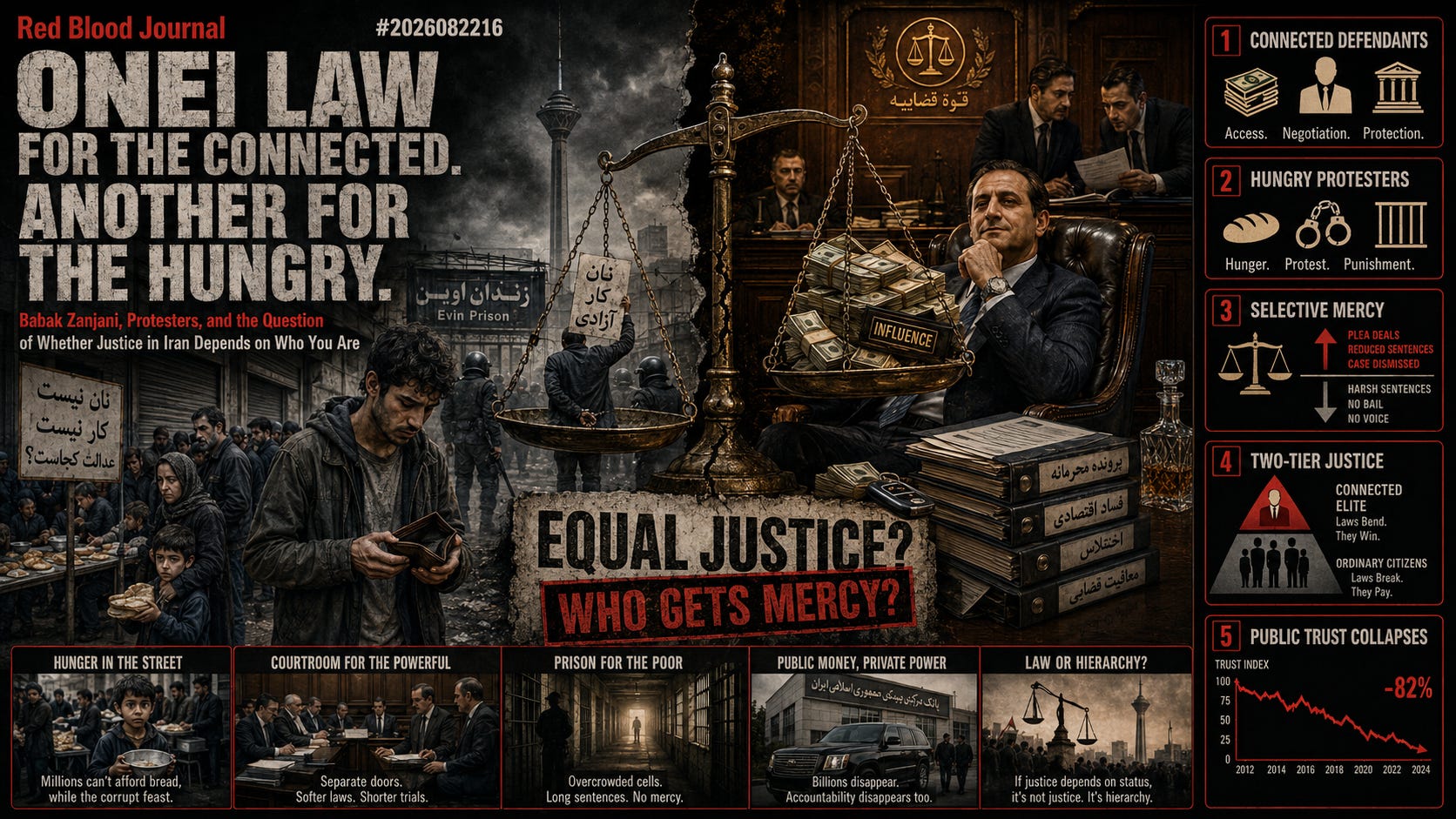
🩸 ⚖️ 💰 🇮🇷 #2026082216 — One Law for the Connected. Another for the Hungry.
Babak Zanjani, Protesters, and the Question of Whether Justice in Iran Depends on Who You Are
🩸 RedBloodJournal.com 🩸
A justice system is not measured by how harshly it can punish.
It is measured by whether the same rules apply to everyone.
That is the question raised by one of the most striking passages in the source behind this report.
The transcript contrasts Babak Zanjani, described there as having been accused of taking billions of dollars connected to public resources, with poor young protesters who take to the streets because they cannot afford to live.
The narrator asks:
Why can the system negotiate with the powerful, forgive the connected, and make accommodations for enormous financial crimes—while showing almost no mercy to a hungry young protester?
That is not merely a question about Babak Zanjani.
It is a question about the structure of justice itself.
🔻 THE CONTRAST IS THE STORY
The transcript describes Zanjani as someone associated with enormous sums of public money.
It says he initially received a death sentence, was later spared, and eventually returned to economic life.
The narrator then contrasts that with a hypothetical or representative young Iranian from a poor neighborhood who goes into the street because of hunger and economic desperation, protests, is arrested, and may face an extreme punishment.
The speaker then says something important:
He opposes execution in all circumstances.
So the argument is not:
Why wasn’t Zanjani executed too?
It is:
Why does the system find flexibility for one kind of defendant and brutality for another?
That distinction matters.
🔻 MERCY IS NOT THE PROBLEM
Mercy is a good thing.
Reducing a death sentence is not evidence of injustice by itself.
A humane legal system should use mercy.
The real problem begins when mercy appears selective.
If the powerful receive reconsideration, negotiation, time, access, and accommodation while the powerless receive maximum punishment, then mercy itself becomes part of privilege.
Justice starts behaving like a market.
And access becomes the currency.
🔻 WHO GETS A SECOND CHANCE?
This may be the most revealing question.
The wealthy defendant often has:
Lawyers.
Connections.
Time.
Information.
Influence.
Access to officials.
A public profile.
Possibly economic value to the state.
The poor protester may have none of those.
One can become useful.
The other can become expendable.
If usefulness affects legal survival, justice has stopped being blind.
🔻 THE SOURCE CALLS THIS STRUCTURAL VIOLENCE
The narrator explicitly describes the disparity as evidence of structural violence.
The argument is that the system can reach accommodations with powerful economic actors accused of massive wrongdoing, yet cannot tolerate a poor person whose protest challenges authority.
That is a deeper allegation than corruption.
Corruption says:
Someone broke the rules.
Structural injustice says:
The rules themselves operate differently depending on who stands before them.
🔻 FINANCIAL CRIME CAN BE NEGOTIATED
There is an uncomfortable reality in many political systems.
A wealthy person accused of financial wrongdoing may possess something the state wants.
Money.
Information.
Networks.
Assets.
Business relationships.
Knowledge of sanctions channels.
Political connections.
The government may therefore see value in negotiation.
Return the money.
Cooperate.
Reveal accounts.
Assist with other cases.
Continue economically useful activity.
The defendant becomes a bargaining partner.
🔻 A PROTESTER OFFERS THE STATE NOTHING
A poor protester may possess no recoverable billions.
No foreign banking network.
No strategic economic role.
No useful commercial connections.
What the protester possesses is something authoritarian governments often fear more:
A public example.
If one person can challenge authority without severe consequences, others may follow.
The state’s incentive can therefore become reversed.
The economically powerful defendant may be valuable alive and cooperative.
The powerless dissident may be considered more politically dangerous precisely because thousands of others can identify with them.
🔻 THIS IS WHY POLITICAL CRIME CAN BE PUNISHED MORE HARSHLY THAN ECONOMIC CRIME
From the perspective of ordinary morality, stealing public wealth on an enormous scale should be extremely serious.
But from the perspective of regime survival, a chant in the street may be viewed as more dangerous.
Why?
Money can sometimes be recovered.
Political obedience is harder to recover once fear disappears.
That creates one of the ugliest incentives in authoritarian governance:
A government may fear dissent more than theft.
🔻 THE THIEF MAY DAMAGE THE TREASURY
The protester threatens the hierarchy.
That difference explains much.
A corrupt insider may weaken the country.
But if he does not challenge the political structure, the structure may survive him.
A protester may possess nothing.
But the protester says:
You no longer have my consent.
That can be existential.
🔻 THE SOURCE MAKES THE ACCUSATION EXPLICIT
The transcript asks why the state can make peace with people accused of looting public resources, yet cannot tolerate the poor person protesting hunger.
It describes this as evidence that the system protects certain powerful actors while turning violence toward those challenging corruption.
This is the central accusation.
Not simply:
There are corrupt people.
But:
The system knows how to negotiate with corruption better than it knows how to listen to suffering.
🔻 THAT IS A LEGITIMACY CRISIS
A government can survive people believing some officials are corrupt.
It has a much harder problem when citizens believe the entire justice structure protects corruption.
Because then reporting wrongdoing becomes dangerous.
Protesting wrongdoing becomes dangerous.
Exposing wrongdoing becomes dangerous.
While benefiting from wrongdoing may be safer.
At that point, law is no longer seen as protection.
It is seen as enforcement of hierarchy.
🔻 THE SYMBOLISM OF ZANJANI IS BIGGER THAN THE MAN
Babak Zanjani becomes politically important because he symbolizes a question:
What happens to people who know how the sanctions economy works from the inside?
Sanctions create strange economic actors.
People able to move oil.
Move money.
Operate through intermediaries.
Navigate blocked banking systems.
Work through front companies.
Solve problems normal institutions cannot solve.
Governments may depend on these people during isolation.
Then those same people become powerful.
That creates an uncomfortable relationship.
The state needs the network.
Then must police the network.
But policing the network too aggressively can destroy something the state still needs.
🔻 THIS IS HOW THE SANCTIONS ECONOMY CAN DISTORT JUSTICE
A normal commercial system rewards transparent transactions.
A sanctions economy rewards people who can operate in darkness.
Opaque companies.
Unusual payment routes.
Trusted intermediaries.
Cross-border connections.
Political permission.
The fewer people able to operate inside this environment, the more valuable those people become.
Then legal accountability becomes complicated.
The person accused of corruption may also know where the money is.
Who moved it.
Which governments were involved.
Which banks participated.
Which officials approved it.
Knowledge becomes leverage.
🔻 THE POOR HAVE NO LEVERAGE
This is perhaps the cruelest contrast.
The poor protester has only a voice.
No billion-dollar network.
No secret accounts.
No powerful intermediaries.
No international contacts the state needs.
Nothing to bargain with.
Except their own freedom.
That means the justice system’s harshest face can fall on the person with the least power to resist it.
🔻 EQUALITY BEFORE LAW MEANS EXACTLY WHAT IT SAYS
Not equality when convenient.
Not equality unless you are useful.
Not equality unless you are connected.
Not equality unless the government needs your money.
The foundational principle is simple:
Same law. Same process. Same dignity.
Anything else is a hierarchy wearing legal clothing.
🔻 THE DEATH PENALTY MAKES THE CONTRADICTION MORE SEVERE
The transcript’s narrator explicitly opposes execution in all circumstances.
That is important because it avoids a false conclusion.
The answer to unequal punishment is not:
Execute more rich people.
The answer is:
Stop using extreme punishment selectively.
Justice should rise toward fairness.
Not spread cruelty more evenly.
🔻 WHAT SHOULD HAPPEN TO A MASSIVE FINANCIAL OFFENDER?
Investigate.
Recover assets.
Prosecute transparently.
Publish evidence.
Allow defense.
Use independent courts.
Return stolen public wealth.
Expose accomplices.
Prevent recurrence.
That is accountability.
The public does not need spectacles.
It needs certainty that money taken from the public returns to the public and that nobody is protected by connections.
🔻 WHAT SHOULD HAPPEN TO A PROTESTER?
If the protester commits no violent crime:
Listen.
Protect speech.
Protect assembly.
Investigate legitimate grievances.
If an actual offense occurs, use proportional law and due process.
A state that cannot distinguish between criticism and existential threat has already lost confidence in itself.
🔻 FEAR OF THE STREET CREATES MORE ANGER IN THE STREET
Harsh punishment may suppress demonstrations temporarily.
But perceived injustice creates memory.
Families remember.
Neighborhoods remember.
Prisons create networks.
Stories spread.
Each disproportionate punishment becomes another argument against the legitimacy of the system.
Repression can therefore manufacture the opposition it was designed to prevent.
🔻 WHY DID HE GET MERCY?
This is the question people will keep asking.
Was it financial recovery?
Cooperation?
Political usefulness?
Connections?
Changed judicial judgment?
Other considerations?
The uploaded source does not provide enough evidence to establish the answer.
That gap matters.
A transparent system would make the reasoning public.
When high-profile legal outcomes are poorly explained, speculation fills the space.
And in an environment already saturated with distrust, people usually assume the worst.
🔻 TRANSPARENCY IS THE ANTIDOTE
Publish the evidence.
Publish the charges.
Publish the amount recovered.
Publish the legal reasoning.
Publish the sentence modification.
Explain the statutory basis.
Show why one case received clemency and another did not.
Justice should withstand sunlight.
If it cannot, the secrecy itself becomes part of the accusation.
🔻 THE REAL QUESTION IS NOT BABAK ZANJANI
The real question is:
Would the same legal system treat an unknown citizen the same way?
If the answer is yes, prove it.
If the answer is no, reform it.
That is the test.
🔻 LAW WITHOUT EQUAL APPLICATION IS POWER
A government can have thousands of laws.
Courts.
Judges.
Prosecutors.
Prisons.
Appeals.
Legal codes.
But if the public believes results depend on status, those institutions stop functioning as justice.
They function as administration of power.
That distinction eventually becomes visible.
🔻 WHEN THE POOR FEAR JUSTICE AND THE POWERFUL NEGOTIATE WITH IT
That is perhaps the most dangerous arrangement of all.
The powerless see the courtroom as a threat.
The powerful see it as a negotiation.
Once that perception becomes widespread, confidence collapses.
People stop believing justice exists inside the system.
And when people stop expecting justice inside institutions, they begin searching for it outside them.
History shows where that can lead.
🩸 THE RED BLOOD PERSPECTIVE
The source raises an important question but does not fully answer it.
It contrasts Babak Zanjani’s changing legal fate with the harsh treatment of poor protesters and interprets the difference as evidence of structural violence and unequal justice.
That comparison deserves investigation.
Not because mercy toward Zanjani was necessarily wrong.
Mercy is not wrong.
Selective mercy is the problem.
Why does a powerful defendant receive reconsideration?
Why does a powerless citizen sometimes receive none?
What criteria determine leniency?
Are they written?
Are they transparent?
Are they equally available to everyone?
Those are the questions an independent justice system should be able to answer.
Because justice is not demonstrated by punishing the weak.
It is demonstrated when the powerful know they stand before the same law.
🌊 OCEAN OF LOVE AND POSITIVITY PERSPECTIVE
A better Iran does not need revenge.
It needs fairness.
No executions.
No political prisons.
No protected billionaires.
No hungry young person terrified of speaking.
No official above investigation.
No citizen beneath dignity.
If someone steals public wealth, recover it and hold them accountable fairly.
If someone protests because life has become unbearable, hear them.
Justice should heal society rather than frighten it.
A court should be the place where power disappears and facts remain.
Where a billionaire and a laborer stand at the same height.
Where the government must prove its case.
Where mercy is principled rather than purchased by status.
That kind of justice would be stronger than repression because people would defend it voluntarily.
The greatest protection for any country is not fear of the state.
It is trust in the law.
In an Ocean of Love and Positivity.
🩸🌊✨ Fantastic!
⚖️
Two Laws: The Selective Mercy of Iranian Justice
Aug 23, 2026
The provided text examines a profound crisis of legal legitimacy in Iran, specifically highlighting the stark contrast in treatment between wealthy elites and impoverished protesters. Using the case of Babak Zanjani, a billionaire whose death sentence for financial crimes was commuted, the source argues that the justice system offers negotiation and mercy to the powerful while imposing brutality on the weak. This disparity is described as structural violence, where the state views high-level corruption as a bargainable asset but perceives grassroots dissent as an existential threat. Ultimately, the narrative asserts that for a legal system to be valid, it must move away from selective leniency and ensure the same standards of dignity and accountability apply to every citizen regardless of status. This critique suggests that when justice becomes a market accessible only through influence, it ceases to be law and instead becomes a mere mechanism for maintaining hierarchy.
#RedBloodJournal #2026082216 #Iran #Justice #RuleOfLaw #EqualJustice #SelectiveJustice #TwoTierJustice #BabakZanjani #Corruption #SystemicCorruption #ElitePrivilege #ConnectedElite #PoliticalConnections #EconomicCrime #FinancialCrime #PublicMoney #Accountability #Transparency #DueProcess #HumanRights #PoliticalPrisoners #Protesters #IranProtests #EconomicProtests #Poverty #Hunger #LowWages #StructuralViolence #DeathPenalty #NoExecutions #Clemency #JudicialReform #IndependentCourts #PublicTrust #IranianPeople #IranianEconomy #SanctionsEconomy #QuestionEverything #OceanOfLoveAndPositivity #RedBlood


